
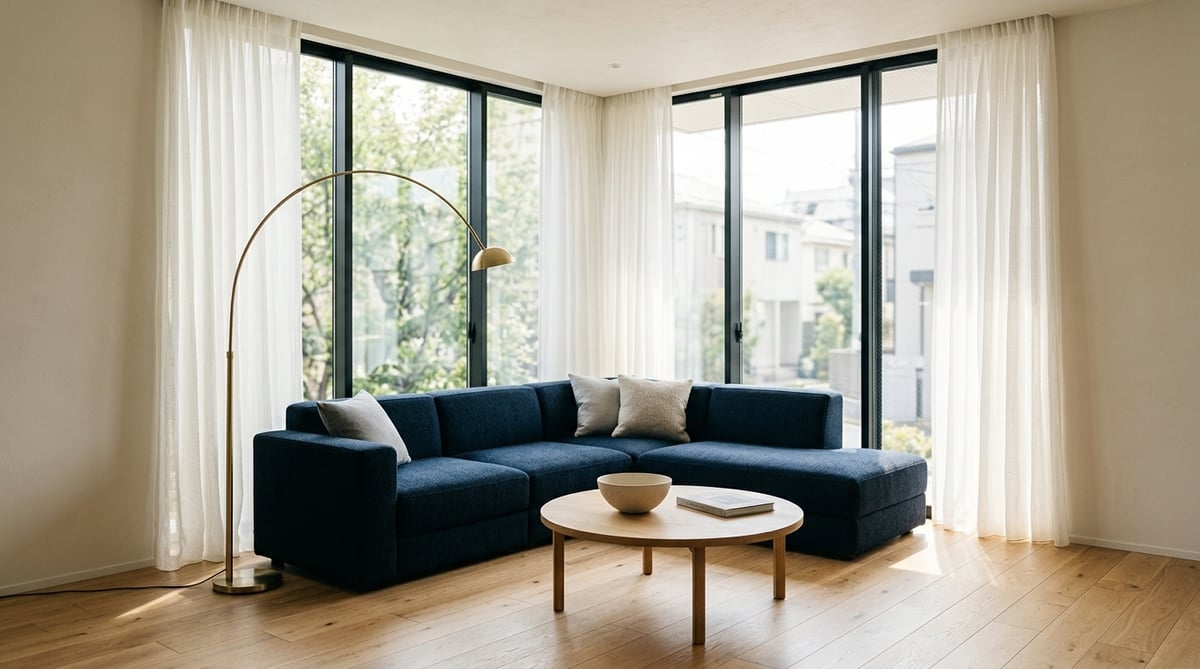
In the quiet morning light, gentle sunshine streams through an east-facing window across wooden flooring, while fresh steam rises from freshly ground coffee brewing in the kitchen. In one room, a child wakes up and happily flips through a picture book, while across the hallway behind a firmly closed sliding door, an adult dives into focused early-morning work and video conferences without worrying about typing noise or background chatter. Come evening, the family naturally gathers around the central dining table to share warm meals and unwind together. As family structures evolve and remote work becomes a permanent fixture of modern life, the spaces we require from our Tokyo homes demand more thoughtful and nuanced planning than ever before.
For couples welcoming a newborn into their growing family, or dual-career households where both partners work from home, the most difficult decision when apartment hunting is often choosing between a 3DK, 3LDK, or 3SLDK layout. Looking at rental listings, many international residents find themselves wondering: Should we prioritize a spacious living room with a 3LDK? Is a budget-friendly, renovated vintage 3DK genuinely comfortable for daily life? And can that service room or storage space marked as "S" on floor plans actually function as a dedicated home office or bedroom?
As a licensed Japanese real estate broker (Takken) with over a decade of property brokerage and building management experience in Tokyo, I have guided thousands of international residents, expat families, and working couples through their home-finding journey. What this hands-on experience consistently proves is that choosing a home based solely on floor plan acronyms or building age often leads to unnecessary rent burdens, awkward lifestyle bottlenecks, and compromised daily comfort. The key is understanding statutory Japanese floor area standards, identifying your priorities among location, living space, and interior quality within a fixed budget, and creating a peaceful, sustainable home.
In this guide, we dive into the exact tatami mat standards set by the Real Estate Fair Trade Council for DK versus LDK spaces, the legal sunlight calculations under Article 28 of the Building Standards Act that define a service room (S), the practical trade-offs among 3DK, 3LDK, and 3SLDK layouts at an identical rent budget (such as 160,000 to 200,000 yen per month), the cost-performance of renovated vintage 3DK units, and essential on-site walkthrough inspection tips for hassle-free living.
- Comprehensive breakdown comparing 3DK, 3LDK, and 3SLDK floor plans within identical rent budgets across Tokyo.
- Official fair trade advertising regulations dictate that for layouts with 2 or more bedrooms, dining-kitchens between 6 and under 10 tatami mats are classified as DK, while 10 mats or more qualify as LDK.
- A service room (S) is not necessarily tiny—it simply does not meet the legal 1/7 effective window-to-floor sunlight calculation under Article 28 of the Building Standards Act, making it an affordable hidden gem for remote work.
Fundamental Differences and Mat Standards of 3DK, 3LDK, and 3SLDK
When browsing Japanese real estate portals, you will constantly encounter listings labeled "3DK," "3LDK," and "3SLDK." While all three layouts feature three independent bedrooms, do you know the precise statutory definitions that separate these letter codes and how they affect daily living? In Japan, real estate agencies cannot assign these layout designations subjectively. To protect consumers and tenants, statutory regulations established by the Real Estate Fair Trade Council enforce strict criteria.
DK vs. LDK Boundaries Defined by the Real Estate Fair Trade Council
The boundary dividing a Dining-Kitchen (DK) from a Living-Dining-Kitchen (LDK) is codified with numerical floor area guidelines in the "Fair Competition Codes Concerning Property Descriptions" enacted by the Real Estate Fair Trade Council.
A crucial rule within these regulations is that the required threshold area for a DK or LDK designation changes depending on the total number of private bedrooms in the home. Because our focus here is on homes with three bedrooms, the standard for "two or more bedrooms" applies strictly:
- 3DK (Dining-Kitchen): Features 3 bedrooms plus a shared dining and kitchen area measuring between 6 tatami mats and under 10 tatami mats.
- 3LDK (Living-Dining-Kitchen): Features 3 bedrooms plus an integrated living, dining, and kitchen area measuring 10 tatami mats or greater.
Furthermore, under Article 11, Paragraph 16 of the Enforcement Regulations, one tatami mat (jo) is legally standardized at a minimum of 1.62 square meters. Consequently, in a property with three bedrooms, if the shared kitchen and eating area measures between 9.72 square meters (approx. 6 mats) and under 16.20 square meters (approx. 10 mats), it must legally be listed as "3DK." If it measures 16.20 square meters (approx. 10 mats) or larger, it is designated as "3LDK."
In day-to-day property management, we frequently encounter properties where the shared living space measures 9.8 tatami mats. Even if this unit features a brand-new island counter kitchen, premium recessed lighting, and designer flooring, because it falls short of 10 mats by a mere 0.2 mats, Japanese law prohibits the agent from listing it as a 3LDK—it must be advertised as a 3DK. Conversely, a compact unit with minimal overall floor space can legally be marketed as a 3LDK as long as the shared living space clears 10.1 tatami mats. Looking past the alphabet code to evaluate actual dimensions and layout flow is essential for smart apartment hunting in Tokyo.
The Building Standards Act Sunlight Rule Separating Service Rooms (S) from Habitable Rooms
The letter "S" on a Japanese floor plan stands for "Service Room," often referred to in Japanese architectural terminology as "Nando" (storage room). A property listed as "3SLDK" indicates that it has three statutory habitable bedrooms, an integrated living-dining-kitchen area of 10 mats or more, plus an additional service room. In terms of physical room count, you effectively enjoy four separate enclosed rooms.
Why is this room designated as "S" instead of being recognized as a full bedroom? The answer lies in Article 28 of Japan's Building Standards Act, which governs natural lighting and ventilation requirements for habitable residential rooms.
For a room to legally qualify as a "habitable room" where human beings continuously sleep, relax, or study, its exterior window openings must meet strict statutory ratios relative to the room's total floor area:
- Effective Natural Lighting Ratio (Building Standards Act Article 28, Paragraph 1): The effective window opening area must equal at least one-seventh (1/7) of the room's floor area.
- Effective Ventilation Ratio (Building Standards Act Article 28, Paragraph 2): Openable window ventilation area must equal at least one-twentieth (1/20) of the room's floor area.
In dense urban centers like Tokyo, the primary reason an extra room is categorized as a service room is the 1/7 natural lighting requirement. Importantly, "effective lighting area" is not simply the physical dimensions of the window glass. It is calculated by multiplying the window area by an statutory "daylight correction factor" that accounts for the height of neighboring exterior buildings and the setback distance to property boundary lines.
Even if a room spans a comfortable 6 tatami mats (approx. 10 square meters) with a wide exterior window, if an adjacent apartment building stands just 1 meter away from that window, the mathematical daylight correction factor drops precipitously. When the calculated lighting value dips below the legal 1/7 threshold, government building inspectors cannot certify the space as a habitable bedroom. As a result, the floor plan must formally mark it as a "Service Room" or "Nando."
In other words, a service room is not necessarily cramped or unsuitable for living—it is simply a space that fell slightly short of daylight geometry formulas. Understanding this regulatory nuance gives savvy tenants an immense advantage when searching for spacious homes at reasonable rates.
Gross Wall-Center Area vs. Usable Net Interior Area
When comparing floor plans, every prospective tenant checks the total floor area (square meters) listed on property flyers. However, in Japan, two distinct measurement methods exist: "Wall-Center Area" (hekishin) and "Net Interior Area" (uchinori). Being aware of the hidden gap between them is crucial.
Rental portal listings and agency recruitment flyers in Japan almost universally display the Wall-Center Area. This metric calculates floor space measured from the center line of the building's exterior and boundary walls. In contrast, Net Interior Area—which is recorded in official government real estate registry deeds—measures the actual usable floor space within the interior finished walls where rugs and furniture can actually be placed.
In sturdy reinforced concrete (RC) or steel-framed reinforced concrete (SRC) condominium buildings, structural exterior walls and party walls separating adjoining apartments are typically 150 mm to 200 mm or more in thickness. Because half of this heavy structural wall thickness is factored into the advertised area, an apartment advertised at 60.00 square meters actually provides a usable net interior living area that is 5% to 8% smaller than stated.
For example, a 60.00-square-meter listing generally yields an effective living area of roughly 55.20 to 57.00 square meters. That missing 3.0 to 4.8 square meters equals approximately 1.8 to 3.0 tatami mats—the size of a generous walk-in closet or a compact private workstation. Furthermore, in standard rigid-frame (Rahmen) structures where thick structural concrete columns and ceiling beams project inwards, dead space reduces perceived roominess even further. Always look closely at pillar placements and actual wall-to-wall dimensions rather than judging a property solely by its headline square meters.
| Layout Type | Typical Floor Area | Communal Space Area | Total Rooms & Composition | Tokyo 23 Wards Rent Range |
|---|---|---|---|---|
| 3DK | 45 sqm – 60 sqm | DK: 6 to under 10 mats | 3 Bedrooms + Dining-Kitchen | 120,000 – 170,000 JPY (largely renovated) |
| 3LDK | 65 sqm – 80 sqm | LDK: 10+ mats (typically 12–16 mats) | 3 Bedrooms + Living-Dining-Kitchen | 180,000 – 280,000+ JPY (varies by age) |
| 3SLDK | 70 sqm – 90 sqm | LDK: 10+ mats (typically 14–18 mats) | 3 Bedrooms + 1 Service Room + LDK | 190,000 – 290,000 JPY (bargain per sqm) |
Licensed real estate specialists fluent in Tokyo's eastern and central wards help you organize your criteria, discover off-market listings, and audit initial move-in quotes via video call.
Trade-Offs of 3DK, 3LDK, and 3SLDK at the Same Monthly Rent
The most decisive constraint when renting an apartment in Tokyo is your monthly rental budget. With an unlimited budget, anyone could rent a luxury high-rise 3LDK directly connected to central transit hubs. However, for sensible families, international professionals, and forward-planning working couples, balancing rent with daily living expenses, future education, and savings is paramount.
Let us consider a realistic Tokyo 23 Wards monthly budget of 160,000 to 200,000 JPY. Holding this budget fixed, comparing a 3DK, 3LDK, and 3SLDK reveals dramatic real-world trade-offs across location convenience, building age, and interior fixtures.
Location, Building Age, and Specifications Under an Identical Budget
Tokyo residential rent is fundamentally calculated by multiplying three core variables: Location (station popularity and walking distance), Floor Area (square meters), and Building Age (structure and common area finishes). If you cap your monthly rent, expanding your living area inevitably forces compromises on proximity to the station or building age. Conversely, prioritizing station-front locations requires reducing floor area or accepting a mature building age.
Within the 160,000 to 200,000 JPY monthly range, each layout represents a distinctly different set of living conditions:
| Layout Type | Location & Transit Access | Building Age & Grade | Interior & Wet Area Fixtures | Key Strengths & Caveats |
|---|---|---|---|---|
| 3DK (Fully Renovated Vintage) |
23 Wards East/North & select West hubs Prime 5–8 min walk from station |
Approx. 30–40 years New Earthquake Code RC Mansion |
All-new plumbing & modern doors/floors Auto-reheat bath, washlet, vanity vanity |
[Strength] Superb transit & room separation [Caveat] Retro common areas & stairs |
| 3LDK (Standard Spec) |
Outer ward boundaries or suburban borders 15+ min walk or connecting bus ride |
Approx. 25–35 years or newer wooden terrace house |
Partially refreshed interior (Retains some dated original fixtures) |
[Strength] Bright 12+ mat communal living [Caveat] Heavy commute fatigue on rainy days |
| 3SLDK (With Service Room) |
12–15 min walk from major express hub or under 10 min from semi-express stop |
Approx. 20–30 years Condominium-grade large RC complex |
High-grade condo specifications (Floor heating, dishwasher often present) |
[Strength] 4 usable rooms, tremendous storage [Caveat] Must check AC sleeve in service room |
The Reality of Choosing a 3LDK: Distance, Suburbs, or Unrenovated Compromises
Many house hunters naturally say, "If we are renting as a family, we really want a bright, expansive living room." However, searching for a 3LDK within Tokyo's 23 Wards under a 160,000 to 200,000 JPY budget quickly reveals stiff market realities.
Currently, the average monthly rent for newer 3LDK condominiums (over 70 sqm) in central and southern Tokyo ranges from 300,000 to 450,000+ JPY. Even in eastern and northern wards known for balanced living costs—such as Adachi, Katsushika, Edogawa, Itabashi, and Kita wards—a 3LDK within a 10-minute walk from a train station typically commands 220,000 to 260,000 JPY per month.
Consequently, holding rent around 180,000 JPY while insisting on a 3LDK forces your search into one of three compromises:
- Significant Distance from the Station: Properties requiring a 15- to 20-minute walk through quiet residential roads, or a 10-minute local bus ride to the nearest train platform.
- Suburban Migration: Moving outside Tokyo's 23 Wards into western Tokyo (such as Hachioji or Machida) or across the prefecture border into Chiba or Saitama.
- Unrenovated Mature Properties: Units within a 10-minute walk built in the 1970s or early 1980s that have never undergone a full renovation, still featuring traditional Japanese tatami mats, balance gas water heaters, and aged bathrooms.
When juggling daily commutes, grocery runs, and daycare drop-offs with a stroller, trudging an 18-minute route through summer heat or winter downpours drains mental and physical stamina. In brokerage consultations, we repeatedly hear the regretful realization: "We sacrificed commute convenience for an expansive living room, but our weekdays were so exhausting that we barely had the energy to enjoy it."
Why 3SLDK Units Are Hidden Gems: Discounted Value from Service Room Labels
In contrast, broadening your horizon to include "3SLDK" units often uncovers exceptional hidden value on the market.
As explained earlier, a service room (S) is classified as non-habitable simply due to statutory daylight calculation formulas. When apartment hunters search portal sites, the overwhelming majority filter specifically by "3LDK" or "4LDK." Because listings tagged as "3SLDK" fall outside these primary filters, they receive fewer portal inquiries.
Consequently, even though a 3SLDK boasts 75 to 85 square meters of floor area and provides four fully functional enclosed rooms, landlords often price them 10,000 to 30,000 JPY per month below pure 4LDK or comparable 3LDK units to compensate for the perceived "storage room" label.
This is especially true in owner-spec condominium developments. In many of these buildings, the room positioned along the central corridor faces an exterior lightwell (alcove). The room itself is built as a perfect rectangle spanning 5 to 6 tatami mats, lacking only the mathematical lighting multiplier to earn an official bedroom title.
For functions that do not require intense direct sunlight—such as a quiet home office with blackout curtains, an audio-isolated video conference studio, a tranquil master bedroom for undisturbed sleep, or a walk-in wardrobe housing all household clothing—a service room performs brilliantly. Securing four functional rooms at the price of a standard three-bedroom makes the 3SLDK one of the smartest architectural choices in Tokyo.
Renovated Vintage 3DK: Cost Performance and Space Flexibility
For young families and dual-remote working households, the most compelling option right now is the renovated vintage 3DK. The term "3DK" sometimes evokes outdated impressions of 1970s apartment blocks or dim kitchens. However, modern Japanese architectural renovation techniques, combined with rental market supply dynamics, have transformed the value proposition of 3DK residences.
Prioritizing Location, Value & Room Count
- ✓ Walk to transit hubs within 23 Wards at reasonable monthly rent
- ✓ Three separate private rooms protect quiet concentration and privacy
- ✓ Brand-new kitchen, bathroom, washlet toilet, and fixtures
- ✓ Saves 30,000 to 50,000 JPY monthly to build future family savings
- ✕ Exterior facades, stairwells, and entrance halls exhibit vintage age
- ✕ Oversized sectional sofas require clever spatial planning in the dining area
Prioritizing Expansive Living Rooms
- ✓ 12–16 mat living space easily accommodates large family furniture
- ✓ Naturally draws the entire family together into one open gathering hub
- ✓ Newer building common areas often feature auto-locks and parcel lockers
- ✕ Far from train stations at the same budget, causing lengthy commutes
- ✕ Higher rent absorbs household buffers for education, dining, and travel
- ✕ Individual bedroom sizes are often curtailed to maximize the living area
Why Full-Plumbing Renovated 3DKs Attract Families and Remote Workers
In Japan, the 3DK layout was the undisputed gold standard of residential construction during the economic expansion of the 1980s and early 1990s. Reinforced concrete (RC) buildings constructed during this era often possess exceptionally robust structural skeletons, with thick concrete walls and sturdy foundations that easily rival contemporary construction.
While verifying that a building was certified under the "New Earthquake Resistance Code" (enacted on June 1, 1981) is a mandatory safety baseline, full-renovation properties that strip mature apartments down to their concrete skeleton and renew all internal piping, subflooring, and fixtures are gaining immense popularity among savvy local and international renters.
Eighty percent of your daily tactile living satisfaction depends on your interior flooring, walls, and wet-area fixtures. Stepping inside a fully renovated 3DK reveals bright, contemporary wood-grain flooring and refined accent walls. The kitchen boasts a brand-new system kitchen with a 3-burner gas stove. The bathroom features a modern unit bath with push-button automatic reheating (oiburi) and an overhead clothes drying ventilator. The toilet is equipped with a heated bidet seat, and the bathroom entryway hosts a full-width vanity mirror with integrated LED lighting.
Surrounded by premium brand-new fixtures, living inside one of these renovated apartments feels indistinguishable from a newly built condominium. For residents comfortable with a vintage exterior facade and classic stairwell, it offers unmatched quality of life per yen.
The 3-Bedroom Advantage: Dual Remote Offices, Child Nursery, and Master Bedroom
The defining architectural strength of a 3DK is that within a compact, efficient footprint of 50 to 60 square meters, it provides three entirely separate, enclosed rooms with real doors.
Many contemporary 2LDK apartments offer a 12- to 14-mat living area but only two bedrooms (such as a 6-mat bedroom and a 5-mat room). When both partners work from home several days a week alongside an energetic child, room contention becomes inevitable:
- One bedroom must serve as the primary couple's bedroom.
- The second bedroom becomes either the nursery or an office for one partner.
- The other partner is forced to work from the dining table in the living room.
Working in the living room creates unavoidable daily tension: conference call microphones pick up kitchen range hood exhaust, running tap water, and clattering plates. When children return home from school and turn on cartoons, uninterrupted concentration disappears entirely.
In contrast, a 3DK layout with three distinct rooms allows for balanced zoning:
- Room A (Approx. 6 mats): Master Bedroom dedicated to rest and restorative sleep.
- Room B (Approx. 6 mats): Child's Bedroom with a study desk, bookshelf, and bed.
- Room C (Approx. 4.5–6 mats): Dedicated Dual Workstation accommodating two workstations for quiet, simultaneous focus.
The dining-kitchen (DK) remains strictly an area for preparing meals and eating together. Closing the interior doors physically separates office stress from family life. You can feel your family's comforting presence nearby while maintaining absolute privacy for professional responsibilities.
Converting to an Open 2LDK via Flexible Sliding Partitions
Another major advantage of the traditional 3DK is its spatial versatility.
In many 1980s and 1990s 3DK floor plans, the central 6- to 8-mat dining-kitchen connects directly to an adjoining 6-mat room separated by full-height sliding doors (fusuma or modern sliding panels).
The true genius of this design emerges when you slide these partitions all the way back into their wall pocket. In seconds, the 7-mat DK and the adjoining 6-mat bedroom merge into a single, contiguous 13-mat living-dining space.
This layout can adapt to your family's life stages over several years:
- Toddler & Early Childhood Years: Leave the partitions open to create an expansive 13-mat living room alongside two private bedrooms (master bedroom and home office). While cooking dinner in the kitchen, you enjoy an unobstructed view of your toddler playing safely on the living area rug.
- Upper Elementary to Teenage Years: When your child needs privacy and a dedicated study room, close the sliding doors to re-establish the original 3DK layout. You now have a private student bedroom, a quiet master bedroom, and a separate home office.
Unlike rigid open-plan apartments with fixed drywall partitions, a flexible 3DK adapts organically to your family's changing lifestyle over time.
Reallocating 30,000–50,000 JPY in Monthly Rent to Education and Savings
When selecting a home, consider the long-term compounding impact of residential lease expenses on your overall finances.
For example, renting a newly constructed 3LDK within a 7-minute walk of a major transit station in Tokyo's 23 Wards costs roughly 230,000 JPY per month. By comparison, renting a fully renovated, earthquake-certified 3DK located at the very same 7-minute walk typically costs between 170,000 and 180,000 JPY per month.
This 50,000 JPY monthly rent reduction delivers real financial breathing room. Over a single year, it totals 600,000 JPY. Across a typical two-year Japanese rental lease cycle, that equals 1,200,000 JPY in retained capital. Over the six years of an elementary school education, it amounts to 3,600,000 JPY in liquid cash savings.
Redirecting these monthly savings into university education funds, enrichment classes, an annual family holiday abroad, or a down payment on a future permanent home brings genuine lifestyle security. True luxury is not paying a premium for layout acronyms—it is creating financial peace of mind while enjoying an accessible, comfortable home.
| Household Composition | Remote Work Patterns | Recommended Optimal Layout | Spatial Strategy & Room Assignment |
|---|---|---|---|
| Couple without Children | Both partners fully remote | 3DK (Renovated Vintage) | Assign two rooms as individual private offices, with the third as master bedroom. Eliminates call noise overlap entirely. |
| Couple + 1 Toddler / Infant | One remote, one in-office | 3DK (Flexible Sliding Doors) | Open sliding partitions for a 13-mat play area. Use one enclosed room for remote work and another as bedroom. |
| Couple + 1 School-Age Child | 1–2 days remote weekly | 3LDK (Standard Model) | Establish a child room and master bedroom. Place a workstation in the open living room for family communication. |
| Couple + 2 Children | Either partner working home | 3SLDK (With Service Room) | Assign the 3 bedrooms to 2 kids and master bedroom. Turn the service room into an air-conditioned office or walk-in closet. |
Equipment Checks Before Using a Service Room as a Workspace or Bedroom
When evaluating a 3SLDK, the primary question is whether that service room can comfortably accommodate an adult for long working hours or quiet sleep. When walking through a property listed with a "storage room" or "service room," never skip these three critical equipment checks.
Air Conditioning Viability: Dedicated Outlets, Sleeves, and Outdoor Compressor Space
The single biggest hurdle to converting a service room into a bedroom or home office is air conditioning feasibility.
In Japanese apartments, rooms legally certified as habitable bedrooms come pre-installed with a dedicated 100V or 200V single-phase electrical circuit near the ceiling, along with an exterior wall sleeve (pipe opening) to route refrigerant lines outside. However, because a service room is officially classified as non-habitable storage, developers sometimes omit air conditioner infrastructure entirely to lower construction expenses.
During your property walkthrough, examine the walls for these three prerequisites:
- Dedicated Air Conditioner Power Outlet: Look for a grounded, single-circuit electrical receptacle located near the ceiling. Powering a wall-mounted air conditioner from a regular floor-level outlet via an extension cord is strictly prohibited by Japanese fire safety electrical codes due to high fire risks.
- Refrigerant Pipe Wall Sleeve or Concealed Piping: Check for a circular conduit hole penetrating the exterior wall. If the room is positioned in the interior core without direct exterior exposure, verify whether pre-installed concealed piping (senko-haikan) runs through the ceiling plenum out to the balcony.
- Outdoor Compressor Unit Placement Space: Confirm whether there is a designated spot on the balcony or in the corridor for that specific room's outdoor condenser unit, or whether the building management rules permit dual-tier mounting brackets.
If neither a sleeve nor outdoor condenser space exists, installing a standard split-system air conditioner will be impossible. You would then have to rely on a window-mounted cooling unit or use an oscillating air circulator to draw conditioned air from the adjacent living room. Given Tokyo's hot and humid summers, confirming AC feasibility is vital for your comfort.
Ventilation and Moisture Control: Combatting Humidity and Managing Light
Because service rooms fall below the legal 1/7 window-to-floor area ratio, they receive less direct sunlight and are prone to stagnant air if unmanaged.
When the window faces an internal lightwell or an enclosed public hallway, residents often hesitate to leave it open due to privacy or security considerations. Without steady airflow, humidity can accumulate during Tokyo's June rainy season, raising mold risks behind wardrobes and along baseboards.
During your walkthrough, verify the following ventilation provisions:
- 24-Hour Mechanical Ventilation Registers: Check whether an exterior air intake vent (push-button damper) is mounted on the wall.
- Mechanical Exhaust Fan: If the window is small or fixed, ensure there is an active ceiling or wall exhaust fan.
- Door Undercut Clearance: Verify that the room's entrance door has an approximate 1 cm gap (undercut) at the bottom, allowing air to circulate even when the door is shut.
For desk workers, lack of direct sunlight can actually be an advantage: it delivers consistent, glare-free ambient light without screen reflections. By pairing a compact dehumidifier with an air circulator, a service room transforms into an ideal, focused home office year-round.
Outlets, TV Jacks, and Wired Ethernet LAN Conduits
Transforming a service room into a productive remote workspace requires dependable power and internet infrastructure.
Storage-designated rooms often have only one dual-socket electrical outlet in a corner. Once you plug in a PC tower, dual monitors, a printer, mobile chargers, and a desk lamp, that circuit can quickly become overloaded. Map out where power outlets are located and how your work desk will connect to them.
Even more critical is network stability. High-definition video meetings and large file transfers benefit greatly from a wired Ethernet connection. Look for a modular LAN port on the wall, or check if an empty CD conduit tube is installed through which a technician can pull Cat6 wiring. In reinforced concrete buildings, thick walls and metal fire doors can degrade Wi-Fi signals, making a hardwired connection a major asset for smooth remote work.
Essential On-Site Walkthrough Checklist for Family Apartments
No matter how many photos or virtual tours you review online, you cannot judge real day-to-day comfort without walking through the property in person. For family households where schedules and routines overlap, on-site walkthroughs require careful measurement. Here are four essential steps and spatial checkpoints to guide your viewing.
Measure Existing Large Furniture
Record the exact width, depth, and height of your refrigerator, washing machine, and beds
Verify On-Site Clearances
Use a tape measure to check fridge alcoves, laundry pan dimensions, and outlet heights
Audit Common Moving Routes
Inspect elevator door width, stairway landings, and entrance hallway turning radiuses
Walk the Neighborhood Routes
Walk the actual routes to schools, daycare, supermarkets, pediatricians, and parks
Dimensions for Large Refrigerators, Cabinets, and Dining Tables
The most common surprise for families moving into Tokyo apartments involves kitchen appliance dimensions.
When inspecting a 3DK or compact 3LDK, always bring a tape measure to check the dedicated refrigerator alcove. Modern family refrigerators (450 to 550+ liters with French doors) measure 650 mm to 685 mm wide, requiring at least 700 mm of clearance for ventilation. In 3DK units built in the 1980s or 1990s, alcoves were often designed for older, compact refrigerators under 600 mm wide. If the space measures only 620 mm across, a large refrigerator simply will not fit.
Pay close attention to these additional details:
- Door Swing Direction: Ensure that the refrigerator door opens fully without hitting an adjacent wall or doorframe.
- Dining Table Clearance: Placing a standard 4-person dining table (120–140 cm long, 80 cm wide) in a 6- to 8-mat dining-kitchen requires at least 60 cm of clearance behind pulled-out chairs for comfortable walkway passage.
- Kitchen Appliance Circuit Capacity: Verify that the kitchen has separate electrical circuits so running a microwave, rice cooker, and electric kettle at the same time does not trip the breaker.
Entryway and Moving Clearance: Elevators, Stairs, and Doorways
Another major moving-day headache is discovering that while a piece of furniture fits inside the apartment, it cannot make it through the building's hallways or elevator.
In older buildings, common corridors and stairs are often more compact than in modern builds. Before entering the apartment, measure these three critical choke points:
- Elevator Openings and Interior Depth: Measure the door width (typically around 800 mm), cab depth, and ceiling height. Make sure your drum washing machine, queen-size mattress, and 3-seater sofa will fit. Check whether the rear emergency hatch can be unlocked for extra clearance.
- Stairwell Landing Turning Clearance: If an item does not fit in the elevator and must be carried up the stairs, measure the ceiling height and turning width on intermediate landings.
- Front Door Clear Opening and Hallway Corners: Open the apartment door 90 degrees and measure the clear width between the door handle and doorframe. If the entryway leads immediately into a 90-degree hallway turn, long furniture can easily get stuck. Measure the ceiling height to ensure items can be tilted vertically around corners.
Neighborhood Amenities: School Districts, Daycare, Supermarkets, and Parks
A comfortable lifestyle extends beyond your front door. The surrounding neighborhood plays an equally significant role in your family's daily happiness and peace of mind.
After your walkthrough, take time to explore the immediate neighborhood on foot:
- School Commute Safety: Walk the route to your designated public elementary or junior high school. Check whether sidewalks are separated from vehicle traffic by guardrails, look out for blind intersections, and observe evening street lighting.
- Daycare Locations and Morning Commute: Check where local daycares (hoikuen) and kindergartens are located relative to your walking route to the train station. A simple drop-off on your way to work saves substantial time every morning.
- Everyday Grocery Shopping: Look for supermarkets with fresh produce and late-night drugstores within walking distance. Check whether store aisles and entrances are stroller-friendly.
- Neighborhood Parks: Having a clean park with safe playground equipment nearby provides a welcoming space for children to play, while giving parents a relaxing spot to enjoy fresh air.
Smart Apartment Hunting: Eliminating Unnecessary Move-In Costs
Finding an ideal floor plan and neighborhood is only half the journey. Unnecessary move-in fees and unexpected contract costs can quickly strain your budget. Understanding how Japanese rental fee structures work allows you to secure your home without overpaying.
![[H2 2026] Lucky Daian Moving Calendar: Moving Costs by Rokuyo & 3 Steps to Save Big](https://soraitokyo.jp/hs-fs/hubfs/blog-eyecatches/batch3_realistic_genkan.jpg?width=400&height=225&name=batch3_realistic_genkan.jpg)
Frequently Asked Questions (FAQ)
QWhat is the difference in utility bills (electricity and gas) between a 3DK and a 3LDK?
ABecause of differences in spatial volume and cooling/heating efficiency, a 3DK is generally easier and more economical to heat and cool, resulting in lower monthly electricity bills. In a 3LDK, conditioning an expansive 12- to 16-mat living space requires large air conditioners to run continuously, driving up winter heating expenses. In contrast, a 3DK divides the 6- to 8-mat dining area and individual bedrooms with doors, letting you condition only the specific rooms currently in use. However, because older buildings may have lower window airtightness or single-pane glazing, check for draft seals or double-paned glass during your walkthrough.
QCan a room marked as 'S' (Service Room / Nando) be safely used as a child's study room?
AYes, provided that appropriate lighting, ventilation, and air conditioning are in place. The statutory service room label merely indicates that natural sunlight calculations fell below Building Standards Act ratios—it does not indicate hazardous building materials or substandard construction. In fact, because direct blinding sunlight is absent, study desks do not suffer from sharp glare or notebook shadows, offering steady ambient light. To support focus and eye health, install a quality LED desk lamp providing 500 to 750 lux, and ensure adequate ventilation and temperature control via air conditioning or an air circulator.
QAre there earthquake safety concerns when renting a renovated 3DK over 30 years old?
AAs long as the building received its building certification on or after June 1, 1981, under Japan's New Earthquake Resistance Code (Shin-Taishin), structural safety is well protected. This modern code requires buildings to withstand seismic intensities of upper 6 to 7 without structural collapse, and reinforced concrete (RC) condominiums built to this standard have demonstrated excellent resilience during major seismic events. For added confidence, consider condominium-grade buildings with 30 to 50 or more units that maintain detailed maintenance histories and long-term repair funds.
QFor a working couple where both partners work from home, is a 3DK or a 2LDK better?
AIf both partners work from home on a regular basis, a 3DK is by far the better choice. In a 2LDK, there are only two enclosed rooms (a bedroom and one office). When both partners have simultaneous video meetings, one person is forced to work from the living room, causing acoustic crossover, household distractions, and potential privacy concerns. With a 3DK, you can establish a primary bedroom while designating the remaining two rooms as dedicated private home offices. Working without worrying about keyboard tapping, phone calls, or overlapping schedules substantially reduces day-to-day stress.

Author: Sorai Tokyo Editorial Team (Supervised by Licensed Real Estate Agents)
A real estate consulting team specializing in assisting foreign nationals find rooms and explaining initial costs in Tokyo. We break down language barriers and differences in customs, offering dedicated support in Japanese, English, and Vietnamese for a safe and secure start to your new life.