
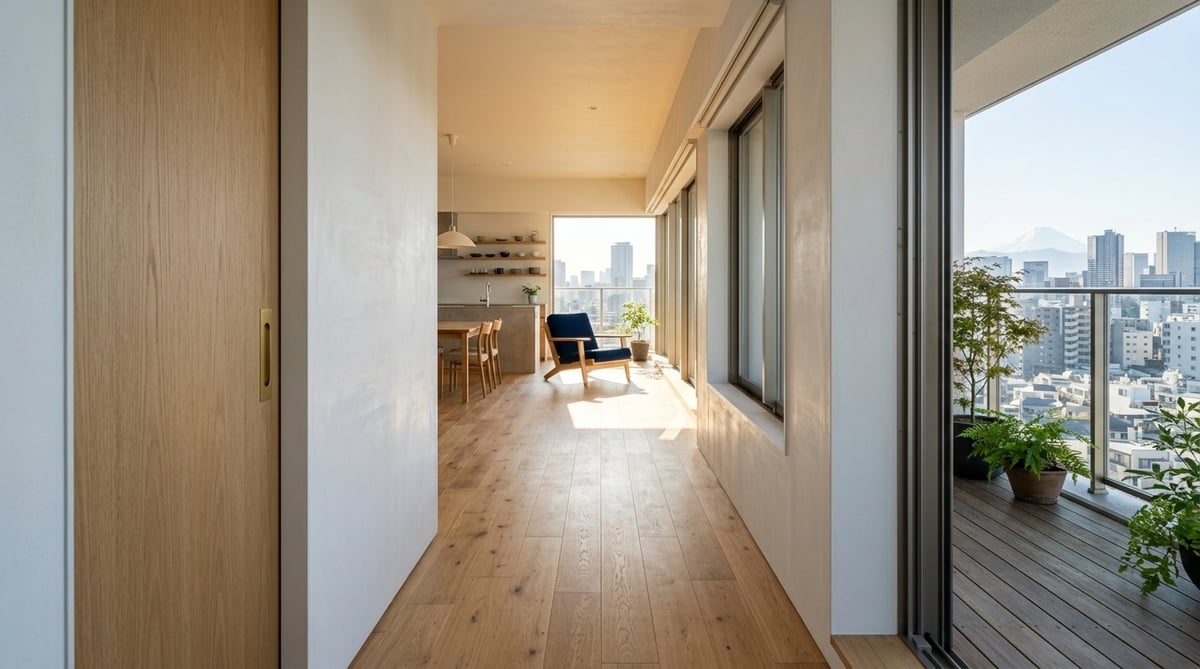
Standing outside Gotanda Station at 8:00 AM on a weekday morning, the cool breeze drifting across the Meguro River splits commuters into two distinct streams. One group steps briskly onto the escalators heading up to the elevated JR Yamanote Line platform, while the other quietly descends the stairs along Sakurada-dori to the Toei Asakusa Line platform on the second basement level. Even for professionals heading toward the same Shinagawa or Shinbashi business districts, the texture of the morning feels subtly different depending on whether you ride above ground along the loop line watching the city wake up, or travel underground on a direct train straight through to Higashi-Ginza and Nihonbashi without a single transfer.
In the evening, stepping off the Toei Asakusa Line at Togoshi Station—just two stops south of Gotanda—brings an immediate softening of the city's pace. Walking back toward the station with clients after a property viewing, surrounded by the aroma of freshly fried croquettes and warm dashi broth drifting from the storefronts of Togoshi Ginza Shopping Street, we often hear the same thoughtful dilemma: "It's genuinely hard to decide between the Yamanote Line's mobility and bustling station-front convenience, or riding just one to three stops south on the Asakusa Line for a more spacious home and quieter nights."
When choosing a place to live in Tokyo, neither line is inherently the right answer for everyone. The loop-line freedom highlighted in our Yamanote Line Area Guide and the elevated residential neighborhoods and direct airport access covered in our Toei Asakusa Line Area Guide each offer distinct advantages. By comparing your daily commute, weekend routines, and the practical difference in total two-year housing costs, you can identify the line and neighborhood that fit your lifestyle most naturally.
- The Toei Asakusa Line offers direct access to Mita, Shinbashi, Higashi-Ginza, Nihonbashi, and both Haneda and Narita Airports, with guaranteed first-train seating from Nishi-Magome.
- The JR Yamanote Line connects major hubs including Shibuya, Shinjuku, and Tokyo Station roughly every 2 minutes 30 seconds, with originating trains from Osaki and Ikebukuro.
- On the southern side, moving 1 to 3 stops south from Gotanda, Shinagawa, or Tamachi to Togoshi or Magome creates approximately 700,000 to 2,200,000 JPY in two-year housing cost savings.
Practical Comparison of Commute Routes, Operations, and Seating Availability
On a transit map, both lines connect Gotanda toward Shinbashi, Akihabara, and Ueno along a similar corridor. In practice, however, everything from train car dimensions and through-service networks to the nature of morning congestion differs significantly.
| Comparison Item | Toei Asakusa Line | JR Yamanote Line |
|---|---|---|
| Train Specs & Formation | 18m-class, 8-car trains (Toei 5500 series: 3 doors per side, 1,435mm standard gauge; platform doors installed at all stations) | 20m-class, 11-car trains (E235-0 series: 4 doors per side, 1,067mm narrow gauge; platform doors installed at all 30 stations) |
| Operations & Through-Service | 4-operator reciprocal through-service with Keikyu, Keisei, Hokuso, and Shibayama Railways (direct to Haneda & Narita Airports) | Independent loop operation with no through-service to other lines (high-frequency schedule at ~2 min 30 sec intervals during morning peak) |
| Morning Peak Congestion (FY2025) | 123% (most crowded section: Honjo-Azumabashi to Asakusa, 7:30–8:30 AM; 134% in FY2024) | Outer loop 135% (Ueno to Okachimachi) / Inner loop 136% (Shin-Okubo to Shinjuku) (FY2024: 134% outer, 139% inner) |
| Key Seating & Originating Hubs | Nishi-Magome Station (all trains originate here), Sengakuji Station (select originating trains & same-platform transfer with Keikyu Line) | Osaki Station (originating trains near rail yard), Ikebukuro Station (select originating trains available) |
| Direct Business Districts | Gotanda, Mita, Daimon, Shinbashi, Higashi-Ginza, Nihonbashi, Ningyocho, Asakusabashi, Kuramae | Shinagawa, Tamachi, Hamamatsucho, Shinbashi, Yurakucho, Tokyo, Kanda, Akihabara, Shibuya, Shinjuku, Ikebukuro |
Direct Nihonbashi & Airport Access on the Asakusa Line vs. Subcenter Coverage on the Yamanote Line
A defining strength of the Toei Asakusa Line is its straight underground route north of Shinbashi along the eastern side of Chuo-dori, passing directly beneath established financial, trading, and pharmaceutical office districts such as Higashi-Ginza, Takaracho, Nihonbashi, and Ningyocho. Compared with getting off the Yamanote Line at Tokyo or Yurakucho Station and walking or transferring to a subway to reach Nihonbashi or Ningyocho, the Asakusa Line lets you step out near your office building's nearest exit without even opening an umbrella on rainy mornings. Furthermore, through-service with the Keikyu and Keisei Lines—including Airport Limited Express trains—connects directly to both Haneda and Narita Airports without transfers. For frequent business travelers or expats flying home, minimizing stairs with large suitcases adds meaningful everyday ease. If you are also comparing station distances and train frequencies with other subways in the Shinbashi, Nihonbashi, and Higashi-Ginza corridor, our guides on Ginza Line vs. Toei Asakusa Line and Hibiya Line vs. Toei Asakusa Line provide a closer look at office-building compatibility.
The JR Yamanote Line, meanwhile, pairs the eastern business corridor (Shinagawa, Shinbashi, Yurakucho, Tokyo, Kanda) with the western subcenters (Meguro, Ebisu, Shibuya, Shinjuku, Ikebukuro) on a single loop. For professionals who visit multiple terminals during the week, or dual-income households where one partner works near Marunouchi and the other in Shibuya or Shinjuku, living along the Yamanote Line offers reliable one-seat access in both directions. Trains arrive roughly every 2 minutes 30 seconds during peak hours without needing to check a timetable, creating a reassuring sense of flexibility if you miss a train by seconds.
Morning Seating Opportunities and Delay Patterns: Nishi-Magome & Sengakuji vs. Osaki & Ikebukuro
If you want to turn your 20-to-30-minute morning commute into quiet time for reading or catching up on news, understanding how originating stations work on both lines will widen your search effectively. At the southern terminus of the Toei Asakusa Line, Nishi-Magome Station connects directly to the Magome Rail Yard, meaning every train departing during the 7:00 AM hour (about 11 trains) and 8:00 AM hour (about 12 trains) originates at Nishi-Magome. By waiting for one or two trains, you can comfortably secure a seat all the way to Gotanda, Shinbashi, or Nihonbashi. Additionally, Sengakuji Station—the boundary with the Keikyu Main Line—features a two-island, four-track layout with select originating trains and frequent same-platform transfers between Keikyu trains from Shinagawa and Asakusa Line trains from Nishi-Magome, keeping transfer walking to a minimum.
On the Yamanote Line, finding a seat at major intermediate stations like Shinagawa, Shinbashi, or Ueno during the morning rush is difficult. However, originating trains are scheduled from Osaki Station (adjacent to the Tokyo General Rolling Stock Center) and Ikebukuro Station in the north. For clients seeking Yamanote Line seating in southern Tokyo, we often recommend checking Osaki alongside Gotanda.
Delay patterns also differ. Because the Toei Asakusa Line operates across four railway networks, schedule disruptions from strong winds or crossing incidents on the Keikyu or Keisei Lines can ripple into the subway. That said, because major Asakusa Line stations—Gotanda, Mita, Daimon, Shinbashi, Higashi-Ginza, Nihonbashi, and Asakusabashi—intersect with JR, Tokyo Metro, and other Toei lines, alternative detour routes are easy to arrange. Conversely, the Yamanote Line is insulated from external line delays, but its tight 2.5-minute peak headway means a brief delay from a stuck bag or passenger assistance at one station can quickly cause spacing adjustments across following trains.
Transfer Realities and Outside-Gate Connections at Gotanda, Shinbashi, Mita, and Takanawa
If you plan to live on the Asakusa Line and transfer to the Yamanote Line at Gotanda or Shinbashi, it helps to picture the vertical distance and outside-gate transfer time rather than just looking at lines on a map.
At Gotanda Station, the JR Yamanote Line runs on elevated tracks (with the Tokyu Ikegami Line even higher), while the Toei Asakusa Line platform sits on the second basement level (one island platform, two tracks). Transferring requires exiting the ticket gates and walking through the B1 concourse, so allowing 5 to 7 minutes from platform to platform during the morning rush keeps the transfer calm. Shinbashi Station similarly requires an outside-gate transfer between the elevated JR platforms and the B2 Asakusa Line platform. In the Tamachi and Mita area, the Asakusa Line and Toei Mita Line connect inside the gates across B2 and B3 levels, whereas transferring to JR Tamachi Station requires an outside-gate walk via the underground passage or Exit A4.
The landscape around Sengakuji, Shinagawa, and Takanawa Gateway has also evolved significantly. While taking the Keikyu Line one stop from Sengakuji to Shinagawa remains standard, you can also walk above ground along Daiichi-Keihin toward Takanawa Gateway Station, which held its town opening in March 2025. Redevelopment and elevated pedestrian decks linking the stations continue toward full completion in FY2031, steadily improving walkability. On the eastern side of Tokyo, Asakusabashi Station on the Asakusa Line connects to Akihabara Station on the Yamanote Line in one stop (about 2 minutes) via the JR Sobu Line local service, or a flat 10-to-15-minute walk (about 1.0 to 1.3 km) along the elevated tracks on pleasant days.
Simply enter the rent and deposit from portal listings to calculate a full, itemized breakdown including brokerage and guarantor fees without hidden add-ons.
Rent Market Comparison and 2-Year Housing Cost Break-Even Points
The clearest financial contrast between the two lines lies in the regional difference: moving 1 to 3 stops south from central transfer hubs on the southern side produces a sharp drop in rent, whereas on the eastern side, rent differences are minimal. Below is a median rent overview across key transfer and comparison stations.
| Station (Ward) | Main Lines | Price per sqm | 1R | 1K | 1DK | 1LDK | 2LDK |
|---|---|---|---|---|---|---|---|
| Shinbashi (Minato) | Yamanote, Asakusa, Ginza, etc. | 5,500 JPY/sqm | 112,000 JPY | 151,000 JPY | 186,000 JPY | 263,000 JPY | 387,000 JPY |
| Shinagawa (Minato) | Yamanote, Keikyu Main, Tokaido, etc. | 5,400 JPY/sqm | 110,000 JPY | 148,000 JPY | 182,000 JPY | 258,000 JPY | 374,000 JPY |
| Tamachi (Minato) | Yamanote, Keihin-Tohoku (Mita transfer) | 5,300 JPY/sqm | 106,000 JPY | 143,000 JPY | 176,000 JPY | 246,000 JPY | 361,000 JPY |
| Sengakuji (Minato) | Asakusa, Keikyu Main | 5,300 JPY/sqm | 106,000 JPY | 143,000 JPY | 176,000 JPY | 246,000 JPY | 361,000 JPY |
| Gotanda (Shinagawa) | Yamanote, Asakusa, Tokyu Ikegami | 5,000 JPY/sqm | 99,000 JPY | 133,000 JPY | 164,000 JPY | 228,000 JPY | 332,000 JPY |
| Osaki (Shinagawa) | Yamanote, Shonan-Shinjuku, Rinkai | 4,900 JPY/sqm | 97,000 JPY | 131,000 JPY | 161,000 JPY | 224,000 JPY | 325,000 JPY |
| Togoshi (Shinagawa) | Asakusa (walkable to Togoshi-Ginza) | 4,550 JPY/sqm | 87,000 JPY | 118,000 JPY | 145,000 JPY | 200,000 JPY | 283,000 JPY |
| Nakanobu (Shinagawa) | Asakusa, Tokyu Oimachi | 4,550 JPY/sqm | 87,000 JPY | 118,000 JPY | 145,000 JPY | 200,000 JPY | 283,000 JPY |
| Magome (Ota) | Asakusa | 4,000 JPY/sqm | 75,000 JPY | 102,000 JPY | 125,000 JPY | 173,000 JPY | 244,000 JPY |
| Nishi-Magome (Ota) | Asakusa (all trains originate here) | 3,850 JPY/sqm | 72,000 JPY | 98,000 JPY | 120,000 JPY | 164,000 JPY | 233,000 JPY |
| Kuramae (Taito) | Asakusa, Oedo | 4,700 JPY/sqm | 90,000 JPY | 122,000 JPY | 150,000 JPY | 207,000 JPY | 293,000 JPY |
| Ueno (Taito) | Yamanote, Ginza, Hibiya, etc. | 4,500 JPY/sqm | 86,000 JPY | 117,000 JPY | 143,000 JPY | 196,000 JPY | 280,000 JPY |
2-Year Total Housing Cost Differences in Southern Tokyo by Household Type
When planning a rental budget, looking beyond monthly rent to the total 2-year cost (24 months of rent plus 1 month for the standard renewal fee, totaling 25 months) reveals just how much financial breathing room moving 1 to 3 stops south creates.
For single residents seeking a 1K apartment, Minato Ward addresses such as Shinagawa, Tamachi, and Sengakuji sit in the mid-to-upper 140,000 JPY range, while Gotanda averages 133,000 JPY. Moving two stops south on the Asakusa Line to Togoshi reduces rent by 15,000 JPY per month, and three stops to Magome saves 31,000 JPY per month—totaling 775,000 JPY over 25 months. Comparing Shinagawa 1K rents with Magome yields a 1,150,000 JPY difference over 25 months. Even if you keep the same 120,000–130,000 JPY monthly budget, moving to Togoshi or Magome allows you to upgrade from a compact 1K near Gotanda to a spacious 1DK or corner unit with a separate washbasin and reheating bathtub.
For couples in 1LDK apartments, this difference translates directly into furniture, appliances, or savings. Shifting two stops from Gotanda to Togoshi saves 700,000 JPY over 25 months—enough to cover a quality dining set and washer-dryer with funds to spare. Extending to Magome widens the 25-month gap to 1,375,000 JPY compared with Gotanda, or 1,825,000 JPY compared with Tamachi or Sengakuji.
For families or remote workers needing a 2LDK, larger floor areas amplify the per-square-meter price gap. Gotanda versus Togoshi saves 1,225,000 JPY over 25 months, while Gotanda versus Magome reaches 2,200,000 JPY. Trading just 3 to 6 minutes of train ride for a calmer residential neighborhood yields 700,000 to 2,200,000 JPY in 2-year flexibility—a compelling advantage of the southern Asakusa Line.
Why Eastern Tokyo Shows the Opposite Pattern: Kuramae vs. Ueno and Asakusabashi
Looking toward northeastern Tokyo, however, reveals the exact opposite pricing dynamic. Along the Toei Asakusa Line, Kuramae (1K 122,000 JPY; 1LDK 207,000 JPY; 2LDK 293,000 JPY) and neighboring Asakusabashi (1K 124,000 JPY; 1LDK 209,000 JPY) command slightly higher median rents than Yamanote Line stations like Ueno (1K 117,000 JPY; 1LDK 196,000 JPY; 2LDK 280,000 JPY) and Okachimachi (1K 119,000 JPY; 1LDK 200,000 JPY).
This stems from urban history and housing stock. Ueno and Okachimachi feature expansive commercial districts around Shinkansen terminals and older mixed-use office-residential buildings. In contrast, Kuramae's flat grid near the Sumida River has attracted independent coffee roasters, leather workshops, and modern mid-rise residences tailored to singles and dual-income couples. Because residents choose Kuramae for its 10-minute commute to Nihonbashi or Higashi-Ginza paired with quiet weekend cafe walks, the eastern-side decision centers on lifestyle preference—terminal vibrancy versus neighborhood calm—rather than rent savings. For a closer look at how Kuramae and Daimon compare with the Oedo Line, see our Toei Asakusa Line vs. Toei Oedo Line guide.
Overlapping Walking Zones: Osaki, Nakanobu, and Togoshi-Ginza
When browsing listings in southern Tokyo, you will frequently see properties within a 7-to-12-minute walk of two different lines—such as "12 min from Gotanda, 8 min from Osaki" or "5 min from Togoshi, 7 min from Togoshi-Ginza." Understanding the subtle differences between these overlapping stations helps clarify your choice.
Walking 10 minutes from Gotanda along the Meguro River or Sony-dori brings you into Osaki's sphere. While rents are similar, the atmosphere contrasts sharply: Gotanda offers lively street-level bistros and casual eateries, whereas Osaki features wide pedestrian decks connecting office towers and commercial complexes with clean separation of foot and vehicle traffic. Those who enjoy spontaneous street-level dining gravitate toward Gotanda, while those prioritizing originating Yamanote Line trains, Shonan-Shinjuku/Rinkai Line access, and orderly plazas prefer Osaki.
Similarly, Togoshi and Nakanobu on the Asakusa Line share identical median rent levels. Togoshi sits steps away from Tokyu Ikegami Line's Togoshi-Ginza Station (1K 119,000 JPY; 1LDK 202,000 JPY), offering daily strolls through a 1.3-kilometer shopping street. Nakanobu, meanwhile, intersects with the Tokyu Oimachi Line, making it ideal if you want direct weekday commutes to Shinbashi and Nihonbashi paired with easy weekend rides to Jiyugaoka, Futako-Tamagawa, or Oimachi (1K 125,000 JPY; 1LDK 213,000 JPY) for JR Keihin-Tohoku and Rinkai Line connections.
Living Environment, Shopping, and Ground Conditions in Southern Tokyo (Gotanda, Togoshi, Magome)
Even within southern Tokyo, stepping off the main avenue reveals distinct variations in slope gradients, zoning, and everyday supermarket options from station to station.
Gotanda | Commercial Convenience vs. Meguro River Lowlands and Jonan-Gozan Plateaus
The area immediately around Gotanda Station (Higashi-Gotanda 1-chome, Nishi-Gotanda 1–2-chome) is zoned for high-density commercial use, allowing you to complete grocery shopping between the ticket gate and your building's auto-lock entrance. Alongside Gotanda Tokyu Store and Seijo Ishii Atre Gotanda 1, the Food Style Higashi-Gotanda store (converted and opened on October 29, 2026) supports daily errands even after late workdays.
During viewings, however, pay close attention to elevation. The flat blocks along Gotanda Station and the Meguro River sit on valley-floor lowlands and backswamps. While convenient for walking and cycling, properties along Sakurada-dori (Route 1) or Yamate-dori require checking window soundproofing (double-pane or acoustic-rated sashes) and verifying inland flood hazard maps and whether electrical/transformer equipment is elevated above ground level. Climbing the gentle slope toward Higashi-Gotanda's plateau (Ikedayama and Shimazuyama) transforms the scenery into a quiet, tree-lined residential enclave. For deeper detail on these micro-neighborhoods, see our Gotanda Station Area Guide and Shinagawa, Osaki & Gotanda Expat Rental Guide.
Togoshi & Nakanobu | Warm Shopping Streets and Stable Loam-Plateau Residential Zones
Exiting Togoshi Station (Exits A2 or A3) brings you directly to the intersection of Daini-Keihin (Route 1) and Togoshi Ginza Shopping Street. Fresh produce and meat at Ozeki Togoshi-Ginza and Bunkado Togoshi-Ginza sit within easy walking distance, while Life Osaki Hyakutandori serves the southeastern residential blocks. Traditional tofu shops, butchers, and bakeries operate alongside chains, making evening errands feel welcoming.
Stepping one block off Daini-Keihin into Togoshi 3-chome or Yutakacho 1-chome shifts the zoning into calm Category 1 Residential and Category 1 Medium-to-High-Rise Exclusive Residential areas. Much of this ground rests on the Musashino volcanic ash (loam) plateau, placing it outside designated flood inundation zones. If you consider properties closer to the Tachiai River lowland to the south, reviewing Shinagawa Ward's rainwater and inland flood hazard map is still a smart precaution.
Magome & Nishi-Magome | Quiet Elevated Neighborhoods and Supermarket Planning
One to two stops further south, Magome and Nishi-Magome (Naka-Magome, Higashi-Magome, Nishi-Magome in Ota Ward) leave commercial bustle behind within a few minutes' walk from the station, opening into quiet low-rise and mid-rise residential streets. Elevated areas such as Naka-Magome 1-chome sit on stable loam plateau ground with peaceful, softly lit streets at night. Because Magome features undulating terrain with both plateaus and valley cuts, walking the route from the station to check slope gradients and local drainage is recommended for valley-floor blocks.
For daily groceries, Maruetsu Petit Magome-Ekimae and My Basket Magome-Ekimae handle quick weekday pickups, while the larger Life Higashi-Magome store serves weekend stock-ups. One practical note for Nishi-Magome: while all trains originate there, its primary station-front supermarket, Bunkado Nishi-Magome, is temporarily closed for reconstruction. If you choose Nishi-Magome, check during your viewing whether walking to Magome/Higashi-Magome stores or using a building with parcel lockers for online grocery delivery fits your routine.
Central & Eastern Tokyo (Shinagawa, Takanawa, Tamachi, Shinbashi, Kuramae): Daily Life & Hazard Checks
When prioritizing proximity to central offices or eastern Tokyo, understanding recent retail openings and water-related hazard planning ensures a smooth transition.
Shinagawa, Sengakuji & Tamachi | Takanawa Plateau vs. Shibaura/Konan Waterfront and New Retail
In southern Minato Ward, Daiichi-Keihin (Route 15) and the JR tracks divide two contrasting landscapes: the elevated Takanawa 2–4-chome and Mita loam plateaus to the west, lined with temples, greenery, and low-to-mid-rise residences, versus the reclaimed waterfront land of Konan 2-chome and Shibaura 2-chome to the east, known for canal views, flat sidewalks, and high-rise towers. We explore this contrast further in Shinagawa & Takanawa vs. Konan & Tamachi and our South Yamanote Luxury Expat Rental Guide.
Previously, residents on the quiet Takanawa and Sengakuji hills had limited nearby supermarket choices. That has improved markedly with the opening of Meidi-Ya Takanawa Store on the 1st floor of NEWoMan Takanawa North (opened September 12, 2025), Food Style Mita on the Mita side (opened March 7, 2026), and Life Musubu Tamachi directly connected to Tamachi Station's East Exit.
Shinbashi | Central Mobility and Commercial/Reclaimed-Land Considerations
Where the Yamanote, Asakusa, Ginza, and Yurikamome Lines meet, Shinbashi (Shinbashi 2-chome, Nishi-Shinbashi, Higashi-Shinbashi, Shiodome) cuts morning commutes under 10 minutes and lets you walk home after late dinners. (For a central-section comparison with the Ginza Line, see Ginza Line vs. Yamanote Line.) For home cooks, Motomachi Union Shinbashi and Niku no Hanamasa Nishi-Shinbashi provide reliable everyday ingredients.
Because Shinbashi sits on commercial and reclaimed lowland, check the street atmosphere at night as well as during the day, test window soundproofing, verify sightlines from neighboring office buildings, and confirm whether the building's electrical room is elevated above the first floor or equipped with flood barriers.
Kuramae | Calm Sumida River Living and Taito Ward Flood Hazard Checks
Stepping off Edo-dori or Kasuga-dori in Kuramae reveals flat, walkable sandbar streets ideal for morning strolls along the Sumida River Terrace and neighborhood coffee roasteries. Supermarkets divide cleanly by side: Yamazaki Misuji and Life Shin-Okachimachi serve the western side, while Summit Store Ryogoku Ishihara serves the eastern side near Umayabashi and Kuramaebashi Bridges.
As licensed real estate advisors, we always highlight flood preparedness here. While parts of Kuramae and Asakusa appear outside minor-river flood zones, Taito Ward's flood hazard map for a maximum-scale Arakawa River overflow indicates potential inundation of 3 meters or more, prolonged water retention, and recommendations for advance wide-area evacuation. Choosing a unit on the second floor or higher, confirming building flood-prevention equipment and emergency power placement, and knowing your evacuation route before moving in will let you enjoy riverside living with peace of mind.
Choosing by Lifestyle and Essential Lease & Viewing Checks
Bringing together commute routes, 2-year housing costs, and local environments makes it clear which line aligns best with your priorities.
Space, Plateau Calm, and Direct Nihonbashi & Airport Access
- ✓ You want direct access to Mita, Daimon, Shinbashi, Higashi-Ginza, Nihonbashi, or Haneda/Narita Airports without transfers.
- ✓ You want to reduce morning commute stress using Nishi-Magome originating trains or Sengakuji same-platform transfers.
- ✓ You want 700,000 to 2,200,000 JPY in 2-year housing cost savings or extra living space by moving 1–3 stops to Togoshi or Magome.
- ✓ You prefer quiet loam-plateau residential streets or warm local shopping streets like Togoshi Ginza.
Loop-Line Mobility, Subcenter Access, and Station-Front Retail
- ✓ You want one-seat access not only to Tokyo and Shinagawa, but also to Shibuya, Shinjuku, and Ebisu.
- ✓ You value ~2.5-minute peak train intervals without needing to check a timetable.
- ✓ You want Osaki originating trains or immediate access to major supermarkets and commercial hubs in Shinagawa, Tamachi, and Gotanda.
- ✓ You are a dual-income household with workplaces split between eastern and western Tokyo.
Aligning Your Choice with Workplaces and Weekend Routines
In practice, imagining your Friday evenings and weekend afternoons is just as important as mapping your Monday morning commute. If your office is in Shinbashi, Higashi-Ginza, or Nihonbashi and you enjoy cooking at home or strolling through quiet neighborhood streets, moving 1 to 3 stops south on the Asakusa Line to Togoshi, Nakanobu, or Magome delivers strong value in both rent and atmosphere. Conversely, if your work and social life span Shibuya, Ebisu, Shinjuku, and Marunouchi, the Yamanote Line's speed and frequency around Gotanda, Osaki, Tamachi, or Shinagawa justify the higher rent. You can also combine both—commuting from Magome or Togoshi on weekdays and transferring at Gotanda on weekends.
Viewing Checks (Noise & Future Sunlight) and Legal Lease Points (Fixed-Term & Restoration)
Once you narrow down your shortlist, verify two practical details in person. Because station-front buildings along the Asakusa Line often face major avenues (Daini-Keihin, Daiichi-Keihin, Edo-dori) and Yamanote Line buildings sit near Sakurada-dori, Yamate-dori, or elevated tracks, test interior quietness with windows closed (checking T-2 to T-4 acoustic sash ratings or double glazing). Also look across from your main balcony for coin-parking lots or low-rise structures that could be redeveloped into taller buildings in commercial zones.
For newer residences in Shinagawa, Takanawa, Gotanda, Tamachi, and Kuramae, also review fixed-term lease rules and move-out restoration clauses carefully.
To avoid surprises at move-out, familiarize yourself with the Tokyo Metropolitan Ordinance on Prevention of Disputes over Rental Housing (the Tokyo Rule) and the Ministry of Land, Infrastructure, Transport and Tourism's Restoration Guidelines. Normal wear and tear and age-related depreciation are the landlord's responsibility—for example, wallpaper depreciates to a residual value of 1 JPY over a 6-year statutory useful life, and tenant-caused damage is generally prorated per damaged wall face rather than the entire room.
When a contract includes a special clause assigning routine house-cleaning costs to the tenant, Supreme Court precedent (December 16, 2005) requires that the scope be clearly and specifically stated in writing and that the tenant explicitly understands and agrees to bear those normal-wear costs. Separately, for individual consumer contracts, Article 10 of the Consumer Contract Act (and Supreme Court precedent of March 24, 2011) invalidates fixed deduction or repair clauses that are excessively high relative to rent and local norms. Review the Tokyo Rule explanation sheet and special clauses calmly during your Important Matters Explanation before accepting the keys.
Choosing the Right Line for Your Commute Rhythm and Living Space
Where the Toei Asakusa Line and JR Yamanote Line meet at Gotanda or Shinbashi, the choice goes beyond transit maps—it reflects how you want to spend your hours and what kind of neighborhood you want to return to each evening. Whether you choose the Yamanote Line's 2.5-minute loop-line agility, the Asakusa Line's quiet plateau neighborhoods and 2-year cost savings in Togoshi and Magome, or Kuramae's riverside cafes close to Nihonbashi, Tokyo offers a fitting match for every rhythm.
If numbers and minutes on a screen still leave you undecided, take a quiet walk from the station past the local supermarket to the street in front of the building on a weekday evening or weekend afternoon. Often, the feel of the breeze and the glow of the neighborhood shops will tell you immediately where you belong.
If you would like a calm, objective second opinion on any property or line comparison, feel free to reach out to Sorai Tokyo anytime. Simply send a property URL to our official LINE (@soraitokyo), and our 24/7 AI concierge and licensed advisors will check real-time availability in the agent database, review initial costs transparently, and support smooth visa and guarantor-free screening—with no phone number required, no pushy sales calls, and no store visits needed. You can also access our smart tools from the bottom menu on mobile or the footer on desktop whenever it suits your schedule.
Frequently Asked Questions (FAQ)
QHow much time should I allow when transferring between the Toei Asakusa Line and JR Yamanote Line at Gotanda or Shinbashi?
ABoth Gotanda and Shinbashi require an outside-gate transfer through an underground concourse connecting the elevated JR Yamanote Line platforms to the B2 Toei Asakusa Line platform. Allowing 5 to 7 minutes from platform to platform accounts comfortably for stairs, escalators, and morning gate congestion. Similarly, transferring between Mita Station and JR Tamachi Station involves an outside-gate walk via underground passages or street-level exits, so a similar buffer is recommended.
QWhich stations offer the best chance of getting a seat during the morning rush on each line?
AOn the Toei Asakusa Line, all trains originate at Nishi-Magome Station (about 11 trains in the 7:00 AM hour and 12 in the 8:00 AM hour on weekdays), making it easy to sit toward Shinbashi and Nihonbashi by waiting one or two trains. Sengakuji Station also offers select originating trains and same-platform transfers with the Keikyu Main Line. On the JR Yamanote Line, while seating at intermediate stations like Shinagawa or Ueno is rare, originating trains are available at Osaki and Ikebukuro Stations.
QIf my company signs a corporate lease for a fixed-term apartment in Shinagawa or Gotanda, can we still terminate early for a sudden job transfer?
AThe statutory early-termination right under Article 38, Paragraph 7 of the Act on Land and Building Leases (allowing 1-month notice for unavoidable reasons such as job transfers on residential units under 200 sqm) applies only to individual residential contracts and does not apply to corporate leases. Before signing a corporate fixed-term lease, it is essential to verify that a voluntary early-termination clause is written into the contract so your company is not liable for the remaining lease term.

Sorai Tokyo Co., Ltd. Editorial (Licensed Real Estate Agency #113297)
Licensed online real estate agency handling residential leasing across 15 major Tokyo lines (Member of All Japan Real Estate Association). Powered by our proprietary 24/7 AI "SorAi" on iOS/LINE and dedicated licensed realtors, we support renters end-to-end from vacancy checks on major portals to viewings and digital contracts.