
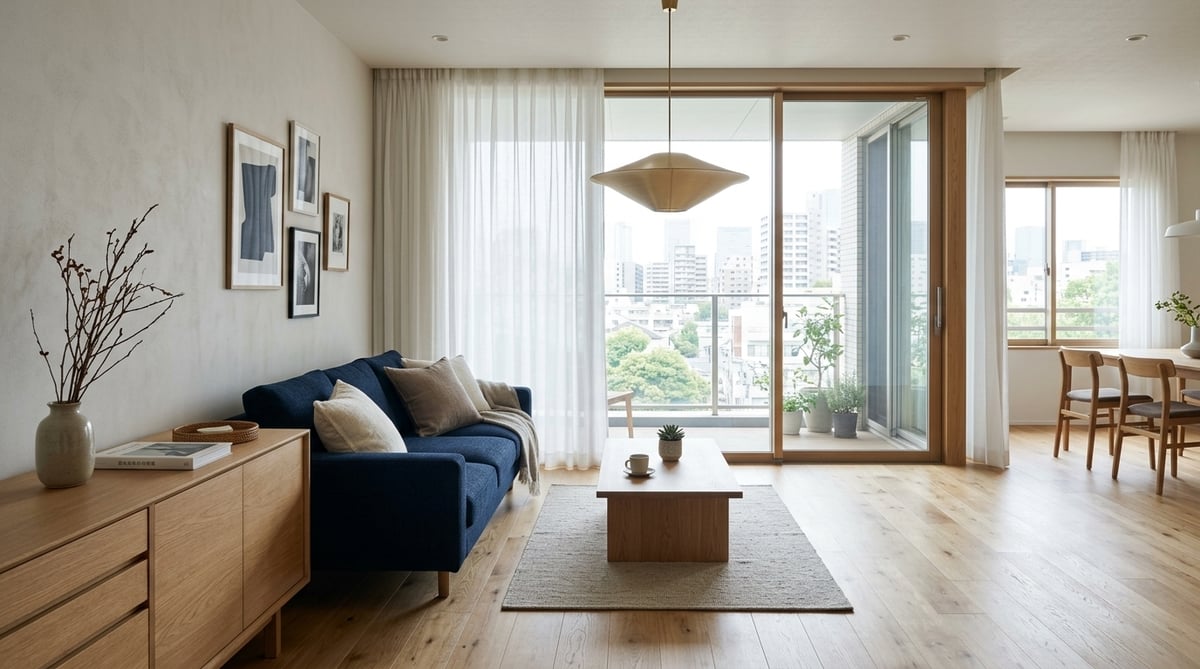
Stepping away from the intersection outside the station where Tamagawa-dori (Route 246) meets the elevated Metropolitan Expressway Route 3, turning into Komazawa Koen-dori or Jiyu-dori immediately leaves the hum of traffic behind, replaced by tree-lined sidewalks bathed in dappled light. On the walk back from viewings, as the lush canopy of the 410,000-square-meter Tokyo Metropolitan Komazawa Olympic Park comes into view, clients who were previously focused purely on room dimensions often slow their pace, looking across the tranquil low-rise streetscapes and remarking how pleasant it would be to begin weekend mornings right here.
At the same time, for households searching for 2LDK (median rent ¥277,000/month) or 3LDK (median rent ¥343,000/month, average ¥4,450/sqm) layouts along the Tokyu Den-en-toshi Line, Komazawa-daigaku can pose an interesting decision. While offering swift access to central Tokyo—around 7 minutes to Shibuya during daytime off-peak hours (10 to 12 minutes during morning peak commute) and 23 minutes to Otemachi (28 to 32 minutes during morning peak)—it is bypassed by express trains and lacks a direct-access department store or large commercial complex atop the station. Choosing between the lively dining and retail culture of Sangenjaya just one stop closer to Shibuya, stretching the budget toward Futako-tamagawa or Jiyugaoka with their extensive shopping districts, or stepping back to prioritize park greenery and low-rise residential calm is what fundamentally shapes daily life here.
Furthermore, walking the neighborhoods reveals distinct micro-climates within the same walking radius of Komazawa-daigaku Station. The Kamiuma and Nozawa districts north of Route 246 contrast noticeably with Komazawa and Fukasawa extending west and south of the park in terms of height zoning, elevation contours, and municipal elementary and junior high school boundaries in Setagaya Ward. Evaluating your daily commute, shopping patterns, life with pets, and growing children, this guide breaks down the neighborhood characteristics and leasing practices to help you make a well-informed choice.
- Median rents of ¥277,000 for 2LDK and ¥343,000 for 3LDK save roughly ¥810,000 to ¥970,000 over two years compared to neighboring Sangenjaya, positioning the station as a residential haven.
- Just a short block away from the avenue's commercial strip, Category I Exclusively Low-Rise Residential Zones spread across stable loam upland plateaus, preserving quiet three-story architectural settings.
- While express trains pass through and large station malls are absent, a direct 7-minute daytime ride to Shibuya and extensive Tokyu Bus connections to Jiyugaoka complement everyday urban mobility.
2LDK & 3LDK Market Rents and Comparison with Neighboring Stations
When considering 60 sqm to 80+ sqm family-sized rentals around Komazawa-daigaku Station, the key anchor is balancing transit time to major downtown business hubs against two-year total living expenses. Despite being only three stops from Shibuya, the absence of an extensive nightlife quarter creates a distinct cost advantage for 2LDK and larger floor plans relative to neighboring hubs.
Market Rents and 2-Year Total Housing Cost Comparison Across Key Stations
Below is a comparative breakdown of median rental rates and square-meter pricing across four representative stations frequently compared by couples and families in the Setagaya and Meguro areas.
| Station (Ward) | 1K | 1LDK | 2LDK | 3LDK | Per-Sqm Rate |
|---|---|---|---|---|---|
| Komazawa-daigaku (Setagaya) | ¥116,000 | ¥196,000 | ¥277,000 | ¥343,000 | ¥4,450/sqm |
| Sangenjaya (Setagaya) | ¥126,000 | ¥215,000 | ¥307,000 | ¥379,000 | ¥4,750/sqm |
| Sakura-shinmachi (Setagaya) | ¥114,000 | ¥194,000 | ¥274,000 | ¥339,000 | ¥4,400/sqm |
| Jiyugaoka (Meguro) | ¥132,000 | ¥226,000 | ¥325,000 | ¥402,000 | ¥4,900/sqm |
When evaluated across a standard two-year tenancy including initial move-in fees and renewal fees (calculated at approximately 27 months of monthly rent equivalent), choosing Komazawa-daigaku over Sangenjaya reduces overall housing expenditures by approximately ¥810,000 for a 2LDK and roughly ¥970,000 for a 3LDK. For households targeting a monthly budget of around ¥300,000, while Sangenjaya often requires compromising on space (high 50s sqm) or accepting older building stock, Komazawa-daigaku opens realistic opportunities for spacious 2LDKs exceeding 65 sqm, or low-rise condominium rentals equipped with on-site flat parking and dedicated trunk storage rooms. Compared to Jiyugaoka to the south, the two-year cost difference expands to approximately ¥1,300,000 for a 2LDK and ¥1,590,000 for a 3LDK, presenting a solid financial foundation for families mindful of education funds and household margins.
Meanwhile, rental rates are nearly identical to neighboring Sakura-shinmachi to the west. With direct train connections to Shibuya, Omotesando, and Otemachi via the Hanzomon Line being identical from both stops, the distinction lies in the character of the daily journey home. Sakura-shinmachi appeals to those who favor tidy commercial avenues with underground power lines and friendly community retail streets. In contrast, Komazawa-daigaku naturally resonates with residents who place immediate walking access to sprawling park lawns, cycling paths, and open-air playgrounds at the heart of their weekend family routines. For an overview of housing stock across the corridor, see our Den-en-toshi Line (Ikejiri-ohashi to Futako-tamagawa) 2LDK & 3LDK Rental Guide, and for those prioritizing late-night dining or vibrant street life, our Sangenjaya 2LDK & 3LDK Rental and Living Guide offers valuable perspective.
Commuting on Semi-Express & Local Trains and the Shibu 11 Bus Link to Jiyugaoka
Komazawa-daigaku Station is served by Local and Semi-Express trains, while Express trains pass through without stopping. The nearest express interchange stations on the Den-en-toshi Line are Sangenjaya to the east and Futako-tamagawa to the west. However, during morning peak weekday hours heading toward downtown Tokyo, Shibuya is only three stops away, taking roughly 10 to 12 minutes (and around 7 minutes during daytime off-peak). Because trains continue seamlessly along the Tokyo Metro Hanzomon Line to Nagatacho and Otemachi (roughly 28 to 32 minutes during morning peak and 23 minutes off-peak), commuting aboard Local or Semi-Express services is remarkably straightforward without any transfers. Many residents appreciate that station platforms and ticket gates remain unhurried precisely because express transfers do not concentrate here. Detailed network connections and schedules can also be reviewed in our Tokyu Den-en-toshi Line Area Guide and Tokyo Metro Hanzomon Line Area Guide.
While trains serve the east-west axis, north-south connections are smoothly facilitated by the Tokyu Bus "Shibu 11" route (operating between Den-en-chofu Station, Jiyugaoka Station Entrance, Tokyo Medical Center, Komazawa-daigaku Station, and Shibuya Station). Operating with frequent headways, it is a deeply rooted daily route for local residents traveling south along Jiyu-dori toward Meguro and Ota Wards. When traveling to the Jiyugaoka district, passengers alight at the Jiyugaoka Station Entrance bus stop on Jiyu-dori rather than entering the station plaza, followed by an easy, flat walk directly into Jiyugaoka's shopping quarters. Even on weekends with strollers or luggage, reaching Jiyugaoka's specialty boutiques, cafes, and medical clinics via a single bus ride without detouring through Shibuya or Futako-tamagawa is a distinct everyday perk of living here.
Choosing Between Fukasawa/South Komazawa Park and the Jiyugaoka Station Walk
When searching for spacious 2LDK or 3LDK homes south of Komazawa Park in the Fukasawa neighborhood, home seekers often ask: "If we are walking this far south, shouldn't we focus our search directly around Jiyugaoka Station on the Toyoko and Oimachi Lines?" Indeed, from southern Fukasawa, both Jiyugaoka and Komazawa-daigaku are within accessible bicycle and bus reach.
In practical real estate consulting, this choice rests on two clear criteria: primary commuting transit routes and surrounding foot traffic. If household commuting routes head toward Shibuya, Omotesando, Aoyama-itchome, or Otemachi along the Hanzomon Line, basing daily transit at Komazawa-daigaku avoids unnecessary transfers. Conversely, if work or school requires daily travel toward Yokohama, Musashi-kosugi, Nakameguro, or points along the Oimachi Line, prioritizing walking access to Jiyugaoka, Kuhombutsu, or Oyamadai Stations brings greater morning efficiency despite higher rent levels. Furthermore, while the 10-minute walking radius around Jiyugaoka Station buzzes with weekend shoppers, the low-rise residential quarters of Komazawa and Fukasawa maintain a relaxed neighborhood atmosphere dominated by local families and park visitors. For households who prefer taking the bus to Jiyugaoka for dining and retail while returning to a quiet hilltop home to sleep, the cost-to-quality balance of Komazawa and Fukasawa is particularly compelling.
Simply enter the rent and deposit from portal listings to calculate a full, itemized breakdown including brokerage and guarantor fees without hidden add-ons.
Micro-Districts of Kamiuma, Komazawa, Fukasawa, and Nozawa: Plateau Foundations and School Zones
Understanding the living environment of Komazawa-daigaku requires paying close attention to the stark contrast in city planning (zoning) between main arterial avenues and inner residential lanes. Depending on the direction and distance you walk from the station, the openness of the sky and nighttime quiet change considerably.
Commercial Corridors on Route 246 vs Category I Exclusively Low-Rise Zones
Along Tamagawa-dori (Route 246) directly above the station, land is designated as a Commercial Zone with a 500% floor area ratio (FAR), lined with medium- to high-rise condominiums of 10 stories or more, supermarkets, drugstores, and eateries. While offering the peace of mind of reaching your building entrance via well-lit avenues within minutes of leaving the station, balconies facing the arterial roadway and elevated expressway require consideration regarding traffic noise and air quality. When viewing apartments near the avenue, checking acoustic insulation with windows closed (such as double glazing or T-rated soundproof sashes), acoustic baffling on 24-hour ventilation ports, and the practicality of bathroom dryers or indoor laundry setups helps prevent surprises after moving in.
However, stepping just one or two blocks off the main avenue into Komazawa 1- to 4-chome, Kamiuma 1- and 4-chome, Fukasawa, or Nozawa leads into extensive Category I Exclusively Low-Rise Residential Zones (typically 100% to 150% FAR, with strict 10-meter or 12-meter building height caps). Commercial arcades and amusement facilities are prohibited here, creating orderly residential streetscapes of low-rise condominium residences (mostly three stories) and detached family homes. While natural sunlight and open sky views are well-preserved, commercial illuminated signage is absent at night; taking a walk along your commuting path after dusk to check streetlight spacing and sidewalk visibility ensures lasting comfort.
Musashino Plateau Loam Soil and Hazard Map Nuances in Fukasawa's Lowland Areas
Geologically, the vast majority of Komazawa-daigaku sits atop the volcanic ash plateau (loam plateau) forming the Musashino Plateau. Neighborhoods on this tableland, such as Kamiuma 4-chome and the area surrounding Komazawa Park, feature naturally compacted, cohesive ground. In Setagaya Ward's official hazard maps, these plateau areas are situated safely outside flood inundation risk zones and are not classified as large-scale reclaimed valley fills, reflecting elevated structural stability.
| Representative Area | Streetscape & Zoning Trends | Topography & Ground Characteristics | Key Points to Check During Viewings |
|---|---|---|---|
| Kamiuma 1 & 4-chome / West Nozawa (Station North to Northeast) | Transitions quickly from avenue commercial zoning into Category I Exclusively Low-Rise Residential Zones | Flat to gently sloping volcanic loam plateau; predominantly outside flood inundation zones | Nighttime streetlight brightness, sidewalk widths, and window acoustic performance for units close to the avenue |
| Komazawa 1 to 4-chome (Station West to Park West/North) | Park-adjacent Category I Low-Rise Zones with mid-rise residences along secondary avenues | Stable loam plateau tableland; open, airy streetscapes with abundant greenery coverage | Walking distance and cycling routes from the station, perimeter drainage gradients, and retaining wall conditions |
| Fukasawa Area (South of Komazawa Park to Nomigawa Basin) | Extensive Category I Low-Rise Zones combined with neighborhood commercial pockets along Jiyu-dori and Komazawa-dori | Mix of plateau ground and valley bottom flatlands along the Nomigawa and tributaries, with gentle slopes | Block-specific inland flooding/pluvial hazard levels, ground-floor/substation elevation, and flood barrier provisions |
One practical detail to consider when exploring southward toward Fukasawa is subtle micro-topography. While the majority of the area sits on high tableland, strips running along the Nomigawa stream basin and its former branches (such as neighborhood commercial pockets in Fukasawa 6-chome) encompass flat valley bottom lowlands. While flat roads make pushing strollers and riding bicycles effortless, rainwater drainage dynamics differ from elevated plateaus. Cross-referencing prospective properties against Setagaya Ward's pluvial and fluvial flood hazard maps by exact block number, confirming whether electrical substations are elevated above ground, and noting on-site flood barriers and drainage slopes will give you complete peace of mind.
Block-Specific School Boundaries and Childcare Infrastructure in Setagaya Ward
Beyond Komazawa Olympic Park itself, families choose this area for the reassurance of having the National Hospital Organization Tokyo Medical Center—a major comprehensive medical hub with emergency pediatric support—situated just southeast of the park grounds. Inside the park, children's adventure playgrounds (Squirrel Park, Horse Park, and Pig Park) equipped with age-appropriate play equipment, splash ponds, and dedicated children's practice cycling tracks allow young children to play safely in nature year-round without traveling far from home.
For households considering public elementary and junior high schools, Setagaya Ward's strict school zone boundaries require careful attention. Even within the same Kamiuma neighborhood name, Kamiuma 1-chome falls under Asahi Elementary and Koma-dome Junior High School, whereas Kamiuma 4-chome is assigned to Komazawa Elementary and Komazawa Junior High School. In Fukasawa, assignments split between Fukasawa Elementary/Junior High and Higashi-Fukasawa Elementary/Junior High at the exact street block and lot number level. Never assume a school assignment based solely on station proximity; once a candidate property is identified, verify the official address with the Setagaya Ward Board of Education boundary registers.
Living with Dogs, Daily Shopping Convenience, and Scenarios to Look Elsewhere
While Komazawa-daigaku is widely renowned for the large and medium-sized dogs seen relaxing on cafe terraces and strolling park promenades, entering the rental market often reveals an unexpected gap between public perception and actual building rules. Here is an objective review of pet policies, shopping logistics, and lifestyle scenarios where another neighborhood might serve you better.
Pet Regulations Around Komazawa Park and the Reality of Large Dog Rentals
Komazawa Olympic Park features a registered dog run, surrounded by dog-friendly cafes, veterinary clinics, and pet grooming salons. However, examining the detailed bylaws of homeowner association (HOA) condominium rentals around the station reveals that the vast majority enforce strict ceilings: "Only one small dog or cat under 50 cm in shoulder height and 10 kg in weight (or up to two pets in select properties)." Many buildings also require pets to be carried or fully enclosed inside a carrier bag or crate within common hallways and elevators.
Daily Grocery Routes by Station Exit and Healthcare Access
Komazawa-daigaku Station operates a single ticket gate with three main above-ground exits: the West Exit (northwest), the East Exit (northeast), and the Komazawa Park Exit (southwest). Although there is no sprawling multi-story shopping mall at the station, well-stocked supermarkets are conveniently distributed along each walking corridor. Toward Kamiuma 4-chome from the West Exit stands Maruetsu Manaka, while the Komazawa Park Exit along Route 246 toward Komazawa 4-chome features a multi-floor Seiyu. Walking east toward Nozawa and Jiyu-dori brings you to Ozeki Nozawa, ensuring grocery stops on the walk home are effortless from any exit.
Furthermore, along Komazawa Koen-dori and throughout Fukasawa's residential corners, independent bakeries offering fresh morning sourdough, quality greengrocers, and understated neighborhood bistros are scattered throughout the neighborhood, fostering a refined local food culture distinct from cookie-cutter franchise strips. Residents typically pick up everyday perishables on the short walk home from the station, while taking quick trips to Futako-tamagawa or Shibuya by train, or hopping on the direct bus to Jiyugaoka for seasonal apparel, department store shopping, and entertainment.
Who Thrives in Komazawa-daigaku vs Profiles Better Suited to Other Hubs
No matter how green or structurally sound a neighborhood is, lifestyle preferences dictate whether Komazawa-daigaku is your ideal fit. The comparative breakdown below outlines where this neighborhood excels and where alternative stations may better match your goals.
Prioritizing Low-Rise Quiet, Park Greenery, and Spacious Living
- ✓ Wanting immediate access to a 410,000-sqm park for weekend jogging, dog walks, and children's outdoor play
- ✓ Seeking to save ¥800,000+ over two years vs Sangenjaya/Jiyugaoka to secure 65+ sqm layouts or upgraded finishes
- ✓ Needing direct commutes to Shibuya and Otemachi while coming home to calm, low-rise residential streets
- ✓ Utilizing e-bikes and Tokyu Buses to integrate Jiyugaoka and Futako-tamagawa smoothly into daily life
Prioritizing Station-Connected Retail and Express Train Speeds
- ✓ Requiring direct-access station shopping malls and underground food halls to complete all errands without getting wet
- ✓ Relying on daily express train stops and multi-line interchanges to minimize transit minutes
- ✓ Demanding a home under 5 minutes' walk from the station with zero arterial road sound below ¥300,000/month
- ✓ Seeking late-night dining diversity and buzzing pedestrian streets right outside the front door
A crucial consideration is the simultaneous demand for "under 5 minutes from the station" and "Category I Low-Rise serenity." The immediate 5-minute radius around Komazawa-daigaku Station consists predominantly of commercial and quasi-residential zoning along Route 246. Reaching authentic low-rise residential pockets with private hedges and quiet lanes (such as deep in Komazawa 2- to 4-chome, Fukasawa 1- to 8-chome, or inner Kamiuma) naturally requires an 8- to 15-minute walk. Embracing this walking distance as a pleasant daily transition surrounded by greenery and open sky is the fundamental key to enjoying life in this area.
Lease Contract Practices: Fixed-Term Tenancies, Corporate Leases, and Initial Cost Scrutiny
In the 2LDK and 3LDK market of Komazawa, Fukasawa, and Kamiuma, high-spec condominium units and custom detached residences leased by private owners are common. Because monthly rents range from ¥280,000 to ¥400,000+, examining contract structures, initial move-in costs, and restoration clauses against statutory standards is vital for safeguarding your household's interests.
Fixed-Term Tenancies (Article 38 of the Land and Building Lease Act): Individual vs Corporate Leases
In high-grade condominiums and detached homes across Fukasawa and around Komazawa Park, many properties are offered under Fixed-Term Building Lease Contracts (Article 38 of the Land and Building Lease Act) while the owners are temporarily away on overseas or domestic corporate transfers. While these properties often feature premium interior specifications at rents slightly below prevailing market rates, the lease terminates definitively upon the expiration of the term without automatic renewal. Even if a listing states "re-contracting negotiable upon mutual agreement," extension is not possible if the owner returns; aligning contract end dates with your children's school milestones is therefore critical.
Furthermore, an often-overlooked legal distinction exists between individual leases and corporate housing (company contract) leases regarding statutory mid-term cancellation rights. For residential fixed-term leases under 200 sqm, individual tenants possess a statutory right to cancel early with one month's notice if unavoidable circumstances (such as job transfer, medical care, or family caregiving) make continuing the residence impossible (Article 38, Paragraph 7 of the Act). However, this statutory right protects individual tenants only—it does not apply to corporate contracts where your employer is the legal lessee. When leasing a fixed-term property under a corporate contract, unless a specific mid-term termination rider (e.g., cancellation permitted with 1 to 2 months' advance written notice) is explicitly written into the lease agreement, your company risks liability for rent across the entire remaining term upon early departure. Aligning your company's corporate housing policy with contract riders beforehand is essential.
Restoration Guidelines, Tokyo Rules, and Enforceability of Pet Riders
For premium properties and pet-negotiable rentals, lease agreements frequently include special riders such as "mandatory tenant-paid move-out cleaning" or "non-refundable deduction of one month's deposit plus specialized deodorization/disinfection fees when keeping pets." Clear legal benchmarks established by administrative guidelines and Supreme Court precedents govern these obligations.
Under the Ministry of Land, Infrastructure, Transport and Tourism (MLIT) "Troubles and Guidelines Concerning Restoration to Original Condition," normal wear and tear and natural deterioration (such as sun-faded tatami/flooring or minor furniture indentations) are deemed covered by monthly rent and remain the lessor's responsibility. The guideline establishes the depreciable lifespan of wall and ceiling wallpaper at 6 years (depreciating to a residual book value of ¥1 after 6 years of occupancy). Even if wallpaper is damaged through tenant negligence or pet scratches, the standard rule does not require paying for entire room re-papering; costs should be apportioned by individual affected wall planes while factoring in elapsed years. Additionally, under the Tokyo Metropolitan Rental Housing Dispute Prevention Ordinance (widely known as the Tokyo Rules), licensed real estate agents are legally required to deliver and explain a dedicated written explanation of these burden principles and special riders before contract signing.
For special riders such as fixed cleaning fees or non-refundable deposit deductions to be legally enforceable, three strict requirements must be satisfied pursuant to Supreme Court precedent (Second Petty Bench Judgment, December 16, 2005) and Article 10 of the Consumer Contract Act: (1) the scope and amount of expenses borne by the tenant, including normal wear, must be objectively and clearly specified in the contract; (2) the tenant must clearly understand and agree to the specific obligations; and (3) the terms must not be excessively one-sided or violate good faith relative to market rent levels. Carefully checking that flat fees are reasonable and ensuring cleaning charges and deposit deductions do not result in double billing during application and explanation stages is paramount.
Brokerage Commission Regulations (Article 46) and a 4-Step Pre-Application Checklist
At rental tiers between ¥277,000 (median 2LDK) and ¥343,000 (median 3LDK), initial move-in fee line items quickly translate into differences of hundreds of thousands of yen. Under Article 46 of the Real Estate Brokerage Act, total brokerage remuneration receivable by a brokerage agency from both lessor and lessee is capped at one month's rent (plus tax), with the tenant's share legally capped at 0.55 months' rent (tax included) as the standard default (up to 1.1 months only with explicit prior consent). On a ¥300,000 monthly rent property, the difference between 0.55 months (¥165,000) and 1.1 months (¥330,000) is ¥165,000. Scrutinizing the estimate objectively alongside optional add-ons (such as discretionary disinfection fees or emergency support packages) is essential.
If you have already found candidate properties on portal sites such as SUUMO or Homes, our Portal Listing Concierge is at your service. Simply share the property URL through our official LINE account (@soraitokyo / https://line.me/R/ti/p/@soraitokyo). Our licensed real estate advisors will cross-reference internal inter-broker databases to check real-time availability, evaluate your initial cost quote, and provide an objective second opinion. Available via the fixed bottom menu on mobile or the footer on desktop, you can easily access our suite of smart tools completely free of charge, with zero phone numbers required, no pushy sales calls, and no in-person store visits needed.
Conclusion: Making an Informed Choice for Family Living in Komazawa-daigaku
The true value of Komazawa-daigaku lies in its rare equilibrium: maintaining immediate direct transit to Shibuya (roughly 7 minutes off-peak, 10 to 12 minutes in morning peak) and Otemachi (around 23 minutes off-peak, 28 to 32 minutes in morning peak), while opening up into open three-story residential streetscapes and 410,000 square meters of parkland the moment you step off the avenue. Compared to the bustling commercial density of Sangenjaya or the luxury brand identity of Jiyugaoka, saving between ¥810,000 and ¥1,590,000 over two years allows families to reallocate financial resources into generous floor plans of 65+ sqm, enriching experiences, or educational funds—a practical advantage that grows more rewarding over time.
It is true that express trains pass through, direct station department stores are absent, and choosing the quietest Category I Low-Rise zones requires walking several minutes from the station. Yet, when supported by Tokyu Bus routes, electric-assist bicycles, and weekend strolls through Komazawa Olympic Park and Jiyugaoka, this neighborhood provides a remarkably balanced, grounded environment for raising children and enjoying life with pets.
Whether clarifying which specific block among Kamiuma, Komazawa, and Fukasawa best matches your family's commute and school criteria, or evaluating whether a condominium lease contract and initial quote are fully transparent, please feel free to reach out to Sorai Tokyo. Supported by our 24/7 dedicated AI concierge on LINE with smooth English guidance, transparent second opinions, no guarantor consultation options, and supportive visa screening, we are here to accompany your relocation journey with care and precision.
Frequently Asked Questions About 2LDK & 3LDK Rentals in Komazawa-daigaku
QExpress trains do not stop at Komazawa-daigaku. Is the morning commute to Shibuya and Otemachi inconvenient?
AWhile express trains pass through, Shibuya Station is only three stops away via Local and Semi-Express trains, taking roughly 10 to 12 minutes during morning peak hours (around 7 minutes off-peak). Because trains continue directly along the Tokyo Metro Hanzomon Line to Omotesando, Nagatacho, and Otemachi (roughly 28 to 32 minutes during morning peak and 23 minutes off-peak), commuting to central Tokyo office districts is very efficient without needing transfers. Trains are crowded during peak hours, but the short travel time to Shibuya helps minimize fatigue.
QAre there many 2LDK and 3LDK apartments near Komazawa Park that welcome large dogs?
AAlthough the park area is exceptionally popular with dog owners, the vast majority of condominium rental units enforce HOA bylaws limiting pets to one small dog or cat under 10 kg and 50 cm in height. Properties accommodating large dogs are restricted to dedicated pet-coexistence residences or detached rental homes. We strongly recommend checking the original HOA bylaws for size limits and reviewing security deposit conditions rather than relying solely on "Pets Negotiable" portal descriptions.
QHow do parenting environments and school districts differ between Komazawa/Fukasawa and Kamiuma?
AThe Komazawa and Fukasawa areas southwest and south of the station sit close to Komazawa Olympic Park and the Tokyo Medical Center, characterized by spacious low-rise residential plots. Kamiuma, to the north of the station, offers convenient access to supermarkets along Route 246 and quiet low-rise streets within a 10-minute walk. Note that public school boundaries in Setagaya Ward divide at the exact block level (e.g., Kamiuma 1-chome is zoned for Asahi Elementary/Koma-dome Junior High, while Kamiuma 4-chome attends Komazawa Elementary/Komazawa Junior High), making confirmation by official property address essential.
QWhat should be noted when renting a fixed-term lease apartment in Komazawa under a corporate housing contract?
AUnder Article 38 of the Land and Building Lease Act, the statutory right to cancel a residential fixed-term lease early due to job transfers or other unavoidable circumstances (for units under 200 sqm) applies exclusively to individual tenant contracts—not to corporate leases where the employer is the lessee. If entering a fixed-term contract under a company name, you must confirm that a custom early-cancellation rider (e.g., termination allowed with 1 to 2 months' advance notice) is explicitly included in the lease agreement before signing to prevent financial liability for remaining lease months.



Sorai Tokyo Co., Ltd. Editorial (Licensed Real Estate Agency #113297)
Licensed online real estate agency handling residential leasing across 15 major Tokyo lines (Member of All Japan Real Estate Association). Powered by our proprietary 24/7 AI "SorAi" on iOS/LINE and dedicated licensed realtors, we support renters end-to-end from vacancy checks on major portals to viewings and digital contracts.