
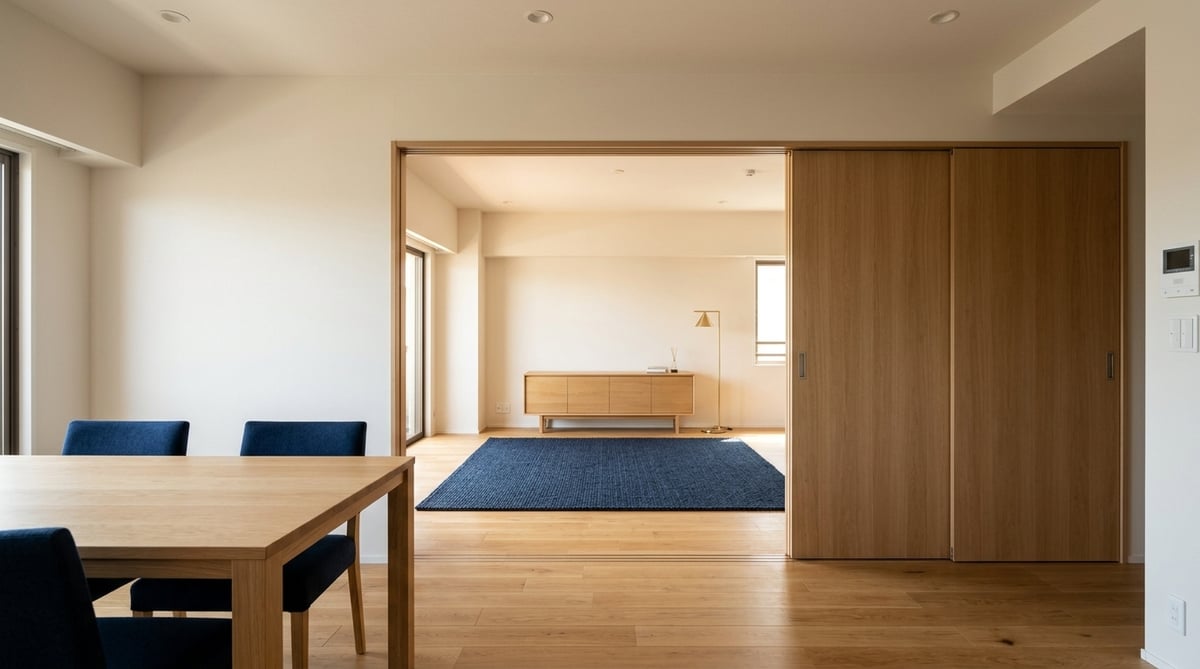
On a quiet weekend afternoon, while walking with couples through the tree-lined streets of Shimouma or Nozawa in Setagaya Ward during property viewings, we often hear a familiar dilemma: "From here, we can walk north to Sangenjaya or head southeast to Gakugeidaigaku. We like both neighborhoods so much that we cannot decide." For dual-income households and multicultural families considering a 2LDK or 3LDK apartment in the 300,000 to 400,000 JPY range in southern Tokyo, Sangenjaya on the Tokyu Den-en-toshi Line (2LDK median: 307,000 JPY; 3LDK median: 379,000 JPY; 4,750 JPY per square meter) and Gakugeidaigaku on the Tokyu Toyoko Line (2LDK median: 323,000 JPY; 3LDK median: 399,000 JPY; 4,950 JPY per square meter) are two compelling options whose living areas partially overlap.
Looking solely at rent levels on a floor plan or the distance of being one or two express stops from Shibuya, the two stations appear quite similar. However, once you overlay weekday morning and evening routines, the contours of daily life diverge in distinct ways. Beyond the difference in direct central Tokyo connections from Shibuya—whether your commute follows the Hanzomon Line axis toward Otemachi and Nagatacho, or the Fukutoshin Line toward Shinjuku-sanchome and Ikebukuro paired with a cross-platform transfer to the Hibiya Line at Nakameguro—the urban planning of the residential districts 5 to 10 minutes beyond each commercial core differs markedly between mid-rise apartment blocks and low-rise residential zones.
Neither station is universally superior. What matters most is how you spend the first 15 minutes of your morning, which streets you prefer for picking up groceries on the way home, and how much quietness you want in your bedroom at night. From the practical perspective of a licensed Japanese real estate transaction specialist who has walked both neighborhoods extensively, this guide organizes the key decision points: commuting, shopping, block-by-block terrain and ward-border considerations, 27-month total housing cost comparisons, and essential lease clauses for higher-budget rentals.
- Sangenjaya offers direct Hanzomon Line access to Otemachi and Nagatacho, while Gakugeidaigaku provides direct Shinjuku-sanchome service and a same-platform Hibiya Line transfer at Nakameguro.
- Sangenjaya stands out for mid-rise residences and multiple competing supermarkets, whereas Gakugeidaigaku features expansive Category 1 Low-Rise Exclusive Residential Zones and requires careful attention to the Meguro–Setagaya ward border.
- Over 27 months, Sangenjaya saves approximately 432,000 JPY on a 2LDK and 540,000 JPY on a 3LDK, making the trade-off between a quiet low-rise environment and extra floor space or budget flexibility the central decision.
Direct Networks Beyond Shibuya and Morning Commutes: Den-en-toshi & Hanzomon vs. Toyoko, Fukutoshin & Hibiya
While both stations sit just minutes from Shibuya by express train, dual-income couples working in different parts of Tokyo will notice a decisive difference in the rail networks extending beyond Shibuya and the ease of transfers along the way. Let us examine the line characteristics that shape your daily door-to-door commute.
Sangenjaya: Direct Access to Otemachi and Nagatacho Plus the Setagaya Line Terminus
All train types on the Tokyu Den-en-toshi Line—Express, Semi-Express, and Local—stop at Sangenjaya Station. Its greatest advantage is through-service directly onto the Tokyo Metro Hanzomon Line at Shibuya. Without changing platforms or climbing stairs, you can travel straight to Omotesando, Aoyama-itchome, Nagatacho, Hanzomon, Kudanshita, Jinbocho, and Otemachi, the gateway to the Marunouchi business district. If one partner commutes to financial institutions, trading houses, or professional firms around Otemachi and Marunouchi, or to offices near Nagatacho and Kasumigaseki, being able to fold your umbrella and step directly into the underground office corridors on a rainy morning reduces daily fatigue.
At the same time, weekday morning rush-hour crowding on inbound Den-en-toshi Line trains is a practical reality to factor in. Rather than insisting on an Express train during peak hours, choosing a Local or Semi-Express train—which stops at Ikejiri-ohashi and then Shibuya—often provides a slightly calmer cabin environment for a brief two-stop ride. Sangenjaya is also the terminus of the Tokyu Setagaya Line tramway. On weekends, taking a two-car train toward Shoin-jinja-mae, Gotokuji, or Shimotakaido offers a relaxed change of pace while remaining close to central Tokyo. For a broader view of stations along this corridor, see our Tokyu Den-en-toshi Line Area Guide and Tokyo Metro Hanzomon Line Area Guide.
Gakugeidaigaku: Flexible Dual-Axis Access to Shinjuku-sanchome, Roppongi, and Shin-Yokohama
Gakugeidaigaku Station is served by Express and Local trains on the Tokyu Toyoko Line. Although daytime F-Liner Limited Express and weekday Commuter Limited Express trains pass through, Express trains reach Nakameguro and Shibuya in just two stops. From Shibuya, through-service onto the Tokyo Metro Fukutoshin Line connects directly to Meiji-jingumae, Shinjuku-sanchome, and Ikebukuro—an axis not available on the Den-en-toshi Line.
Equally valued by dual-income households is the cross-platform transfer to the Tokyo Metro Hibiya Line at Nakameguro, just one stop away. Because Hibiya Line trains—including trains originating at Nakameguro—arrive on the opposite side of the same platform, you can transfer without stairs to reach Ebisu, Hiroo, Roppongi, Toranomon Hills, Kasumigaseki, Hibiya, Ginza, and Kayabacho. If one partner commutes toward Shinjuku or Shibuya while the other works in Roppongi, Ginza, or Hibiya, Gakugeidaigaku's dual-route flexibility creates breathing room in the morning. Heading south, the line also connects smoothly to Jiyugaoka, Yokohama, and Minato Mirai, as well as Shin-Yokohama Station via Hiyoshi and the Tokyu Shin-Yokohama Line, which is convenient for frequent Tokaido Shinkansen business trips.
Households Best Suited for Sangenjaya
- ✓ Want direct, transfer-free commutes to Otemachi, Nagatacho, and Omotesando
- ✓ Prefer choosing among multiple large supermarkets along different routes home
- ✓ Want to keep 27-month housing costs lower while securing floor space and modern amenities
Households Best Suited for Gakugeidaigaku
- ✓ Need smooth commutes to Shinjuku-sanchome, Ikebukuro, or Hibiya Line hubs (Roppongi, Ginza)
- ✓ Value quiet evenings in a Category 1 Low-Rise Exclusive Residential Zone
- ✓ Enjoy independent-shopped shotengai streets and daily walks in Himonya Park
Simply enter the rent and deposit from portal listings to calculate a full, itemized breakdown including brokerage and guarantor fees without hidden add-ons.
Evening Grocery Runs and Weekend Pace: Competing Supermarkets vs. Shotengai and Parks
For dual-income households living in a 2LDK or 3LDK, how smoothly you can pick up groceries during the 10-minute walk from the station directly shapes your evening downtime. Neither neighborhood lacks daily conveniences, yet the layout of their shops and the atmosphere of their streets feel quite different.
Sangenjaya: Multiple Supermarkets Aligned with Every Route Home
One of Sangenjaya's practical strengths is the concentration of distinct large and mid-sized supermarkets around the station, allowing you to choose naturally based on which direction you live. In the basement of Carrot Tower, directly connected to the Setagaya Line ticket gates, sits Tokyu Store Sangenjaya. Along Chazawa-dori to the north, Seiyu Sangenjaya offers groceries alongside daily necessities and apparel. Toward Sangenjaya 2-chome, Niku no Hanamasa Sangenjaya stocks generous portions of fresh produce and meat, while Daiei Sangenjaya along Setagaya-dori in 1-chome serves the southwest side. No matter which exit you use, everyday shopping remains balanced.
On weekdays, you can stop by a station-front supermarket or independent bakery and delicatessen; on weekend mornings, you can stroll to the fountain plaza at Setagaya Park or the shaded paths of Mishuku no Mori Park for coffee. For families considering international schools, note that while the British School in Tokyo (BST) Showa Campus is located on the Showa Women's University grounds in Sangenjaya, that campus is dedicated to Secondary students. Families with younger children will need to plan separate commutes to other campuses. For a closer look at individual blocks around the station, see our Sangenjaya 2LDK & 3LDK Family Rental Guide.
Gakugeidaigaku: Warm Shotengai Streets Paired with Himonya Shopping and Greenery
Stepping out of Gakugeidaigaku Station, you immediately find Gakugeidaigaku Tokyu Store beneath the elevated tracks, making rainy-day grocery stops effortless. Stretching straight east and west from the ticket gates are the neighborhood's signature shotengai shopping streets. Traditional greengrocers, butchers, and prepared-food shops stand side by side with understated bistros, patisseries, and bookshops, casting a warm, welcoming glow over the walk home at night.
If you choose a residence southeast toward Himonya or west-southwest toward Kakinokizaka and Higashigaoka, your shopping options expand to include AEON Style Himonya—a large-format store covering groceries, children's goods, and household items in one stop—as well as Seijo Ishii Kakinokizaka along Komazawa-dori for imported ingredients. Nearby, Himonya Park offers a boating pond and mature trees where residents read on benches or enjoy unhurried afternoon walks.
Zoning, Micro-Terrain, and When to Consider Neighboring Stations
When viewing 2LDK and 3LDK apartments in the 300,000 to 400,000 JPY range, it is essential to look beyond "8 minutes on foot" and check how zoning (which governs building height and allowable uses), micro-terrain (elevated plateau vs. valley floor), and even municipal ward boundaries shift from block to block.
Sangenjaya: Loam Plateaus vs. Greenway Valley Floors in Taishido, Mishuku, and Shimouma
Immediate station areas such as Taishido 4-chome and parts of Taishido 2-chome along Route 246 (Tamagawa-dori) and Setagaya-dori are designated as Commercial Zones with floor-area ratios of 500% to 600% (while the station-side portion of Sangenjaya 1-chome is a Neighborhood Commercial Zone at 300%). While these blocks offer abundant high-convenience apartments, traffic volume remains high day and night. During viewings, test window soundproofing with the windows closed (checking for double-pane glazing or acoustic T-ratings) and look at adjacent lots—such as coin-operated parking or small older houses—to gauge whether a taller building could later block your main sunlight. Narrow side streets near the station also lack separated sidewalks, so families using strollers should walk the exact route home.
Step one block inward into Taishido 2–3-chome, Mishuku 1–2-chome, or Shimouma 2-chome, and you reach stable volcanic ash loam plateaus zoned as Category 1 Residential or Category 1 Medium-to-High-Rise Exclusive Residential Zones (200% floor-area ratio). Here, the bustle of the main roads fades into calm streets lined with mid-rise residences. However, corridors along former streams now converted into greenways—such as parts of Sangenjaya 2-chome, Shimouma 3-chome, and the southern edge of Sangenjaya 1-chome along the Karasuyamagawa and Jakuzuregawa Greenways—sit slightly lower as valley floors. Even where official river flood hazard maps show these blocks outside designated flood inundation zones, heavy downpours can cause localized runoff. If considering a ground-floor unit or semi-basement maisonette, inspect the street drainage slope, raised electrical equipment rooms, and floodgate provisions on site.
Gakugeidaigaku: Category 1 Low-Rise Zones and the Meguro–Setagaya Ward Border
Around Gakugeidaigaku Station, Takaban 2–3-chome is a 400% Commercial Zone (with parts of Chuocho 2-chome and Meguro-honcho 2-chome zoned Semi-Industrial at 200%), yet walking 5 to 10 minutes past the shotengai transforms the streetscape. Across Takaban 1-chome, Gohongi 2-chome, Chuocho 1-chome, Himonya 5–6-chome, and westward into Shimouma 6-chome and Nozawa 3-chome in Setagaya Ward, expansive Category 1 Low-Rise Exclusive Residential Zones (60% building coverage, 150% floor-area ratio) sit atop stable loam plateaus largely outside river flood hazard zones. Strict height limits preserve three-story apartment buildings and detached homes, offering quiet nights and wide skies.
A critical practical detail for dual-income families with children is the municipal ward border. Gakugeidaigaku Station itself is in Takaban, Meguro Ward, but crossing Komazawa-dori from the west exit into Shimouma 6-chome or Nozawa 3-chome places your residence in Setagaya Ward. Whether your resident registration falls in Meguro or Setagaya changes licensed daycare admission scoring tables, sibling priority rules, childcare leave return criteria, and local subsidies. Public elementary and junior high school districts also divide by exact street block rather than station name—for example, Gohongi 2-chome and Takaban 2-chome fall under different elementary schools within Meguro, and Taishido 2-chome in Setagaya splits between Mishuku and Taishido Elementary Schools. Always verify the exact street address against official ward school and daycare lists before applying.
When Ikejiri-ohashi, Yutenji, or Komazawa-daigaku May Fit Better
Express-stop convenience is appealing, yet depending on your priorities, neighboring Local or Semi-Express stops can offer a cleaner balance of calm surroundings and budget:
If you prefer to avoid bustling station-front commercial districts altogether and focus purely on proximity to Shibuya plus a quiet residential setting, consider Ikejiri-ohashi (2LDK median: 325,000 JPY) between Sangenjaya and Shibuya, or Yutenji (2LDK median: 313,000 JPY) one stop north of Gakugeidaigaku. Ikejiri-ohashi is just one stop from Shibuya, and elevated residential pockets such as Higashiyama 3-chome in Meguro Ward remain remarkably serene. Yutenji, served only by Local trains, keeps its station-front commercial scale modest, with Category 1 Low-Rise zones in Yutenji 1-chome and Category 1 Medium-to-High-Rise zones in Nakacho 1-chome connecting easily on foot or by bicycle to both Gakugeidaigaku and Nakameguro.
Conversely, if you work remotely most days and do not need Express trains, expanding one stop west from Sangenjaya to Komazawa-daigaku (2LDK median: 277,000 JPY; 3LDK median: 343,000 JPY) lets you secure newer 65-square-meter-plus layouts or 3LDK units around 300,000 JPY while enjoying low-rise streets in Kamiuma 4-chome and the greenery of Komazawa Olympic Park.
2LDK & 3LDK Rent Medians and 27-Month Total Housing Cost Simulation
Alongside neighborhood feel, objective rent data helps anchor long-term household planning. Below are median rents by layout and approximate per-square-meter rates across Sangenjaya, Gakugeidaigaku, and three neighboring stations.
| Station (Main Ward) | Lines & Train Types | 1LDK Median | 2LDK Median | 3LDK Median | Approx. Price / sqm |
|---|---|---|---|---|---|
| Sangenjaya (Setagaya) | Den-en-toshi (Exp, Semi-Exp, Local), Setagaya Line | 215,000 JPY | 307,000 JPY | 379,000 JPY | 4,750 JPY/sqm |
| Gakugeidaigaku (Meguro) | Toyoko Line (Express, Local) | 224,000 JPY | 323,000 JPY | 399,000 JPY | 4,950 JPY/sqm |
| Ikejiri-ohashi (Setagaya / Meguro) | Den-en-toshi Line (Semi-Exp, Local) | 226,000 JPY | 325,000 JPY | 402,000 JPY | 4,900 JPY/sqm |
| Yutenji (Meguro) | Toyoko Line (Local) | 217,000 JPY | 313,000 JPY | 387,000 JPY | 4,850 JPY/sqm |
| Komazawa-daigaku (Setagaya) | Den-en-toshi Line (Semi-Exp, Local) | 196,000 JPY | 277,000 JPY | 343,000 JPY | 4,450 JPY/sqm |
Reading Floor Space and Building Age Across the Five Stations
The table highlights a subtle 200 JPY per square meter gap between Sangenjaya and Gakugeidaigaku. On a 65-square-meter 2LDK, that translates to roughly 13,000 to 16,000 JPY less per month in Sangenjaya, and around 20,000 JPY less on a 75-square-meter 3LDK. In Gakugeidaigaku, extensive 150% low-rise zoning limits the number of units per building, creating scarcity that lifts rents. Sangenjaya, by contrast, offers a broader stock of family-sized units across 200% medium-to-high-rise residential zones and main-road buildings, giving you more choice in building age and floor level. For households willing to look further west along the same line toward Sakurashinmachi, Yoga, and Futako-tamagawa, see our Den-en-toshi & Hanzomon Line 2LDK & 3LDK Family Rental Guide.
27-Month Total Housing Cost: A 432,000 to 540,000 JPY Difference
A monthly difference of 16,000 to 20,000 JPY may appear modest on its own. In Japanese rental practice, however, comparing 27-month total housing costs—24 months of rent plus non-refundable initial and renewal fees (1 month key money + 1 month brokerage fee + 1 month renewal fee at year two)—reveals the true financial gap.
Over 27 months, the difference between Sangenjaya and Gakugeidaigaku comes to 432,000 JPY for a 2LDK (8,289,000 JPY vs. 8,721,000 JPY) and 540,000 JPY for a 3LDK (10,233,000 JPY vs. 10,773,000 JPY). Deciding whether to invest that 432,000 to 540,000 JPY in Gakugeidaigaku's low-rise quietness and Toyoko/Hibiya commute, or choose Sangenjaya and allocate the savings toward home-office furnishings, on-site parking, or household flexibility, gives couples a concrete framework for discussion. You can also use the SorAi smart tools via the bottom menu on mobile or the footer on desktop to estimate move-in costs for your target rent range.
Legal, Screening, and Building Checks for 300,000–400,000 JPY Leases
Many 2LDK and 3LDK rentals in Sangenjaya and Gakugeidaigaku are individually owned condominium units or owner-managed low-rise residences rather than standard single-occupant apartments. Knowing the legal, screening, and equipment checkpoints in advance prevents surprises.
Fixed-Term Leases in Corporate Housing and Dual-Income / Offer-Letter Screening
Around 70-square-meter units in southern Tokyo frequently use Fixed-Term Residential Leases (Act on Land and Building Leases, Article 38), often because the owner is posted abroad. Before signing, the landlord must provide and explain a separate written notice stating that the lease will not renew and will terminate at the end of the term. Special care is required when renting through a corporate housing (shataku) contract.
For tenant screening in the 300,000 to 400,000 JPY tier, preparing documents tailored to your employment profile is key. When combining incomes as a dual-income couple, guarantor companies differ on whether the partner can be added as a co-signer or must be listed as a co-tenant. If you have recently joined a foreign-affiliated firm or are relocating to Tokyo, choose a management and guarantor company that accepts employment contracts or offer letters in place of prior-year tax certificates. For foreign nationals, confirming compatibility with multilingual guarantor companies (such as GTN) in advance keeps screening smooth.
Mechanical Parking Dimensions, Pet Rules, and Legal Standards for Initial & Restoration Costs
In low-rise residences—especially in Gakugeidaigaku's Category 1 Low-Rise zones or Sangenjaya's Mishuku and Shimouma areas—check underground or mechanical parking pallet dimensions carefully. Buildings 10 to 20 years old often cap vehicles at 1,850 mm width, 1,550 mm height, and 2,000 kg weight, which can exclude modern SUVs and heavier electric vehicles. Verify actual dimensions with mirrors folded and tire outer widths. Similarly, even in pet-friendly condominiums, HOA bylaws commonly enforce strict limits (such as under 50 cm length, under 10 kg, one pet per unit, and carrying pets in common areas) alongside fixed deodorizing or sanitizing fees in the lease.
Understanding official rules for initial and move-out costs also prevents unnecessary expenses. Under Article 46 of the Real Estate Brokerage Act, brokerage fees are capped at one month's rent plus consumption tax, and charging a full month to the tenant requires the tenant's consent. In Tokyo, the Tokyo Metropolitan Ordinance on Prevention of Disputes over Rental Housing (the "Tokyo Rule") requires a licensed specialist to explain and deliver written documentation before signing, clarifying that normal wear and tear and age-related deterioration are the landlord's responsibility, while tenant negligence is the tenant's responsibility, and that repairs for aging water heaters or air conditioners generally fall to the landlord.
Under the Ministry of Land, Infrastructure, Transport and Tourism's Restoration Guidelines, wallpaper has a useful life of 6 years (reaching a residual value of 1 JPY after six years), and accidental damage is generally calculated per affected wall面 rather than the entire room. For special clauses such as move-out cleaning fees to be valid, Supreme Court precedent (December 16, 2005) requires three conditions: clear written specification of tenant responsibility including normal wear, explicit tenant understanding and agreement, and a reasonable fee proportionate to the rent. If you have a listing flyer or initial-cost quote you would like reviewed, send the URL to Sorai Tokyo's Property Check & Second-Opinion Desk via our official LINE (@soraitokyo). Our licensed specialists will check live availability in the inter-agent database and provide an objective review of initial fees and lease clauses—with no phone number required and zero pushy sales calls.
Choosing the Right Rhythm Between Sangenjaya and Gakugeidaigaku
Although Sangenjaya and Gakugeidaigaku sit side by side on the map, each supports a distinct daily rhythm. For couples who value transfer-free commutes to Otemachi, Nagatacho, and Omotesando, the flexibility of multiple competing supermarkets, and saving 432,000 to 540,000 JPY over 27 months to invest in extra floor space or home amenities, the residential streets of Taishido, Mishuku, and Shimouma around Sangenjaya are a dependable choice.
For couples who prioritize flexible commutes toward Shinjuku-sanchome, Ikebukuro, or Roppongi and Ginza via Nakameguro, along with open skies in a three-story Category 1 Low-Rise zone, independent-shopped shotengai streets, and quiet afternoons in Himonya Park, Gakugeidaigaku offers lasting satisfaction.
When numbers on a floor plan are not enough to decide, walk from your candidate apartment to both stations on a weekday evening and a weekend afternoon. In the glow of the streetlights and the pace of the neighborhood, you will quickly sense which street feels most natural. Whenever you would like a second opinion, you can reach our 24/7 AI concierge and licensed specialists anonymously on LINE (@soraitokyo) with no phone number required and at your own pace.
Frequently Asked Questions About 2LDK & 3LDK Rentals in Sangenjaya and Gakugeidaigaku
QIf we live halfway between the two stations, such as in Shimouma or Nozawa, which station is more convenient?
AThe biggest advantage of living in between is choosing based on your destination: Sangenjaya for direct rides to Otemachi, Nagatacho, and Omotesando, and Gakugeidaigaku for Shinjuku-sanchome or Hibiya Line transfers to Roppongi and Ginza. Because some blocks are a 12-to-15-minute walk from either station, check rainy-day bus routes, bicycle parking availability, and whether the address falls in Meguro or Setagaya Ward during your viewing.
QWhat should we check when leasing a fixed-term property under a corporate housing contract?
AThe statutory early-termination right for unavoidable job transfers under Article 38, Paragraph 7 of the Act on Land and Building Leases applies only to individual-name residential contracts, not corporate leases. Before applying, confirm in writing with the management company and landlord whether a voluntary early-termination clause (typically one to two months' notice upon transfer) can be added and whether any penalty terms fit your company's housing policy.
QCan we have initial fees and lease clauses reviewed before submitting an application?
AYes, anytime. Simply send the URL of any listing you find on a property portal to Sorai Tokyo's official LINE (@soraitokyo). Our licensed specialists will check live availability in the inter-agent database and provide an objective second opinion on initial costs, contract terms, and special clauses—anonymously and with no phone number required.



Sorai Tokyo Co., Ltd. Editorial (Licensed Real Estate Agency #113297)
Licensed online real estate agency handling residential leasing across 15 major Tokyo lines (Member of All Japan Real Estate Association). Powered by our proprietary 24/7 AI "SorAi" on iOS/LINE and dedicated licensed realtors, we support renters end-to-end from vacancy checks on major portals to viewings and digital contracts.