
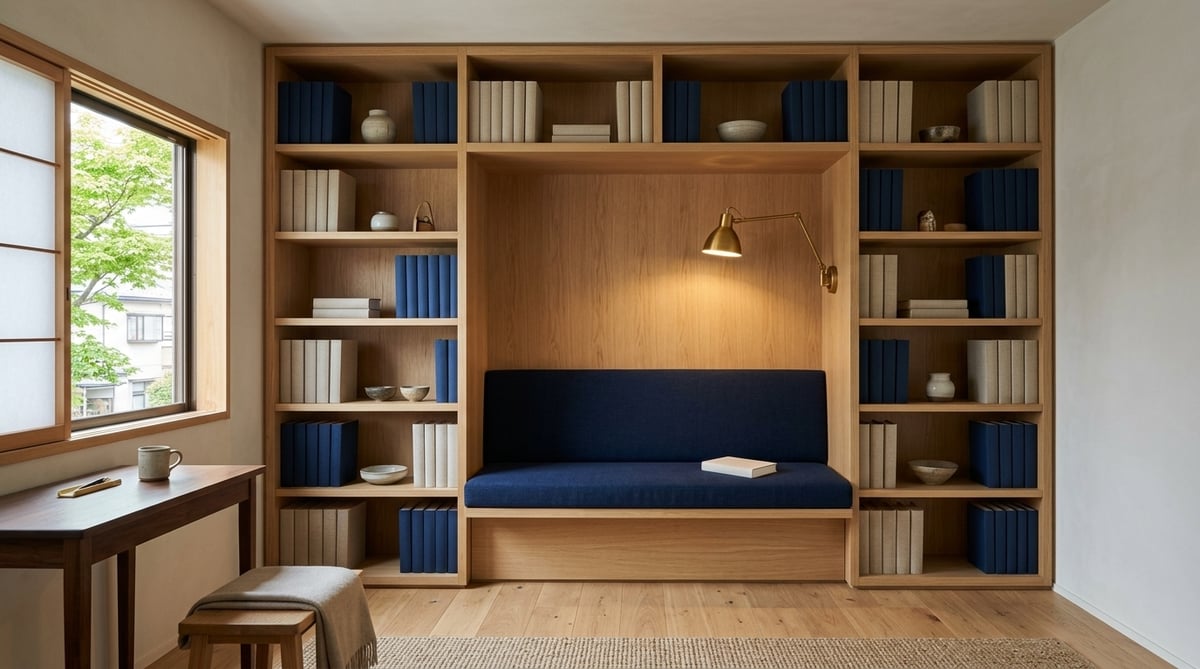
At 2:00 PM on a weekday, as you wrap up a lengthy online meeting and open the window, there is no roar of central Tokyo traffic—only the gentle rustle of garden foliage and birdsong from the courtyard next door. Step off the main avenues of Yanesen—the historic cultural district encompassing Yanaka, Nezu, and Sendagi—into its labyrinth of narrow alleys, and you enter a historic streetscape where through-traffic is physically impossible. The result is a profound quiet that feels almost unbelievable within Tokyo's 23 wards. At twilight, put your laptop to sleep and step into the lane; within minutes on foot, you can settle into a warm heritage cafe or stroll under the deep tree canopy of Nezu Shrine. Breathing in the aroma of a pour-over roast while welcoming the evening breeze provides the exact decompression an overtaxed mind needs.
At the same time, establishing a remote work base in this historic neighborhood requires a clear, professional assessment of older building structures and telecommunications infrastructure. While vintage wooden flats and renovated traditional townhouses offer rich character, their acoustic insulation is often limited, meaning everyday speech during calls and the click of mechanical keyboards can carry directly into adjoining units. Furthermore, even if a property listing advertises high-speed fiber-optic access, an in-building distribution system that relies on legacy copper telephone lines (VDSL) risks sharp evening bandwidth throttling and high latency spikes, disrupting large file transfers and seamless screen sharing.
As a practicing licensed real estate broker who has handled rental brokerage and neighborhood field surveys across Bunkyo and Taito Wards for over a decade, I share an unvarnished view of the true acoustic calm found in Yanesen's backstreets, the soundproofing criteria required for reliable video conferencing, and the exact steps to verify your fiber connection before signing a lease.
Why the Backstreets of Yanesen Are Ideal for Remote Work and Telecommuting
Despite being nestled inside the Yamanote Line loop, the Yanesen area has maintained an extraordinary level of tranquility. This preservation is rooted in a unique urban fabric and topography shaped from the Edo period through the Meiji and Taisho eras. Here, we break down the reality of ambient noise—a critical factor dictating concentration during remote work—alongside the practical business advantages of living close to central work hubs.
Unmatched Serenity in Central Tokyo: The Value of Backstreets Free from Through Traffic
One of the greatest sources of friction when working from home is intermittent external noise intruding into your living space. The roar of accelerating delivery trucks, emergency vehicle sirens, and city buses stopping and starting persistently shatter deep focus, frequently bleeding into online meeting microphones.
A walk through the residential enclaves of Nezu 1-chome and 2-chome, or Sendagi 2-chome and 3-chome, reveals an intricate, web-like network of narrow lanes under 4 meters wide (known as designated existing roads under the Building Standards Act), stepped hillside paths inaccessible to cars, and private dead-end alleys. Vehicles cannot physically cut through these alleyways. Daily traffic is virtually limited to neighborhood residents on foot or bicycle, and the occasional mail delivery scooter.
While daytime noise levels along typical Tokyo arterial roads reach 65 dB to 75 dB (comparable to running a vacuum cleaner), moving deeper into the backstreets of Yanesen drops daytime ambient noise to the 35 dB to lower 40 dB range. This quiet is on par with a dedicated library reading room or a suburban residential neighborhood in the dead of night. Having zero vehicular traffic directly outside your window provides a solid, dependable foundation for long stretches of writing, software development, and deep conceptual work.
Direct 6- to 8-Minute Transit to Otemachi: Tailored for Hybrid Working Models
Even for full-time remote professionals, occasions inevitably arise that require heading into central business districts—whether for weekly office syncs, on-site client presentations, or in-person procedures at municipal offices and financial institutions. Many professionals who relocated to regional hubs or distant bedroom suburbs eventually return to central Tokyo, worn down by grueling commute times on in-office days.
Utilizing the Tokyo Metro Chiyoda Line that runs through Yanesen, travel time is exceptionally swift: approximately 6 direct minutes from Nezu Station to Otemachi Station, and about 8 direct minutes from Sendagi Station. Kasumigaseki is accessible in roughly 12 direct minutes, while Omotesando and Akasaka require no transfers whatsoever. Furthermore, on the western elevated plateau of Sendagi in Bunkyo Ward, Hon-komagome and Todaimae stations on the Tokyo Metro Namboku Line, as well as Nishi-Nippori and Nippori stations on the JR Yamanote Line, are easily within comfortable walking distance.
The ability to work at your desk until 8:30 AM, get ready for a 9:00 AM meeting, and arrive at an Otemachi office desk barely 15 minutes later preserves vital mental and physical energy. You maintain effortless access to major urban business infrastructure while anchoring your everyday life in peaceful, historic residential backstreets. This harmonious contrast is the primary rationale for choosing Yanesen, Bunkyo Ward.
Historic Streetscapes and Verdant Greenery Inspiring Creative Thinking
When seated in front of a monitor all day, intentional context switching directly governs sustained cognitive output. Yanesen offers a sensory-rich neighborhood atmosphere that sterile office clusters and high-density tower mansion districts simply cannot replicate.
Sudo Park, situated on the Sendagi plateau, features a pond and waterfall honoring traditional samurai estate garden design, offering vibrant foliage through every season. A short stroll to Nezu Shrine reveals expansive sacred groves surrounding the main shrine pavilions—designated National Important Cultural Properties—where vibrant azaleas bloom in spring and golden ginkgo carpets form in autumn. Wandering down narrow side streets brings you past converted early-twentieth-century traditional townhouses functioning as art galleries, handmade paper ateliers, and independent artisan bakeries, engaging sight and smell at every corner.
Complex code refactoring ideas or architectural outlines for stalled project proposals often click into place during a 15-minute walk through these backstreets. This organic intersection of historical heritage and lush greenery transcends a mere place of residence, serving as an expansive canvas for focused, intellectual productivity.
Conventional City Living: Noise Friction and Unstable Internet
- Focus shattered by heavy vehicle exhaust noise and emergency sirens along major thoroughfares
- Constant anxiety in timber-frame apartments due to voice leakage into adjacent units during video calls
- Severe connection throttling during peak evening hours caused by legacy in-building VDSL wiring
- Break options restricted to generic chain cafes, leading to exhaustion from congested surroundings
- Mental and physical stamina drained by packed rush-hour trains and long commutes on in-office days
Remote Work Lifestyle in a Yanesen Backstreet Reinforced Concrete Residence
- Sub-40 dB daytime quiet guaranteed by cul-de-sacs and narrow lanes completely free from through traffic
- Solid reinforced concrete dividing walls allowing confident speaking and typing during virtual meetings
- Direct-to-unit fiber-optic cabling (FTTH) maintaining consistent, dedicated gigabit transmission speeds
- Effortless mental refresh with Nezu Shrine, Sudo Park, and artisanal coffee roasters mere minutes away on foot
- Direct 6- to 8-minute transit to Otemachi allowing instant responses to urgent in-office meetings or client calls
Building Structures and Sound Insulation: Comparing Renovated Wooden Properties with Reinforced Concrete
When searching for a home in the Yanesen neighborhood, the single most critical factor requiring careful evaluation is the building structure. While charming renovated traditional wooden houses and retro wooden apartments brimming with old-town character are undeniably appealing, whether they suit remote work is an entirely different matter. Drawing on practical brokerage experience and objective acoustics data, here is a grounded look at how different building structures perform in sound insulation.
Sound Leakage and Typing Noise Risks in Wood-Frame and Light-Gauge Steel Buildings
In residential buildings with wooden or light-gauge steel framing, the mass of the structural frame itself is relatively small, and dividing walls between units often consist merely of gypsum board with intermediate insulation such as glass wool. This structural lightness presents a decisive vulnerability in terms of sound transmission loss—the wall's ability to block noise.
Noise generated during remote work falls primarily into two categories: airborne sound (voices and speaker audio) and structure-borne sound (heavy keystrokes, dragging chairs, and footsteps). The sound insulation performance of demising walls in wooden apartment buildings typically rates around D-30 to D-35. In practice, if an online meeting is held in the adjoining unit at a normal conversational volume of roughly 60 dB, the sound penetrates the wall and emerges on the other side at approximately 25 to 30 dB—a volume clear enough to be easily understood. Because individual words and nuances can be discerned by your neighbors, this poses a substantial security risk regarding professional confidentiality and the protection of private data.
An even more common blind spot is the noise from laptop typing and mouse clicks. Wooden floor assemblies transmit vibrations readily through the framing, meaning desk vibrations can travel through desk legs down into the unit below, occasionally escalating into unexpected noise disputes. While light text-based tasks pose few issues, choosing a wood-frame or light-gauge steel apartment is not something I can recommend for anyone holding frequent, lengthy voice or video calls day in and day out.
Key Concrete Partition Wall and Floor Slab Benchmarks in RC/SRC Buildings for Undisturbed Focus
When it comes to guaranteeing privacy, absolute quiet, and a truly stress-free work-from-home setup, reinforced concrete (RC) or steel reinforced concrete (SRC) buildings serve as your primary defense line.
Concrete possesses immense mass, making it exceptionally effective at physically reflecting and dampening airborne sound waves. When evaluating acoustic performance from architectural drawings and listing floor plans, here are the essential benchmarks to look for:
- Demising Wall Concrete Thickness: 180 mm or thicker (ideally 200 mm or more). Securing this thickness achieves sound insulation performance roughly equivalent to class D-50 to D-55. At this level, unless someone is shouting next door, you practically eliminate the risk of everyday video conference conversations bleeding through the walls. Keep in mind, however, that even within RC buildings—particularly in high-rise towers and specific modern construction designs—the walls separating units may be constructed using dry soundproof partition walls (layered plasterboard assemblies) rather than solid poured concrete. Depending on the construction quality, these can occasionally allow noise leakage, so careful verification is always warranted.
- Floor Slab Thickness: 150 mm or thicker (or at least 200 mm in the case of void slabs). This substantial depth effectively buffers against heavy impact noise (such as jumping or heavy footsteps) as well as light impact noise (such as the tapping of hard slippers), drastically reducing the risk of your focus being shattered by daily living sounds from upstairs.
In charming residential enclaves like Sendagi and Nezu in Bunkyo Ward, you will often find robust low-rise RC residences built between the bubble economy era and the early 2000s. Featuring fewer overall units and predominantly settled, quiet residents, these properties offer an exceptionally serene and productive sanctuary for remote workers.
On-Site Soundproofing Checks: Wall-Knocking and Door/Window Inspection Techniques
Never assume an apartment is soundproof simply because the listing says "reinforced concrete." Here are practical, field-tested soundproofing verification techniques that I always urge clients to perform in person during viewings.
- Demising Wall Knock Test: Gently tap the shared partition wall separating you from the neighboring unit using your knuckles. If it produces a dull, solid, dense thud, it indicates direct plastering over solid concrete or a gypsum lining application, ensuring substantial mass and reliable sound isolation. Conversely, if you hear a hollow, high-pitched resonance echoing across the partition, the interior likely consists of hollow drywall on light steel framing—a clear warning sign of inferior acoustic performance.
- Window Sash and Front Door Seal Inspection: Windows and exterior doors are your primary defense against neighborhood and ambient noise. Close all windows fully and turn the crescent latch; you should feel ambient exterior sounds instantly drop away by a distinct level. Residences fitted with sound-insulating sashes (T-1 to T-2 acoustic grades) or double-pane inner sashes effectively block nearly all day-to-day street noise.
- Ventilation Supply Port Construction: Outdoor sounds often penetrate directly through circular or square supply air vents installed on exterior walls. Listen carefully near the opening to check whether it features an acoustic soundproofing sleeve or hooded baffle, and test how well sound is dampened when the vent damper is shut completely.
| Building Structure | Video Call Sound Leakage | Floor Footsteps & Vibrations | Seismic & Structural Stability | Yanesen Market Rent (Studio to 1BR) | Remote Work Suitability |
|---|---|---|---|---|---|
| Wooden-Frame Apartments (Including Traditional Homes) | High leakage risk (approx. D-30) | Resonates easily due to drum effect | Varies widely from pre-1981 to modern standards | 65,000 to 110,000 yen | Proceed with caution (silent work only) |
| Light-Gauge Steel Frame (Low-Rise Apartments) | Voices penetrate depending on tone and pitch | Footstep impacts transmit to lower floors | Modern seismic standard compliant, flexible resilience | 75,000 to 125,000 yen | Limited (take care during late-night calls) |
| Heavy-Gauge Steel Frame (Mid-Rise Mansions) | Moderately dampens mid-to-high frequencies | Floor impact noise remains noticeable | Sturdy build with solid fire resistance | 85,000 to 145,000 yen | Generally good (rugs or floor mats recommended) |
| Reinforced Concrete (RC) | Effectively blocked (D-50 or higher) | Extremely quiet depending on concrete slab thickness | Outstanding structural integrity and seismic resistance | 95,000 to 185,000 yen | Optimal (ideal for full-time telework) |
| Steel-Framed Reinforced Concrete (SRC) | Virtually complete acoustic isolation (D-55+) | Superior absorption of heavy floor impact vibrations | Highest grade of structural strength and durability | 120,000 to 230,000 yen | Top tier (uncompromised sound isolation) |
The Remote Work Lifeline: Fiber-Optic Internet and How to Steer Clear of the VDSL Trap
No matter how quiet and well-built a reinforced concrete apartment may be, an unstable internet connection can bring your remote work to a complete halt. It is crucial to understand the structural wiring traps hidden behind the standard marketing phrases on rental listings, such as "Fiber-Optic Equipped" or "Internet Ready."
The "Fiber-Ready" Trap: The Hidden Bottleneck of 100 Mbps VDSL Systems
When a property flyer lists an apartment as "Fiber-Optic Ready," a high-speed fiber line has indeed been routed from the utility pole to the building's main distribution frame room. However, the real catch lies in what happens next: the type of cable used to connect that central distribution room to your specific unit.
In mid-sized to large apartment buildings built 15 to 25 years ago, the most common setup is a VDSL system. This architecture repurposes the existing analog copper telephone wires originally installed during construction to transmit internet data directly into each residence.
By technical design, the physical throughput of a VDSL system is capped at a maximum of 100 Mbps down and 100 Mbps up. In an era of heavy data demands, 100 Mbps is purely theoretical, and real-world performance often brings severe frustrations:
- Steep Nighttime Throughput Drops: Between 8:00 PM and midnight on weekdays, when residents return home and simultaneously stream 4K video or game online, actual speeds frequently collapse to 10–20 Mbps or lower.
- High Latency and Packet Loss: Copper wiring is notoriously vulnerable to line noise, causing ping times to spike past 50–100 ms. This leads to laggy screen sharing, choppy audio, and robotic voices during Zoom or Google Meet calls.
- Critically Low Upload Speeds: Pushing large files to cloud storage services like Google Drive, syncing repositories on GitHub, or deploying assets to AWS slows to a crawl, bringing your daily workflow to a dead stop.
For software engineers, UI/UX designers, video editors, and anyone working remotely from home in Tokyo, signing a lease on an apartment reliant on a VDSL network can quickly become a costly misstep that directly undermines your productivity.
How to Identify and Verify Direct-to-Unit Fiber Optic (FTTH) Connections
For a flawless remote work setup, the gold standard is FTTH (Fiber To The Home), where dedicated optical fiber cables run straight from the building's central distribution point directly into your private living space without touching copper telephone wiring at any stage. With direct fiber wiring, you secure massive bandwidth ranging from 1 Gbps up to 10 Gbps for both upload and download speeds, routinely delivering real-world measured speeds between 200 Mbps and 800 Mbps or higher, alongside ultra-low latency.
When touring an apartment or evaluating a lease, follow these three steps to reliably verify the building's internal wiring system:
- Inspect the Multimedia Wall Outlet Inside the Unit: Check the wall plates in the primary rooms. If you spot an optical fiber port labeled with markings such as "Optical", "Fiber", or "SC", there is an extremely high probability that the apartment is wired with direct FTTH. Conversely, if the wall plate only features a modular phone jack (an RJ-11 connector) alongside a standard LAN port, the building likely relies on legacy VDSL or shared Ethernet distribution.
- Check NTT East's Service Availability in Advance: Using the property's exact building name and registered address, perform a service lookup on the official NTT East FLET'S Hikari portal. Carefully review the results for the "Mansion Type" plan to verify whether it explicitly states "Direct Fiber Wiring" or defaults to "VDSL Wiring".
- Confirm Directly with the Property Management Company and Owner: Through your leasing agent, have an inquiry submitted to the property management company to confirm whether the main distribution frame (MDF) facilities have been fully upgraded to all-fiber lines. An experienced licensed broker can verify with a single phone call whether internal retrofitting work from VDSL to FTTH has already taken place.
Key Considerations for Installing Independent Fiber Lines Like NURO Hikari
If the standard FLET'S Hikari connection provided in your apartment falls short of your needs, you might consider installing an independent dark fiber line such as NURO Hikari or au Hikari. However, bringing an individual line into a rental apartment—often referred to as an individual or detached-house plan installation—comes with unique hurdles.
To run an independent fiber line into a unit, obtaining prior written consent from the building owner—and from the homeowner association in the case of condominium-style buildings—is an absolute prerequisite. This approval covers essential construction work, such as drilling holes or screwing mounting brackets into the exterior walls and utilizing shared conduits or internal wiring routes. In areas like Yanesen, known for architecturally distinctive designer apartments, as well as in newer luxury condominiums, building regulations frequently impose an outright ban on exterior drilling to preserve structural aesthetics and protect exterior waterproofing layers.
In some cases, landlords may grant permission if the fiber cable can be routed through an existing air conditioner vent pipe without any drilling or wall screws. Even then, strict conditions typically apply, including a mandatory restoration clause requiring complete line removal upon moving out. If having an independent, high-speed fiber connection is a dealbreaker for your remote work or lifestyle, thoroughly checking the building's telecommunications bylaws before submitting a rental application is indispensable.
| Wiring Method | Theoretical Max Speed | Actual Speed (Estimate) | Latency (Ping) | Video Conference Stability | Large File Transfers |
|---|---|---|---|---|---|
| Fiber-to-the-Home (FTTH) | 1 Gbps to 10 Gbps | 200 Mbps to 800 Mbps | Extremely fast (5–15 ms) | Highly stable (supports multiple calls) | Transfers several GBs in seconds |
| VDSL (via existing phone lines) | 100 Mbps (fixed) | 10 Mbps to 60 Mbps | Noticeable jitter and latency (30–80 ms) | Audio dropouts during peak evening hours | Requires extended upload times |
| In-Building Ethernet LAN | 100 Mbps to 1 Gbps | 50 Mbps to 300 Mbps | Standard (15–30 ms) | Generally good (subject to building traffic) | Practical for everyday file sizes |
| Cable TV Internet (Coaxial) | 120 Mbps to 1 Gbps (Download) | Severely restricted upload speeds | Higher latency (20–50 ms) | Upload bandwidth chokes during screen shares | Significant bottleneck when sending files |
Floor Plans and Furniture Layouts for an Ideal Home Workspace
When working remotely and blurring the line between living space and office, overall square footage matters far less than functional traffic flow and precise furniture clearance dimensions. Drawing on ten years of practical brokerage experience in Tokyo, here is how to create a sustainable, fatigue-free workspace within compact urban footprints.
Balancing Desk and Bed in a 1K: Why You Need at Least 8 Tatami Mats
The standard 1K apartment represents the vast majority of Tokyo's single-occupant rental market. However, attempting to integrate a dedicated home office into a modest 6-mat (approx. 10 sqm) bedroom frequently leads to layout paralysis.
Setting up a standard work desk (120 cm wide by 60 cm deep) alongside an ergonomic task chair like an Aeron or Ergohuman requires a dedicated floor footprint of at least 150 cm by 150 cm (roughly 1.4 mats), accounting for chair clearance and roll-back room. Combine that with a single bed (roughly 100 cm by 200 cm), the door swing clearance of the closet, and the primary walkway through the room, and a 6-mat space is completely saturated—often forcing you into the cramped compromise of working while perched on the edge of the mattress.
To establish a truly independent workstation, look for a bedroom with an effective living area of at least 7.5 mats, and ideally 8.0 mats or larger. In an 8-mat room with a balanced, squarish shape, you can divide the space into two distinct zones: an office zone in one corner and a relaxation/sleeping zone in the other. Using open shelving or freestanding partitions creates visual separation, making the psychological shift between work and rest seamless at the end of the day.
Choosing a 1LDK to Keep Personal Life Off Video Calls
For professionals who regularly hop on camera for client presentations or team meetings, what appears in the background directly impacts professional credibility.
In a 1K apartment, even creative camera angles often fail to hide your bed, drying racks, or open wardrobes. Virtual backgrounds help, but digital artifacts and blurry outlines can be distracting. Moving up to a 1LDK—where the living/dining area and bedroom are partitioned by dedicated walls and doors—fundamentally resolves this challenge.
Key layout details to inspect when evaluating a 1LDK include:
- Sliding Partition Partitions vs. Fully Independent Rooms: Layouts where the living room and bedroom are separated by sliding track panels allow you to create one expansive space when opened, but they provide minimal acoustic isolation. If your partner needs to sleep or rest while you take late-night calls across different time zones, choose an independent floor plan enclosed by solid walls and standard hinged doors.
- Blank Wall Clearance Behind Your Desk: Check whether you can position your desk so a clean, solid wall sits directly behind your chair. Placing your back against a window creates severe backlighting that leaves your face in shadow, while backing up against a doorway creates constant anxiety about housemates crossing into your camera frame.
Desk Positioning Away from Direct A/C Drafts and Power Outlet Placement
Two critical details easily overlooked during apartment viewings that severely undermine productivity and comfort are air conditioning airflow trajectories and electrical outlet positioning.
Sitting in the same chair for eight or more hours a day with chilled summer air or dry winter heat blowing directly onto your scalp, shoulders, or feet quickly leads to neck stiffness, chronic chills, and headaches. Avoid any floor plan where your desk is forced directly beneath the wall-mounted air conditioner or along the direct path of its output vents.
Furthermore, a modern remote setup demands concentrated power: dual monitors, a laptop, chargers, external storage drives, and task lighting. Confirm that the intended desk wall features at least a dual-socket outlet, and measure the distance to the fiber-optic port and wired LAN terminal. Trailing long extension cords across main walkways not only disrupts robot vacuum cleaners but also adds visual clutter that undermines your focus.
Third Places in Yanesen: Boosting Mood and Remote Work Productivity
No matter how well-equipped your home workspace may be, spending the entire day confined to the same four walls inevitably leads to mental fatigue and diminished productivity. Having access to high-quality spaces to reset your mind or dive into focused tasks—all within a few minutes' walk from your front door—is one of the truest pleasures of living in Yanesen.
Scenic Walking Routes and Green Parks for Midweek Refreshment
The most effective remedy for cognitive fatigue from intensive desk work is a combination of rhythmic walking, natural sunlight, and exposure to lush greenery. In Yanesen, pedestrian-friendly walking routes are naturally woven into everyday life.
Sudo Park, situated in Sendagi 3-chome, makes masterful use of the area's tiered plateau terrain with a charming waterfall and pond garden. During the fresh greens of spring or vibrant autumn foliage, you will often find professionals sitting on park benches, reading or structuring their thoughts. Additionally, the winding pathway known as Snake Road, which connects Yanaka to Nezu along the culverted course of the former Aizome River, serves as a pedestrian sanctuary closed to vehicular traffic. Lined with potted doorstep greenery and distinctive independent shops, even a brisk 15-minute stroll along this quiet lane works wonders to clear your mind.
Cafes and Coworking Spaces Tailored for Work and Reading
When you need a change of scenery to open your laptop and power through your to-do list, Yanesen offers a wealth of dependable options. Tucked away in quiet backstreets away from tourist foot traffic, you will discover tranquil traditional coffee shops scented with freshly roasted beans alongside modern coworking hubs that warmly welcome remote workers.
At revitalized historic venues such as Ueno Sakuragi Atari in Yanaka, you can sit on courtyard benches surrounded by leafy gardens and reflect in the gentle breeze. Furthermore, around Nezu and Sendagi stations, neighborhood community cafes and boutique shared offices provide high-speed Wi-Fi, power outlets, and comfortable seating designed for extended reading or focused laptop sessions—giving you the ideal balance of productive energy and peaceful neighborhood warmth.
| Spot / Facility Name | Area & Nearest Station | Key Features & Atmosphere | Wi-Fi / Power | Recommended Remote Work Use Cases |
|---|---|---|---|---|
| Sudo Park | Sendagi, Bunkyo Ward (2 min walk from Sendagi Station) | Tranquil Japanese-style park featuring a pond, waterfall, and lush hillside | None (Natural setting) | Structuring thoughts, leisurely walks, cognitive reset |
| Nezu Shrine Sacred Forest | Nezu, Bunkyo Ward (5 min walk from Nezu Station) | Expansive shrine grove embracing Important Cultural Property structures | None (Natural setting) | Early morning jogging or walking, mindfulness |
| Snake Road (Aizome River Culvert) | Boundary between Sendagi and Yanaka | Gently curving, car-free residential alleyway with local charm | Available at individual venues along the path | Lunchtime strolls, mental refreshment, neighborhood exploration |
| Historic Machiya Cafes in Yanesen | Backstreets of Nezu and Sendagi | Artisanal pour-over coffee and serene, character-rich interiors | Available at selected locations | Reading, brainstorming, light laptop work |
| Community Coworking Spaces & Study Lounges | Near Sendagi and Nippori Stations | Private video call booths, high-speed fiber-optic internet, printing hubs | High-Speed Wi-Fi / Power outlets at all desks | Critical client video calls, full-day deep-focus work sessions |
Practical Steps to Finding Your Ideal Remote-Work Rental in Yanesen
Hunting for a rental home in Yanesen requires an entirely different mindset from searching for a typical high-rise apartment near a major terminal station. Because alleyway locations, building age, and interior specifications vary drastically from one property to another, meticulous on-site verification and objective scrutiny of listings are essential to finding the right home.
On-Site Inspections: Experiencing Daytime and Nighttime Soundscapes
When viewing a property in person, inspecting the surrounding neighborhood across different days of the week and times of day is critical.
For example, a tranquil backstreet where you hear only distant temple bells and chirping birds during the afternoon might echo in the evening with kitchen exhaust fans from nearby eateries or idling delivery vans. Conversely, other residential pockets may see brief daytime traffic from small local craft workshops or couriers, only to slip into profound, pin-drop silence once dusk falls.
During your property walkthrough, try standing in the center of the room with the windows fully open, and then completely closed. Close your eyes and listen attentively for thirty seconds. Tuning your senses to subtle environmental background sounds that often go unnoticed—such as the faint rumble of passing trains along the Yamanote, Keihin-Tohoku, or subway lines near Nippori Station, or the low-frequency hum of a neighboring water heater or air conditioning condenser—is the most reliable defense against unexpected surprises after move-in.
Half-Month Brokerage Fees and Real-Time Availability Checks via REINS
High-quality apartments well-suited for remote work often receive applications within days of appearing on major consumer portals such as SUUMO or LIFULL HOME'S. Unfortunately, the market is also plagued by bait-and-switch listings that remain online long after they are off the market, as well as opaque initial quotes laden with non-essential add-ons like mandatory room sanitization fees, overpriced mini fire extinguishers, and arbitrary administrative surcharges.
At Sorai Tokyo, we query designated inter-broker databases—including the Real Estate Information Network System designated by the Minister of Land, Infrastructure, Transport and Tourism—in real time. This allows us to impartially verify whether a property you found online is genuinely available for lease.
In addition, we provide a completely free second-opinion diagnosis on upfront cost estimates issued by other agencies. We thoroughly scrutinize and help you strip away inflated incidental fees, safeguarding your wallet every step of the way.
Best of all, Sorai Tokyo charges a flat brokerage fee of just half a month's rent (0.55 months including consumption tax) on every rental property. The significant upfront savings can be redirected directly into your home office setup, whether that means an ergonomic task chair, a large external display, or an electric standing desk.
You will never experience tedious office visits or pushy sales calls with us. Every property viewing is conducted effortlessly on-site—meeting and wrapping up right at the building. Whether you are on mobile using our bottom navigation bar or on desktop exploring our footer, you can freely access our initial cost simulator and other smart tools anytime. Let us help you craft the seamless fusion of a serene home and a focused workspace.
Frequently Asked Questions (FAQ)
Q Can I work remotely from a renovated wooden house in Yanesen?
A If your remote work primarily involves text-based programming, writing, design, or reading documentation, you will find it very comfortable. However, if your daily routine requires frequent video calls or if you tend to type late at night or early in the morning, sound travels easily through wooden walls and floors to adjacent or lower units, which can lead to noise disputes with neighbors. For those whose daily work relies on constant speaking, choosing a reinforced concrete (RC or SRC) apartment is the safest and most reliable approach.
Q How can I check whether an apartment uses a VDSL internet connection?
A good first step is to visually inspect the wall outlet plate in the unit: check if it has a dedicated optical fiber port marked with the character for optical connection, or if it only provides a standard modular telephone jack (RJ-11). For a definitive answer, you can enter the building name into NTT East's service area search tool to verify the supported plan, or simply reach out to us at Sorai Tokyo. We will contact the property management company and the telecommunications provider directly on your behalf to confirm whether the unit features direct fiber-to-the-home (FTTH) or older VDSL wiring.
Q What is the minimum room size needed to comfortably work from home in a studio apartment?
A To comfortably accommodate a 100 cm to 120 cm work desk and an ergonomic office chair without blocking pathways to your bed or closet doors, we strongly recommend a living area of at least 7.5 to 8.0 tatami mats (roughly 12 to 13 square meters). Placing a large desk in a room of 6.0 mats or smaller significantly restricts your walking pathways, which often leads to spending off-hours sitting on the bed and blurs the boundary between work and personal rest.
Q Can Sorai Tokyo help me find a home tailored for remote work?
A We would be delighted to assist you. At Sorai Tokyo, we regularly help full-remote software engineers, creative professionals, legal and financial specialists, and many others find homes optimized for telework. From evaluating structural sound insulation and verifying FTTH fiber wiring to measuring precise usable dimensions for furniture placement, our licensed real estate brokers provide thorough, end-to-end guidance from an expert perspective. Furthermore, our brokerage fee is consistently set at half the standard rate (0.55 months' rent including tax). Please feel free to message us anytime via our official LINE account.

Author: Sorai Tokyo Editorial Team (Supervised by Licensed Real Estate Agents)
A real estate consulting team specializing in assisting foreign nationals find rooms and explaining initial costs in Tokyo. We break down language barriers and differences in customs, offering dedicated support in Japanese, English, and Vietnamese for a safe and secure start to your new life.