
While apartment hunting in central Tokyo, many people look for a 3LDK when seeking dedicated remote work spaces for two people or private bedrooms for an expanding family. However, in prime central districts like Minato, Shibuya, Shinjuku, and Bunkyo, the going rent for a 3LDK exceeding 70 square meters routinely exceeds 350,000 to 550,000 yen per month. Looking objectively at monthly household finances, many international residents find themselves struggling with the burden of fixed costs, caught between ideal aspirations and everyday reality.
Scanning Japanese floor plans (madori), you will frequently come across the notation 2SLDK or 2LDK+S. These apartments offer generous living spaces spanning 60 to 75 square meters. Looking closely at the layout, you will find a living-dining-kitchen area, two standard bedrooms, and another room labeled S for Service Room or Nando (storage room). Even though it effectively provides three independent private rooms, the monthly rent is often set 30,000 to 80,000 yen lower than a comparable 3LDK in the exact same neighborhood.
It is completely natural to wonder: "Why is there such a major price difference when the number of usable rooms looks identical?" or "Can a room labeled as a storage room truly be comfortable to live in day-to-day?" In short, a 2SLDK simply contains one room that cannot be legally classified as a habitable living room under Japan's Building Standards Act due to strict daylighting and natural ventilation calculations. As long as you know how to inspect air conditioning installation capabilities, ventilation paths, and room livability, a 2SLDK represents an exceptionally smart, rational choice for curbing central Tokyo living costs.
- Statutory minimum window-to-floor ratio to classify as a habitable room
- Average market rent discount for 2SLDK vs 3LDK in identical areas
- Total savings across deposit, key money, fee discounts, 24 months of rent, and renewal fees
Key Differences Between 2SLDK and 3LDK and the Legal Definition of a Service Room
Browsing Tokyo rental portal sites and floor plan flyers, you will encounter diverse layout notations such as 2LDK+S, 2SLDK, 2LDK+DEN, and 2LDK+N. All of these signify an apartment featuring an LDK (living, dining, kitchen), two independent habitable rooms, and one additional service room that cannot legally be designated as a habitable room. While the day-to-day layout and traffic flow allow you to enjoy three practical rooms, why does Japanese real estate enforce such strict classification? Let us unpack the regulatory foundation.
Japanese Real Estate Advertising Rules and What the "S" Label Really Means
In Japanese property listings and architectural flyers, landlords and real estate agencies cannot freely label rooms however they wish. Under the Fair Competition Codes Concerning Property Descriptions, marketing spaces that fail to satisfy the Building Standards Act's definition of a "habitable room" as a standard bedroom, Western-style room, or child's room is strictly prohibited as misleading representation.
Consequently, even if a room spans 6 or 8 tatami mats (roughly 10 to 13 square meters), features beautiful hardwood flooring, and comes equipped with built-in closets and private hinged doors, it must legally be marked as a Service Room (S), Storage Room (N / Nando), Free Room (F), or Den. While Western properties might treat such bonus rooms as utility areas or pantries, in modern urban Tokyo condominiums, the vast majority of service rooms are fully usable private rooms that simply fell short of technical natural daylighting ratios.
Daylighting and Ventilation Standards Under Article 28 of the Building Standards Act
The decisive benchmark determining whether a space qualifies as a legal living room is codified under Article 28 of Japan's Building Standards Act. Spaces where residents spend prolonged, continuous periods of daily life—such as living rooms, dining rooms, bedrooms, and children's study rooms—are legally mandated to secure adequate natural sunlight and air circulation to safeguard health and hygiene.
Article 28, Paragraph 1 dictates that a residential habitable room must possess functional window openings whose effective daylighting area equals at least one-seventh (1/7) of the total floor area. For example, to classify a 6-mat room (roughly 10 square meters) as a legal bedroom, it requires an effective daylighting calculation of approximately 1.43 square meters or more. Furthermore, Paragraph 2 requires ventilation openings covering at least one-twentieth (1/20) of the floor area. While mechanical 24-hour ventilation systems are standard in modern Japanese buildings and satisfy airflow rules easily, meeting natural daylighting requirements involves rigorous structural hurdles.
The Daylighting Correction Coefficient and Why Service Rooms Emerge in Tokyo Condominiums
A surprising fact for many house hunters is that even a room with a large, ceiling-high window can legally be categorized as a service room. In architectural building certification calculations, authorities do not simply measure the raw physical surface area of the glass. Instead, they apply a complex Daylighting Correction Coefficient based on the building height and the exact distance to neighboring boundary lines.
In designated residential zoning districts, this correction factor is typically calculated using the formula: [Horizontal distance to adjacent property boundary line (D) ÷ Vertical distance from window center to upper eaves or roofline (H)] × 6.0 − 1.4. In high-density Tokyo commercial hubs and residential neighborhoods, neighboring concrete walls, retaining walls, or adjacent towers often stand only a few meters away. When adjacent clearance is tight, the correction multiplier can drop to zero or even a negative number, regardless of how expansive the glass window is.
As a mathematical result, the effective legal daylighting area is officially logged as zero during the architectural confirmation review, preventing developers from listing it as a bedroom. Put simply, a service room is not a dark, humid cellar or storage closet; rather, it is a fully functional room that simply missed the legal mathematical threshold due to central Tokyo's dense spatial environment.
| Comparison Dimension | Standard Habitable Room (LDK / Bedroom) | Service Room (S / Nando / Den) |
|---|---|---|
| Legal Definition (Building Standards Act) | Space intended for continuous occupation (living, sleeping, working) | Non-habitable space failing daylight or ventilation thresholds |
| Effective Daylighting Ratio | Window openings must equal at least 1/7 of floor area | Under 1/7 of floor area (calculated legally as deficient) |
| Listing Notation | Can be advertised as "Bedroom", "Western Room", "Japanese Room" | Restricted to "Service Room", "Nando", "S", "DEN", or "F" |
| Dedicated AC Outlet | Standard equipment across virtually all apartments | Varies by building (some offer only general 15A outlets) |
| AC Piping Sleeve | Standard exterior wall sleeve or built-in concealed piping | Cannot install AC in interior rooms without concealed pre-piping |
| TV & LAN Multimedia Ports | Pre-wired standard ports in every bedroom | Frequently absent; requires prior physical verification |
| Typical Everyday Use | Main living room, master bedroom, children's bedroom | Remote work office, private bedroom, walk-in closet, dressing room |
Zero Compromise on Sunlight and Room Openness
- ✓ Abundant direct sunlight and expansive windows across all rooms
- ✓ Pre-configured air conditioning circuits and piping in every bedroom
- ✓ Maximum long-term flexibility for children's rooms or guest suites
Optimizing Fixed Monthly Costs Through Functional Living
- ✓ Secures three functional rooms while cutting rent by tens of thousands of yen
- ✓ Calibrated, subdued light environment ideal for remote work or deep rest
- ✓ Reinvest saved housing funds into travel, dining, hobbies, and personal savings
Consult with experienced bilingual real estate advisors via video call. From selecting safe neighborhoods to verifying contract terms, we help you find the right home.
Rent and Initial Cost Discrepancies Between 2SLDK and 3LDK in Central Tokyo
Enjoying your morning coffee while soft light filters through the living room windows and planning your day in peace requires a solid financial foundation. To ensure housing expenses do not constrain your Tokyo lifestyle, understanding why 2SLDK apartments carry such an advantageous pricing structure across prime central wards is invaluable. Let us examine the market dynamics and cost calculations.
Why Portal Search Filters Create the 2SLDK Price Advantage
The primary reason 2SLDK units offer such significant value has little to do with construction quality. Instead, it stems directly from search algorithms on major Japanese property portals like SUUMO and LIFULL HOME'S. When prospective tenants filter listings, they almost universally tick either the "2LDK" or "3LDK" checkbox.
Under portal categorization logic, a 2SLDK is classified mechanically under "2LDK". Therefore, thousands of prospective tenants who need three rooms—such as growing families or dual-earner couples wanting individual offices—tick "3LDK" and will never see these 2SLDK listings in their search results. Conversely, singles and newlyweds browsing "2LDK" listings often filter them out because the total square footage and overall price point skew higher than standard 2LDK apartments.
Positioned squarely in this commercial "demand blind spot," landlords and management companies face smaller applicant pools. To maintain high occupancy rates, building owners deliberately discount monthly rents below comparable 3LDK market levels. This strategic pricing allows savvy tenants to secure 3-room functionality at a substantial discount.
Market Rent Comparisons for 2SLDK vs 3LDK Across Central Tokyo Wards
To quantify the real-world rent variance across central Tokyo, we analyzed verified market transaction data from condominium-grade and premium rental developments across Minato, Shibuya, Shinjuku, Bunkyo, Chuo, and Meguro wards. The table below illustrates the typical monthly rent spreads and floor areas.
| Tokyo Ward & Prime Areas | 2SLDK Rent Range (60–72㎡) | 3LDK Rent Range (72–85㎡) | Monthly Rent Spread | Annual Cost Savings |
|---|---|---|---|---|
| Minato Ward (Minami-Aoyama, Shirokane, Shiba) | ¥360,000 – ¥480,000 | ¥450,000 – ¥620,000 | Approx. ¥80,000 – ¥140,000 | ¥960,000 – ¥1,680,000 |
| Shibuya Ward (Yoyogi-Uehara, Ebisu) | ¥330,000 – ¥440,000 | ¥400,000 – ¥550,000 | Approx. ¥70,000 – ¥110,000 | ¥840,000 – ¥1,320,000 |
| Shinjuku Ward (Nishi-Shinjuku, Kagurazaka, Yotsuya) | ¥280,000 – ¥370,000 | ¥340,000 – ¥450,000 | Approx. ¥50,000 – ¥80,000 | ¥600,000 – ¥960,000 |
| Bunkyo Ward (Hongo, Koishikawa, Myogadani) | ¥260,000 – ¥350,000 | ¥320,000 – ¥420,000 | Approx. ¥50,000 – ¥70,000 | ¥600,000 – ¥840,000 |
| Chuo Ward (Nihombashi, Kachidoki, Tsukishima) | ¥270,000 – ¥360,000 | ¥330,000 – ¥430,000 | Approx. ¥50,000 – ¥70,000 | ¥600,000 – ¥840,000 |
| Meguro Ward (Naka-Meguro, Yutenji, Jiyugaoka) | ¥290,000 – ¥380,000 | ¥350,000 – ¥460,000 | Approx. ¥60,000 – ¥80,000 | ¥720,000 – ¥960,000 |
Estimated 2-Year Total Cost Savings and the Compounding Impact on Initial Move-in Fees
The financial difference between leasing a 2SLDK and a 3LDK extends far beyond monthly rent payments. When signing a lease in Japan, move-in fees—including security deposit (shikikin), key money (reikin), brokerage fees, guarantor company fees, and advance rent—are all calculated as direct multiples of the monthly base rent. Additionally, lease renewals occurring every two years typically require a renewal fee equal to one full month's new rent.
For example, if you choose a 2SLDK with a monthly rent 60,000 yen lower than an equivalent 3LDK, you save roughly 250,000 to 350,000 yen on upfront move-in costs alone. Adding the cumulative 24-month rent savings (1,440,000 yen) and renewal fee savings (60,000 yen), your total financial savings surpass 1,750,000 to 1,850,000+ yen across a single two-year lease term. Channeling these retained funds into international schooling, personal investments, or future home purchase reserves delivers unmatched lifestyle security.
Essential Equipment Standards for Comfortable Living in a Service Room
When considering a 2SLDK, the most critical physical aspects to evaluate are room climate control, air exchange, and thermal comfort. Spaces officially submitted as storage areas during architectural permit phases can occasionally omit standard bedroom infrastructure. To prevent post-move surprises, licensed real estate agents rely on three non-negotiable on-site equipment benchmarks.
Concealed Air Conditioner Pre-Piping and Dedicated Electrical Circuits
The single greatest operational pitfall in a service room is air conditioner installation. In typical condominium bedrooms, exterior walls have pre-drilled sleeve openings that route refrigerant lines directly to an outdoor compressor on the balcony. However, when a service room sits in the central interior core of a building without direct exterior wall exposure, drilling through structural concrete walls is strictly prohibited.
In these layouts, whether the developer installed embedded concealed pre-piping (hidden refrigerant lines and gravity drain lines routed through the ceiling plenum or walls) determines whether climate control is possible. If concealed pre-piping is absent, installing a standard wall-mounted split-system air conditioner is physically impossible. Furthermore, even with pre-piping, you must verify the presence of a dedicated high-capacity AC electrical outlet (single-phase 100V 20A or 200V) mounted near the ceiling. Connecting an AC unit to a standard 15A convenience outlet risks breaker trips and fire hazards, and professional installers in Japan will flatly refuse installation.
Mechanical Ventilation Systems, Condensation Prevention, and Moisture Control
Service rooms featuring smaller windows or interior-facing exposures are prone to air stagnation. When occupied for long hours as a telework office or sleeping suite, human respiration steadily elevates carbon dioxide levels, resulting in lethargy, headaches, and impaired cognitive focus.
Under revised Building Standards Act regulations enforced since 2003, all modern Japanese residential buildings must incorporate 24-hour mechanical continuous ventilation. When inspecting a 2SLDK, confirm whether ceiling or wall-mounted intake/exhaust supply diffusers are properly positioned inside the service room, and verify that the interior door features an undercut gap along the floor threshold to facilitate continuous exhaust flow. With an engineered airflow path in place, the room maintains crisp, clean indoor air even without opening exterior windows.
Power Outlets, Hardwired Ethernet (LAN), and Wi-Fi Signal Penetration
Transforming a service room into a productive remote workstation requires ample power for dual monitors, laptops, task lamps, and mobile chargers. Apartments originally designated with basic storage rooms occasionally provide only a single duplex outlet tucked into an inconvenient corner.
Equally critical is verifying hardwired LAN data ports. In central Tokyo reinforced concrete (RC) residential buildings, structural shear walls and acoustic partitions heavily attenuate wireless radio frequencies. If your wireless router sits in the living room, Wi-Fi speeds inside an interior service room can degrade significantly. A hardwired RJ45 LAN port enables a direct wired backhaul connection to a mesh Wi-Fi satellite access point, guaranteeing ultra-low latency for seamless global video conferences and high-bandwidth tasks.
Optimal Living Setups and Furniture Layouts Tailored to Your Lifestyle
The distinctive characteristics of a service room—gently shielded natural light and secluded acoustic separation—transform into powerful advantages for modern urban lifestyles. Far from being a disadvantage, subdued ambient illumination creates exceptional environments across four primary residential setups.
Setup ①: Dedicated Remote Work Study and Video Conference Suite
With hybrid and remote work firmly established in Tokyo's international corporate sector, converting a service room into a dedicated office suite is the most popular layout choice. In standard south-facing bedrooms, shifting sunlight causes harsh screen glare throughout the day, while strong backlighting casts dark shadows over your face on Zoom and Teams video calls.
A service room maintains consistent, gentle ambient lighting that eliminates screen reflections. Positioning a sturdy 120cm to 140cm executive desk paired with an ergonomic task chair and subtle, warm indirect backlighting creates a distraction-free professional haven. When spontaneous business calls arise, you can conduct sensitive client discussions without worrying about household chatter or living room background activity.
Setup ②: Restorative Dark Master Bedroom for Uninterrupted Sleep
For medical professionals, shift workers, and anyone prioritizing restorative sleep, a service room transforms into an ideal sleeping sanctuary. In east-facing Tokyo apartments, intense morning dawn rays can inadvertently disrupt sleep cycles at 4:30 AM in the summer, while roadside bedrooms suffer from flashing streetlights and passing vehicle headlights.
Free from direct exterior window glare, a service room allows you to achieve pitch-black darkness without relying on cumbersome multi-layer blackout curtains. Accommodating a semi-double or double mattress with luxury linens, warm accent reading lights, and an essential oil diffuser establishes a calming retreat where you can wake up refreshed on your own schedule.
Setup ③: Walk-in Dressing Suite and Family Storage Hub
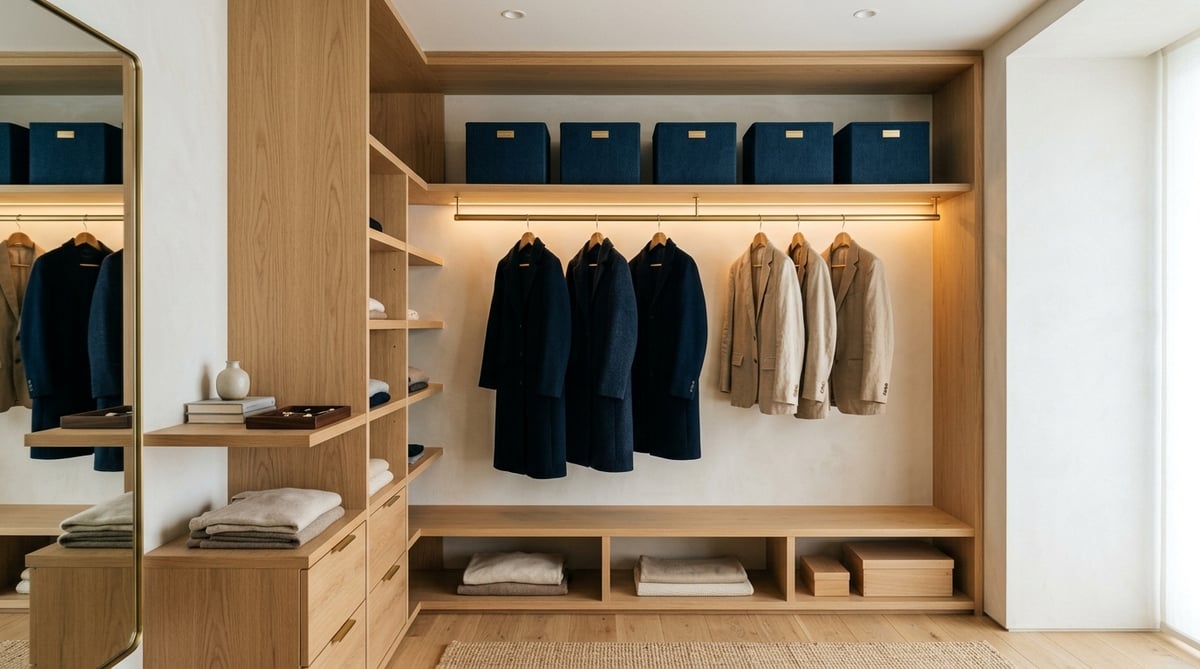
Utilizing the space as a walk-in dressing suite and high-capacity storage hub provides immense functional value. Hanging fine designer garments, suits, leather jackets, and bespoke shoes inside sunlit bedrooms frequently causes fabric fading and material degradation from ultraviolet exposure.
Shielded from sunlight, a service room protects fine textiles, luxury leather bags, and valuable book collections. Installing modular open clothing racks, solid hardwood dressers, a full-length vanity mirror, and an upholstered accent bench turns the room into a personal boutique. Centralizing bulky luggage, winter outerwear, and sporting equipment here frees your primary living room and bedroom from clutter, cultivating a serene, minimalist aesthetic.
Setup ④: Private Studio for Audio, Video Editing, Streaming, and Hobbies
For content creators, podcast hosts, musicians (practicing digital piano or guitar), and gamers, an interior service room offers exceptional utility. Because the room is buffered from external facade walls, structural acoustic isolation naturally dampens outward sound transmission while blocking outdoor traffic noise.
Mounting acoustic absorption panels along key wall reflection points and setting up a multi-monitor display arm produces a focused creative hub. Because the room is isolated by a solid hinged door, you can record audio, edit video late into the night, or engage in gaming sessions without disturbing your partner or roommates.
| Lifestyle Setup | Recommended Floor Space | Mandatory Requirements | Optimized Layout & Traffic Flow |
|---|---|---|---|
| Remote Work Office | 4.5 to 6.0 tatami mats (7.5–10㎡) | Air conditioning, 20A circuit, wired LAN / mesh Wi-Fi | 120–140cm desk, rear ambient lighting, wall-mounted shelving |
| Private Bedroom | 5.0 to 6.5 tatami mats (8.2–10.7㎡) | Air conditioning, 24-hr ventilation grill, solid privacy door | Semi-double/double bed, nightstand, soft baseboard lighting |
| Dressing Suite & Storage | 3.5 to 5.0 tatami mats (5.8–8.2㎡) | Continuous mechanical airflow, dehumidifier outlet | Open modular clothing racks, vanity mirror, central dressing ottoman |
| Creative Studio | 4.5 to 6.0 tatami mats (7.5–10㎡) | Air conditioning, surge-protected power, sound absorption | L-shaped workstation, monitor arms, acoustic felt wall paneling |
The Practical On-Site Viewing Checklist for 2SLDK Apartments
No matter how appealing a printed layout appears, the true livability of an apartment can only be judged on-site. Visiting properties during twilight when neighborhood illumination comes alive provides genuine clarity on acoustic comfort and lighting balance. Use this checklist on your smartphone during physical apartment viewings.
Entryway Traffic Flow, Noise Transmission, and Personal Privacy
Pay close attention to visual sightlines and footpaths from the moment the front entrance (genkan) door opens. When a service room sits directly adjacent to the main entrance, footsteps from arriving family members or package couriers will transmit directly into the room. If planning to use it as a bedroom or private office, test the acoustic insulation by closing the bedroom door while your agent walks through the corridor.
Consider whether the service room connects directly to the central living room or accesses the main hallway independently. If two people work remotely from home simultaneously, independent hallway access ensures that one partner can host client meetings in the living room while the other works quietly in the service room without mutual distraction.
Natural vs Artificial Lighting, Ceiling Fixture Mounts, and Power Placements
Lighting perceptions shift dramatically depending on the time of day. If viewing during daylight hours, turn off interior lights to assess baseline natural brightness. If the room looks out into a light well or common corridor, privacy louvers or frosted privacy glass are often installed, which changes the balance between natural light and external visibility.
Examine the ceiling lighting bracket (hooking rosette / sealing bracket) and power outlet coordinates. If outlets are positioned on the opposite wall from where you plan to place your desk or bed, extension cords will run across walkways, creating clutter and tripping hazards. Checking for three-prong grounded outlets is especially important if setting up premium desktop computer workstations.
Mobile Cellular Carrier Reception (4G/5G) and Wi-Fi Signal Integrity
Inside heavy reinforced concrete buildings in Tokyo, cellular frequencies (4G/5G) can occasionally experience signal degradation in interior rooms. Step into the service room, close the door completely, and verify that your phone maintains robust carrier signal bars while loading heavy web pages smoothly.
While Japanese telecom carriers provide complimentary indoor femtocell booster antennas and Wi-Fi calling features upon request, testing real-time cellular strength beforehand ensures you avoid connectivity surprises immediately after moving in.
| Inspection Category | Specific On-Site Check Item | Acceptance Criteria & Pass Benchmark |
|---|---|---|
| Climate Control | Dedicated high-voltage AC outlet and concealed pre-piping | Must feature high-mounted dedicated 20A socket and piping sleeve |
| Airflow & Ventilation | 24-hour mechanical ventilation grill suction and door clearance | A tissue paper held to the ceiling grill should hold in place by suction |
| Power & Network | Outlet count, positioning, and smartphone signal strength | At least two duplex sockets in usable locations; 3+ cellular signal bars |
| Acoustic Isolation | Acoustic dampening from hallway and living room with door closed | Conversation and corridor footfalls muffled to negligible background levels |
| Lighting Infrastructure | Ceiling bracket standard (rosette) and task illumination | Standard Japanese ceiling mount present; supports dimmable fixtures |
Define Your Needs
Clarify the primary use of the service room (office, bedroom, storage)
Check via LINE
Send portal URLs to our LINE concierge to pre-verify AC piping records
On-Site Inspection
Meet directly on-site to inspect AC circuits, signal strength, and noise levels
Fair Sign & Lease
Save on brokerage fees, navigate screening, and sign via online IT explanation
Making the Final Choice Between 3LDK and 2SLDK with Sorai Tokyo
There is no single correct answer when selecting a home. Choosing a sun-drenched 3LDK where daylight fills every room is an investment in vitality and expansive luxury. Alternatively, selecting a 2SLDK to prudently manage fixed housing costs and reinvesting your savings into unforgettable family experiences and future security is an equally rewarding lifestyle decision.
Adapting to Life Stage Transitions and Family Evolution
For couples expecting children or raising infants and toddlers, the absolute requirement for sunlit private study bedrooms lies years down the road. During early childhood and primary school years, children in Japan overwhelmingly study in central living areas alongside their parents rather than spending prolonged periods secluded in bedrooms.
Leasing a 2SLDK during these formative years to minimize housing costs while accumulating savings creates an exceptionally sound relocation strategy. When children eventually reach junior high school and require dedicated study environments, you can transition smoothly to a larger property. Unlike the rigid commitments of a 35-year mortgage, the flexibility of leasing in Tokyo allows you to adapt seamlessly to life's changing chapters.
Financial Breathing Room and Reinvesting in Tokyo Life
Saving 50,000 to 80,000 yen each month unlocks 600,000 to 960,000 yen annually in net disposable income—surpassing 1,800,000 yen over three years. This financial freedom empowers you to savor weekend brunches at your favorite neighborhood bistros, embark on seasonal trips across Japan, or invest comfortably in wellness, fitness, and language development without guilt.
True luxury in Tokyo living is not measured purely by square meters. Freedom from the anxiety of inflated rental payments brings a deep sense of calm, elevating your everyday appreciation of life in Japan.
Objective Listing Second Opinions and Free LINE Concierge Support
At Sorai Tokyo, we assist international residents, expatriates, and multicultural families in navigating central Tokyo's rental market with complete confidence. Whenever you find an appealing listing on portals like SUUMO or LIFULL HOME'S, simply send the property link to our official LINE account (@soraitokyo / https://line.me/R/ti/p/@soraitokyo). Our licensed Japanese real estate brokers cross-reference official B2B industry databases (REINS) to verify true live availability, provide transparent second opinions on move-in quotes to remove inflated optional fees, and verify air conditioner pre-piping—entirely online and completely free of charge.
With Sorai Tokyo, there are zero pushy sales calls, no store visits required, and no Japanese phone number needed. Furthermore, you can freely access our suite of smart SorAi web tools—including our Move-in Cost Simulator, Property Inspection Reports, and Visa/Guarantor Screening Consultation—directly from the bottom navigation on mobile or the footer on desktop. We are here to ensure your Tokyo home search is transparent, effortless, and financially sound.
QIs it legally permissible to use a service room or storage room as a bedroom or child's room?
AYes, absolutely. Under Japanese law, tenants enjoy complete legal freedom regarding how they designate and furnish internal rooms. Using a service room as a master bedroom, child's nursery, or home office does not violate any housing regulations or lease terms. Daylighting benchmarks under the Building Standards Act govern architectural design approval and commercial advertising; they do not dictate private lifestyle usage. As long as air conditioning and mechanical ventilation are present, it functions perfectly as a comfortable bedroom.
QIf a service room lacks air conditioner piping, how can I manage summer heat and winter cold?
AWithout concealed pre-piping or exterior sleeves, installing a standard wall-mounted split-system air conditioner is impossible. In this situation, the most practical solution is running the air conditioner in the adjacent living room or bedroom while using an electric air circulator fan placed at the door threshold to direct conditioned air inward. While portable spot air conditioners with exhaust ducts are an option if a window or corridor vent is accessible, compressor operating noise and condensate water tank drainage can be cumbersome. We strongly recommend selecting properties with pre-verified AC installation capabilities.
QDoes renting a 2SLDK increase move-out restoration costs or cleaning fees in Japan?
ANo. The presence of a service room has no bearing on move-out restoration (genjo kaifuku) costs. Under the Ministry of Land, Infrastructure, Transport and Tourism (MLIT) Restoration Guidelines, standard wear-and-tear and natural depreciation are covered by monthly rent. However, if unventilated ultrasonic humidifiers cause mold growth on wallpaper, or if leaking AC condensate water damages flooring due to negligence, tenants can be held liable. Maintaining proper ventilation and regular cleaning ensures a smooth, dispute-free move-out.
![[H2 2026] Lucky Daian Moving Calendar: Moving Costs by Rokuyo & 3 Steps to Save Big](https://soraitokyo.jp/hs-fs/hubfs/blog-eyecatches/batch3_realistic_genkan.jpg?width=400&height=225&name=batch3_realistic_genkan.jpg)

Author: Sorai Tokyo Editorial Team (Supervised by Licensed Real Estate Agents)
A real estate consulting team specializing in assisting foreign nationals find rooms and explaining initial costs in Tokyo. We break down language barriers and differences in customs, offering dedicated support in Japanese, English, and Vietnamese for a safe and secure start to your new life.