
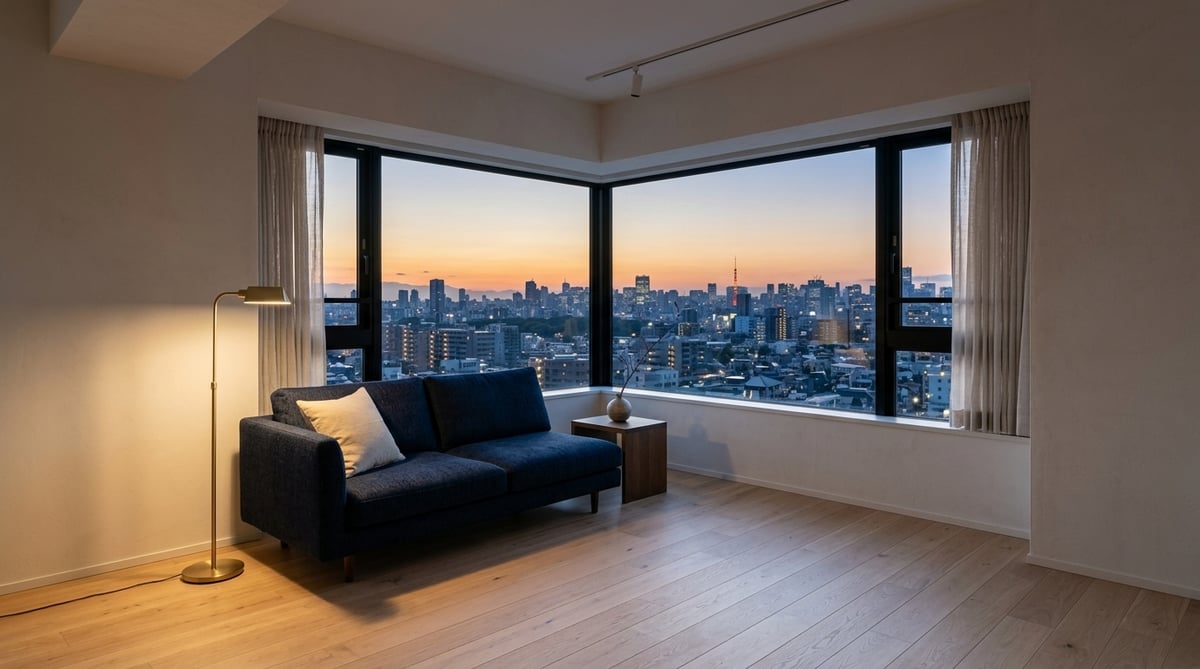
On a weekday evening, stepping just one block north of Yasukuni-dori into the grounds of Waterras, the sharp footsteps of the business district soften, replaced by a gentle breeze drifting through manicured greenery. Walking through this neighborhood during property viewings, many prospective residents are genuinely surprised to discover that despite being at the core of central Tokyo—just one station and roughly 2 minutes from Otemachi Station, or about 4 minutes direct to Tokyo Station—Awajicho Station maintains median rents of ¥132,000 for a 1K and ¥224,000 for a 1LDK. This represents a substantial reduction compared to its immediate southern neighbor, Otemachi Station (1K ¥162,000 / 1LDK ¥284,000).
At the same time, before finalizing a lease, many people pause to weigh practical concerns: "Will this commercial district lined with office buildings become deserted and eerily quiet at night and on weekends?" "Can I easily handle daily home cooking and fresh grocery shopping beyond convenience stores?" "Being close to the Kanda River basin, how should I evaluate heavy rain and urban flooding hazards?" These are essential, realistic questions that accompany urban living in central Tokyo.
Connected via underground pedestrian corridors to Shin-Ochanomizu Station on the Chiyoda Line and Ogawamachi Station on the Toei Shinjuku Line, and with JR Kanda and Akihabara stations comfortably within walking distance, Awajicho serves as a major transit hub. Yet, stepping onto side streets immediately reveals quiet, established residential pockets. Below, we systematically review the balance between rent budgets and commute times, the distinctions between nearby stations, and essential on-site checkpoints for evaluating buildings.
- Median rent is ¥132,000 for a 1K and ¥224,000 for a 1LDK—saving roughly ¥60,000 per month on a 1LDK compared to adjacent Otemachi Station.
- In addition to the Marunouchi Line, underground concourses provide direct, seamless access to the Chiyoda Line (Shin-Ochanomizu Station) and Toei Shinjuku Line (Ogawamachi Station).
- From Exit A5, residents can easily access the basement Olympic supermarket at Waterras Mall and Seijo Ishii at Ochanomizu Sola City without worrying about rainy weather.
Three Connected Underground Lines and How Station Exits Shape Morning Routines
The primary advantage of living near Awajicho Station is that it is not merely an isolated single-line stop, but part of an interconnected three-line subterranean network. Marunouchi Line Awajicho Station connects outside the ticket gates via underground passageways to Ogawamachi Station on the Toei Shinjuku Line and Shin-Ochanomizu Station on the Tokyo Metro Chiyoda Line. This allows commuters to select the optimal line depending on their destination or real-time train operations.
| Key Destination | Line Used (Boarding Station) | Est. Travel Time | Transfers | Commute & Practical Notes |
|---|---|---|---|---|
| Otemachi Station | Marunouchi Line (Awajicho) / Chiyoda Line (Shin-Ochanomizu) | Approx. 2 mins | 0 | Parallel running lines make alternative routing simple during delays. Also walkable within roughly 15 minutes. |
| Tokyo Station | Marunouchi Line (Awajicho) | Approx. 4 mins | 0 | Offers effortless access for Shinkansen travel and commutes to the Marunouchi and Yaesu business corridors. |
| Kasumigaseki Station | Chiyoda Line (Shin-Ochanomizu) / Marunouchi Line (Awajicho) | Approx. 6 mins (Chiyoda Line) | 0 | Direct connection to government ministries and Toranomon; roughly 10 minutes via the Marunouchi Line. |
| Ginza Station | Marunouchi Line (Awajicho) | Approx. 7 mins | 0 | Quick access makes evening dining, shopping, and returning home late hassle-free. |
| Shinjuku Station | Toei Shinjuku Line (Ogawamachi) / Marunouchi Line (Awajicho) | Approx. 11 mins (Shinjuku Line) | 0 | Marunouchi Line loops south taking approx. 19 minutes; using Ogawamachi Station saves time on busy mornings. |
| Ikebukuro Station | Marunouchi Line (Awajicho) | Approx. 14 mins | 0 | Direct ride to Ikebukuro and the northern hubs via Ochanomizu and Korakuen without transferring. |
| Omotesando Station | Chiyoda Line (Shin-Ochanomizu) | Approx. 14 mins | 0 | Direct, rapid commute to the Akasaka, Nogizaka, and Minami-Aoyama fashion districts. |
How Ogawamachi and Shin-Ochanomizu Stations Balance the U-Shaped Marunouchi Line
Looking at a route map, the Marunouchi Line traces a distinctive U-shape, running south from Ikebukuro through Ochanomizu and Awajicho to Tokyo, Ginza, and Akasaka-mitsuke, before curling back northwest toward Yotsuya and Shinjuku. As a result, boarding the Marunouchi Line from Awajicho directly to Shinjuku requires traveling around Tokyo and Ginza, taking roughly 19 minutes. This is where neighboring Ogawamachi Station on the Toei Shinjuku Line becomes invaluable. Running straight west beneath Yasukuni-dori, the Toei Shinjuku Line carries you through Ichigaya and Shinjuku-sanchome to Shinjuku Station in just about 11 minutes.
For those commuting to Akasaka, Omotesando, or Yoyogi-uehara, Shin-Ochanomizu Station on the Chiyoda Line serves as your primary daily connection via the underground walkway. To gain deeper insight into residential environments and price differences along that route, our Chiyoda Line Area Guide offers a helpful comparison between central wards and the Bunkyo or eastern areas. One practical detail to keep in mind: while transferring between Awajicho and Ogawamachi is quite brief on the B1 level, Shin-Ochanomizu's platform sits deep underneath the Surugadai hill. Allowing an extra 5 to 7 minutes for the underground walk ensures a stress-free morning routine.
Platform Layout and the Separate Elevator Access Between Exits A1 to A7
Awajicho Station features a standard two-track, two-side-platform layout located beneath Yasukuni-dori. On the B1 concourse, there are two distinct gate clusters: the Ogawamachi-side gates on the west and the Sudacho-side gates on the east. Although an underground cross-platform passageway exists inside the ticket gates, it requires climbing stairs up and down. If carrying heavy luggage or traveling with a stroller, choosing the specific street exit matching your platform direction from the start is much more convenient.
During on-site viewings, we make it a point to clearly explain the split elevator layouts. The station has seven official exits (A1 through A7). However, the street-level elevator serving Platform 1 (southbound toward Tokyo, Ginza, Shinjuku, and Ogikubo) is located at Exit A2 on the south side of Yasukuni-dori (near Kanda Sakura-kan and Chiyoda Elementary School). Conversely, the street-level elevator serving Platform 2 (northbound toward Ochanomizu, Korakuen, and Ikebukuro) is located on the north side at Exit A5 (near Waterras Mall and Ochanomizu Sola City).
If you frequently commute with rolling suitcases toward Tokyo Station or push a stroller, being able to reach the correct elevator exit without needing to cross the broad, multi-lane crossings of Yasukuni-dori or Chuo-dori makes a notable difference on rainy days. When evaluating an apartment, consider walking the multi-level path to the specific platform you will rely on most, rather than relying solely on flat station distance figures.
Simply enter the rent and deposit from portal listings to calculate a full, itemized breakdown including brokerage and guarantor fees without hidden add-ons.
Awajicho Rent Rates vs. Surrounding Stations: Otemachi, Ochanomizu, and JR Kanda
Despite carrying a prestigious Chiyoda Ward address, Awajicho presents a very balanced rent profile when contrasted with adjacent Marunouchi Line stations and nearby JR hubs. Shin-Ochanomizu Station shares identical baseline pricing, while moving just one stop north or south—or walking toward the JR tracks—shifts the neighborhood character and monthly living costs considerably.
| Station (Ward / Primary Lines) | Est. Rent per m² | Studio (1R) | 1K | 1DK | 1LDK | 2LDK |
|---|---|---|---|---|---|---|
| Awajicho Station (Chiyoda Ward / Marunouchi Line) | ¥5,000 / m² | ¥98,000 | ¥132,000 | ¥163,000 | ¥224,000 | ¥323,000 |
| Shin-Ochanomizu Station (Chiyoda Ward / Chiyoda Line) | ¥5,000 / m² | ¥98,000 | ¥132,000 | ¥163,000 | ¥224,000 | ¥323,000 |
| Otemachi Station (Chiyoda Ward / Marunouchi Line, etc.) | ¥5,800 / m² | ¥120,000 | ¥162,000 | ¥200,000 | ¥284,000 | ¥418,000 |
| Ochanomizu Station (Bunkyo Ward / Marunouchi Line, JR) | ¥5,000 / m² | ¥98,000 | ¥132,000 | ¥163,000 | ¥224,000 | ¥323,000 |
| Kanda Station (Chiyoda Ward / JR Lines, Ginza Line) | ¥5,100 / m² | ¥101,000 | ¥136,000 | ¥167,000 | ¥233,000 | ¥338,000 |
| Hongo-sanchome Station (Bunkyo Ward / Marunouchi Line, Oedo Line) | ¥4,700 / m² | ¥90,000 | ¥122,000 | ¥150,000 | ¥207,000 | ¥298,000 |
Marunouchi Line Comparison: The ¥60,000 Gap with Otemachi vs. Ochanomizu and Hongo-sanchome
While Otemachi Station is only 2 minutes away by subway (or a pleasant 15-minute walk), comparing median rents reveals a gap of ¥30,000 per month for a 1K, ¥60,000 for a 1LDK, and ¥95,000 for a 2LDK. Because Otemachi and Marunouchi represent Japan's preeminent financial district, the overall inventory of rental apartments there is very limited, and available units lean heavily toward luxury high-rises with 24-hour concierge services. In contrast, the neighborhood surrounding Awajicho (including Kanda-Tsukasacho, Kanda-Awajicho, and Kanda-Sudacho) hosts numerous practical, high-spec condominium-grade rentals ranging between 25 and 45 m². This makes it feasible to live within walking or cycling distance of Marunouchi while keeping monthly fixed costs realistic.
Looking northward, Ochanomizu Station shares practically the same rental averages across all layouts. While direct Marunouchi Line access to Tokyo and Ikebukuro is identical, the daily ambiance is quite different. The plateau around Ochanomizu Station is occupied by university campuses, major university hospitals, musical instrument shops, and historic bookstores, resulting in lively daytime foot traffic driven by students and medical visitors. Awajicho, situated on flatter terrain, features a calmer, adult urban pace where residents can utilize three underground lines and step directly into supermarkets like Olympic at Waterras. If your goal is to lower your monthly budget further—targeting a 1LDK around ¥200,000 within a quiet Bunkyo Ward residential atmosphere—expanding your search one more stop north to Hongo-sanchome opens up attractive low-rise options.
Walking 7 to 8 Minutes to JR Kanda Station: Entertainment Bustle vs. Orderly Streets
Walking south along Chuo-dori from Exit A1 or the Sudacho intersection, you reach Kanda Station—servicing the JR Yamanote, Chuo, and Keihin-Tohoku Lines, as well as the Tokyo Metro Ginza Line—in just 7 to 8 minutes. Given this proximity, international residents often wonder whether renting closer to Kanda makes more sense. Rental prices at Kanda are only slightly higher—about ¥4,000 more for a 1K and ¥9,000 more for a 1LDK—placing both stations within the same practical budget tier.
However, walking home after 9:00 PM reveals a sharp contrast in lifestyle. The streets beneath the JR elevated tracks and around Kanda's West Exit are packed with bustling izakayas, bars, and casual eateries catering to corporate workers, illuminated by bright neon late into the night. While this offers abundant casual dining choices and unmatched direct access to Shibuya, Shinagawa, and Tokyo via the Yamanote Line, it can feel overly lively for those who prioritize tranquility at home. By comparison, the Awajicho neighborhood—particularly Kanda-Awajicho 2-chome around Waterras and Kanda-Tsukasacho 2-chome behind Exit A2—calms down gracefully after office hours, allowing for a quiet, well-lit walk back to your residence.
Awajicho Station: Ideal For
- ✓ Using the Marunouchi, Chiyoda, and Shinjuku subway lines seamlessly regardless of weather
- ✓ Regular home cooking supported by supermarkets at Waterras and Sola City
- ✓ Peaceful nights and quiet weekends away from crowded entertainment quarters
JR Kanda Station: Ideal For
- ✓ Relying on the Yamanote, Chuo, and Keihin-Tohoku lines for citywide or bullet train travel
- ✓ Relying primarily on casual neighborhood restaurants and late-night teishoku spots
- ✓ Bright, bustling station exits with plenty of pedestrian activity late at night
Furthermore, choosing a home on the northeastern side of the Awajicho district (such as Kanda-Sudacho 2-chome or eastern Kanda-Awajicho 2-chome) puts JR Akihabara Station (1K ¥132,000 / 1LDK ¥224,000) within an 8- to 10-minute walk across the historic Manseibashi bridge from Exit A3. Commuting via the Marunouchi and Chiyoda lines during the week while strolling over to Akihabara or Kanda on weekends for electronics and retail illustrates how easily multiple distinct districts blend into one seamless living experience here.
Grocery Shopping and Atmosphere: Maintaining Daily Home Routines in Central Tokyo
When searching for a home in Chiyoda Ward's commercial neighborhoods, prospective residents frequently ask whether fresh produce, meat, and everyday groceries are readily available after work. While the historic Kanda area once centered primarily on small merchant shops and convenience stores, the modern developments of Waterras and Ochanomizu Sola City have substantially elevated grocery convenience around Awajicho Station.
| Store Name | Location & Station Access | Business Hours | Selection & Daily Practical Use |
|---|---|---|---|
| Olympic Supermarket (Awajicho) | Waterras Mall B1F (Direct underground access via Exit A5) | 9:00 AM – 9:00 PM | Primary full-line station supermarket carrying fresh vegetables, meats, seafood, and household essentials. |
| Seijo Ishii (Ochanomizu Sola City) | Ochanomizu Sola City B1F (Direct underground concourse) | Weekdays: 7:30 AM – 11:00 PM Weekends & Holidays: 9:00 AM – 9:00 PM |
Specializes in prepared deli items, imported goods, cheeses, and wine; open until 11:00 PM on weekdays. |
| Maruetsu Petit (Kanda-Tsukasacho) | Kanda-Tsukasacho 2-chome, Chiyoda Ward | 7:00 AM – 11:00 PM | Compact urban supermarket nestled in the residential pocket, ideal for early mornings and late returns. |
| Gyomu Super (Kanda) | Kanda-Tacho 2-chome, Chiyoda Ward | 9:00 AM – 8:00 PM | Excellent for bulk staples, frozen ingredients, seasonings, and beverages to keep living expenses economical. |
Underground Supermarket Access via Exit A5 and Late-Night Options
The anchor of everyday home cooking is Olympic Supermarket Awajicho, located on basement level 1 of Waterras Mall. By taking the direct underground concourse on the Exit A5 side, residents can walk from the ticket gates directly into the store without carrying an umbrella, even during torrential summer downpours. Stocking fresh produce, poultry, beef, fish, and daily toiletries in one spot, Olympic provides the comprehensive selection typical of suburban grocery stores right in the center of Tokyo.
Because Olympic closes at 9:00 PM, having alternatives for late-night returns is essential. Two reliable options remain open until 11:00 PM on weekdays: Seijo Ishii Ochanomizu Sola City (connected underground) and Maruetsu Petit Kanda-Tsukasacho (located southwest of Yasukuni-dori). Working professionals returning late can pick up high-quality prepared meals at Seijo Ishii, or grab breakfast essentials, dairy, and sliced vegetables at Maruetsu Petit. In addition, for stocking up on frozen vegetables, pasta, and pantry goods over the weekend, Gyomu Super Kanda in Kanda-Tacho provides an economical resource that effectively controls grocery expenses.
Weekday Lunch Energy vs. Quiet Weekend Serenity
Living in Awajicho reveals an extraordinary contrast between weekdays and weekends. From Monday through Friday around noon, streets fill with office professionals. The Kanda Renjakucho shopping street near Exit A7, the historic alleys of Kanda-Sudacho, and the modern plaza of Waterras brim with activity, from long-standing soba and Western-style restaurants to specialized curry houses and boutique cafes. Stepping out during remote work hours to enjoy lunch at an establishment that has operated for over a century is one of the distinct privileges of living in this quarter.
Conversely, from Saturday afternoon through Sunday, office lights go dark, vehicle traffic along Yasukuni-dori and Sotobori-dori thins dramatically, and a tranquil calm settles over the neighborhood. Because Awajicho does not feature sprawling fashion malls or movie theaters, those who prefer high-energy retail immediately outside their doorstep might find the weekends subdued. However, for residents who cherish quiet weekend mornings—reading with freshly brewed coffee on the Waterras plaza, browsing the historic second-hand bookshops of Jimbocho near Exit A6, or taking a peaceful jog toward the Imperial Palace and Marunouchi Naka-dori—this serene atmosphere offers restorative living.
Topography, Flood Hazards, and Commercial Zoning: Key Checkpoints During Viewings
Rather than evaluating a property solely on floor plans and interior decor, assessing its architectural safeguards in relation to historical topography and municipal zoning rules ensures peace of mind after moving in. Because elevation and hazard classifications shift noticeably across Awajicho, both the building's ground-floor structure and window exposures deserve scrutiny.
Lowland Elevations (4–5m), the Slope to Surugadai, and Reading the Hazard Maps
Geographically, the area comprising Kanda-Awajicho, Kanda-Sudacho, Kanda-Tsukasacho, and Kanda-Ogawamachi is largely flat, situated on sandy bars and lowlands at elevations of roughly 4 to 5 meters above sea level. This flat terrain makes walking and cycling effortless. However, heading northwest toward Ochanomizu and Kanda-Surugadai, the ground rises sharply toward the Hongo plateau (elevations of 15 to 20 meters). Historic slopes such as Awajizaka beside Waterras, and Kobai-zaka or Yurei-zaka near Sola City, mean that selecting an apartment with a Surugadai address requires navigating noticeable inclines on daily commutes.
Flood preparedness is equally important to examine objectively. While certain micro-elevations along Yasukuni-dori fall outside official inundation zones, the Kanda River flows just to the north. Under the Chiyoda Ward Flood Hazard Map (Kanda River Edition, modeling maximum anticipated precipitation), river overflows and storm drain backflow could result in projected flood depths of 0.5 to 1.0 meter (and localized pockets between 1.0 and 3.0 meters).
Consequently, when renting in this area, selecting an apartment on the second floor or above is a standard guideline. In addition, verify on-site whether the building entrance features flood barrier plates (waterproof barriers) and whether critical electrical sub-station rooms (which power elevators and water pumps) are positioned on elevated ground floors rather than deep in the basement.
Commercial Zoning Realities: Acoustic Environments and Future Sunlight Protection
Under Tokyo's urban planning regulations, the entire Awajicho station area—including secondary backstreets—is designated as a "Commercial Zone." Because high floor-area ratios are permitted, medium-to-high-rise office buildings and residential towers stand in close proximity. This creates substantial variance in sunlight and sound insulation between individual units.
During your viewing, evaluate ambient noise with the windows both closed and slightly open. Buildings facing major thoroughfares such as Yasukuni-dori (Exits A1, A2, A4), Chuo-dori (Sudacho intersection to Exit A3), or Sotobori-dori experience nighttime delivery trucks and emergency vehicle traffic. The presence of double-glazed windows or high sound-transmission loss ratings (such as T-2 or T-3 acoustic sashes) significantly impacts sleep quality. If you prioritize absolute quiet, units set back one block inside Kanda-Tsukasacho 2-chome, Kanda-Tacho 2-chome, or inner Kanda-Awajicho 2-chome provide unexpectedly peaceful interiors.
A second critical factor in commercial zones is the condition of neighboring plots facing your balcony. Unlike low-rise residential zones with strict height and setback limits, open views currently looking over coin parking lots or older two-story office buildings could eventually be replaced by taller structures. To safeguard long-term natural light and privacy, prioritize apartments facing broad public roadways, corner layouts fronting intersections, or units overlooking permanently protected public open spaces such as the Waterras complex.
When to Consider Other Neighborhoods vs. Who Thrives in Awajicho
While Awajicho strikes an exceptional balance between transit efficiency and rent value, it is not suitable for every lifestyle. Examining your personal priorities helps clarify whether another district might offer a more comfortable fit.
Three Scenarios Where Alternative Neighborhoods May Be More Fulfilling
First, if expansive park greenery, low-rise residential streets, and large open lawns are your highest priorities. Awajicho is situated entirely within a high-density commercial district dominated by corporate buildings and mid-to-high-rise residences; there are no sprawling public parks in the immediate vicinity. If the quiet, empty feel of an office district on weekends feels lonely, or if you seek tree-lined residential paths for raising children, looking a few stops north along the Marunouchi Line into Bunkyo Ward—such as Hongo-sanchome (median 1LDK ¥207,000) or Myogadani (median 1LDK ¥194,000)—will align better with your vision of home.
Second, if you wish to eliminate all flood vulnerability by residing strictly on elevated, firm bedrock plateaus. Because Awajicho sits on low-lying ground at an elevation of 4 to 5 meters, those uncomfortable with any flood hazard designation may experience lingering anxiety. If high elevation is a non-negotiable requirement, focus your search on the uphill Surugadai address, or consider high-ground neighborhoods along the directly connected Chiyoda Line, such as Yushima (median 1LDK ¥200,000) or Sendagi (median 1LDK ¥186,000) on the Hongo Loam plateau.
Third, if you regularly travel with strollers or wheelchairs and frequently alternate between northbound and southbound Marunouchi trains. As noted earlier, Awajicho Station separates its street elevators by platform direction: Exit A2 for Platform 1 (Ogikubo-bound) and Exit A5 for Platform 2 (Ikebukuro-bound), located on opposite sides of Yasukuni-dori. While predictable single-direction daily commutes present no issue, families frequently boarding in both directions with strollers may find it simpler to use Shin-Ochanomizu Station (which features a single island platform with elevator access to both directions) or neighboring stations with simpler layouts.
Lifestyles That Naturally Match Awajicho
Conversely, for single professionals, expat workers, and dual-income couples seeking to keep commutes to Otemachi, Tokyo, Kasumigaseki, Ginza, or Shinjuku under 15 minutes while securing extra personal time in the mornings and evenings, Awajicho is an outstanding choice.
For example, compared to renting in Otemachi or Akasaka (both averaging ¥284,000 for a 1LDK), choosing Awajicho (¥224,000 for a 1LDK) saves approximately ¥60,000 per month, or ¥720,000 annually. This savings can be directed toward a more spacious floor plan, higher floor levels, or superior soundproofing in a condominium-grade residence. On weekdays, you can pick up fresh ingredients at Waterras or Sola City via Exit A5 for dinner; on weekends, you can take tranquil walks to Marunouchi or Jimbocho along peaceful streets. For those desiring an organized, sophisticated lifestyle in central Tokyo, Awajicho delivers unmatched efficiency and understated calm.
Awajicho Station Living Summary: Navigating Central Tokyo at Your Own Pace
Awajicho Station on the Tokyo Metro Marunouchi Line seamlessly links underground to Shin-Ochanomizu Station (Chiyoda Line) and Ogawamachi Station (Toei Shinjuku Line), while placing JR Kanda and Akihabara stations within easy walking distance. At the same time, it maintains reasonable median rents of ¥132,000 for a 1K and ¥224,000 for a 1LDK—far below adjacent central hubs.
Because the area balances functional commercial efficiency with the quiet residential comfort of Waterras and adjacent backstreets, finding the right property requires attentive on-site verification: observing the difference between weekday midday energy and weekend calm, assessing window soundproofing against traffic, and confirming flood barriers and utility positions relative to hazard maps.
If you are comparing multiple properties or have questions regarding building management, contract terms, or foreign resident screening, feel free to reach out to Sorai Tokyo. By sending any listing URL to our official LINE account (@soraitokyo / https://line.me/R/ti/p/@soraitokyo), our licensed real estate advisors will cross-reference the official real estate agent database (REINS) to verify real-time availability, audit initial move-in estimates, and offer transparent second opinions. International residents can take advantage of our 24/7 dedicated AI concierge on LINE, no Japanese phone number required, zero sales calls, no obligatory office visits, transparent fee audits, and support for visa screening and non-guarantor rental options. Feel free to explore our smart tools anytime at your own pace.
Frequently Asked Questions: Renting Near Awajicho Station
QHow long does it take to transfer to Shin-Ochanomizu and Ogawamachi stations, or walk to JR Kanda Station?
AOgawamachi Station on the Toei Shinjuku Line is adjacent on the B1 concourse outside the gates, taking roughly 2 to 3 minutes between ticket gates. Shin-Ochanomizu Station on the Chiyoda Line is also linked via underground corridors, but because its platform is situated deep beneath Surugadai, walking comfortably takes about 5 to 7 minutes. JR Kanda Station is a flat 7- to 8-minute walk directly south on surface streets.
QGiven its reputation as an office district, are there concerns about walking alone at night or buying weekend groceries?
AWhile office commuter traffic drops off after 9:00 PM, main sidewalks along Yasukuni-dori, Chuo-dori, and around Waterras are exceptionally well-lit with streetlamps and surveillance, without the disorderly touts found in heavy nightlife entertainment zones. For weekend groceries, Olympic Supermarket at Waterras Mall (9:00 AM – 9:00 PM), Seijo Ishii at Ochanomizu Sola City (open weekends 9:00 AM – 9:00 PM), and Maruetsu Petit Kanda-Tsukasacho (7:00 AM – 11:00 PM) operate reliably, making everyday home cooking completely seamless.
QAre there noticeable differences in living atmosphere across Kanda-Awajicho, Kanda-Tsukasacho, and Kanda-Sudacho?
AYes. Kanda-Awajicho 2-chome to the north is favored for its modern, manicured sidewalks and direct underground supermarket connections at Waterras and Sola City. To the southwest, Kanda-Tsukasacho 2-chome and Kanda-Tacho 2-chome offer quieter residential side streets with quality condominiums, convenient to Maruetsu Petit and Gyomu Super. Kanda-Sudacho to the east fronts Chuo-dori and Yasukuni-dori, providing an active urban setting with swift pedestrian access to both JR Kanda and Akihabara stations.
QWhat is the school and educational environment like for families and dual-income households?
AChiyoda Ward is known for modern integrated community school complexes that combine public elementary schools with kindergartens and daycare centers. Depending on exact street addresses, catchment areas include Chiyoda Elementary School (located within Kanda Sakura-kan near Exit A2), Shohei Elementary School toward Soto-Kanda, or Ochanomizu Elementary School near Surugadai and Ogawamachi. Additionally, Kudan Secondary School, a prestigious public combined junior and senior high school, is within the ward, making 2LDK and larger apartments attractive for families planning long-term education in central Tokyo.




Sorai Tokyo Co., Ltd. Editorial (Licensed Real Estate Agency #113297)
Licensed online real estate agency handling residential leasing across 15 major Tokyo lines (Member of All Japan Real Estate Association). Powered by our proprietary 24/7 AI "SorAi" on iOS/LINE and dedicated licensed realtors, we support renters end-to-end from vacancy checks on major portals to viewings and digital contracts.