
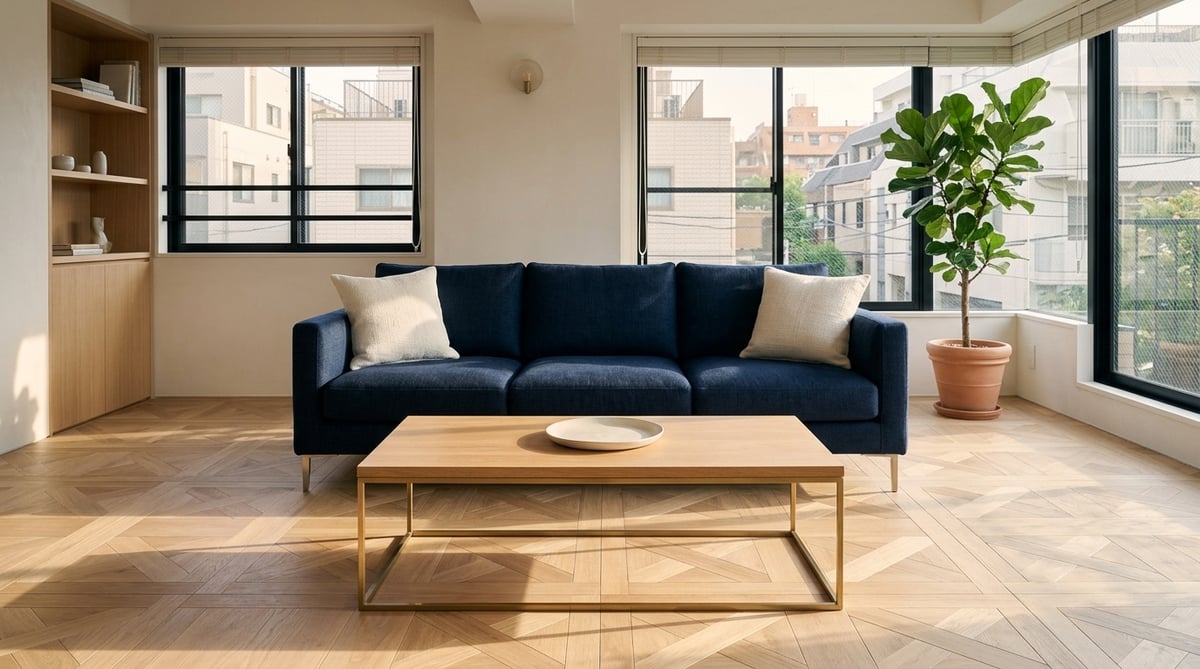
Turn south off Aoyama-dori (National Route 246) at the Minami-Aoyama 3-Chome intersection, and follow the tree-shaded street down toward the peaceful residential pockets of Minami-Aoyama 4-Chome. Within moments, the constant hum of city traffic fades away behind elegant mid-rise condominium facades. While walking this refined enclave during property viewings, international clients often step out onto a balcony, take in the expansive Tokyo sky, and voice the exact same dilemma.
"Even though it shares the prestigious Minami-Aoyama and Kita-Aoyama address in Minato Ward, Gaiemmae Station (median 1LDK: ¥263,000/month) is roughly ¥21,000 cheaper per month than neighboring Omotesando Station (¥284,000/month), and about ¥7,000 less than Aoyama-Itchome Station (¥270,000/month). But will life be inconvenient relying on only a single subway line like the Ginza Line? And without giant suburban supermarkets, where do people actually buy their daily groceries?" It is a pragmatic and understandable question for anyone relocating to Tokyo.
Furthermore, subtle nuances easily missed on floor plans—such as event crowds on game days at Meiji Jingu Stadium or Chichibunomiya Rugby Stadium, as well as the gentle slopes descending from the Aoyama-dori ridge toward Minami-Aoyama 4-Chome and Gaien-Nishi-dori (affectionately called Killer-dori)—profoundly influence day-to-day comfort. Balancing a tranquil Aoyama lifestyle and favorable rent against multi-line transit hubs and colossal shopping centers requires clear insights. Drawing upon verified on-the-ground real estate practice, here is everything you need to navigate apartment hunting in Gaiemmae with confidence.
- Median monthly rent is ¥151,000 for 1K, ¥263,000 for 1LDK, and ¥387,000 for 2LDK apartments. For 1LDK layouts, Gaiemmae is roughly ¥21,000/month lower than neighboring Omotesando and ¥7,000/month lower than Aoyama-Itchome.
- Direct access to Shibuya, Akasaka-Mitsuke, Ginza, and Nihombashi on the Tokyo Metro Ginza Line. Choose Omotesando or Aoyama-Itchome if multi-line flexibility is vital, or consider overlapping Nogizaka on the Chiyoda Line for direct commutes to Kasumigaseki and Otemachi.
- Daily groceries revolve around boutique and quality-focused markets such as Seijo Ishii Minami-Aoyama (open 24/7), Ville Marche Aoyama, and Bio c' Bon. Not recommended for households looking for mega discount supermarkets for bulk buying.
Gaiemmae Rent Market & Station Comparisons: Omotesando, Aoyama-Itchome, and Nogizaka
The standard benchmark rental rate per square meter around Gaiemmae Station is approximately ¥5,500/sqm. Within the prestigious Aoyama and Akasaka corridors of Minato Ward, this sits at a noticeably more accessible level than the multi-line interchange stations flanking it on either side. It enjoys steadfast popularity among single professionals, international expats, and dual-income couples seeking more living space for the same budget while anchoring their home in a calmer quarter of Aoyama.
Rent by Layout & Typical Property Characteristics Across Budget Tiers
Before launching your search, review the typical rental pricing across layouts within walking distance of Gaiemmae Station. The table below outlines median monthly rents alongside the core mid-market range (20th to 80th percentiles), intentionally excluding extreme luxury vintage residences and sub-compact micro-units to give you practical, actionable data.
| Layout | Median Rent | Core Range (P20–P80) | Typical Building Features & Location Trends |
|---|---|---|---|
| 1R (Studio) | ¥112,000 | P20: ¥96,000 – P80: ¥133,000 | Older condominium rentals and compact studio units primarily along Aoyama-dori and Gaien-Nishi-dori |
| 1K (1 Bed + Kitchen) | ¥151,000 | P20: ¥133,000 – P80: ¥170,000 | From the upper ¥150,000s, newer builds with separate washbasins, auto-locks, and quiet side-street settings become common |
| 1DK (1 Bed + Dining/Kit) | ¥186,000 | P20: ¥167,000 – P80: ¥212,000 | Spacious single units around 30 sqm. Ideal for remote workers needing separate desk space away from the sleeping area |
| 1LDK (1 Bed + Living/Dining) | ¥263,000 | P20: ¥232,000 – P80: ¥303,000 | Well-equipped mid-rise residences and designer apartments in Minami-Aoyama 2–4 Chome and Kita-Aoyama 2–3 Chome |
| 2LDK (2 Bed + Living/Dining) | ¥387,000 | P20: ¥332,000 – P80: ¥461,000 | Low- and mid-rise residential buildings in quiet residential zones like Minami-Aoyama 4-Chome. Perfect for couples and families |
P20–P80 represents the central 60% of real market asking rents, spanning the 20th to 80th percentiles.
If you are searching for a single-occupancy 1K apartment (median ¥151,000), options in the lower ¥130,000s tend to be older buildings directly fronting major thoroughfares, or units with compact single-burner kitchen layouts. If amenities such as an independent bathroom washbasin, a two-burner stove, and package delivery lockers are essential, setting your budget between the upper ¥150,000s and ¥170,000 will grant you access to peaceful apartments tucked away in Minami-Aoyama 2-Chome or Kita-Aoyama 2-Chome.
For couples or singles seeking extra breathing room in a 1LDK (median ¥263,000), listings start around ¥230,000. However, homes offering over 40 square meters of floor space, southern sun exposure, and walk-in closets predominantly cluster between ¥260,000 and ¥300,000+. When stepping up to a 2LDK (median ¥387,000), well-managed mid-rise and low-rise condominiums in the tranquil residential pockets of Minami-Aoyama 4-Chome enter your radar, providing an oasis of calm right in the heart of metropolitan Tokyo.
The Ginza Line Corridor: Rent Gaps vs. Transfer Convenience Across Neighboring Stations
Almost every house-hunter considering Gaiemmae evaluates it against its immediate neighbors on the Tokyo Metro Ginza Line: Omotesando to the west, Aoyama-Itchome to the east, and Akasaka-Mitsuke two stops away. As covered in our comprehensive Ginza Line Area Guide, all of these stations share direct, single-train access to Tokyo's prime commercial and financial epicenters: Shibuya, Akasaka-Mitsuke, Toranomon, Ginza, and Nihombashi. Consequently, your decision hinges on choosing between immediate multi-line interchange flexibility versus lower monthly rent and day-to-day neighborhood tranquility.
| Station (Ward) | Est. Price / m² | 1K Median (Range) | 1LDK Median (Range) | 2LDK Median (Range) | Transit Lines & Neighborhood Vibe |
|---|---|---|---|---|---|
| Gaiemmae (Minato) | ¥5,500 / m² | ¥151,000 P20: ¥133k – P80: ¥170k |
¥263,000 P20: ¥232k – P80: ¥303k |
¥387,000 P20: ¥332k – P80: ¥461k |
Ginza Line (standalone). Corporate offices blend with quiet residential enclaves and Meiji Jingu Gaien greenery |
| Omotesando (Minato) | ¥5,800 / m² | ¥162,000 P20: ¥143k – P80: ¥183k |
¥284,000 P20: ¥251k – P80: ¥328k |
¥418,000 P20: ¥358k – P80: ¥498k |
Ginza, Chiyoda, Hanzomon Lines. High luxury shopping density, vibrant with weekend shoppers and visitors |
| Aoyama-Itchome (Minato) | ¥5,600 / m² | ¥154,000 P20: ¥136k – P80: ¥173k |
¥270,000 P20: ¥239k – P80: ¥311k |
¥394,000 P20: ¥338k – P80: ¥469k |
Ginza, Hanzomon, Toei Oedo Lines. Stately office and residential district near the Akasaka Estate |
| Nogizaka (Minato) | ¥5,700 / m² | ¥159,000 P20: ¥141k – P80: ¥180k |
¥279,000 P20: ¥247k – P80: ¥322k |
¥411,000 P20: ¥352k – P80: ¥489k |
Chiyoda Line (standalone). Quiet residential setting overlapping Gaiemmae's neighborhood in Minami-Aoyama |
| Akasaka-Mitsuke (Minato) | ¥5,700 / m² | ¥159,000 P20: ¥141k – P80: ¥180k |
¥279,000 P20: ¥247k – P80: ¥322k |
¥411,000 P20: ¥352k – P80: ¥489k |
Ginza & Marunouchi Lines (5 lines via Nagata-cho connection). Lowland commercial hub with endless dining |
Comparing Gaiemmae to adjacent Omotesando reveals a median price difference of ¥21,000/month for a 1LDK and ¥31,000/month for a 2LDK. Over a standard two-year lease, this yields savings of roughly ¥500,000 to ¥740,000. That capital can be repurposed toward a newer building grade or a more generous floor plan. Omotesando Crossing is only about a 10-minute stroll along Aoyama-dori; you can effortlessly walk over to Omotesando for shopping on weekends, while keeping your home station at the less tourist-heavy Gaiemmae. This balanced lifestyle is precisely why Gaiemmae commands sustained loyalty.
Meanwhile, for residents who frequently take the Toei Oedo Line to Roppongi, Azabu-Juban, Shiodome, or Shinjuku, Aoyama-Itchome Station—which sits at just a ¥7,000/month premium for 1LDKs—makes a compelling case. Furthermore, if you rely heavily on the Marunouchi, Yurakucho, or Namboku lines to Tokyo Station or Shinjuku and prioritize an abundance of dining directly outside your doorstep, comparing the lively lowland commercial environment of Akasaka-Mitsuke will be well worth your time.
Alternative Line Comparison: Nogizaka (Chiyoda Line) & Commuting Dynamics
When viewing apartments across Minami-Aoyama 2-Chome near the Aoyama Cemetery, you will frequently come across listings marked "9-minute walk to Gaiemmae Station, 8-minute walk to Nogizaka Station." This prompts many to wonder: "If I am walking that far anyway, should I focus my search around Nogizaka Station instead?"
Nogizaka Station on the Tokyo Metro Chiyoda Line commands a median 1K rent of ¥159,000 and 1LDK of ¥279,000—roughly ¥8,000 to ¥16,000 higher per month than Gaiemmae despite also being a standalone station. The deciding factor is straightforward: which transit line aligns with your daily commute? For expats and professionals heading directly into government and corporate centers like Kasumigaseki, Hibiya, or Otemachi via the Chiyoda Line, living closer to Nogizaka offers an effortless morning routine.
Conversely, if your workplace sits along the Ginza Line (Shibuya, Toranomon, Shimbashi, Ginza, Kyobashi, or Nihombashi), or if you envision spending Saturday mornings jogging beneath the golden ginkgo trees of Meiji Jingu Gaien, centering your life around Gaiemmae is more cost-effective. Choosing an address around Minami-Aoyama 1-Chome or 2-Chome lets you enjoy the best of both worlds: jump on the Ginza Line for your daily commute, and walk over to Nogizaka Station whenever you need the Chiyoda Line.
Simply enter the rent and deposit from portal listings to calculate a full, itemized breakdown including brokerage and guarantor fees without hidden add-ons.
Ginza Line Transit Access & Station Navigation Guide
Some prospective tenants worry that living at a single-line station might mean tedious waits or frustrating transfers. However, the Ginza Line boasts one of the most frequent departure schedules in Tokyo's entire subway network, with trains arriving every few minutes even during mid-day hours. Being able to head down to the platform without checking a timetable provides true peace of mind on busy mornings and late evenings.
Direct Commutes to Shibuya, Akasaka-Mitsuke & Seamless Cross-Platform Transfers
When connecting to lines beyond the Ginza Line, the line's historic cross-platform transfer stations significantly offset any single-station drawbacks. Traveling one stop west to Omotesando, the Hanzomon Line (Shibuya / Den-en-toshi Line direction) departs directly across the same platform—enabling transfers to Shibuya or Futako-Tamagawa in just a few steps without stairs.
Similarly, traveling two stops east to Akasaka-Mitsuke allows you to step across the platform to board the Marunouchi Line bound for Tokyo Station, Otemachi, and Ikebukuro (trains heading toward Yotsuya and Shinjuku depart from a different level). Furthermore, Aoyama-Itchome connects smoothly to the Hanzomon Line and Toei Oedo Line, and Omotesando connects to the Chiyoda Line. You can effortlessly link into central Tokyo's rail network with a quick one- or two-stop hop.
Station Layout: Navigating the 2 Ticket Gates & Exits
Gaiemmae Station's platforms are located on the Basement 2 (B2) level in a two-track, dual side-platform arrangement. By using the B1 concourse, you can cross between the Shibuya-bound and Asakusa-bound platforms inside the ticket gates. If you inadvertently enter via an entrance on the opposite side of the street, you do not have to tap out or pay an additional fare to reach your train.
The ticket gates on the B1 level are split into two separate concourses—the Shibuya-side gate and the Asakusa-side gate. Choosing the right one matches your destination perfectly:
- Shibuya-Side Gates (near Car 1): Connects to Exits 1a & 1b on the south side of Aoyama-dori (ideal for Minami-Aoyama 3-Chome and Gaien-Nishi-dori / Killer-dori), as well as Exit 3 (heading north toward Meiji Jingu Stadium and Stadium-dori) and Exit 2 (for Chichibunomiya Rugby Stadium).
- Asakusa-Side Gates (near Car 6): Provides smooth access to Exit 4a (toward the Meiji Jingu Gaien Ginkgo Avenue and ITOCHU Tokyo Headquarters) and Exit 4b (directly connected into the Aoyama OM-SQUARE building). This gate is the most convenient when heading home toward Kita-Aoyama 1-Chome and 2-Chome.
If you are traveling with baby strollers or heavy luggage, we recommend checking the official Tokyo Metro station map in advance to confirm elevator locations and barrier-free routes.
Daily Shopping Environment & 4 Scenarios Where You Should Skip Gaiemmae
No matter how scenic an upscale neighborhood appears, if daily grocery shopping fails to match your lifestyle, friction will gradually build up. Gaiemmae features neither a suburban-style station roundabout nor a sprawling multi-story shopping mall. Instead, day-to-day life relies on boutique, urban supermarkets integrated into commercial building ground floors.
Mastering Daily Groceries: Seijo Ishii, Ville Marche, and Bio c' Bon
Here is an overview of verified supermarkets and pharmacies frequently used by Gaiemmae residents, complete with distances from station exits and operating hours.
| Store Name | Category | Location & Distance | Hours |
|---|---|---|---|
| Seijo Ishii Minami-Aoyama | Supermarket (Imported & Deli) | 2-27-25 Minami-Aoyama, Minato-ku (Hulic Minami-Aoyama 1F) (2 min walk from Exit 1a) |
Open 24 Hours |
| Ville Marche Aoyama | Supermarket (Fresh produce, meats, imported foods) |
2-13-5 Kita-Aoyama, Minato-ku (Aoyama Suncrest 1F) (3 min walk from station, close to Exits 3 & 1a) |
8:00 – 23:00 |
| Bio c' Bon Gaien-Nishi-dori | Organic Supermarket | 3-42-2 Jingumae, Shibuya-ku (6 min walk from station) |
9:00 – 21:00 |
| My Basket Aoyama-Itchome Sta. West | Compact Grocery | 2-2-15 Minami-Aoyama, Minato-ku (Win Aoyama 1F) (12 min walk from Gaiemmae / next to Aoyama-Itchome) |
7:00 – 23:00 |
| Sugi Pharmacy Minami-Aoyama | Drugstore & Prescription Dispensing | 3-1-3 Minami-Aoyama, Minato-ku (Spline Aoyama Tokyu 1F) (2 min walk from station / near Exit 1a) |
9:00 – 22:00 |
| Matsumoto Kiyoshi Minami-Aoyama | Drugstore & Cosmetics | 2-27-20 Minami-Aoyama, Minato-ku (3 min walk from station / near Exit 1a) |
9:00 – 22:00 |
Store hours and holiday schedules are subject to change. Please verify with official merchant notices before visiting.
The most dependable anchor for local life is Seijo Ishii Minami-Aoyama, located along Aoyama-dori right outside Exit 1a. Because it operates 24 hours a day, you can pick up artisanal prepared meals, artisan bread, fresh milk, and imported treats even when arriving home late after overtime work. On the other hand, if you want fresh vegetables, cut meats, and fish for everyday home cooking, Ville Marche Aoyama in Kita-Aoyama 2-Chome is your go-to destination. Open from 8:00 AM to 11:00 PM, it is only a 3-minute walk from Exit 3 or a quick hop across Aoyama-dori from Exit 1a.
A 6-minute walk northwest along Gaien-Nishi-dori brings you to Bio c' Bon Gaien-Nishi-dori in Jingumae 3-Chome, celebrated for organic produce, bulk nuts, dried fruits, and natural bio wines—a pleasant stop during weekend strolls. If you live toward the eastern side of Minami-Aoyama 2-Chome, My Basket Aoyama-Itchome Station West (a 12-minute walk from Gaiemmae) provides everyday convenience goods. Daily essentials, cosmetics, and prescription medicines are fully covered until 10:00 PM by Sugi Pharmacy Minami-Aoyama and Matsumoto Kiyoshi Minami-Aoyama near Exit 1a, making routine errands remarkably efficient for busy professionals.
4 Types of House-Hunters Who Should Reconsider Living in Gaiemmae
However, this shopping setup and station profile will not suit every renter. To ensure you make an informed decision without regrets, here are four conditions under which you might want to look at neighboring stations or different neighborhoods instead:
- Households requiring large-scale discount supermarkets for bulk buying: The walking catchment consists of boutique, curated grocery stores like Seijo Ishii, Ville Marche, and Bio c' Bon. There are no suburban hypermarkets or discount chains. If you are feeding a growing family and need economy multi-packs, relying on online grocery delivery services or choosing a different train line with hypermarket access will save both time and money.
- Commuters who demand direct, multi-line rail connectivity without transfers: As a standalone Ginza Line station, reaching JR lines, Toei subways, or other Tokyo Metro routes always requires changing trains at Omotesando, Aoyama-Itchome, Akasaka-Mitsuke, or Shibuya. If eliminating all transfers is a non-negotiable priority, settling at a major interchange station is far more convenient.
- Those who dislike event crowds and stadium cheers on game days: When night games or weekend tournaments take place at Meiji Jingu Stadium or Chichibunomiya Rugby Stadium, the areas around Exits 2 and 3 and the Shibuya-side ticket gates see heavy surges of sports fans between 5:00 PM and 10:00 PM. In addition, apartments on the Kita-Aoyama side may catch stadium noise depending on wind direction. If uninterrupted quiet is your paramount goal, focus on Minami-Aoyama 4-Chome across Aoyama-dori, or consider Nogizaka away from stadium corridors.
- Anyone wanting to avoid walking or cycling on hilly slopes: While Aoyama-dori itself is flat, walking down into Minami-Aoyama 4-Chome or Gaien-Nishi-dori (Killer-dori) involves noticeable elevation changes. If pushing a stroller up hills or riding a bicycle without electric pedal assist feels burdensome, confine your search strictly to properties immediately adjacent to the level Aoyama-dori ridge.
Prioritizing Calm Aoyama Living with Balanced Rent
- ✓ Daily commute centers on the Ginza Line (Shibuya, Akasaka-Mitsuke, Toranomon, Ginza)
- ✓ Want to save ¥10,000–¥30,000/month compared to Omotesando to secure more space or modern fixtures
- ✓ Value high-quality, boutique grocery shopping at Seijo Ishii (24h) and Ville Marche
- ✓ Enjoy weekend walks along the Meiji Jingu Gaien Ginkgo Avenue and strolling into Omotesando
Prioritizing Multi-Line Hubs or Suburban Hypermarkets
- ✓ Require 1-seat direct commutes to Kasumigaseki/Hibiya (Chiyoda Line) or Roppongi/Shinjuku (Oedo Line)
- ✓ Need large-format discount supermarkets to stock up on groceries for the week
- ✓ Strongly dislike sports crowds or transit bottlenecks on baseball/rugby event days
- ✓ Prefer a completely flat walking path between station and apartment, avoiding any hills
How Neighborhood Character Shifts: Aoyama-dori, Minami-Aoyama 4-Chome, and Kita-Aoyama
When attending viewings across the Gaiemmae district, you quickly realize that even for properties listed with identical "5- to 8-minute walk" stats, the ambient sound levels and walking topography vary dramatically depending on whether a building fronts Aoyama-dori, nestles into the southern residential quarter, or faces north toward the Meiji Jingu parks. Understanding zoning regulations and local topography gives tangible clarity to floor plans.
Minami-Aoyama 2 & 3-Chome (Aoyama-dori) vs. Minami-Aoyama 4-Chome (Residential Zone)
The areas immediately south of Exits 1a and 1b in Minami-Aoyama 2-Chome and 3-Chome are designated as Commercial Zones. Here, stylish corporate headquarters, boutique interior showrooms, and specialty cafes stand alongside condominium residences. Wide, well-lit sidewalks and 2-minute walks to Seijo Ishii and pharmacies offer reassuring security for late arrivals. Conversely, traffic along Aoyama-dori never completely ceases at night, meaning window glazing and sound insulation ratings directly determine indoor comfort.
Walking just a few minutes south from Aoyama-dori into Minami-Aoyama 4-Chome brings an immediate and noticeable transformation in ambiance. Zoning shifts to Category II Medium/High-Rise Exclusive Residential (and Category I in parts toward Omotesando), strictly barring noisy commercial ventures and entertainment venues. Instead, quiet mid-rise and low-rise residences dominate the landscape. In public school zoning, Minami-Aoyama 2-Chome falls under Aoyama Elementary School, while Minami-Aoyama 4-Chome feeds into the prestigious Seinan Elementary School (with junior high school choice options such as Aoyama Junior High School), attracting settled, long-term families.
The key physical factor to check during an on-site visit is the slope. Aoyama-dori sits upon the ridge line of the Musashino Plateau at an elevation of roughly 31 meters. As you walk south into Minami-Aoyama 4-Chome toward the Nezu Museum and the historical Kogai River basin, the ground gently slopes downward. Heading home is an easy downhill descent, but the morning commute requires an uphill walk toward the station. We always advise clients to walk this route imagining their daily footsteps in dress shoes, heels, or during rainy weather.
Kita-Aoyama & Killer-dori: Creative Vibes & Stadium Event Considerations
North of Aoyama-dori lies Kita-Aoyama 2-Chome and 3-Chome, alongside Gaien-Nishi-dori (Killer-dori) stretching toward Sendagaya and Harajuku. This precinct has cultivated a distinct bohemian charm populated by fashion design studios, art galleries, and intimate European bistros. Gaien-Nishi-dori also forms a slope that descends northwest toward Jingumae/Sendagaya and southwest toward Nishi-Azabu, with exceptionally quiet low-rise pockets tucked just behind the main avenue.
For residents of Kita-Aoyama, the famed Ginkgo Avenue near Exit 4a and the expansive parklands of Meiji Jingu Gaien serve as personal backyard jogging and walking courses. Enjoying lush seasonal greenery at your doorstep is a rare luxury in central Tokyo. That said, on evening baseball game days (Tokyo Yakult Swallows) or rugby match days, the northern sidewalks see energetic crowds. Additionally, gradual urban renewal projects are underway in the Jingu Gaien district, so checking nearby construction routes and sightline shifts during on-site inspections is prudent.
Plateau Geology & 3 Field Inspection Checkpoints: Soundproofing & Night Pathways
Long-term peace of mind also calls for evaluating ground stability and flood risk. The ridge along Aoyama-dori at Gaiemmae Station sits atop the stable Kanto Loam volcanic plateau. On the official Minato Ward Flood Hazard Map, this ridge is designated outside all anticipated flood inundation zones. (Low-lying streets further south approaching the former river basin should still be cross-checked per property). While flood mitigation and backflow prevention are critical in lowland areas like Shibuya Station and Akasaka-Mitsuke, Gaiemmae's elevated ridge location provides natural geological safety.
When inspecting properties with foreign clients, our licensed agents always focus on three practical on-site criteria beyond standard floor plan specifications:
- Verify Window Sound Insulation in Commercial Zones (Aoyama-dori & Gaien-Nishi-dori): When touring properties along major roads, open the windows to listen to traffic, then shut them completely to evaluate indoor tranquility. Units equipped with double-glazed sash windows or certified soundproof glass (T-2 rating or higher) remain surprisingly serene. Listen carefully near the 24-hour ventilation intake vents to ensure traffic noise is not leaking into the room.
- Inspect Drainage Slopes and Retaining Walls on Hillside & Lower-Floor Units: Even though broad regional flood risk is low, buildings along slopes in Minami-Aoyama 4-Chome or near Gaien-Nishi-dori—especially ground-floor or semi-basement maisonette units—require careful attention. Verify that the road-to-property slope directs rainwater away from the foundation, and inspect dry areas, retaining walls, and perimeter concrete for water staining or wear.
- Assess Streetlight Spacing and Sidewalk Widths at Night in Residential Pockets: Deep inside Minami-Aoyama 4-Chome and Kita-Aoyama, streets turn remarkably quiet once retail shops close. If you find a home you like during a daylight tour, we recommend walking the route from the station exit to the entrance lobby again in the evening to gauge street lighting and sidewalk clearance when passing oncoming cars.
Summary: Making an Informed Rental Decision in Gaiemmae
Gaiemmae Station gracefully delegates sprawling department stores and noisy transit interchanges to neighboring Omotesando, Aoyama-Itchome, and Akasaka-Mitsuke. In return, it offers the tranquil residential prestige of Kita-Aoyama and Minami-Aoyama alongside the verdant greenery of Meiji Jingu Gaien—all at rents ¥10,000 to ¥30,000/month lower than Omotesando (an average ¥21,000 difference for 1LDK apartments).
If your daily work commute is anchored along the Ginza Line and you appreciate grabbing fresh groceries at Seijo Ishii (open 24/7) or Ville Marche, Gaiemmae provides an exceptionally comfortable, unpretentious lifestyle in central Tokyo. On the other hand, if you require direct single-seat travel to Kasumigaseki or Hibiya, overlapping Nogizaka on the Chiyoda Line makes sense; if you want multi-line access including the Toei Oedo Line, consider Aoyama-Itchome; and if suburban hypermarkets are non-negotiable, exploring alternative rail corridors will lead you to the right home.
When you discover an apartment in Gaiemmae, Minami-Aoyama, or Kita-Aoyama that catches your eye, or if you wonder whether quoted initial move-in costs align with fair market standards, our team at Sorai Tokyo is here to support you. Foreign residents, expats, and students can send any public property link directly to our official LINE account (@soraitokyo / https://line.me/R/ti/p/@soraitokyo). A licensed Japanese real estate broker will pull the real-time listing status from the official B2B MLS database (REINS) and deliver a free, transparent second-opinion audit of all upfront fees—with no guarantor options, smooth visa screening guidance, zero phone calls, and no high-pressure sales visits.
You can access our interactive smart tools (SorAi) via the bottom menu on mobile or in the footer on desktop, completely anonymously and without submitting a phone number. Take your time, explore at your own pace, and let us help you find your ideal Tokyo home.
Frequently Asked Questions About Living Near Gaiemmae Station
QAre there late-night supermarkets or drugstores around Gaiemmae Station?
AYes. Seijo Ishii Minami-Aoyama, located just a 2-minute walk from Exit 1a, operates 24 hours a day, providing prepared meals, fresh dairy, and breakfast items at any hour. Additionally, Ville Marche Aoyama (a 3-minute walk away) stays open until 11:00 PM with full fresh produce and meat selections. For drugstores, both Sugi Pharmacy Minami-Aoyama (with prescription dispensing) and Matsumoto Kiyoshi Minami-Aoyama near Exit 1a remain open until 10:00 PM.
QCan I switch between opposite platforms inside the ticket gates at Gaiemmae Station? Where are the elevators?
AYes. Although Gaiemmae has separate side platforms on the B2 level, you can cross between the Shibuya-bound and Asakusa-bound tracks inside the ticket gates via the B1 concourse without paying another fare. For elevator locations connecting platforms to concourses and street level, please consult the latest official Tokyo Metro station map.
QHow much do baseball games and sports events at Jingu Stadium impact daily life?
AOn night game days, areas around Exits 2 and 3 along Stadium-dori and the Shibuya-side ticket gates see heavy sports crowds before the game (5:00 PM to 6:00 PM) and right after the game (around 9:00 PM). If you prefer a quieter neighborhood, consider looking into residential pockets like Minami-Aoyama 4-Chome across Aoyama-dori. On game nights, you can also avoid the bulk of the crowds by using the Asakusa-side ticket gates and Exits 4a/4b.
QHow should I decide between Gaiemmae, Omotesando, and nearby Nogizaka?
AIn median 1LDK rent, Gaiemmae (¥263,000) is approximately ¥21,000/month lower than Omotesando (¥284,000) and ¥16,000/month lower than Nogizaka (¥279,000). If your commute is primarily along the Ginza Line (Shibuya, Toranomon, Ginza, Nihombashi) and you want a calm residential feel with balanced rent, choose Gaiemmae. If you prioritize multi-line subway connectivity and high-end commercial vibrancy right outside your door, pick Omotesando. If you need direct single-train access to Kasumigaseki or Hibiya via the Chiyoda Line, Nogizaka is your best match.



Author: Sorai Tokyo Editorial Team (Supervised by Licensed Real Estate Agents)
A real estate consulting team specializing in assisting foreign nationals find rooms and explaining initial costs in Tokyo. We break down language barriers and differences in customs, offering dedicated support in Japanese, English, and Vietnamese for a safe and secure start to your new life.