
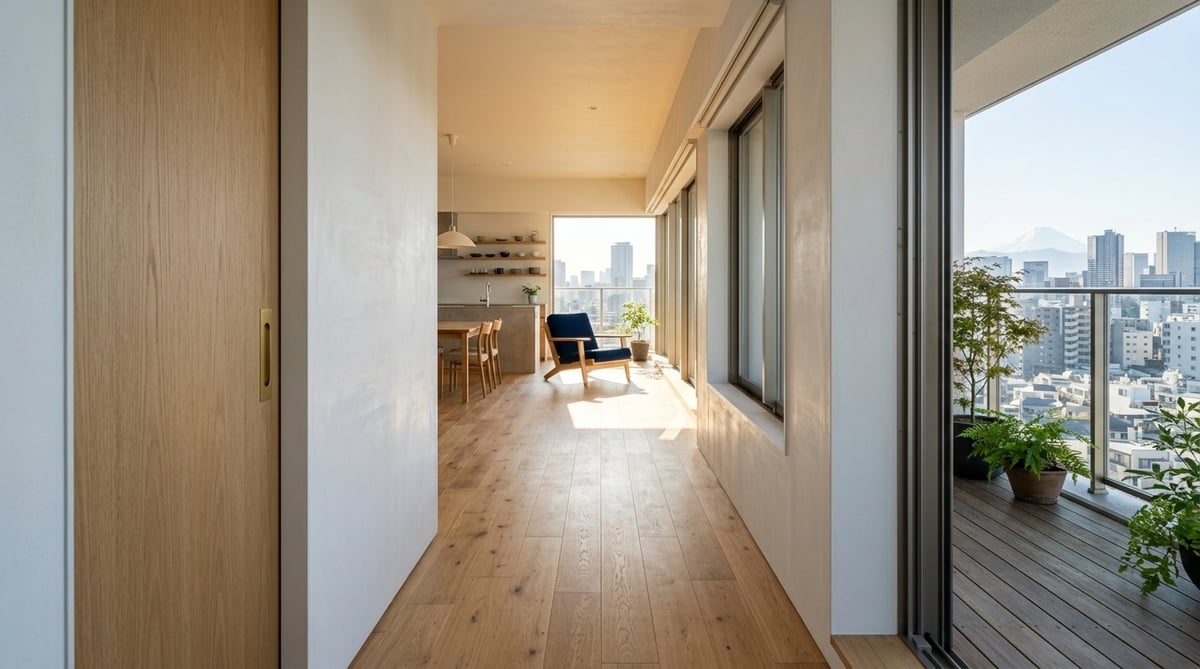
When stepping onto the surface at the Nakano-sakaue intersection where Ome-kaido and Yamate-dori meet, looking east down the slope toward the soaring skyscrapers of Nishi-Shinjuku, clients joining our property viewings often pause in contemplation. Those towers sit just a few minutes away by bicycle, or a direct 4-minute ride to Shinjuku Station and about 20 minutes to Otemachi Station via the Tokyo Metro Marunouchi Line. Despite such immediate proximity to central Tokyo, simply crossing the Kanda River into Nakano Ward noticeably moderates the rental market.
The median rent around Nakano-sakaue Station stands at ¥124,000 for a 1K, ¥209,000 for a 1LDK, and ¥299,000 for a 2LDK (with a unit price of ¥4,800 per square meter), placing it in the higher bracket within Nakano Ward. Even so, compared to Nishi-Shinjuku Station just one stop to the east on the Marunouchi Line (where 1K averages ¥140,000 and 1LDK ¥242,000), monthly expenses decrease by roughly ¥16,000 for single layouts and ¥33,000 for 1LDK units, all while retaining dual-line daily transit across both the Tokyo Metro Marunouchi Line and Toei Oedo Line.
On the other hand, the station area is defined by commercial office complexes and wide arterial avenues, offering fewer of the nostalgic traditional shopping streets where one might leisurely pick up evening side dishes. The core trade-off when evaluating Nakano-sakaue comes down to this: whether to prioritize dual-line central connectivity and moderate costs just one stop down from Nishi-Shinjuku, or to extend one stop west to Shin-Nakano Station (1K ¥117,000, 1LDK ¥195,000) or a 12- to 15-minute walk to Higashi-Nakano Station (1K ¥120,000, 1LDK ¥203,000) for vibrant, pedestrian-scale local shopping.
- The Tokyo Metro Marunouchi Line (4 min to Shinjuku, ~20 min to Otemachi) and Toei Oedo Line (direct to Roppongi and Daimon) intersect here, effortlessly accommodating dual-income couples commuting to different business districts.
- Crossing the Kanda River border from neighboring Nishi-Shinjuku (Shinjuku Ward) lowers median rents by ¥16,000/month for a 1K and ¥33,000/month for a 1LDK, allowing you to secure greater floor space or newer building specifications for the same budget.
- To avoid traffic noise along Ome-kaido and Yamate-dori, as well as the 15-20 meter steep grade and flood hazard zones along the eastern Kanda River basin, seasoned real estate advisors recommend focusing on elevated residential streets set one block back, such as Honcho 2-3 chome and Chuo 2-chome.
Commuter Access via the Marunouchi and Oedo Lines, Underground Gates, and Exit Strategy
The core appeal of Nakano-sakaue Station lies in the seamless underground interchange between two critical arteries: the Tokyo Metro Marunouchi Line, which spans east-west across Tokyo, and the Toei Oedo Line, which loops through key business and lifestyle hubs. The Marunouchi Line provides direct transit to Shinjuku, Akasaka-mitsuke, Kasumigaseki, Ginza, Tokyo, and Otemachi. Meanwhile, the Oedo Line carries passengers directly to Tochomae, Aoyama-itchome, Roppongi, Azabu-juban, Daimon, and Shiodome, as well as northbound to Higashi-Nakano, Nakai, Nerima, and Hikarigaoka (with Iidabashi and Kasuga accessible via a straightforward transfer at Tochomae). For those seeking a wider perspective on station characteristics across this corridor, our Marunouchi Line Area Guide provides a complete overview of rent balances and neighborhood profiles.
Optimizing Morning Routines: Honcho vs. Intersection Ticket Gates
While Nakano-sakaue Station is entirely underground, it spans beneath a massive road junction formed by Ome-kaido and Yamate-dori. Consequently, choosing the right ticket gate and exit for your daily commute makes a significant difference. Getting stuck at surface-level pedestrian crossings can easily cost 2 to 3 minutes, making it essential to align your underground route with the orientation of your residence.
| Ticket Gate (Level) | Designated Surface Exits | Accessibility Equipment | Primary Connections & Neighborhood Destinations |
|---|---|---|---|
| Tokyo Metro Honcho Gate (Basement 1F) |
Exit 3 | Elevator, escalator, stairs (accessible restroom within gate) | South side of Ome-kaido, barrier-free access toward Nakano-Honcho 2-3 chome |
| Tokyo Metro Nakano-sakaue Intersection Gate (Basement 1F, direct link to Oedo Line concourse) |
Exit 1 | Stairs | North of Ome-kaido / West of Yamate-dori, Olympic Supermarket, Jogan-ji Temple, Chuo 2-chome |
| Exit 2 | Stairs | South of Ome-kaido / West of Yamate-dori, directly connected to Harmony Square & Harmony Tower, Nakano-sakaue Post Office | |
| Exit A1 | Elevator, escalator | Directly connected to Across City Nakano-sakaue & Sumitomo Nakano-sakaue Building, Life Supermarket, Chuo 1-chome | |
| Exit A2 | Stairs | North of Ome-kaido, toward Eastern Community Activity Center | |
| Toei Oedo Line Gate (Basement 3F level) |
Connects to Exits 1-3, A1, and A2 via underground passageway | Elevator, escalator, stairs | Interchanges with Marunouchi Line outer concourse via pedestrian tunnel (transfer time: ~3 to 5 minutes) |
For mornings when wheeling a suitcase or navigating with a stroller, Exit 3 and Exit A1 are your primary assets. Residents living south of Ome-kaido (in Honcho 2-3 chome) can utilize the Honcho Gate via Exit 3, which features a street-level elevator and an accessible restroom, allowing a calm descent to the platforms without contending with intersection crowds. Conversely, those approaching from the northeast (Chuo 1-chome) can take Exit A1, directly integrated into Across City Nakano-sakaue, utilizing escalators and elevators to access the ticket concourse smoothly.
The network of subterranean passages linking major office complexes provides exceptional convenience during inclement weather. From Exit 2, one can access Nakano-sakaue Harmony Square and Harmony Tower without opening an umbrella; Exit A1 connects seamlessly to the Sumitomo Nakano-sakaue Building and Across City plaza. This allows pedestrians to bypass long surface-level traffic lights. However, keep in mind that the Toei Oedo Line island platform sits at Basement 4F. If your daily commute relies on the Oedo Line, allocating 3 to 4 minutes of vertical transit time from the surface entrance will keep your mornings relaxed and punctual.
Train Frequency and Realistic Rush-Hour Congestion at a Junction Station
The Tokyo Metro Marunouchi Line platform at Nakano-sakaue (Basement 2F) utilizes a rare 2-platform, 3-track layout. The outer tracks handle main-line services running toward Ogikubo and Ikebukuro, while the middle track accommodates branch-line shuttles serving Nakano-shimbashi, Nakano-fujimicho, and Honancho, as well as select through-trains running from Honancho toward central Tokyo.
The primary daily benefit of this layout is high train frequency bound for Shinjuku and central Tokyo. During weekday morning rush hours, main-line trains and direct services originating from Honancho arrive in close succession, meaning you rarely have to wait if you let a crowded train pass. While eastbound cars carry heavy commuter traffic from the Ogikubo and Nakano sectors, the ride to Nishi-Shinjuku Station takes only 2 minutes, and Shinjuku Station is reached in just 4 minutes. This eliminates the prolonged physical strain associated with long-distance packed commutes. Furthermore, on late nights after long working hours, returning from Shinjuku takes only 4 minutes by train, a short taxi ride, or a comfortable 20-minute walk along the brightly lit sidewalk of Ome-kaido if the weather is pleasant.
Simply enter the rent and deposit from portal listings to calculate a full, itemized breakdown including brokerage and guarantor fees without hidden add-ons.
Nakano-sakaue Rental Market vs. 4 Surrounding Stations: Nishi-Shinjuku, Shin-Nakano, Higashi-Nakano, and Nakano-shimbashi
To accurately evaluate rent levels at Nakano-sakaue Station, it is best to compare it against its four neighboring stations across the cardinal directions, clarifying exactly what benefits you receive for the price difference. Comparing median rents and price per square meter highlights the clear transitions created by municipal boundaries and rail line configurations.
| Station Name (Ward) | Price / m² | Studio (1R) | 1K | 1DK | 1LDK | 2LDK | Transit Lines & Neighborhood Character |
|---|---|---|---|---|---|---|---|
| Nakano-sakaue (Nakano Ward) | ¥4,800 | ¥92,000 | ¥124,000 | ¥153,000 | ¥209,000 | ¥299,000 | Marunouchi & Oedo Lines / Commercial office towers blending into quiet residential backstreets |
| Nishi-Shinjuku (Shinjuku Ward) | ¥5,200 | ¥104,000 | ¥140,000 | ¥172,000 | ¥242,000 | ¥354,000 | Marunouchi Line / Skyscraper commercial district, major university hospitals, central urban density |
| Shin-Nakano (Nakano Ward) | ¥4,600 | ¥86,000 | ¥117,000 | ¥144,000 | ¥195,000 | ¥276,000 | Marunouchi Line (Main) / Vibrant traditional shopping street (Nabeya Yokocho) with community warmth |
| Higashi-Nakano (Nakano Ward) | ¥4,650 | ¥89,000 | ¥120,000 | ¥148,000 | ¥203,000 | ¥290,000 | JR Chuo-Sobu (Local) & Oedo Line / Station retail mall (atre vie) and lively local shopping street |
| Nakano-shimbashi (Nakano Ward) | ¥4,300 | ¥81,000 | ¥109,000 | ¥134,000 | ¥178,000 | ¥253,000 | Marunouchi Line (Honancho Branch) / Peaceful riverside low-to-mid-rise residential community |
Evaluating the ¥16,000 to ¥55,000 Monthly Rent Difference Across the Kanda River from Nishi-Shinjuku
Just one station east on the Marunouchi Line lies Nishi-Shinjuku Station, separated from Nakano-sakaue by the Kanda River (at Yodobashi Bridge) and the boundary line dividing Shinjuku and Nakano Wards. Both stations share direct, single-train access to Shinjuku, Akasaka-mitsuke, Ginza, Tokyo, and Otemachi. Yet simply crossing the river into Nakano Ward causes median rents to drop by ¥16,000 for a 1K, ¥33,000 for a 1LDK, and ¥55,000 for a 2LDK each month.
On an annualized basis, this represents a fixed-cost saving of roughly ¥190,000 for a 1K and ¥400,000 for a 1LDK. Living right at the base of Nishi-Shinjuku's high-rise towers to commute on foot within minutes is a practical choice for some. However, for residents who value tangible practical benefits—such as adding 5 square meters of living space for the same budget, or upgrading from a 15-year-old property to a newer apartment with an autolock lobby and independent washroom vanity—Nakano-sakaue offers a balanced alternative for just 2 additional minutes on the train. Note that changing administrative wards from Shinjuku to Nakano also shifts the municipal offices handling residence procedures and licensed nursery school applications, a point worth noting for families planning ahead.
Weighing Budget and Lifestyle Against Shin-Nakano and Nakano-shimbashi
Looking one stop west on the Marunouchi main line toward Shin-Nakano Station, median rents are about ¥7,000 lower for a 1K and ¥14,000 lower for a 1LDK. Because rail connectivity to Shinjuku and Otemachi is virtually identical, this price difference reflects the premium for Nakano-sakaue's direct connection to the Toei Oedo Line (serving Roppongi and Daimon) and its orderly, modern office plaza environment.
If you rarely utilize the Oedo Line and prefer an evening stroll past family-run greengrocers and casual diners along the Nabeya Yokocho shopping street, Shin-Nakano may feel more welcoming. Furthermore, if you wish to reduce housing costs further while prioritizing interior floor space, turning toward Nakano-shimbashi Station on the Honancho branch line brings 1LDK median rents down to ¥178,000—a ¥31,000 monthly discount compared to Nakano-sakaue. Although branch-line shuttle services require a quick cross-platform or stair transfer at Nakano-sakaue during mid-day hours, the station's gentle shopping street and calm residential environment remain popular among remote professionals.
Choosing Between Nakano-sakaue and Higashi-Nakano Within a 12 to 15-Minute Walk
When searching for properties north of Nakano-sakaue Station (around Chuo 1-2 chome), many people notice that walking 12 to 15 minutes north along Yamate-dori brings them to Higashi-Nakano Station (also just one stop / 2 minutes away on the Oedo Line). This frequently prompts the question: if both are within walking distance, is it better to live closer to Higashi-Nakano where rents are slightly lower?
The answer depends on the destination of the secondary rail line and the commercial character of each station area. While both stations share direct Toei Oedo Line service to Roppongi and Daimon (with Iidabashi reached via a transfer at Tochomae), Higashi-Nakano's second connection is the JR Chuo-Sobu Line (Local). For residents who commute directly to Suidobashi, Ochanomizu, Akihabara, or Kinshicho, or who wish to utilize the station-integrated shopping center (atre vie Higashi-Nakano) and the lively Higashi-Nakano Ginza Street daily, Higashi-Nakano fits naturally. Conversely, for professionals commuting daily to Kasumigaseki, Ginza, Tokyo, or Otemachi, living near Nakano-sakaue eliminates transfers at Shinjuku or Yotsuya, reducing daily transit fatigue. If both lines appeal to you, selecting an apartment in northern Chuo 2-chome that sits an 8 to 10-minute walk from both stations offers an appealing balance: Marunouchi Line for weekday commuting, and Higashi-Nakano for weekend dining and retail.
Who Fits Best Near Nakano-sakaue Station
- ✓ Regularly commute to Shinjuku/Otemachi (Marunouchi) and Roppongi/Daimon (Oedo)
- ✓ Want to save ¥16,000 to ¥33,000/month compared to Nishi-Shinjuku while securing newer features
- ✓ Prefer orderly streetscapes and late-night supermarkets without the clutter of entertainment districts
Who Fits Best in Shin-Nakano, Higashi-Nakano, or Nakano-shimbashi
- ✓ Value stopping by neighborhood delicatessens and casual local eateries after work
- ✓ Need direct JR Sobu Line access toward Akihabara, Ochanomizu, and Ichigaya (Higashi-Nakano)
- ✓ Do not use the Oedo Line and wish to save ¥7,000 to ¥31,000/month along the Marunouchi Line
Daily Shopping and Neighborhood Atmosphere: Commercial Towers vs. Quiet Residential Enclaves
Emerging above ground at Nakano-sakaue Station, tall commercial towers like Sunbright Twin, Harmony Square, and Across City Nakano-sakaue encircle the crossroads. On weekday afternoons, business professionals in suits pass through a crisp, professional environment. While the area lacks department stores or extensive covered shopping arcades, day-to-day living reveals a practical selection of grocery and retail amenities tailored to working professionals.
Everyday Groceries and Healthcare: Life Supermarket and Olympic
Daily meal preparation and household restocking center around two substantial supermarkets facing each other across Ome-kaido. On the northeast side near Exit A1, Life Nakano-sakaue (Chuo 1-38-1) operates from 9:30 AM until midnight (24:00), featuring extensive selections of fresh produce, evening prepared meals, and an in-house bakery. Arriving home past 10:00 PM from Otemachi or Roppongi, being able to take an escalator up directly to a well-lit grocery floor provides reliable day-to-day comfort for singles and dual-income couples alike.
Meanwhile, situated a 1- to 2-minute walk west along Ome-kaido from Exit 1, Olympic Nakano-sakaue (Chuo 2-2-1, open 10:00 AM to 10:00 PM) offers a food market on the first floor alongside kitchenware, home storage, and stationery on the second floor. When setting up a new apartment and needing immediate household supplies, these items can be acquired locally without traveling into Shinjuku. Further into the residential pockets, compact supermarkets such as My Basket Nakano Chuo 2-chome (8:00 AM to 11:00 PM) and My Basket Nakano Honcho 3-chome (8:00 AM to midnight) make quick purchases of milk or breakfast bread effortless.
Pharmacies and outpatient care are equally well integrated. Inside the station concourse, Matsumoto Kiyoshi Nakano-sakaue Metropia opens at 7:30 AM on weekdays for quick pre-commute essentials, complemented by the street-level Matsumoto Kiyoshi Nakano-sakaue Ekimae (Honcho 2-46-1) with a prescription dispensary and Mine Pharmacy Nakano-sakaue on the ground floor of Sunbright Twin. The lower podiums of the commercial towers host internal medicine and dental clinics, as well as cafes and restaurants, creating a surprisingly tranquil setting on weekends when office workers are away.
Contrasting Noise Levels: Main Thoroughfares vs. the Residential Pockets of Honcho and Chuo
During apartment viewings in this neighborhood, clients frequently express surprise at the stark transition between the bustling main avenues and the quiet alleys just behind them. Parcels fronting Ome-kaido and Yamate-dori are designated as commercial zoning, lined with mid-to-high-rise residential and office buildings. Yet, walking just 50 to 100 meters inward leads directly into residential zoning categories, such as Category I Mid/High-Rise Residential Zones, where building heights are strictly controlled.
In particular, the residential enclaves of Honcho 2-3 chome (tucked behind Harmony Square from Exits 2 and 3) and Chuo 2-chome (behind Jogan-ji Temple from Exit 1) are free from pachinko parlors or nightlife establishments. After 9:00 PM, vehicular traffic fades, leaving calm, dimly lit residential streets. The broad sidewalks and well-maintained public plazas surrounding the commercial towers feature bright streetlights and open sightlines, allowing residents to walk from the station to their residential street without navigating dark or unmonitored alleys.
Topography and Flood Hazards: Musashino Plateau Ridge vs. Kanda River Lowlands
The name "Nakano-sakaue" literally translates to "Above the Nakano Slope," precisely describing the area's physical geography. Selecting a home solely based on floor plans or construction age without assessing the underlying elevation and road conditions can lead to unexpected daily walking fatigue or environmental noise. Evaluating both topography and building structural specifications is essential during on-site inspections.
The 15 to 20-Meter Elevation Drop at Nakano Slope and Kanda River Hazard Maps
The immediate intersection surrounding Nakano-sakaue Station (elevated portions of Honcho 2-chome and Chuo 2-chome) sits along the ridge of the Musashino Plateau at an altitude of approximately 35 to 40 meters. Sheltered by stable Kanto loam ground layers, this elevated plateau is excluded from flood hazard zones on Nakano Ward's official inundation maps.
However, heading east along Ome-kaido toward Nishi-Shinjuku and the Shinjuku Ward border, the namesake slope drops steeply toward the Kanda River basin (at roughly 20 meters elevation), creating an elevation drop of 15 to 20 meters—comparable to the height of a 5- to 6-story building. Low-lying areas near the river (including the eastern edges of Chuo 1-chome, Honcho 1-chome, and the valley depressions toward Yayoi-cho) fall within designated flood hazard zones with projected inundation depths between 0.5 and 3.0 meters under maximum precipitation scenarios. Even on the plateau, low-lying drainage hollows require attention regarding surface-water ponding.
Apartments in the lowland sector often advertise attractive rents within walking distance of both Nishi-Shinjuku and Nakano-sakaue. However, commuting via Nakano-sakaue entails ascending a 15-meter slope every morning. Deciding whether to walk or utilize an electric-assist bicycle, testing the route in work shoes, and verifying whether electrical infrastructure rooms are elevated on the ground floor or equipped with flood barriers are prudent checks for long-term residential security.
Acoustic Insulation Along Main Roads and Pre-Contract Verification Steps
Another practical consideration is how to navigate life alongside two primary traffic arteries: Ome-kaido and Yamate-dori. Deep beneath Yamate-dori lies the Central Circular Route of the Shuto Expressway (Yamate Tunnel), while surface roads carry freight trucks, local buses, and emergency vehicles around the clock. While these avenues feature modern condominiums equipped with autolock security and parcel delivery lockers, your living comfort will be governed by window orientation and soundproofing ratings.
Units facing the quiet residential streets behind the main avenue can be surprisingly peaceful, even within a building situated along a major road. Conversely, for units with primary windows facing the thoroughfares, checking whether windows feature T-2 rated soundproof sashes or secondary interior glazing (double windows), and ensuring that 24-hour ventilation sleeves include sound dampers, is highly recommended. If you plan to keep windows closed and operate air conditioning year-round, review your lease conditions during the Explanation of Important Matters (Juyo Jiko Setsumei). Verify that the contract adheres to Tokyo Rental Housing Dispute Prevention Ordinance standards (where landlord covers repairs for natural wear of equipment, and wallpaper lifespan amortizes over 6 years) and that fixed move-out cleaning clauses remain within standard, legally reasonable thresholds.
Who Thrives in Nakano-sakaue and Conditions to Reconsider
Regardless of transit convenience, whether an area suits your daily life depends on personal priorities. To prevent mismatch after signing a contract, here is an objective assessment of conditions where alternative neighborhoods may be more fitting.
Three Conditions Where You Might Consider Alternative Areas
First, residents sensitive to traffic sounds or air particulate who prefer leaving windows open for natural ventilation. The station area is partitioned into four quadrants by two wide thoroughfares, generating consistent traffic flow. If quiet surroundings and green, low-rise residential atmospheres are your priority, exploring stations further west into Suginami Ward along the Marunouchi Line—such as Minami-Asagaya (1K ¥109,000, 1LDK ¥178,000) or Shin-Koenji (1K ¥112,000, 1LDK ¥186,000)—or restricting your search to deep residential pockets in Honcho 2-3 chome is advisable.
Second, those seeking traditional shopping streets with small independent purveyors to converse with while picking up evening ingredients. Everyday shopping at Nakano-sakaue revolves around two functional supermarkets (Life and Olympic), with station dining situated mainly in office plazas. If you value strolling through street markets and exploring casual back-alley bistros, neighboring Shin-Nakano with its Nabeya Yokocho, Higashi-Nakano with its Ginza Street and station mall, or the Nakano Station hub (1K ¥118,000, 1LDK ¥197,000) will feel warmer and more community-oriented.
Third, those wishing to avoid steep inclines and river basin inundation risks when evaluating lowland properties to the east. Lower sections along the eastern boundary of Chuo 1-chome and Honcho 1-chome offer closer proximity to Nishi-Shinjuku, but this comes with a 15 to 20-meter grade and projected flood depths of 0.5 to 3.0 meters. If level terrain and elevated ground stability are important to you, staying on the plateau across Honcho 2-3 chome and Chuo 2-chome provides greater reassurance.
Lifestyles That Align Well with This Neighborhood
Conversely, for tenants whose criteria match its specific advantages, Nakano-sakaue delivers consistent satisfaction. For example, for dual-income couples (DINKs) where one partner commutes via the Marunouchi Line toward Ginza, Kasumigaseki, or Otemachi, while the other travels via the Oedo Line toward Roppongi or Shiodome (or Iidabashi via Tochomae), few locations balance both commutes as efficiently.
It also suits corporate professionals working in Nishi-Shinjuku or Shinjuku who desire immediate transit proximity to work without living directly in the center of bustling entertainment zones. By crossing the Kanda River, you capture substantial rent savings—redirecting ¥20,000 to ¥30,000 per month toward a larger kitchen, upgraded bathroom fixtures, or newer construction—with the convenience of picking up dinner at Life until midnight before retiring to a quiet residential pocket. For those seeking functional efficiency, understated surroundings, and reliable connectivity, Nakano-sakaue serves as a dependable residential base.
Finding Your Ideal Residence in Nakano-sakaue
Offering close-range views of Nishi-Shinjuku's skyline while delivering peaceful residential nights just off the main avenue, Nakano-sakaue supports residents balancing commuting efficiency with relaxed living conditions. Whether you leverage the dual-line capability of the Marunouchi and Oedo lines or look slightly westward to Shin-Nakano or Higashi-Nakano for neighborhood warmth, each choice has distinct merit. Consider your everyday transit routes and the evening atmosphere you prefer coming home to, starting your exploration along the stable, elevated plateau streets.
If you come across a potential apartment and want to verify whether the address sits above or below the slope, assess road noise levels, or review the breakdown of move-in costs, Sorai Tokyo is here to assist. Simply share property links via our official LINE account (@soraitokyo / https://line.me/R/ti/p/@soraitokyo). A licensed Japanese real estate broker will check real-time availability on the national inter-broker database, evaluate rental screening criteria, and provide a transparent second opinion on upfront estimates.
Our consultation is completely free, anonymous, and requires no Japanese phone number or store visits. Feel free to reach out at your own pace without pressure. You can also access our suite of smart calculation tools (SorAi) via the bottom menu on mobile or the footer on desktop. We are committed to helping you establish a calm, comfortable home in Tokyo.
Frequently Asked Questions: Living Around Nakano-sakaue Station
QHow congested is Nakano-sakaue Station during morning rush hour?
AWeekday morning trains on the Marunouchi Line (bound for Shinjuku and Tokyo) carry heavy passenger loads from the Ogikubo and Nakano corridors around 8:00 AM. However, because Nakano-sakaue features a 2-platform, 3-track layout where main-line and Honancho branch services converge, train arrivals are frequent. Furthermore, the ride to Nishi-Shinjuku takes just 2 minutes and Shinjuku is only 4 minutes away, keeping physical strain to a minimum. The Toei Oedo Line also operates frequent, reliable services toward Roppongi, Daimon, and Tochomae.
QAre the streets well lit for late-night walks, and what grocery options exist after hours?
AThe station vicinity benefits from the open, well-illuminated plazas of corporate towers and broad sidewalks along major avenues. The absence of red-light or nightlife entertainment venues ensures a secure and composed walk home. For grocery shopping, Life Nakano-sakaue (near Exit A1) and My Basket Nakano Honcho 3-chome are open until midnight (24:00), while My Basket Nakano Chuo 2-chome operates until 11:00 PM, providing ample options for fresh ingredients even on late nights.
QWhich station exits are best when traveling with a stroller or large luggage?
AWhen heading toward the south side of Ome-kaido (Honcho district), the Tokyo Metro Honcho Gate via Exit 3 is the most convenient, featuring a street-level elevator, escalators, and an accessible multi-functional restroom. If you are heading to the northeast quadrant (Chuo 1-chome or toward Life Supermarket), Exit A1 provides escalators and elevators directly linked to Across City Nakano-sakaue, allowing stair-free access between street and concourse.
QHow should I compare Nakano-sakaue with neighboring Nishi-Shinjuku and Shin-Nakano?
AAll three stations share direct Marunouchi Line transit to Shinjuku, Ginza, and Otemachi. If your goal is to save ¥16,000 to ¥33,000 per month compared to Nishi-Shinjuku (1K ¥140,000, 1LDK ¥242,000) while keeping dual-line transit with the Toei Oedo Line, Nakano-sakaue (1K ¥124,000, 1LDK ¥209,000) offers balanced value. If you rarely use the Oedo Line and prefer a traditional neighborhood shopping street alongside an additional ¥7,000 to ¥14,000 monthly rent savings, Shin-Nakano (1K ¥117,000, 1LDK ¥195,000) is well worth considering.




Author: Sorai Tokyo Editorial Team (Supervised by Licensed Real Estate Agents)
A real estate consulting team specializing in assisting foreign nationals find rooms and explaining initial costs in Tokyo. We break down language barriers and differences in customs, offering dedicated support in Japanese, English, and Vietnamese for a safe and secure start to your new life.