
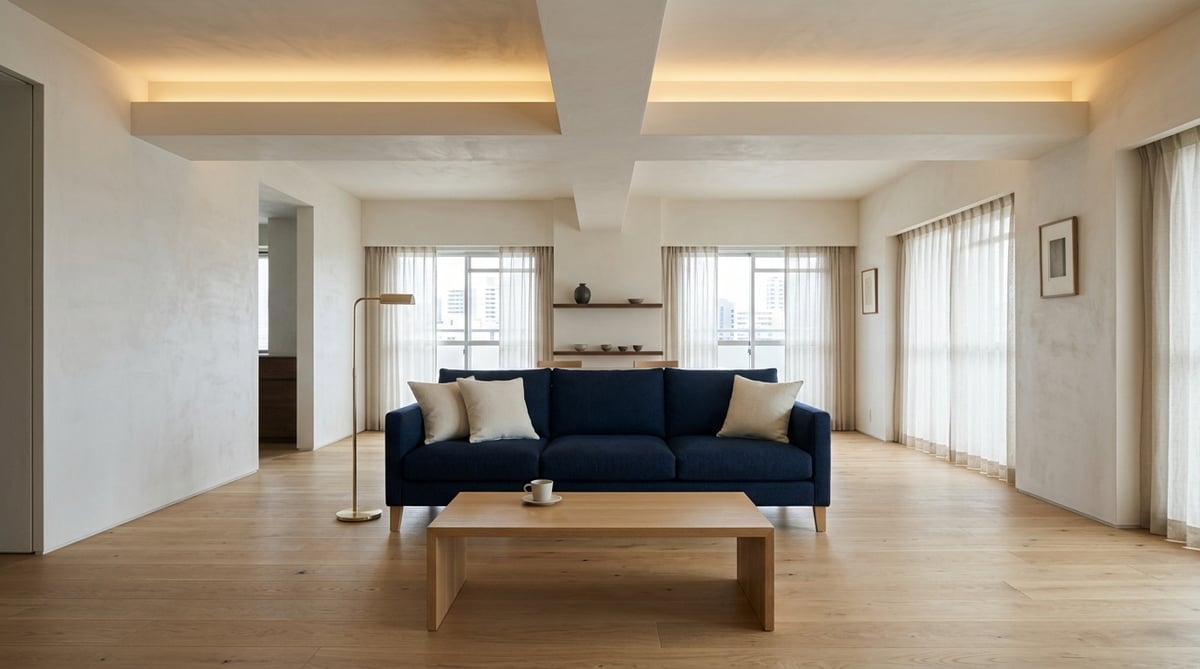
Turn south off Ome-kaido Avenue at the Nabeya Yokocho intersection at dusk, and the sound of passing traffic gradually fades behind you, replaced by the aroma of freshly prepared side dishes and the unhurried pace of neighbors carrying grocery bags. Step one street further into the alleys of Honcho 4-chome, and a calm residential evening unfolds—making it easy to forget that Shinjuku Station is only six minutes away by subway.
Yet when walking this street with clients on the way back from a property viewing, almost everyone pauses to weigh the same question. Average rents around Shin-Nakano Station sit at ¥117,000 for a 1K, ¥195,000 for a 1LDK, and ¥276,000 for a 2LDK. While that is ¥7,000 to ¥14,000 per month more affordable than neighboring Nakano-sakaue one stop closer to Shinjuku (¥124,000 for a 1K, ¥209,000 for a 1LDK), it is virtually neck-and-neck with JR Chuo and Tozai Line Nakano Station—just a 12- to 15-minute walk to the north (¥118,000 for a 1K, ¥197,000 for a 1LDK).
For roughly the same monthly budget, should you choose the area around Nakano Station with its extensive commercial complexes and rapid trains, or opt for Shin-Nakano's direct Marunouchi Line access to Otemachi and Ginza alongside the grounded, everyday warmth of Nabeya Yokocho? How you weigh the shallow underground station's split-gate layout under Ome-kaido Avenue and traffic noise along the main road will clearly determine whether this neighborhood suits your lifestyle.
- Direct Marunouchi Line main-line access to Shinjuku in about 6 minutes, plus Akasaka-mitsuke, Ginza, Tokyo, and Otemachi, at lower rents than Nakano-sakaue
- Strong home-cooking infrastructure anchored by Nabeya Yokocho Shopping Street, featuring Summit, Co-op, Niku no Hanamasa, and three My Basket locations
- Distinct north-south terrain split by Ome-kaido Avenue: solid elevated plateau to the south (Honcho) and flat low-lying valley terrain to the north (Chuo)
Marunouchi Line Commuting & the Reality of the Four-Gate Split Station Under Ome-kaido
6-Minute Shinjuku Access on the Marunouchi Main Line & Direct Links to Central Business Districts
Shin-Nakano Station's (Station Code: M05) greatest strength is its position on the Tokyo Metro Marunouchi main line, offering direct, single-seat access to Tokyo's core business and commercial districts without ever climbing transfer stairs. Shinjuku Station is just three stops and roughly six minutes away. Beyond Shinjuku, the same track continues directly to Yotsuya, Akasaka-mitsuke, Kokkai-gijidomae, Kasumigaseki, Ginza, Tokyo, and Otemachi.
Even within Nakano Ward, stations on the Honancho branch line splitting off at Nakano-sakaue (such as Nakano-shimbashi and Nakano-fujimicho) often require a transfer at Nakano-sakaue depending on the time of day. By contrast, every train bound for Ikebukuro or Ogikubo stops at Shin-Nakano on the main line, so during busy morning hours you can board the next arriving train without checking destination boards. For a broader comparison of stations and connections along the route, see our Marunouchi Line Area Guide.
Above ground, Ome-kaido Avenue and Nakano-dori Avenue are served by a dense network of local buses heading toward Shinjuku Station West Exit, Nakano Station, and even Shibuya Station. Having reliable subway service as your primary commute while still being able to hop on a bus near your home when carrying heavy groceries or heading out on weekends is a practical advantage you notice quickly once you live here.
Side-Platform Layout Without Cross-Street Underpasses: Exits & Elevator Locations
At the same time, anyone considering Shin-Nakano should understand its station layout: a shallow, two-track side-platform structure built on the B1 level directly beneath Ome-kaido Avenue. While you only need to walk down a short flight of stairs to reach the platform, there is no underground passage outside the ticket gates connecting the north and south sides of Ome-kaido Avenue.
| Ticket Gate | Connected Exit | Direct Platform & Direction | Street-Level Elevator | Location, Hours & Nearby Landmarks |
|---|---|---|---|---|
| Sugiyama Park Intersection South Gate | Exit 1 | Track 1 (for Ogikubo) | Yes | Honcho 4-chome (south side of Ome-kaido). Accessible restroom inside gate. Near Sugiyama Park and Nabeyoko Residents' Activity Center. |
| Sugiyama Park Intersection North Gate | Exit 2 | Track 2 (for Shinjuku & Ikebukuro) | No (stairs only) | Chuo 4-chome (north side of Ome-kaido). Open first train to 23:30 only. Near Shin-Nakano Ekimae Post Office and Toka Elementary School. |
| Nabeya Yokocho Intersection South Gate | Exit 3 | Track 1 (for Ogikubo) | No (stairs only) | Honcho 4-chome (south side of Ome-kaido). Near Nabeya Yokocho Shopping Street and Mizuho Bank ATM corner. |
| Nabeya Yokocho Intersection North Gate | Exit 4 | Track 2 (for Shinjuku & Ikebukuro) | Yes | Chuo 4-chome (north side of Ome-kaido). Near Chubu Sukoyaka Welfare Center and Nakano Fire Station. |
In daily life, this structure means your traffic-light wait times differ depending on whether you live on the south side (Honcho) or north side (Chuo) of Ome-kaido Avenue. For example, if you rent on the south side (near Exits 1 and 3) and commute toward Shinjuku, you either cross Ome-kaido at the street-level crosswalk to enter Exits 2 or 4, or enter Exits 1 or 3 and use the underground connecting stairs inside the paid area (near cars 3–4) to cross over to Track 2.
Conversely, if you live on the north side (such as Chuo 4-chome) and return late at night from Shinjuku, your train arrives at Track 1 on the south side. Exiting directly through Exits 1 or 3 puts you on the south side of Ome-kaido, meaning you must wait at the street crosswalk even on rainy nights—or go up and down the internal connecting stairs to exit on the north side. Another detail that is easy to overlook is that the Sugiyama Park Intersection North Gate (Exit 2) closes at 23:30. If you often return late from overtime or dinners and are considering the northwest side of the station, be sure to check the walking route from Exit 4, which remains open until the last train.
Street-level elevators are installed at only two diagonal corners: Exit 1 on the southwest side (Ogikubo-bound platform) and Exit 4 on the northeast side (Shinjuku-bound platform). Families using strollers daily or professionals who travel frequently with large suitcases will find life noticeably easier if they choose an apartment with convenient access to Exits 1 or 4 rather than relying on stair-only Exits 2 and 3.
Simply enter the rent and deposit from portal listings to calculate a full, itemized breakdown including brokerage and guarantor fees without hidden add-ons.
Current Rent Benchmarks & Station Comparisons: Nakano-sakaue, Higashi-koenji & JR Nakano
Rent by Layout & Comparison with Neighboring Marunouchi Line Stations
Once you cross the Kanda River from Shinjuku and Nishi-Shinjuku (where 1K units average ¥140,000–¥145,000 and 1LDK units ¥242,000–¥251,000) into Nakano Ward, monthly housing costs settle into a more approachable range. To see where Shin-Nakano stands, here is how it compares with four nearby stations that frequently appear on the same shortlist.
| Station (Ward) | Monthly Rent / sqm | 1R | 1K | 1DK | 1LDK | 2LDK |
|---|---|---|---|---|---|---|
| Shin-Nakano (Nakano Ward) | ¥4,600 | ¥86,000 | ¥117,000 | ¥144,000 | ¥195,000 | ¥276,000 |
| Nakano-sakaue (Nakano Ward) | ¥4,800 | ¥92,000 | ¥124,000 | ¥153,000 | ¥209,000 | ¥299,000 |
| Higashi-koenji (Suginami Ward) | ¥4,500 | ¥85,000 | ¥114,000 | ¥141,000 | ¥190,000 | ¥265,000 |
| Nakano (Nakano Ward) | ¥4,600 | ¥88,000 | ¥118,000 | ¥144,000 | ¥197,000 | ¥278,000 |
| Nakano-shimbashi (Nakano Ward) | ¥4,300 | ¥81,000 | ¥109,000 | ¥134,000 | ¥178,000 | ¥253,000 |
While Nakano-sakaue, Shin-Nakano, and Higashi-koenji all share direct Marunouchi main-line access to Shinjuku, Akasaka-mitsuke, Ginza, and Otemachi, their neighborhood character and rent levels differ clearly. Nakano-sakaue, one stop closer to Shinjuku, connects to the Toei Oedo Line and features sleek high-rise office towers around the station—meaning rents run ¥6,000–¥9,000 higher per month for single-person units and ¥14,000–¥23,000 higher for 1LDK and 2LDK layouts. Unless you specifically need direct Oedo Line access (toward Roppongi, Azabu-juban, or Daimon), moving one stop west to Shin-Nakano adds only about two minutes to your ride while freeing up budget for a slightly larger floor plan or upgraded building amenities like an independent vanity or auto-lock security.
Moving one stop further toward Ogikubo brings you to Higashi-koenji (Suginami Ward), known for the greenery of Sanshi-no-mori Park and height-restricted residential streets, where rents dip by roughly ¥3,000 for a 1K and ¥5,000 for a 1LDK. However, supermarkets around Higashi-koenji are somewhat scattered, whereas Shin-Nakano concentrates multiple grocery stores and a historic shopping street within a short walking loop. For residents who cook regularly and want to compare fresh ingredients on the way home from work, Shin-Nakano's daily convenience often outweighs that modest rent difference.
If you look south down the slope toward Nakano-shimbashi on the Honancho branch line, 1LDK rents drop to around ¥178,000—about ¥17,000 less per month. Keep in mind, however, that Nakano-shimbashi sits largely in lower-lying terrain along the Kanda River and has fewer direct main-line trains. Choosing between the two comes down to whether you prioritize Shin-Nakano's elevated plateau terrain and main-line frequency or lower monthly and upfront costs.
Comparing JR Nakano & Shin-Nakano: How to Weigh the 15-Minute Overlap
One of the most common dilemmas for renters is comparing Shin-Nakano with JR Chuo, Sobu, and Tokyo Metro Tozai Line Nakano Station, located roughly one kilometer to the north. As the table shows, both stations share the exact same ¥4,600 per-square-meter rent benchmark, with only a ¥1,000 difference on 1K units and ¥2,000 on 1LDK and 2LDK units. It is natural to wonder whether living closer to Nakano Station—with its multiple rail lines—might be more convenient for the same price.
The reason many residents deliberately choose Shin-Nakano comes down to the difference in weekday commuting comfort and nighttime quietness around your home. Nakano Station is surrounded by a lively commercial district with department stores, dining alleys, and subculture hubs, meaning streets within a 5- to 7-minute walk stay busy late into the night; to reach a quiet residential block, you often end up walking 10 minutes or more anyway. In addition, the morning JR Chuo Rapid Line is among the most crowded routes in Tokyo and is prone to weather-related or service disruptions.
By basing yourself in Shin-Nakano, you enjoy a sheltered underground commute on the Marunouchi Line straight to Kasumigaseki, Ginza, Tokyo, and Otemachi. Then, on weekends when you want dining or shopping variety, you can take a pleasant 12- to 15-minute stroll north along tree-lined Nakano-dori Avenue—or hop on a frequent local bus—to reach Nakano Station. Keeping commercial bustle at a comfortable distance while still having it within easy walking reach is one of Shin-Nakano's quiet strengths.
Living Around Shin-Nakano Station
- ✓ Direct Marunouchi Line commute to Shinjuku, Akasaka-mitsuke, Ginza & Otemachi
- ✓ Efficient grocery shopping with Summit, Co-op & Niku no Hanamasa nearby
- ✓ Quiet residential blocks at night just one street off the main avenues
- ✓ Easy 12- to 15-minute walk to Nakano Station's dining and retail area on weekends
Choosing Nakano or Nakano-sakaue
- ✓ Multi-line connectivity via JR Chuo Rapid & Tozai (Nakano) or Oedo (Nakano-sakaue)
- ✓ Large commercial complexes and office towers right outside the station
- ✓ Smooth underground concourses and pedestrian decks across tracks and avenues
- ✓ Lively stationfront energy (Nakano) or ¥7,000–¥20,000+ higher monthly rent (Nakano-sakaue)
Nabeya Yokocho Shopping Street & Supermarkets: Daily Convenience
Home-Cooking Infrastructure: Summit, Co-op, Niku no Hanamasa & Three My Basket Stores
Daily life in Shin-Nakano is anchored by Nabeya Yokocho Shopping Street, which has served as a local thoroughfare since the Edo period when pilgrims traveled to Myohoji Temple, alongside an unusually deep lineup of grocery stores. Unlike some single-person-oriented stations where residents are limited to convenience stores and small markets, Shin-Nakano lets you choose between multiple supermarkets depending on your meal plan.
Step out of Exit 3 (Nabeya Yokocho Intersection South Gate) and walk briefly south along Nabeya Yokocho Shopping Street to reach Summit Store Nabeya Yokocho, the neighborhood's primary grocery hub. It carries everything from single-portion produce and fresh fish to in-house prepared meals and bakery items, making weekday dinner prep straightforward. Along the shopping street itself, you will also find traditional greengrocers, butcher shops, casual set-meal diners, Japanese confectioners, and unpretentious bistros—creating a warm, approachable mix of home cooking and dining out.
Head slightly east toward Chuo 3-chome along Ome-kaido Avenue, and you will find Co-op Mirai Nakano Chuo—favored by families for its reliable quality—right near Niku no Hanamasa Nakano, which stocks bulk meat packs, imported ingredients, and specialty seasonings. It is easy to do a weekend stock-up at Hanamasa and Co-op, then pick up weekday essentials at a compact market near the station.
Those quick weekday stops are covered by three My Basket urban mini-supermarkets: My Basket Shin-Nakano Ekimae right on Ome-kaido near the station, My Basket Nakano Honcho 4-chome tucked into the southern residential side, and My Basket Shin-Nakano Eki-nishi west of the Sugiyama Park intersection. Whichever exit (1 through 4) is closest to your apartment, you can easily pass a grocery store on your walk home—a major help on rainy evenings or when carrying heavy bags.
Sugiyama Park & Compact Access to Municipal and Postal Services
Beyond groceries, everyday errands are equally compact. Right beside Exit 1 at the corner of Ome-kaido Avenue and Nakano-dori Avenue sits ward-run Sugiyama Park, where cherry blossoms in spring and autumn foliage soften the busy intersection. It is a welcome open space to pause with coffee and bread from a local bakery or let children stretch their legs.
Essential public and financial services are neatly distributed around the four station exits: the Nabeyoko Residents' Activity Center (near Exit 1) for resident certificates and community programs, Shin-Nakano Ekimae Post Office (near Exit 2) for mail and banking counters, a bank ATM corner near Exit 3 (full-service bank branches are located around Nakano Station's north exit), and the Chubu Sukoyaka Welfare Center and Nakano Fire Station (near Exit 4) for childcare and local welfare support.
You will not find movie theaters, department stores, or large electronics retailers right outside Shin-Nakano Station. However, with Shinjuku's department stores and Nakano's shopping arcades only minutes away by train or bicycle, residents who prefer their immediate neighborhood to focus on daily groceries and quiet living often find this pared-back balance refreshing.
Terrain & Living Environment Across Ome-kaido: Honcho Plateau vs. Chuo Lowlands
Stable Plateau Ground in the South (Honcho 4–6-chome) & Elevation Shifts Past Jukkanzaka
When apartment hunting around Shin-Nakano, one important factor that does not show up on a flat street map is the north-south terrain divide along Ome-kaido Avenue. Ome-kaido runs east-west along a ridge of the Musashino Plateau at roughly 35 meters above sea level, and stepping north or south of it changes both the ground composition and streetscape.
| Area (Representative Districts) | Zoning & Streetscape | Terrain & Ground Characteristics | Typical Public School Districts |
|---|---|---|---|
| Along Ome-kaido & Nakano-dori (Main-road frontage in Honcho 4 & Chuo 4) |
Neighborhood Commercial Zone (Shops & mid- to high-rise apartments) |
Flat plateau ridge. Well-lit with steady foot traffic at night, though road noise requires attention. | Splits between Nakano Hongo Elementary and Toka Elementary by block |
| South Side of Station (Inner Honcho 4 to Honcho 5 & 6) |
Primarily Residential Zones (Quiet blocks of low- to mid-rise homes) |
Volcanic-ash loam plateau. Relatively stable elevated ground, largely outside flood-hazard zones. | Nakano Hongo Elementary / Nakano Daini Junior High, etc. |
| North Side of Station (Chuo 3 to 5, near Momozonogawa Greenway) |
Neighborhood Commercial to Residential (Dual-access area toward Nakano Station) |
Gently slopes down into a valley floor toward Momozonogawa Greenway. Easy walking, but check localized rainwater drainage maps. | Toka Elementary / Nakano Higashi Junior High, etc. |
South of the station (Exits 1 and 3), Honcho 4-chome through 6-chome sits on the flat, stable elevated ground of the Musashino Plateau. Step just one alley off Ome-kaido Avenue or Nabeya Yokocho Shopping Street, and taller buildings give way to detached houses and neat 3- to 5-story apartment buildings. Because most of this area lies outside official river-flood hazard zones, it is a reassuring choice for singles, dual-income couples, and families (in the Nakano Hongo Elementary and Nakano Daini Junior High school districts) who prioritize solid ground.
Note, however, that if you walk further south toward Nakano-shimbashi or Yayoi-cho, the elevation drops sharply down slopes such as Jukkanzaka into the Kanda River valley. Some listings advertised as a "9- or 10-minute walk from Shin-Nakano" on the south side sit partway down or at the bottom of this slope. During a viewing, it is worth walking the route yourself to confirm whether the commute is flat along the plateau or involves a daily uphill climb.
North Side (Chuo 3–5-chome): Gentle Slope to Momozonogawa Greenway & Drainage Checks
North of the station (Exits 2 and 4), Chuo 3-chome through 5-chome occupies the midpoint between Shin-Nakano and JR Nakano Station's south exit. Because many properties here are within a 10-minute walk of both stations, the area remains popular with renters who want both Marunouchi Line subway access and JR Chuo Line connectivity.
Topographically, the land slopes gently downward from the Ome-kaido ridge toward the Momozonogawa Greenway, a car-free pedestrian path built over the culverted Momozono River. Lined with seasonal plantings, the greenway is a pleasant setting for morning walks and jogs.
Because this corridor sits slightly lower than the surrounding plateau, it is prudent to check localized rainwater drainage (pluvial flood risk) during heavy downpours. You do not need to rule out the Chuo area—simply choosing a unit on the second floor or higher, or confirming that a ground-floor unit sits raised above street level with floodboards available in the building's common area, lets you enjoy the two-station convenience with peace of mind.
When to Skip Shin-Nakano & Practical Viewing Checklist
Three Cases Where Another Station May Be a Better Fit
Even in a well-connected, convenient neighborhood, certain personal priorities may point you toward a different station. To avoid regrets after signing a lease, consider looking elsewhere if any of these three conditions apply:
- Cross-street underpasses and universal elevator access are essential to your daily routine: Because Shin-Nakano lacks an underground concourse outside the gates to cross Ome-kaido Avenue, and elevators are limited to Exit 1 (south, Ogikubo-bound) and Exit 4 (north, Shinjuku-bound), commuters who want sheltered underground crossings or daily stroller access from a home far from Exits 1 and 4 may prefer Nakano-sakaue, which offers fuller underground connectivity.
- You are sensitive to main-road traffic or sirens and are only looking at lower floors on major avenues: Most rental listings near Shin-Nakano are mid- to high-rise buildings in the Neighborhood Commercial Zone along Ome-kaido and Nakano-dori. These avenues carry taxis and trucks at night, and Nakano Fire Station sits nearby, meaning emergency sirens can be heard. If quietness is your top priority and inner-block units are outside your budget, expanding your search to low-rise residential zones around Higashi-koenji or Shin-koenji is a sensible alternative.
- You want department-store fashion and lifestyle shopping inside a station building: Shin-Nakano excels at groceries and daily necessities, not apparel, large bookstores, or multi-level station malls. If browsing shops inside a station complex on your way home is part of your ideal routine, JR Nakano or Ogikubo will suit you better.
On-Site Viewing Checks: Soundproofing, Sunlight & Building Details
When you visit a shortlisted apartment in Shin-Nakano, look beyond interior finishes and check these four neighborhood-specific points in person:
- Window soundproofing (T-rating / double glazing) and balcony orientation: Even in buildings facing Ome-kaido or Nakano-dori, units whose windows face away from the avenue toward the quiet residential interior—or upper-floor units with double-pane sashes—feel noticeably calmer. Test the noise difference with windows open and closed.
- Surrounding lots and long-term sunlight: Commercial zoning allows taller structures, so check from the balcony whether any open lots or monthly parking areas sit directly in front of your main windows.
- Floor elevation and flood measures on the north side (Chuo / Momozonogawa Greenway): In lower-lying blocks, check whether the entrance and first-floor units sit raised above street level and whether electrical equipment is elevated or protected by floodboards.
- Late-night walking route after 23:30: If your nearest exit is Exit 2 (Sugiyama Park Intersection North Gate), walk the alternative route from Exit 4 at night to check sidewalk width and street lighting.
Choosing a Home in Shin-Nakano: Summary
Just six minutes from Shinjuku on the Marunouchi Line, Shin-Nakano pairs the everyday warmth of Nabeya Yokocho Shopping Street with the calm of plateau residential blocks one street off the avenue. While it does not have flashy stationfront department stores or multi-line transfer concourses, the ability to shop effortlessly at Summit, Co-op, and Niku no Hanamasa—and walk 12 to 15 minutes up tree-lined Nakano-dori to Nakano Station on weekends—offers a well-proportioned balance between weekday efficiency and relaxed living.
When making your final decision, weigh two practical questions against your routine: whether your daily commute and cross-street gate movements feel natural, and whether you prefer the elevated stability of Honcho to the south or the two-station flexibility of Chuo to the north.
If you have questions about a specific property's soundproofing, neighborhood feel, or lease terms, feel free to reach out to Sorai Tokyo anytime. Simply send a property URL to our 24/7 dedicated AI concierge on LINE (@soraitokyo)—no phone number required, zero pushy sales calls, and no store visits needed. Our licensed real estate specialists can check live availability in the agent-only database, provide a free transparent quote second opinion, and advise on no-guarantor options and smooth visa-friendly rental screening at your own pace.
Frequently Asked Questions About Living in Shin-Nakano
QCan you walk from Shin-Nakano Station to JR Nakano Station and use both stations regularly?
AYes. Walking straight north along Nakano-dori Avenue from Shin-Nakano to JR Chuo and Tozai Line Nakano Station's south exit takes roughly 12 to 15 minutes. Especially if you live on the north side in Chuo 3-chome to 5-chome, many apartments are within a 10-minute walk of both stations—allowing you to commute directly to Akasaka, Ginza, or Otemachi on the Marunouchi Line on weekdays and take the JR Chuo Rapid Line to Kichijoji or Tachikawa on weekends. Frequent buses along Nakano-dori also make the trip easy on rainy days.
QWhich side is quieter and easier to live on: the south side (Honcho) or the north side (Chuo)?
AIf you prioritize stable elevated ground and convenient grocery shopping on the walk home, Honcho 4-chome to 6-chome on the south side is generally easier to settle into, sitting on the flat Musashino Plateau near Nabeya Yokocho Shopping Street and Summit Store. If you prefer easy access to both Shin-Nakano and JR Nakano stations along with flat walking paths near Momozonogawa Greenway, Chuo 3-chome to 5-chome on the north side is appealing—just be sure to check building elevation and choose a second-floor or higher unit in low-lying spots.
QAre the gates and elevators at Shin-Nakano Station convenient with a stroller or heavy luggage?
AShin-Nakano has no underground passage outside the ticket gates to cross Ome-kaido Avenue, and street-level elevators are located at Exit 1 (Sugiyama Park Intersection South Gate, Ogikubo-bound platform) and Exit 4 (Nabeya Yokocho Intersection North Gate, Shinjuku-bound platform). The accessible multi-function restroom is inside the Exit 1 gate. Families with strollers will find daily trips much smoother if they select an apartment oriented around Exits 1 or 4 and nearby crosswalks.
QIs nighttime traffic noise noticeable in apartments along Ome-kaido or Nakano-dori?
ABoth Ome-kaido and Nakano-dori carry steady traffic day and night, and Nakano Fire Station is nearby, so lower-floor units with older window frames facing the street can pick up road noise and sirens. However, condominiums with double-pane or T-2+ soundproof sashes—or units whose balconies face away from the main road toward the inner residential blocks—often remain remarkably quiet indoors. Because main-road locations also offer bright nighttime walks close to the station, testing both the windows and air vents in person during a viewing is the most reliable way to decide.



Sorai Tokyo Co., Ltd. Editorial (Licensed Real Estate Agency #113297)
Licensed online real estate agency handling residential leasing across 15 major Tokyo lines (Member of All Japan Real Estate Association). Powered by our proprietary 24/7 AI "SorAi" on iOS/LINE and dedicated licensed realtors, we support renters end-to-end from vacancy checks on major portals to viewings and digital contracts.