
Living in a rented home in Tokyo can sometimes bring unexpected challenges: a sudden notice of a rent increase, an exorbitant security deposit deduction upon moving out, lingering repair requests for a broken air conditioner or water heater, or anxiety about canceling an application before signing. Many international residents and local tenants find themselves facing these issues alone, unsure of where to turn. To bridge this information gap, Sorai Tokyo developed Ask SorAi (SorAi Contract & Market Rate Advisory Guide)—a completely free, objective AI advisory portal available exclusively to friends on our official LINE account. Unlike standard web chatbots where chat histories vanish, Ask SorAi securely preserves your conversation context. It integrates the Japanese Civil Code, the Act on Land and Building Leases, the Ministry of Land, Infrastructure, Transport and Tourism (MLIT) Restoration Guidelines, the Tokyo Metropolitan Rental Dispute Prevention Ordinance (commonly known as the Tokyo Rules), Supreme Court precedents, and comprehensive Tokyo rental market data. Free from pushy sales calls or aggressive marketing, Ask SorAi offers actionable, neutral guidance 24/7 to safeguard your legitimate rights as a resident. In this comprehensive guide, a licensed Japanese real estate broker with a decade of field experience breaks down how to leverage Ask SorAi and navigate rental disputes with clarity and confidence.
Overview and Key Features of Ask SorAi: An Objective AI Advisory Portal for Renters
As evening falls and the neighborhood lights begin to glow, finding an unfamiliar official notice from your building management company in your mailbox can create an immediate sense of unease. For international residents, deciphering complex legal terminology in Japanese lease agreements and responding to unilateral demands from real estate agencies can feel overwhelming without specialized local knowledge. Information asymmetry has long persisted in the real estate industry, often resulting in tenants paying costs they are not legally obligated to bear or relinquishing their rightful claims out of sheer frustration.
To eliminate this isolation and ensure everyone can enjoy a secure and serene living environment, we created the objective advisory AI portal Ask SorAi (https://ask.soraitokyo.jp). Unlike conventional real estate consultation desks that focus on pushing property listings or generating sales leads, Ask SorAi is designed with a single objective: to provide a pure, unbiased advisory environment rooted in statutory law and empirical data. Delivered as an exclusive, private consultation platform for friends on our official LINE account, it offers a thoughtful advisory experience far superior to transient website chat widgets.
Official LINE Member Exclusive: Completely Neutral Consultations with Zero Sales Pressure
Most real estate consultation services and portal valuation websites require you to provide your full legal name, phone number, and email address before you can submit a query. Consequently, within minutes of asking a question, you are often inundated with persistent sales calls from multiple brokerage firms, making it nearly impossible to calmly evaluate your options and resolve your tenancy dispute.
Ask SorAi operates on a fundamentally different philosophy. To ensure you can speak freely without psychological friction, the portal is offered exclusively to friends of our official LINE account. While it utilizes LINE authentication to safeguard your session, you never need to enter your personal phone number, residential address, or full name. Regardless of how intricate your contract dispute may be, you are guaranteed a secure, private advisory space free from sales pitches. To preserve strict neutrality, Ask SorAi never takes the side of a particular landlord or property management company; instead, it delivers rigorous assessments grounded solely in statutory law and official public guidelines.
A Decisive Advantage Over Web Chats: Revisit Your Previous 14 Days of Consultation History
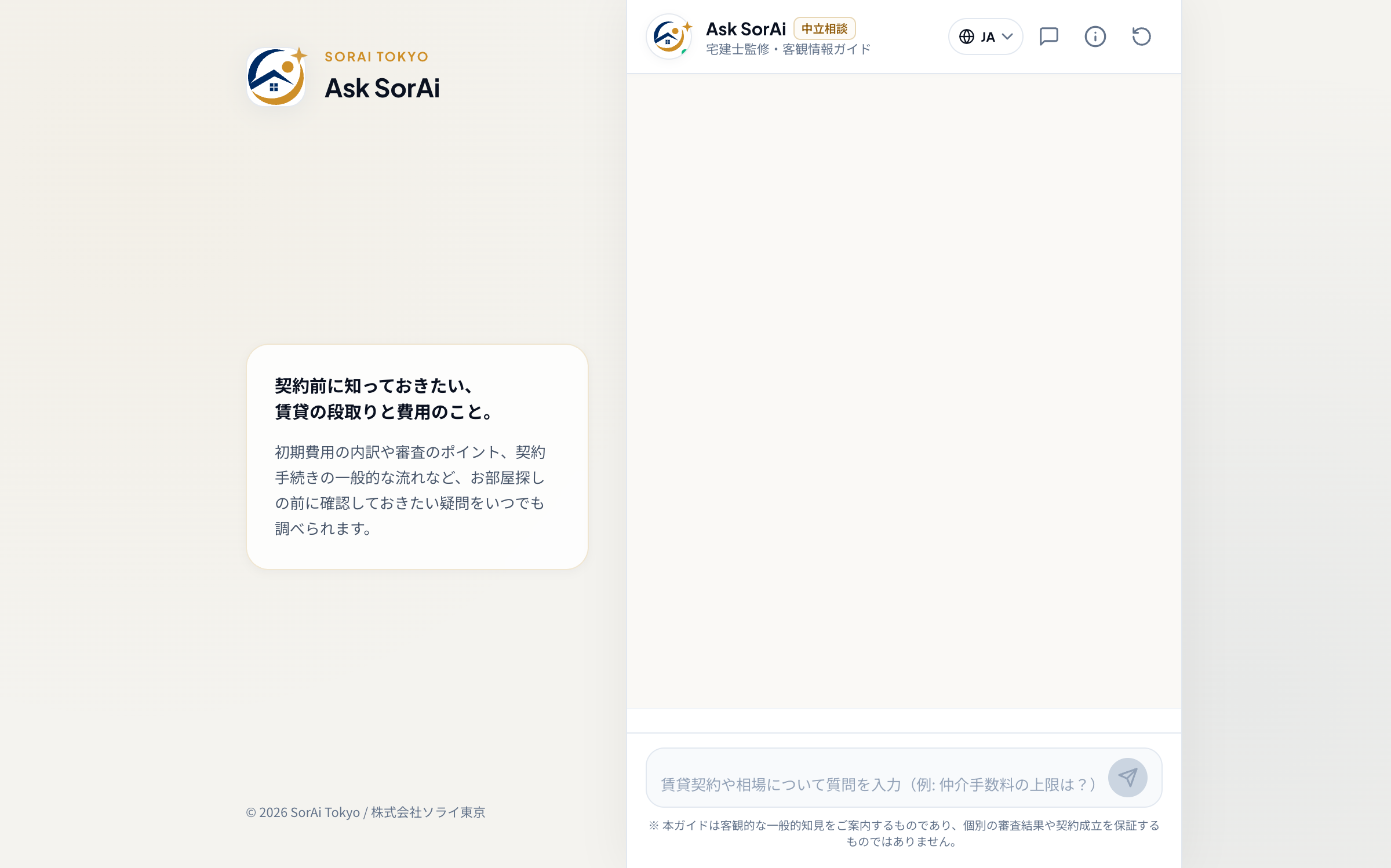
Standard chatbots embedded on corporate websites may seem convenient for a quick answer, but they come with a critical limitation: the moment you close your browser tab or navigate to another page, your entire conversation is wiped out.
Resolving tenancy disputes and auditing lease agreements requires time and patience. Whether you are waiting several days for a property manager to respond or carefully reviewing complex lease clauses in the quiet of your living room, you will often need to reference previous legal explanations and advice. By linking with our official LINE account, Ask SorAi securely preserves your conversation history for 14 days. You can reopen your chat history from your smartphone at any time, ensuring that your consultation context remains uninterrupted and allowing you to receive consistent, evolving advice as your situation unfolds.
| Feature Comparison | Standard Website Chatbots | Ask SorAi (Official LINE Exclusive) |
|---|---|---|
| Access Model | Open to any web visitor (single-use session) | Official LINE friends only (dedicated secure portal) |
| Chat History Retention | Lost instantly upon closing browser or tab | Securely stored for 14 days; review anytime on mobile |
| Domain Expertise | Generic property search and basic receptionist routing | Specialized in lease disputes, deposit refunds, rent hikes, and local pricing |
| Context Continuity | Context lost on return visits; must re-explain from scratch | Seamlessly maintains context throughout management negotiations |
| Sales Solicitations | Risk of follow-up calls when contact info is entered | Zero phone calls or aggressive sales (strict tenant defense) |
Specialized Knowledge Base Deeply Rooted in Lease Law, Disputes, and Tokyo Market Rates
Consulting general generative AI models or generic customer service chatbots about Japanese tenancy issues often leads to vague generalities or outright legal inaccuracies that clash with Japan's Act on Land and Building Leases and established judicial precedents.
Ask SorAi was engineered from the ground up to bypass superficial property filtering and everyday chit-chat, focusing specifically on lease procedures, statutory dispute resolution, and empirical Tokyo rental rate data. Built on the practical insights of licensed real estate brokers who have managed real-world leasing, renewals, and move-out inspections in Tokyo for over a decade, Ask SorAi operates on a specialized legal knowledge framework based on the field experience of licensed real estate brokers.
This specialized framework systematically incorporates the lessor repair obligations under Article 606 of the Civil Code, the rent increase/decrease claim rights under Article 32 of the Act on Land and Building Leases, the MLIT Restoration Guidelines, the Tokyo Metropolitan Rental Dispute Prevention Ordinance, landmark Supreme Court rulings, and real-time transaction data across Tokyo's 23 wards and major railway corridors. It delivers precise, actionable answers tailored to your exact scenario, equipping you with the legal clarity needed to address unfair charges and unilateral demands on equal footing.
Key Differences from Generic AI (Like ChatGPT) and Direct Benefits for Residents
With the widespread adoption of conversational AI, more residents are turning to tools like ChatGPT to review lease clauses or draft responses to property managers. While these general tools are easy to use, relying blindly on their recommendations during negotiations has frequently backfired: tenants have made legally flawed claims that alienated their landlords, or inadvertently agreed to pay fees they had no statutory obligation to cover.
Ask SorAi is built on an entirely different foundation. By embedding the practical expertise of licensed Japanese real estate brokers who understand local tenancy dynamics, statutory boundaries, and judicial standards, Ask SorAi serves as a functional, objective defense shield that protects residents from disadvantageous agreements.
| Evaluation Criteria | Generic AI Models (ChatGPT, etc.) | Ask SorAi Objective Advisory AI |
|---|---|---|
| Legal and Judicial Accuracy | Prone to hallucinations; often blends foreign laws or unverified online forum opinions | Strictly guided by licensed broker rules (Civil Code, Lease Act, MLIT guidelines, court rulings) |
| Ready-to-Send Email Templates | Offers abstract advice such as "contact your landlord to negotiate politely" | Provides ready-to-copy email drafts that assert your rights firmly and professionally |
| Local Statutes and Tokyo Rules | Lacks awareness of Tokyo-specific ordinances and Supreme Court special clause criteria | Fully compliant with Tokyo Rules and MLIT 6-year straight-line depreciation formulas |
| Preemptive Warning on Legal Pitfalls | Fails to anticipate downstream risks like statutory interest or fixed-term non-renewals | Proactively warns of the 10% annual interest rule (Lease Act Art. 32) and fixed-term lease limits |
| Context Retention and Continuity | Sessions expire quickly, forcing you to re-explain your situation from the beginning | Preserves 14 days of chat history via LINE; resume your case on your smartphone anytime |
| Sales Bias and Lead Steering | Many commercial tools steer users toward affiliated listings or sponsored moving services | Zero property sales and zero sales calls; dedicated strictly to neutral tenant advocacy |
Eliminating Inaccurate Assumptions and Erroneous Legal Assertions
Generic AI tools struggle most with the nuanced fact-finding and statutory interpretation required under Japanese real estate law. Because they are trained on broad internet content—including casual personal blogs and foreign legal systems—they frequently generate hazardous hallucinations, such as claiming that a verbal statement during an apartment viewing creates a binding lease cancellation penalty, or that deposits can never be refunded before lease signing.
Ask SorAi operates with 15 strict, broker-curated operational defense rules. It cross-checks user inquiries against the mutual assent standards of Civil Code Article 522, the mandatory full refund of holding deposits under Article 47-2 of the Real Estate Brokerage Act, the MLIT Restoration Guidelines (such as 6-year wallpaper depreciation, 10% or 1-yen residual value, and per-wall calculation standards), the Tokyo Rules, and the Supreme Court three-prong test for cleaning clauses. By eliminating ambiguous guesswork, Ask SorAi provides legally sound recommendations you can trust.
Practical, Ready-to-Send Email Templates for Clear Communication
When you ask a generic AI how to contest an unfair security deposit deduction, the response is often generic: "Call your property manager to ask for an itemized invoice" or "It is important to communicate your dissatisfaction politely." However, what tenants truly need in high-stress situations is the exact wording to assert their statutory rights without escalating into an emotional conflict.
Ask SorAi assesses your specific circumstances and immediately generates a professional, ready-to-copy email template tailored for your property manager or landlord. Whether you are requesting an itemized deposit recalculation, proposing formal discussions regarding a rent increase, or demanding urgent repairs for a broken air conditioner, these templates balance professional courtesy with clear legal grounding, enabling productive, level-headed dialogue.
Preemptive Warnings on Negotiation Traps: 10% Annual Interest and Fixed-Term Leases
In rental negotiations, pushing an aggressive demand without understanding the underlying legal framework can lead to unintended statutory liabilities. Because generic AI tools answer questions in isolation, they rarely anticipate these downstream risks.
For example, if you flatly refuse a landlord's rent increase notice and the dispute eventually goes to formal mediation or court, Article 32, Paragraph 2 (proviso) of the Act on Land and Building Leases dictates that if the court determines a higher rent was justified, the tenant must pay the accrued difference alongside a statutory interest rate of 10% per annum. Furthermore, if you reside under a Fixed-Term Tenancy (Teiki Shakuya), aggressive refusals may prompt the landlord to simply decline a contract renewal upon expiration, forcing you to vacate. Ask SorAi highlights these hidden procedural risks in advance, guiding you toward practical, well-balanced outcomes.
Seamless 14-Day History Retention via LINE: No Need to Repeat Your Case
In standard browser chats or free versions of generic AI models, conversation sessions reset after a short period of inactivity. Because property disputes often span several days or weeks, having to re-type background details—such as your monthly rent, the date the notice arrived, and previous management exchanges—creates unnecessary fatigue.
Through secure integration with your official LINE account, Ask SorAi preserves your dialogue history for 14 days. Even if a property manager takes several days to reply, you can simply open your chat and send a brief update: "The management company responded with this. How should I reply?" Ask SorAi recalls your full case history and delivers immediate, contextual next steps.
A Completely Neutral Defense Shield Free from Sales Steering or Broker Bias
Many online rental consultation services are commercial lead-generation funnels designed to steer renters toward in-house listings or sell customer contact information to affiliated moving and utility companies. As a result, their advice is often biased toward encouraging tenants to give up on their current home and move into a new property.
Ask SorAi by Sorai Tokyo operates with complete independence from brokerage sales steering. Its sole mission is to serve as an objective defense shield, resolving unnecessary anxieties and protecting your right to peaceful tenancy. Because no telephone number or real name is ever required, you can seek advice with complete peace of mind, knowing you will never receive promotional sales calls.
Legal Foundations for Pre-Contract Cancellations and Holding Deposits
During an apartment search in Tokyo, it is common to apply for a property and subsequently encounter unexpected changes—such as discovering an apartment with significantly better terms, or having a job transfer canceled. When applicants seek to withdraw their application, some real estate agencies claim that "cancellation fees apply because screening has already started" or that "holding deposits cannot be refunded."
Understanding the precise legal distinction between an application and an executed lease contract protects you from unlawful penalties.
| Procedural Stage | Contractual Status | Right to Cancel | Deposit Refund Obligation |
|---|---|---|---|
| 1. Submitting Application | Contract not formed | Freely cancellable without penalty | Full refund mandatory (Brokerage Act Art. 47-2) |
| 2. Screening Approval Notice | Contract not formed | Cancellable (no liability for damages) | Full refund mandatory regardless of fee label |
| 3. Important Matters Explanation | Contract not formed (pre-signing) | Right to refuse signing if terms are unacceptable | Full refund mandatory for all pre-contract deposits |
| 4. Executing the Lease Agreement | Contract fully formed | Treated as standard mid-term termination | Governed by lease terms (1-2 months notice rent) |
The Boundary Between Application and Contract Formation (Civil Code Article 522)
Under Article 522 of the Japanese Civil Code, a contract is formed upon the manifestation of mutual assent through an offer and corresponding acceptance. In residential leasing practice, submitting a rental application (Torisage/Moushikomisho) is merely an expression of intent to rent under specified conditions; it does not constitute a legally binding lease agreement, as screening and final landlord approval remain pending.
In standard Japanese real estate transactions, a lease agreement is legally finalized only after the licensed broker delivers the Explanation of Important Matters (IT Jyuusetsu or in-person briefing) and both parties execute the written or digital lease agreement. Prior to this formal execution, the applicant possesses the legal right to withdraw their application at any time without incurring cancellation penalties or damages.
Mandatory Refund of Holding Deposits Under Brokerage Act Article 47-2
Some brokerages ask applicants to pay an upfront sum—often described as an "application deposit" (Moushikomi Shoukokin), "holding deposit" (Azukarikin), or "entry fee"—ranging from a few thousand yen up to one month's rent. If you decide to withdraw your application, what happens to this money?
Article 47-2, Paragraph 3 of the Real Estate Brokerage Act, combined with Article 16-12, Item 1 of its Enforcement Regulations, explicitly prohibits licensed real estate operators from refusing to return holding deposits. Regardless of the label applied to the deposit, if an application is canceled prior to contract execution, the brokerage must promptly refund the entire amount in full. Deducting administrative fees or handling charges from this deposit is strictly unlawful.
Earnest Money vs. Holding Deposits: Mid-Term Lease Termination Rules
Unlike property purchase transactions, residential rental agreements in Japan rarely involve contractual earnest money (Tezuke) under Civil Code Article 557. Even if an agent refers to an advance payment as earnest money, its legal character prior to lease signing is almost always that of a temporary holding deposit, making it fully refundable under the Brokerage Act.
However, once you have received the Explanation of Important Matters and executed the lease contract (via physical seal or verified electronic signature), the transaction transitions from a pre-contract application to a binding legal agreement. If you choose not to move in after signing, the process is treated as an early lease termination (Chuto Kaiyaku). In this case, you will be required to comply with the lease's early termination notice period (typically 1 to 2 months' rent in lieu of notice), making clear awareness of the execution timing essential.
Move-Out Settlements and Security Deposit Rules: The Restoration Guidelines
When moving out of an apartment in Japan, many tenants discover that their security deposit (Shikikin) has been entirely depleted, or worse, that they have received a bill for hundreds of thousands of yen in additional restoration charges (Genjou Kaifuku). Items such as full-room wallpaper replacement, floor waxing, and internal air conditioner cleaning are frequently billed to tenants without proper legal justification.
The definitive tools for protecting your security deposit are the "Restoration Guidelines for Tenancy Disputes" established by the Ministry of Land, Infrastructure, Transport and Tourism (MLIT) and the Tokyo Metropolitan Rental Dispute Prevention Ordinance (Tokyo Rules).
| Area & Type of Wear | Cost Allocation | Service Life & Calculation Standards |
|---|---|---|
| Wallpaper (Normal wear, sunlight fading) | Landlord responsibility | Natural discoloration and electrical static shadows behind appliances belong to the landlord |
| Wallpaper (Intentional or negligent damage) | Tenant responsibility (residual value) | 6-year service life depreciated to 10% (or 1 yen). Apportioned strictly to the damaged wall section |
| Flooring (Sunlight fading, furniture indents) | Landlord responsibility | Depressions from heavy furniture and sunlight fading represent ordinary living wear |
| Flooring (Rain damage from open windows, deep gouges) | Tenant responsibility (localized repair) | Water stains from open windows or pet scratches are tenant obligations; limited to damaged planks |
| Room Cleaning Fees | Landlord responsibility by default | If basic cleaning was maintained, covered by rent. Special clauses require meeting 3 strict criteria |
Core Principles of MLIT Guidelines: Normal Wear and Tear Belongs to the Landlord
The MLIT Restoration Guidelines define restoration as "restoring building value reduction caused by a tenant's intentional acts, negligence, failure to fulfill the duty of care of a prudent manager (Zenkan Chuui Gimu), or use exceeding ordinary residential wear."
In other words, the natural wear and tear (Tsuujou Sonmou) and aging deterioration (Keinen Rekka) that occur during everyday living are legally compensated through your regular monthly rent. Landlords cannot shift the cost of refreshing their property for the next prospective resident onto the departing tenant.
- Indentation marks on flooring or tatami mats from ordinary furniture placement
- Wallpaper discoloration and tatami fading caused by natural sunlight exposure
- Dark electrical shadow marks on walls behind refrigerators and televisions
- Natural internal dust accumulation inside air conditioners from standard usage
- Lock replacement costs for onboarding the next tenant (unless validly contracted otherwise)
- Mold expansion on window frames or walls resulting from neglected condensation
- Severe cigarette smoke residue, nicotine discoloration, and lingering tobacco odor
- Deep gouges or scratches caused by dropping heavy items or moving furniture carelessly
- Scratches on structural posts and odor caused by unauthorized pet breeding
- Stubborn kitchen grease or bathroom lime scale resulting from a gross neglect of basic cleaning
6-Year Wallpaper Depreciation, 10% Residual Value, and Single-Wall Calculation
Even if you accidentally damage a section of wallpaper while moving a bookshelf, you are not responsible for paying to replace the wallpaper across the entire room. The MLIT Guidelines establish that standard vinyl wallpaper has an economic service life of exactly 6 years.
Six years after installation, the depreciated accounting value of the wallpaper drops to 10% (or 1 yen under updated tax depreciation schedules), meaning the tenant's liability is capped at that remaining fraction. For instance, if you damage wallpaper after living in the property for 3 years (half its service life), your maximum liability is approximately 50% of the replacement cost for that specific section. Furthermore, repair calculations must be apportioned strictly to the single damaged wall panel (Ichimen Anbun), rather than the whole room.
Key Provisions of the Tokyo Rules (Dispute Prevention Ordinance)
For rental properties located in Tokyo, the Tokyo Metropolitan Rental Dispute Prevention Ordinance (commonly referred to as the Tokyo Rules) provides an additional layer of consumer protection. Under this ordinance, licensed real estate brokers are legally required to deliver a written explanation of restoration cost principles and minor repair obligations prior to lease execution.
The Tokyo Rules clearly establish that standard wear and tear must be absorbed by the landlord and define the precise scope of minor tenant repairs, acting as a strong legal deterrent against one-sided contractual burdens. If you encounter inflated move-out bills in Tokyo, referencing the Tokyo Rules document you received at signing is one of your most effective defenses.
Supreme Court Landmark Ruling (Dec. 16, 2005): 3 Criteria for Valid Cleaning Clauses
Many residential lease agreements include a special clause stating that "the tenant shall bear the room cleaning fee upon vacating." However, the presence of such a clause does not automatically make the full charge legally enforceable.
In its landmark judgment of December 16, 2005, the Supreme Court of Japan ruled that for a special clause shifting ordinary wear-and-tear restoration costs to a tenant to be legally valid, it must satisfy three rigorous criteria:
- Objective Clarity: The scope of costs and the specific monetary amount (or clear calculation formula) must be explicitly stated in the agreement.
- Informed Consent: The tenant must have received sufficient explanation and possessed a clear, mutual understanding that they were accepting costs beyond their statutory obligations.
- Absence of Usurious Advantage: The terms and amounts must be reasonable according to socially accepted standards and must not violate good faith principles.
If a contract merely states that the tenant "will pay for cleaning upon moving out" without a clear monetary amount, the clause is frequently deemed void under consumer protection principles.
When disputing questionable charges on a move-out invoice, sending a calm, fact-based email referencing official MLIT guidelines is the most effective way to achieve a fair resolution without confrontation.
Dear [Management Company Name] Representative,
Thank you for your assistance during my tenancy at [Building Name] #[Room Number]. I have received and reviewed the move-out settlement statement you kindly sent.
Upon reviewing the details, there are several items regarding the repair calculations that I would appreciate clarifying in light of established guidelines.
According to the MLIT "Restoration Guidelines for Tenancy Disputes," wallpaper repairs are subject to a standard 6-year straight-line depreciation schedule, with tenant liability limited to the residual value and calculated on a per-wall basis for the damaged area.
Could you please share the detailed calculation basis for the wallpaper replacement and cleaning fees, including the square-meter unit price and the depreciation rate applied for my [X] years of tenancy?
Thank you very much for your time and understanding. I look forward to hearing from you at your earliest convenience.
Sincerely,
[Your Full Name]
[Your Contact Details]
Responding to Rent Increase Demands: Practical Application of Lease Act Article 32
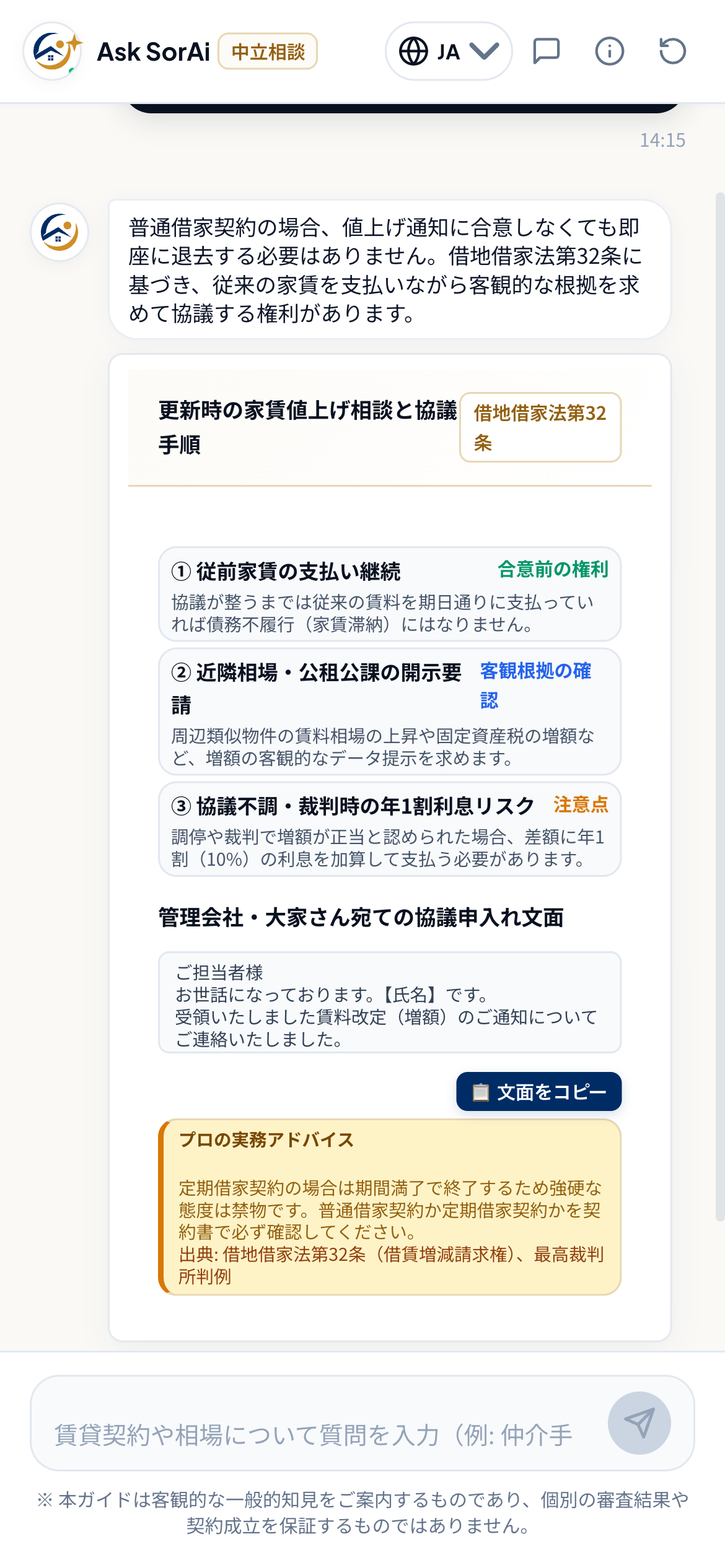
Amid rising inflation, shifting property taxes, and regional development, more landlords and management companies across Tokyo are sending formal notices requesting rent increases—such as announcing an extra 10,000 JPY per month starting next quarter. Many residents assume that if they disagree with the proposed increase, they will be forced to vacate their apartment immediately.
Under Japanese law, a rent increase cannot be enacted through a landlord's unilateral demand alone. Tenants in Japan are granted robust legal protections that secure their right to peaceful continued occupancy.
| Action Phase | Recommended Tenant Response | Legal Standing & Key Safeguards |
|---|---|---|
| 1. Receiving Notice | Request objective evidence (market comparables, tax changes) justifying the increase | A unilateral letter does not alter the lease. You are not required to sign immediate consent. |
| 2. Engaging in Discussion | Express your living situation and budget calmly, proposing realistic mutual discussions | Statutory negotiations under Lease Act Art. 32. Impasse does not justify immediate eviction. |
| 3. Continuing Rent Payments | Pay your existing (pre-increase) rent amount strictly on time via regular bank transfer | Paying the existing rent completely shields you from claims of lease default or rent arrears. |
| 4. Official Legal Deposit | If the owner refuses your existing rent payment, deposit it at the Legal Affairs Bureau | Official deposit (Kyotaku) legally satisfies your payment obligation, nullifying eviction attempts. |
Statutory Criteria for Rent Modification Claims Under Lease Act Article 32
Article 32, Paragraph 1 of the Act on Land and Building Leases allows either party to request an adjustment of rent for the future when the current rent has become unreasonable due to:
- Increases or decreases in property taxes and public burdens levied on the land or building
- Appreciation or depreciation of real estate values and broader economic changes
- Discrepancies compared to prevailing rents of comparable neighboring properties
Crucially, this right is bilateral—tenants can also request reductions if market conditions decline—and cannot be exercised simply on subjective claims of inflation. The landlord bears the legal burden of presenting concrete, objective proof demonstrating that the existing rent is demonstrably below comparable market benchmarks.
The Fundamental Rule During Impasse: Paying Existing Rent Prevents Default
The single most important statutory rule for tenants facing a rent increase notice is found in Article 32, Paragraph 2: until formal agreement is reached, the tenant fulfills their legal obligation by continuing to pay the amount they deem appropriate (typically the existing contract rent).
Even if discussions reach a temporary stalemate, paying your previous rent on time ensures you are not in legal default (Saimu Furikou). Even if a management company claims that "refusing the increase means immediate eviction," a landlord cannot terminate a standard residential lease without rigorous, legally recognized "just cause" (Seitou Jiyuu), which rent negotiations alone do not satisfy.
Handling Refusal of Payment: The Legal Affairs Bureau Official Deposit (Kyotaku)
On rare occasions, an aggressive landlord or manager might attempt to force acceptance by refusing to accept the existing rent, rejecting bank transfers, or turning off automated debit services.
If you fail to take action when payment is refused, you risk giving the landlord grounds to claim non-payment. In this situation, you should immediately visit the nearest Legal Affairs Bureau (Houmukyoku) and complete a "Performance Deposit" (Bensai Kyotaku) under Civil Code Article 494. Depositing your existing rent with the government agency legally extinguishes your payment obligation, completely eliminating any grounds for lease termination.
The 10% Annual Interest Rule and Finding a Constructive Compromise
While tenants have strong rights, it is equally important to be mindful of Article 32, Paragraph 2 (proviso). If negotiations break down and the matter is settled through court mediation or litigation that finds an increase was justified, the tenant must pay the accrued difference between the paid amount and the court-determined rent, plus interest calculated at 10% per annum.
If objective market data indicates that neighborhood rents have indeed surged, escalating the dispute to formal court proceedings may lead to retroactive interest liabilities. Consulting Ask SorAi to evaluate real-time neighborhood benchmarks allows you to explore pragmatic compromises—such as agreeing to a modest adjustment of 2,000 to 3,000 JPY per month, or proposing to maintain current rates until the next renewal.
Standard Leases vs. Fixed-Term Leases: Critical Strategic Differences
Before entering any rent negotiation, check whether your lease is a Standard Tenancy (Futsuu Shakuya) or a Fixed-Term Tenancy (Teiki Shakuya).
Under a Standard Tenancy, tenant rights are heavily protected, and a landlord cannot refuse renewal without substantial just cause. Conversely, a Fixed-Term Tenancy terminates definitively upon the expiration of its term; re-contracting is entirely at the landlord's discretion. If you hold a Fixed-Term Lease and strongly refuse a rent adjustment, the owner may simply choose not to re-contract when the lease ends. Understanding your contract type is essential for choosing the right negotiation approach.
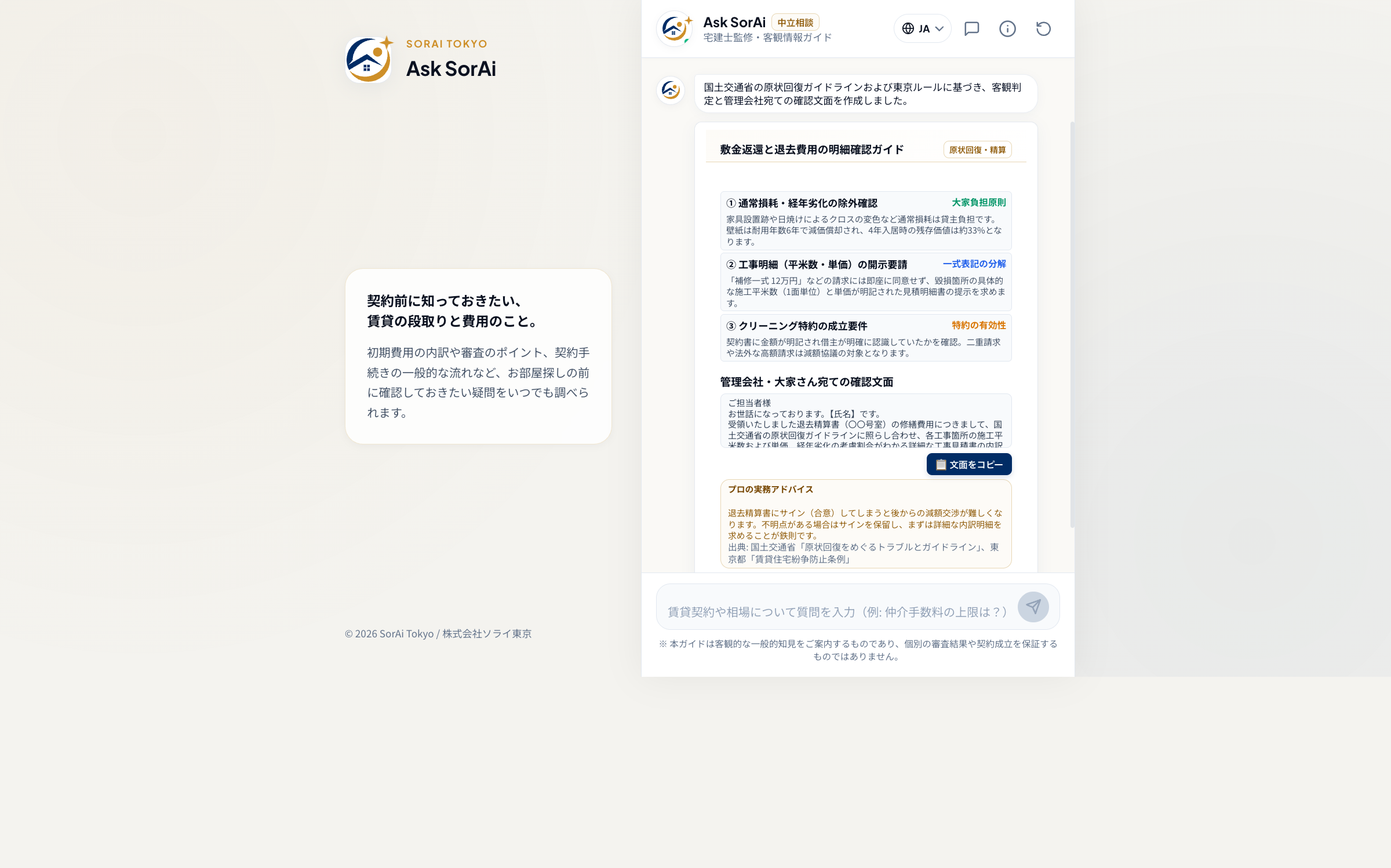
Rather than rejecting a rent increase notice outright, this template opens a constructive conversation by requesting objective supporting data while confirming your continued payment of existing rent.
Dear [Management Company Name] / [Landlord Name],
Thank you for your ongoing support. I am writing regarding the recent notice concerning a proposed revision of the monthly rent for unit #[Room Number].
While I understand that general economic conditions and operating costs have fluctuated, an increase of [Amount] JPY represents a significant adjustment for our household budget, making immediate acceptance difficult.
In accordance with Article 32 of the Act on Land and Building Leases, could you please provide the objective data supporting this adjustment, such as comparable transaction rates in our immediate neighborhood or specific changes in public assessments?
Please note that while we engage in mutual discussions, I will continue to pay the existing rent amount ([Current Rent] JPY/month) punctually in accordance with Article 32, Paragraph 2 of the Act.
I appreciate your understanding and look forward to reaching an amicable solution together.
Sincerely,
[Your Full Name]
[Your Contact Details]
Equipment Failures, Repair Obligations, and Rent Reduction Guidelines
An air conditioner failing in the height of Tokyo's humid summer or a water heater breaking down in mid-winter can disrupt your daily life. It is not uncommon for tenants to notify their management company, only to be met with weeks of silence under the pretext that contractors are unavailable or owner approval is pending.
Following the major revisions to the Japanese Civil Code in April 2020, tenant protections regarding residential equipment failures were codified into clear, enforceable statutory rights.
| Affected Equipment | Grace Period (Cure Window) | Standard Rent Reduction Rate | Practical Impact on Living Quality |
|---|---|---|---|
| Air Conditioner (Total loss of heating/cooling) | 3 Days | 5,000 JPY/month or 10% reduction | Loss of climate control; elevated health risk in summer/winter |
| Water Heater (No hot water) | 3 Days | 10% reduction (plus public bath reimbursement) | Inability to bathe; loss of hot water for cooking and cleaning |
| Toilet (Inoperable, sewage backup) | 1 Day | 20% to 30% reduction | Complete loss of sanitation facilities; severe disruption |
| Water Supply (Total loss of running water) | 1 Day | 30% to 50% reduction | Complete disruption of drinking, cooking, bathing, and hygiene |
| Bathroom (Broken tub or shower) | 3 Days | 10% reduction | Inability to shower at home; necessity of external public baths |
Landlord Repair Obligations (Civil Code Article 606) and Tenant Duty of Notice
Under Article 606, Paragraph 1 of the Civil Code, the lessor bears a statutory obligation to make all repairs necessary for the tenant's use and enjoyment of the leased property. In residential rentals, standard fixtures—such as installed air conditioners, water heaters, ventilation fans, and washlet toilets—are considered part of the living space covered by your monthly rent. Their maintenance is the landlord's statutory duty.
At the same time, tenants hold a reciprocal duty. Under Article 615, when repairs are required, the tenant must notify the lessor without delay. Neglecting to report an issue—such as ignoring a small pipe leak until it damages flooring—can expose the tenant to liability for breach of due care (Zenkan Chuui Gimu). Promptly documenting and reporting any defect in writing is your best legal protection.
The Tenant's Right of Self-Repair (Civil Code Article 607-2)
Prior to 2020, tenants were often unsure whether hiring their own contractor to fix broken equipment would be reimbursed. The revised Civil Code introduced Article 607-2, explicitly establishing the tenant's right of self-repair under either of the following conditions:
- The tenant has notified the lessor that repairs are necessary, but the lessor fails to perform the necessary repairs within a reasonable timeframe.
- There are pressing and urgent circumstances (e.g., a burst pipe flooding the apartment during a freezing holiday weekend when the landlord cannot be reached).
When you exercise this statutory right, you are legally entitled under Civil Code Article 608, Paragraph 1 to demand immediate and full reimbursement (Hiyou Shoukan Seikyuu) from the landlord for all necessary expenses incurred.
Automatic Statutory Rent Reductions and the JPM Industry Guidelines
Under Civil Code Article 611, Paragraph 1, if any part of the leased premises becomes unusable, the rent is automatically reduced in proportion to the unusable portion. Crucially, the revised law states that this reduction occurs by operation of law—it does not require a formal dispute to become an entitlement.
To establish fair monetary figures, Japanese property managers rely on the "Rent Reduction Guidelines for Equipment Failures in Rental Housing" published by the Japan Property Management Association (JPM). For an air conditioner failure, standard benchmarks suggest a reduction of approximately 5,000 JPY per month (or 10% of monthly rent), calculated on a pro-rata daily basis once the initial 3-day grace period has passed.
Documenting maintenance requests in writing establishes clear evidence of the date of notice, paving the way for self-repair reimbursement and statutory rent reductions.
Dear [Management Company Name] Representative,
I am writing to follow up on the air conditioning failure in unit #[Room Number], which I previously reported on [Date]. Could you please provide an immediate update on the contractor schedule?
The unit remains completely inoperable, creating extreme room temperatures that present a serious health risk. Under Civil Code Article 606, Paragraph 1, the lessor is obligated to maintain essential living equipment.
Please note that if a concrete repair schedule is not provided by [Date, e.g., 3-5 days from notice], I will proceed with arranging an authorized repair service independently in accordance with Civil Code Article 607-2, Item 1.
All costs incurred will be billed directly to the lessor pursuant to Civil Code Article 608.
Furthermore, I request that a pro-rata rent reduction be applied to my next monthly invoice in accordance with Civil Code Article 611 and standard JPM industry guidelines.
Thank you for your prompt attention to this urgent matter.
Sincerely,
[Your Full Name]
[Your Contact Details]
Screening Strategies for Freelancers and International Residents, Plus Tokyo Market Data
Finding a home in Tokyo should be an exciting milestone. Yet, despite Japan's expanding international workforce, traditional tenant screening practices can still present hurdles for freelancers, entrepreneurs, and foreign residents.
By understanding how guarantor companies evaluate applications and preparing the right supporting documents in advance, you can substantially improve your approval rates.
Screening Preparation for Freelancers: Documentation and Bank Balance Reviews
Unlike full-time salaried employees, freelancers and independent contractors do not receive monthly payslips. As a result, guarantor companies focus heavily on the stability and continuity of your income. The traditional affordability guideline is that monthly rent should not exceed one-third of your net income; for freelancers, this is calculated based on taxable income after business deductions on your tax return.
If you are in your first year of freelancing or have deducted significant expenses, presenting bank statement copies demonstrating steady client deposits, active service contracts, or a bank balance certificate showing at least two years of rent reserves can make a substantial difference. Choosing properties that utilize independent guarantor companies (Dokuritsukei) rather than credit-agency-linked companies (Shinpan-kei) is another effective strategy.
Screening Insights for Foreign Residents: Visas and Language Considerations
While Tokyo is increasingly cosmopolitan, some landlords remain hesitant due to concerns regarding Japanese communication, daily trash disposal etiquette, or the availability of an emergency domestic contact.
To ensure a smooth screening process, international applicants can build confidence by submitting a valid Residence Card with ample visa duration, an employment verification letter, and, where applicable, a Japanese Language Proficiency Test (JLPT) certificate. Many institutional landlords now partner with multilingual guarantor companies that provide native English support, opening up a wide variety of quality rental options.
Proxy Contracts vs. Illegal Name Lending: Knowing the Legal Boundaries
When an applicant is between jobs or studying, having a family member sign the lease is often considered. Here, it is vital to distinguish between a legitimate proxy contract and illegal name lending (Meigi-kashi).
A legitimate family proxy contract involves full disclosure to the landlord—openly explaining that the parent is the legal contracting party while the child is the registered occupant. In contrast, concealing the occupant's identity and signing under another person's name constitutes unauthorized subleasing under Civil Code Article 612 and may amount to fraud, resulting in immediate lease termination. Transparency during the application stage is essential.
Evaluating Tokyo Market Rents: Comparing True Effective Costs
Rental rates displayed on public portal sites reflect the landlord's initial asking price, which may differ from final transacted averages. Furthermore, comparing properties solely on monthly rent overlooks upfront costs—such as key money (Reikin), agency fees, free-rent concessions, and guarantor fees—which significantly alter the effective monthly cost.
Ask SorAi draws on a market database of actual transaction data across Tokyo's 23 wards and major commuter railways, allowing you to quickly benchmark whether an advertised rent is aligned with fair market value. Evaluating these factors before signing ensures your tenancy remains financially sustainable.
When searching for a home or reviewing lease terms, explore our complete suite of smart tools (SorAi). From your smartphone's bottom menu or our website footer, you can freely access our Move-In Cost Simulator, Property Diagnostic Reports, Custom Search Requests, and Online Consultation Bookings anytime.
Through our official LINE account, you can simply send the URL of any apartment found on public rental portals. Our licensed real estate brokers will cross-reference internal industry databases to verify real-time availability, perform a detailed review of upfront fees, and provide a transparent second opinion on third-party estimates—entirely free and online. With zero sales calls or high-pressure tactics, we invite you to connect with us whenever you need reliable guidance.
Protecting Your Serene Living Environment with Practical Legal Knowledge
Whether you are enjoying a warm cup of coffee in a sunlit living room or returning to the quiet comfort of your apartment after a busy day in Tokyo, your home is more than physical square footage. It is your personal sanctuary—a foundation for rest, rejuvenation, and daily well-being.
When unexpected tenancy disputes arise—whether over deposit deductions, sudden rent increases, or unresolved equipment issues—you do not have to navigate them alone. Japanese law and public guidelines provide robust protections designed to secure peaceful, fair tenancy for conscientious residents. Success lies in avoiding heated emotional exchanges, grounding your stance in objective facts and clear statutory rules, and engaging in steady, professional dialogue.
Ask SorAi by Sorai Tokyo stands ready around the clock as your reliable, objective advisory companion. Whenever you face a question or concern regarding your home in Tokyo, we invite you to open Ask SorAi and explore your rights with complete confidence.



Frequently Asked Questions About Ask SorAi
QIs Ask SorAi truly free to use? Are there any hidden fees or follow-up sales calls?
AYes, Ask SorAi is completely free for anyone who connects with our official LINE account. The system does not require your phone number, legal name, or physical address. There are zero consultation fees, and our architecture prevents follow-up sales calls or marketing outreach. You can use our neutral advisory tools with complete peace of mind.
QHow does Ask SorAi differ from standard website chat widgets?
AStandard web chat widgets lose your conversation history as soon as you close the browser tab or switch pages. Ask SorAi links securely with your official LINE account, safely retaining your chat history for 14 days so you can revisit past discussions anytime. This allows you to maintain full context across ongoing landlord negotiations. In addition, Ask SorAi specializes deeply in lease disputes, security deposit refunds, rent negotiations, and Tokyo market data rather than generic property browsing.
QMy management company says I must pay a cancellation penalty even though I haven't received the Important Matters Explanation. Is that legal?
ANo, you are not legally obligated to pay a cancellation fee. Under the Real Estate Brokerage Act and general Civil Code principles, a lease contract is not formed until the Important Matters Explanation is delivered and the contract documents are formally executed. Prior to this, an applicant may withdraw freely without penalty. Furthermore, any holding deposit or application fee paid must be refunded in full pursuant to Article 47-2 of the Real Estate Brokerage Act.
QMy move-out repair quote is unexpectedly high. What should I do before signing the deposit settlement agreement?
ADo not sign or verbally accept any settlement invoice if you disagree with the charges, as doing so makes subsequent negotiation far more challenging. Review the invoice against the MLIT Restoration Guidelines to check whether straight-line depreciation (such as 6-year wallpaper lifespan) has been applied and whether charges include normal wear and tear that the landlord should bear. Then, request an itemized recalculation in writing using our provided email template.
QCan my landlord refuse to renew my lease and evict me if I disagree with a rent increase notice?
AUnder a standard residential lease, a landlord cannot refuse lease renewal or force an eviction simply because you do not consent to a rent increase. Under Article 32, Paragraph 2 of the Act on Land and Building Leases, as long as you continue paying your existing rent amount on time during discussions, you are not in legal default, and your tenancy rights remain fully protected under Japanese law.
QWhat makes Ask SorAi different from general AI assistants like ChatGPT?
AGeneral AI tools frequently confuse Japanese real estate statutes with foreign laws or informal blog commentary, resulting in legal hallucinations regarding deposit refunds or depreciation formulas. Their advice is also often limited to vague suggestions like "contact management to discuss." Ask SorAi operates on strict defense rules supervised by licensed Japanese brokers, integrating the Civil Code, Lease Act, MLIT Guidelines, and Tokyo Rules. It generates ready-to-send email drafts and preemptively warns you of downstream risks, such as statutory interest or fixed-term lease limits. Furthermore, its 14-day history retention via LINE allows for continuous support across multi-day negotiations.

Author: Sorai Tokyo Editorial Team (Supervised by Licensed Real Estate Agents)
A real estate consulting team specializing in assisting foreign nationals find rooms and explaining initial costs in Tokyo. We break down language barriers and differences in customs, offering dedicated support in Japanese, English, and Vietnamese for a safe and secure start to your new life.