
On a dusk walk home from work, passing the warm aroma of prepared dishes drifting along Kita-Senju's Shukubamachi-dori and returning to your apartment building, many people have felt a sudden unease upon finding an unfamiliar envelope from the management company in their mailbox. Opening it under the soft light of the dining room and seeing a notice stating, "Your rent will be revised starting from the next renewal," or "Please remit an additional security deposit to cover the difference with the new rent," or receiving a steep move-out settlement statement after the final inspection—at that moment, a great many tenants find themselves worrying alone, wondering, "Will I be unable to continue living here if I do not comply?"
Faced with specialized legal terminology lined up in a lease agreement and matter-of-fact notices from a management company, it is not easy for a tenant with limited knowledge or negotiation experience to engage in discussions on equal footing. In my own experience of over 10 years handling lease administration and move-out settlement consultations in Tokyo's rental market, I have heard countless voices saying, "I signed the consent form without really understanding it," or "I did not know who to ask, so I ended up swallowing the loss."
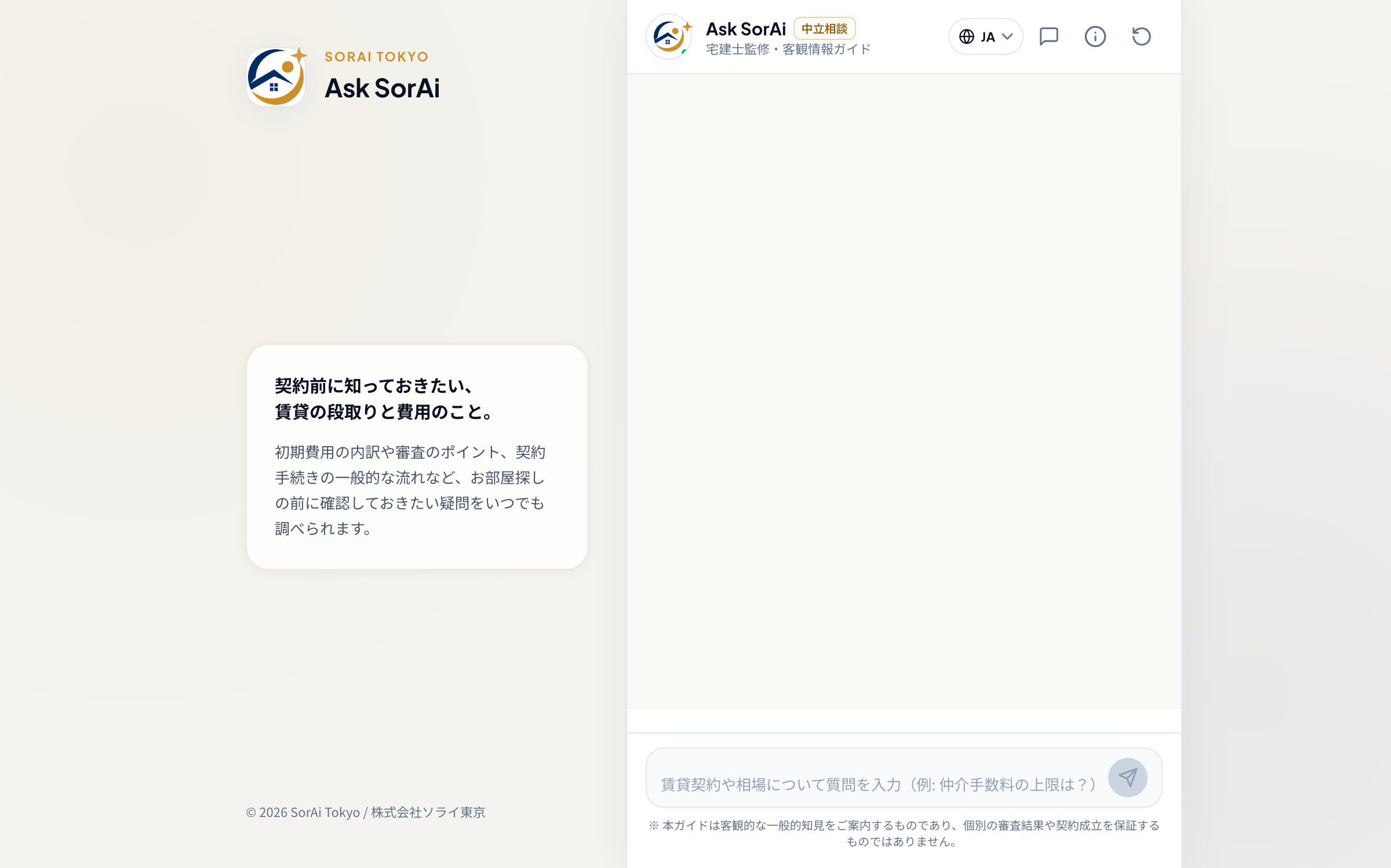
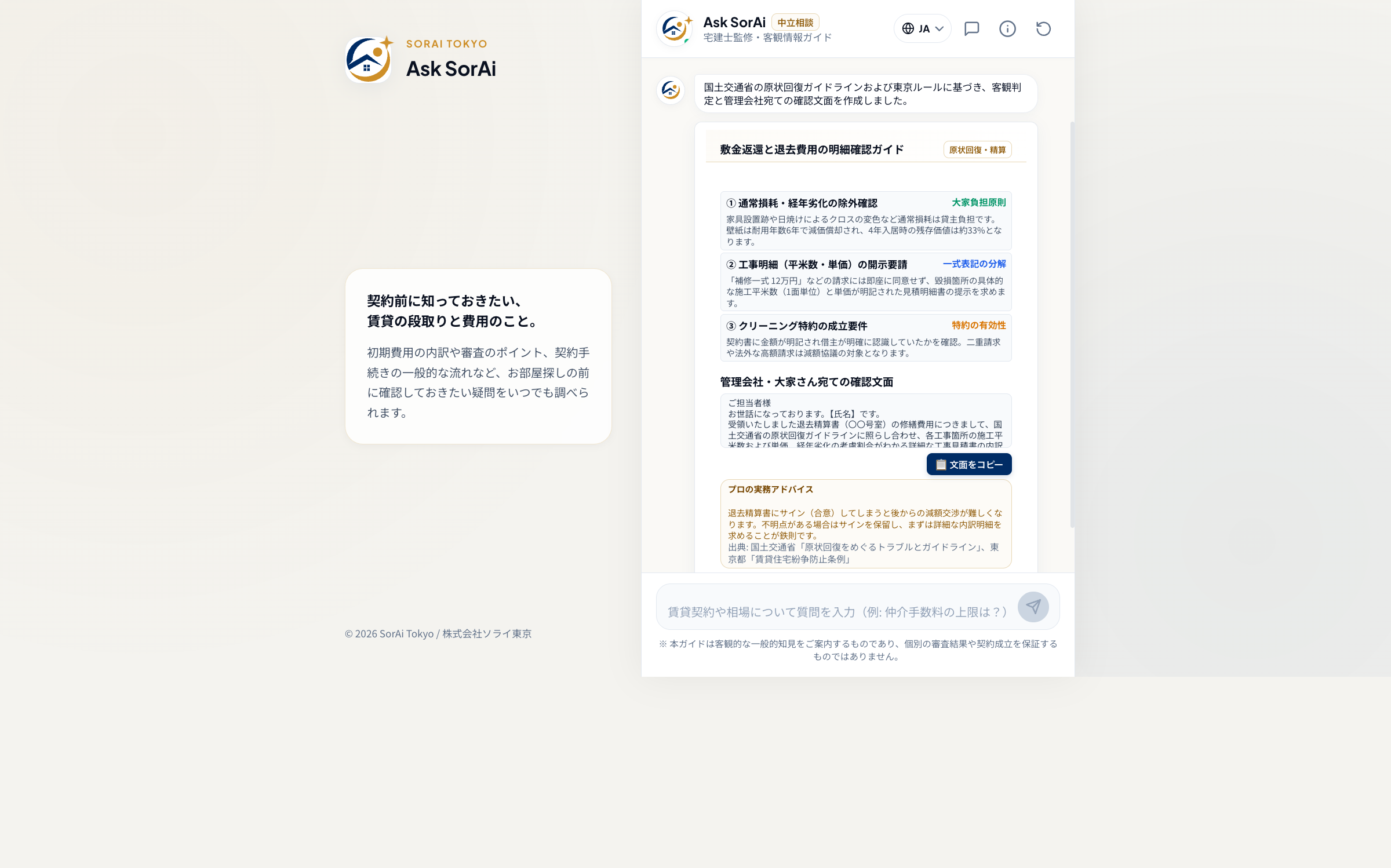
To gently support you through such uncertainties and isolation in daily life, and to deliver clear legal criteria as if serving tea across a calm counter, we developed "Ask SorAi (SorAi Contract & Market Guide)," a free AI consultation portal exclusively for official LINE friends. No registration of your phone number or name is required; based on the Civil Code, the Act on Land and Building Leases, Ministry of Land, Infrastructure, Transport and Tourism guidelines, Supreme Court precedents, and objective Tokyo rent market data, you can organize a concrete path forward to protect your cherished home and rights 24 hours a day.
- A rent increase is not finalized by the landlord's notice alone; as long as you pay the previous rent on time during negotiations, the lease cannot be terminated.
- Providing an additional security deposit following a rent revision is, in principle, not a legal obligation unless there is an explicit increase clause in the lease agreement.
- For wallpaper replacement upon move-out, public guidelines are based on a 6-year useful life, a residual value of 1 yen after 6 years, and prorated calculation per single wall surface.
Features of the Objective Consultation Portal "Ask SorAi" for Rental Contract Questions and How It Differs from General AI
When facing housing contract disputes or changes in terms at renewal, what residents need most is not a sales pitch for another property or a push to move, but a neutral advisor who can objectively organize their current situation in light of Japanese law and local market rates. Provided by Sorai Tokyo, the objective AI consultation portal "Ask SorAi (https://ask.soraitokyo.jp)" is separated from apartment-hunting inquiry desks and designed as a dedicated environment specializing in contract procedures, legal disputes, and market rate verification.
Official LINE Integration That Carries Over 14 Days of Consultation History Without Phone Number Registration
On typical free real estate consultation desks or appraisal sites, users are often required to enter their name, phone number, and email address before they can even submit a question. Worried about receiving follow-up phone calls or sales pitches after registering their contact details, many people end up accepting the terms presented by their management company without ever consulting anyone. Ask SorAi can be used solely through one-tap authentication via our official LINE account, with no need to register your name, phone number, or current street address. Without leaning toward the position of any specific landlord or management company, it maintains a neutral consultation space that protects residents' rights and peaceful daily lives.
Another major difference from standard simple chatbots on websites is the continuity of your conversation history. Confirming lease agreements or discussing rent revisions is rarely resolved in a single day's exchange. When you contact a management company to confirm a point and receive a reply from their representative a few days later, a web chat that disappears the moment you close the browser forces you to re-enter your contract terms and background from scratch in a long message. Because Ask SorAi securely retains your conversation history for the past 14 days through its integration with official LINE, you can simply add a short note a few days later—such as, "I received this reply from the management company. How should I respond next?"—and receive concrete advice based on your previous context.
Differences from General Web Chats and General-Purpose AI Tools, and Practical Message Drafting
In recent years, more people have been entering questionable clauses from their contracts or questions about move-out costs into general-purpose AI tools to look them up. While they offer the convenience of grasping a quick overview, general-purpose AI tools are trained on a mix of personal anecdotes from the internet and even overseas rental laws. This creates the danger of them presenting plausible-sounding answers that contradict Japan's unique Land and Building Lease Act, Tokyo Metropolitan ordinances, or Supreme Court precedent requirements. In actual practice, we have seen clients who nearly gave up rights they were entitled to claim because they believed incorrect information—such as "expressing an intent to apply verbally during a viewing incurs a cancellation fee," or "even before signing the contract, deposited money will not be returned."
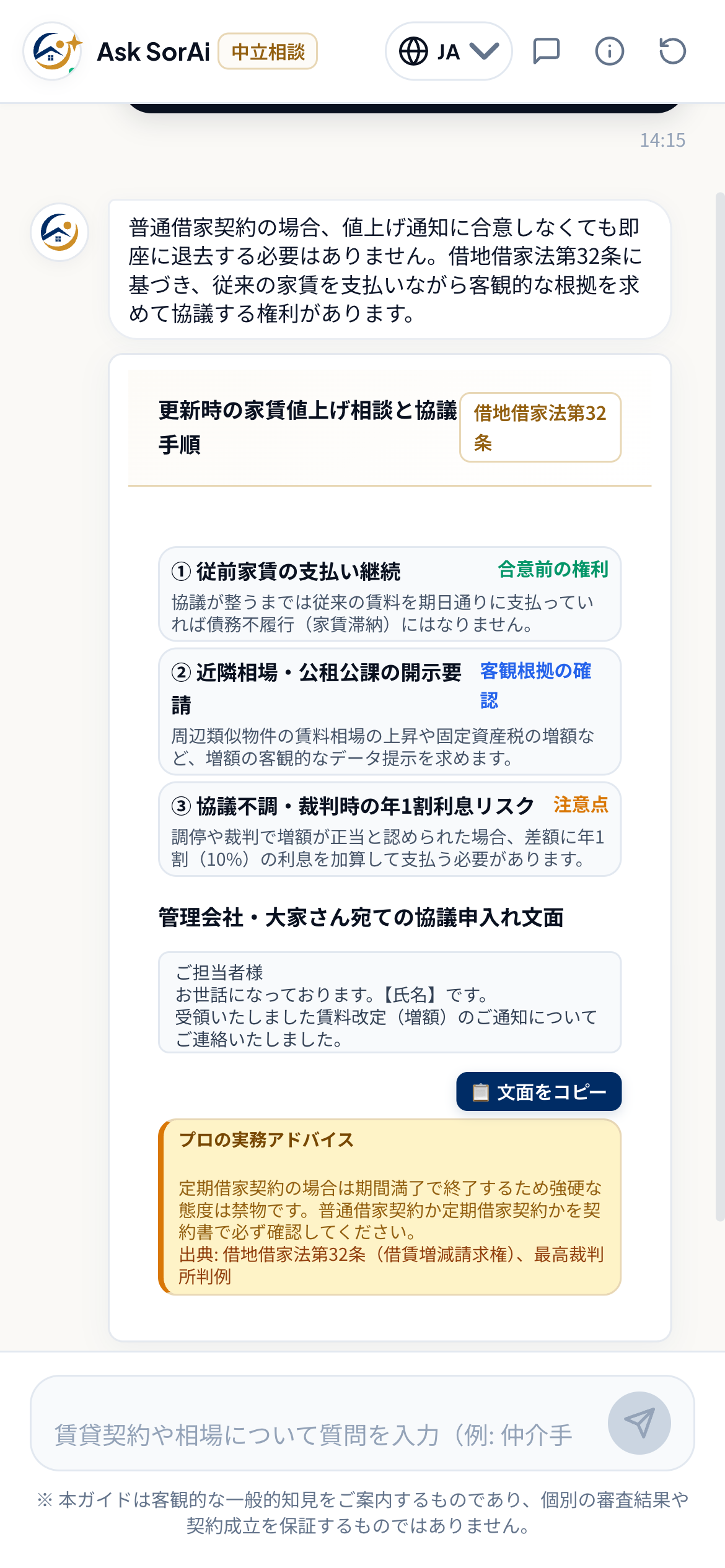
Furthermore, even if you ask a general consultation tool, "I am not convinced by the security deposit settlement or rent increase," it almost always ends with a textbook generalization like, "Let's check the breakdown with the management company and negotiate sincerely." What residents truly struggle with is the practical phrasing: "Specifically what words should I choose to convey the legal grounds without straining my relationship with the management company or landlord?" Based on protective rules supervised by licensed Real Estate Transaction Specialists (Takken-shi), Ask SorAi organizes the legal points while also drafting polite confirmation and negotiation emails that you can copy and paste directly from your smartphone and send.
| Comparison Item | General Web Chat | General-Purpose AI Tool | Ask SorAi (Official LINE Exclusive) |
|---|---|---|---|
| Usage Steps & Personal Info | May require entering name and contact info when inquiring | Available by creating an account | Official LINE integration only; no name or phone number registration required |
| Chat History Continuity | History is easily lost when closing tabs or navigating pages | Requires re-entering preconditions if threads are separated | Retains past 14 days of history for continuous consultation across multiple days |
| Accuracy on Japanese Real Estate Law & Precedents | Focused on property tours and store visit reservations | Risk of misjudgment due to mixing folklore and overseas laws | Compliant with the Civil Code, Land and Building Lease Act, MLIT Guidelines, Tokyo Rule, and Supreme Court precedents |
| Practical Messages for Management Companies | Does not support drafting messages tailored to individual circumstances | Remains at abstract advice and tends to diverge from practical customs | Provides ready-to-send practical email drafts that include legal grounds without causing friction |
| Proactive Guidance on Negotiation Risks | Not supported | Tends to give one-off answers only to the specific question asked | Organizes risks in advance, including 10% annual interest and points to note for re-contracting fixed-term leases |
Precisely because your home is where you live your daily life, getting into an emotional confrontation with your landlord or management company is something no one wants. Showing courtesy to the other party's position while calmly stating the line that must be protected as a tenant ultimately brings about a mutually agreeable resolution.
Simply enter the rent and deposit from portal listings to calculate a full, itemized breakdown including brokerage and guarantor fees without hidden add-ons.
Legal Principles and Response Procedures When Receiving a Rent Increase Notice and Additional Security Deposit Request
About two to three months before your lease renewal, you may receive a rent increase notice from your management company along with the renewal guide, citing reasons such as "rising neighborhood market rates and increased property taxes or maintenance costs." Seeing instructions like "Please sign and seal the enclosed consent form and return it by the deadline" can make you anxious that refusing to sign will prevent renewal and force you to move out, but you can feel reassured by first calmly reviewing the fundamental principles of Japanese tenancy law.
Continuing to Pay the Previous Rent Under Article 32 of the Act on Land and Building Leases, Performance Deposit, and the 10% Annual Interest Caution
Rent revisions under an ordinary lease agreement are governed by the "right to request an increase or decrease in rent" stipulated in Article 32, Paragraph 1 of the Act on Land and Building Leases. The most important principle here is that a rent increase notice from the landlord is strictly a "proposal to negotiate an increase," and a unilateral notice alone does not automatically finalize the new rent. The rent increase is not finalized until the tenant agrees, or, if discussions fail to reach a consensus, until the final amount is determined through mediation or litigation at a summary court.
Furthermore, under Article 32, Paragraph 2 of the Act on Land and Building Leases, until an agreement is reached regarding the increase, as long as the tenant continues to pay "the amount they consider reasonable (in principle, the previous rent amount)" on time by the monthly due date, it does not constitute rent delinquency (default). Your lease cannot be terminated, nor can you be forced to vacate, solely because you do not agree to a rent increase, so it is crucial to first continue making your monthly rent payments without interruption. In the unlikely event that the landlord or management company refuses to accept payment—such as by closing the transfer account or returning your remittance on the grounds that they will only accept the new rent—do not simply hold onto the cash. Instead, by completing a performance deposit (Article 494 of the Civil Code) procedure at the Legal Affairs Bureau with jurisdiction over the property's location, you can legally maintain your status as having properly paid the rent.
On the other hand, there is also a negotiation caveat that tenants should be aware of. If you continue to flatly refuse to pay "even a single yen more" without checking the basis or engaging in any discussion, and the matter eventually goes to court where the landlord's request for an increase is ruled justified, then under the proviso to Article 32, Paragraph 2 of the Act on Land and Building Leases, you will be required to settle the shortfall against the previous rent you had been paying with interest at a high rate of 10% per annum. That is why, rather than ignoring the notice or emotionally rejecting it out of hand, the wisest protective approach is to calmly compare the current asking rents of comparable nearby apartments and the supporting materials provided by the management company, and carefully explore a request to keep the rent unchanged or a price range where both parties can compromise.
Why Checking Special Clauses Is Essential for "Additional Security Deposit Requests" Accompanying Rent Revisions
Alongside rent increase notices, an increasingly common consultation involves cases where tenants are asked for an additional security deposit (increased deposit), such as: "As the rent is increasing from ¥92,000 to ¥98,000 per month, please also transfer the ¥6,000 difference for the security deposit (equivalent to one month's rent) upon renewal." When this is printed as a matter-of-course billing item on the document, it may appear as though you are obligated to pay it, but there is a clear legal order of verification here.
To state the conclusion first, unless a specific and clear special clause is stated in your current lease agreement—such as "If the rent is revised, an additional security deposit equivalent to the difference from the revised new rent shall be deposited"—there is, in principle, no legal basis for the landlord to automatically compel an additional security deposit to match a rent increase. This is because a security deposit is collateral entrusted based on the contractual agreement at the time of move-in, and an additional buildup cannot be unilaterally mandated without an explicit agreement.
Moreover, even if your contract does contain a clause regarding replenishing the security deposit difference, if you have not agreed to the rent increase itself and are still in the negotiation stage, the new rent itself has not been finalized, so no obligation to pay an additional security deposit arises. When you receive a notice, you can handle the situation calmly by organizing the facts one by one according to the following steps.
How Negotiation Approaches Differ Between Ordinary Leases and Fixed-Term Leases (Article 38 of the Act on Land and Building Leases)
When I receive a consultation about a rent revision, the very first thing I always ask clients to confirm is whether their contract is an "ordinary lease agreement" or a "fixed-term lease agreement (Article 38 of the Act on Land and Building Leases)." Depending on this difference in contract type, the balance of power in negotiations and the landing point you should aim for change significantly.
Under a standard ordinary lease agreement, for a landlord to refuse renewal, the law requires extremely strict "justifiable grounds," such as the need to demolish an aging building or compensation via eviction fees, meaning the tenant's residential stability is heavily protected. In contrast, a fixed-term lease agreement is a contract that definitively ends upon the expiration of the lease term without renewal. "Re-contracting" to continue living in the same room after the term expires is strictly the conclusion of a brand-new contract, which cannot be established without the mutual agreement of both the landlord and the tenant. Therefore, in situations where a new rent is presented as a condition for re-contracting upon the expiration of a fixed-term lease, continuing to refuse adamantly creates a practical risk that the landlord will forgo re-contracting altogether, leaving you with no choice but to vacate at the end of the term. Gauging a realistic sense of proportion according to your contract type leads to a decision you will not regret.
Official Standards Protecting Tenants Against Move-Out Restoration, Additional Security Deposit Claims, and In-Tenancy Equipment Failures
When you decide to move to a new home at the time of lease renewal, a move-out inspection and security deposit settlement for your current apartment await. Throughout the year—not just during the spring and autumn moving seasons—we receive many inquiries from tenants saying, "Not only was my one-month security deposit not returned, but I was also billed over a hundred thousand yen in additional repair fees." Furthermore, knowing the official standards can greatly ease your mental burden when dealing with an air conditioner or water heater breakdown during your tenancy, or when you have no choice but to cancel after applying for a new apartment.
The MLIT Guidelines' "6-Year Depreciation & Single-Wall Proration," Supreme Court Precedents, and Article 10 of the Consumer Contract Act
The nationwide practical benchmark for determining cost-sharing upon moving out is the Ministry of Land, Infrastructure, Transport and Tourism (MLIT) "Guidelines on Troubles Regarding Restoration to Original Condition." The guidelines clearly state that repair costs for "normal wear and tear" and "aging deterioration" arising from ordinary daily living—such as natural wallpaper discoloration from sunlight, floor indentations from placing furniture, or electrical scorching behind a television or refrigerator—are already included in the monthly rent and are, in principle, the landlord's responsibility. Furthermore, for rental housing in Tokyo, the Tokyo Metropolitan Ordinance on Prevention of Disputes over Rental Housing (commonly known as the Tokyo Rule) obligates real estate agents to deliver and explain these restoration principles and any special clauses in a separate written document before the contract is concluded.
Even if there is damage caused by the tenant's intent or negligence—such as accidentally tearing the wallpaper while moving or nicotine staining from indoor smoking—the tenant is not responsible for the full cost of replacing it with brand-new material. The guidelines set the statutory useful life of vinyl wallpaper (walls and ceilings) at 6 years; the tenant's share of the cost decreases linearly with each year of occupancy, reaching a residual value of 1 yen after 6 years. Additionally, the area subject to replacement is not the entire room, but is in principle calculated on a prorated basis for the single wall unit containing the damaged area.
There is also a clear distinction in court precedents regarding special clauses that frequently become points of contention in practice, such as "house cleaning costs upon moving out shall be borne by the tenant." In the Supreme Court Second Petty Bench ruling of December 16, 2005, it was established that for a special clause requiring the tenant to bear repair costs for normal wear and tear to be validly formed, strict requirements must be met: (1) the scope, amount, and details of what the tenant bears must be unambiguously and specifically stated in the contract, and (2) the tenant must clearly recognize and agree to bear even the portion of normal wear and tear that they would not ordinarily be obligated to pay. Alongside this, as a separate legal framework for residential lease agreements concluded by individuals, under Article 10 of the Consumer Contract Act (and the Supreme Court rulings of March 24 and July 12, 2011), if the amount of a non-refundable deposit deduction clause or fixed-rate repair clause is excessively high—contrary to the principle of good faith and unilaterally harming the consumer's interests in light of the building's age, monthly rent, and neighborhood market rates—it is deemed invalid.
If you are presented with an estimate for additional charges exceeding your security deposit at the move-out inspection, it is important not to sign in agreement under the pressure of the moment. Instead, put it on hold by saying, "I will take this home to review the contract and the breakdown," and request itemized disclosure of unit prices, construction area, and depreciation by years of occupancy. Specific verification steps at move-out are detailed in our Practical Guide to Move-Out Costs and Restoration Guidelines, and pre-contract special clause checks are thoroughly organized in our Rental Lease Special Clauses Checklist.
Obligation to Return Deposits Upon Pre-Contract Application Withdrawal and Rent Reduction Guidelines for Equipment Failures
Even while considering your next home or during your daily life in your current apartment, knowledge of the Civil Code and the Real Estate Brokerage Act serves as a reliable support. For example, if you submit a rental application for an apartment you like, pass the tenant screening, and then have to cancel due to a sudden cancellation of a job transfer or family circumstances, some people worry that "a penalty will apply because I passed the screening." However, in light of the principle of Article 522 of the Civil Code, a lease contract has not yet been formed at the stage of submitting an application or passing screening. As long as it is before you receive the explanation of important matters and complete signing and sealing (or concluding an electronic contract) on the lease agreement, you can withdraw your application without penalty. In such cases, regardless of what the payment was called—such as "application earnest money" or "deposit"—under Article 47-2, Paragraph 3 of the Real Estate Brokerage Act and Article 16-12, Item 2 of its Enforcement Regulations, the agent is obligated to return the full amount.
Furthermore, if built-in air conditioners, water heaters, toilets, or other equipment stop working due to aging deterioration during your tenancy, the landlord has an obligation to carry out repairs necessary for the use and enjoyment of the property (Article 606, Paragraph 1 of the Civil Code), and the tenant has a duty to promptly notify the landlord or management company upon discovering a defect (Article 615 of the Civil Code). If repairs are not carried out within a reasonable period despite notification, or in urgent circumstances, the tenant has the option to make repairs themselves and claim reimbursement for necessary expenses (Article 607-2 and Article 608, Paragraph 1 of the Civil Code), and there is also a provision whereby rent is automatically reduced in proportion to the degree to which daily life is impaired (Article 611, Paragraph 1 of the Civil Code). As a practical benchmark, the standards in the guidelines published by the Japan Property Management Association (JPMA) are as follows.
| Target Equipment / Nature of Defect | Rent Reduction Rate (Guideline) | Exempt Days | Practical Verification & Communication Points |
|---|---|---|---|
| Electricity Outage | 40% | 2 days | Affects lighting, air conditioning, and refrigeration; notify the emergency contact desk as top priority |
| Water Supply Stoppage | 30% | 2 days | Confirm with the management company whether it is a building-wide tank/pump failure or exclusive-use piping |
| Toilet Unusable | 20% | 1 day | Has the shortest exempt period of 1 day; request prompt repair arrangements |
| Air Conditioner Malfunction | 10% | 3 days | Adjusted according to actual circumstances such as season, region, and number of units installed in the rooms |
| Bath Unusable (Water Heater Failure, etc.) | 10% | 3 days | Take photos of the error code and model number and send them to the management company via email, etc. |
| Gas Unusable | 10% | 3 days | Check if the microcomputer gas meter needs resetting before reporting the equipment defect |
The JPMA guideline reduction estimate is calculated using the formula: "Monthly Rent × Reduction Rate × (Days Defect Persisted − Exempt Days) ÷ Days in That Month." For example, if the built-in air conditioner in an apartment with a monthly rent of 80,000 yen (in a 30-day month) stops working for 6 days, subtracting the 3 exempt days leaves 3 eligible days, resulting in an estimate of "80,000 yen × 10% × 3 days ÷ 30 days = 800 yen." What we want to convey from practical experience is that rather than using these standards to argue over a few hundred or a few thousand yen in reductions, calmly stating, "In light of Article 611 of the Civil Code and the JPMA guidelines, our daily life is being disrupted beyond the exempt period, so could you please let us know the schedule for the repair work?" serves as an extremely reassuring, objective basis for dialogue to prompt swift repair arrangements that might otherwise be put off.
Negotiate to Stay or Move? Break-Even Points and Neighborhood Selection Based on Kita-Senju Rent Market Rates
Once you have clarified your legal rights and the steps for responding, the next decision to consider carefully is whether to negotiate calmly with the management company to stay in your current apartment, or to use this lease renewal as an opportunity to move to a new room or neighborhood. Here, using the Kita-Senju area in Adachi Ward—where five lines intersect: the Tokyo Metro Chiyoda Line, Hibiya Line, JR Joban Line, Tobu Skytree Line, and Tsukuba Express—as a concrete model case, we will break down the financial break-even point and how to choose your living environment.
Kita-Senju Average Rent by Layout vs. Initial Moving Costs (4 to 5 Months' Rent)
When you receive a rent increase notice, your decision hinges on two points: where the proposed revised rent stands compared to current local market rates, and how it balances against the initial costs of moving to a new place. The table below summarizes the latest average rent by layout around Kita-Senju Station alongside the estimated initial costs when moving into a property in the same price range.
| Layout | Kita-Senju Average Rent (Est.) | Benchmark Unit Price per sqm | Estimated Initial Moving Costs (4–5 Months' Rent) |
|---|---|---|---|
| 1R | 73,000 JPY | 3,900 JPY/sqm | Approx. 292,000–365,000 JPY (+ moving company fees) |
| 1K | 98,000 JPY | 3,900 JPY/sqm | Approx. 392,000–490,000 JPY (+ moving company fees) |
| 1DK | 121,000 JPY | 3,900 JPY/sqm | Approx. 484,000–605,000 JPY (+ moving company fees) |
| 1LDK | 162,000 JPY | 3,900 JPY/sqm | Approx. 648,000–810,000 JPY (+ moving company fees) |
| 2LDK | 229,000 JPY | 3,900 JPY/sqm | Approx. 916,000–1,145,000 JPY (+ moving company fees) |
Compared to the five central Tokyo wards (where benchmarks are roughly 143,000 JPY for a 1K and 242,000 JPY for a 1LDK), Kita-Senju offers direct access to major central business districts while making it much easier to keep monthly fixed costs down. For example, consider a case where you began renting a 1K apartment in Kita-Senju four years ago at 92,000 JPY per month and have now received a renewal notice proposing an increase to 98,000 JPY per month. A monthly increase of 6,000 JPY totals 144,000 JPY over two years (24 months), and even including a renewal fee equivalent to one month of the new rent, the total comes to roughly 242,000 JPY. On the other hand, if you were to rent a new 1K in the same Kita-Senju area at the current market rate of around 98,000 JPY, initial costs alone—such as security deposit, key money, initial guarantor fee, and advance rent—would run around 400,000 to 490,000 JPY, plus moving company fees on top of that.
In this way, if the proposed amount is at or below the current local market rate and you are satisfied with the comfort of your current apartment and your daily commute, using an email template drafted with Ask SorAi to calmly negotiate—such as asking, "As I hope to continue renting this unit carefully for the long term, would it be possible to keep the rent unchanged or consider an adjustment of around 2,000 to 3,000 JPY per month?"—and choosing to stay makes sense both financially and for your peace of mind. Conversely, if you are asked for an aggressive increase far exceeding the local market rate, or if a change in your life stage has made your current space feel cramped, it becomes a good opportunity to pivot toward moving before paying the renewal fee. For a detailed financial comparison between renewing and moving, see Lease Renewal vs. Moving Cost Profit-and-Loss Simulation, and for tips on selecting properties that keep initial moving costs low, check Tips for Keeping Initial Costs Low in Kita-Senju: How to Find Zero-Brokerage-Fee and Zero-Key-Money Properties and Contract Checkpoints.
Street-by-Street Living Environments Around Kita-Senju Station and On-Site Inspection Points
If you are considering moving within the Kita-Senju area at the time of your renewal, knowing how the neighborhood's character shifts just one street or station exit away will help you find an apartment that fits your daily rhythm. On the West Exit side, a lively atmosphere extends from major commercial facilities such as Lumine Kita-Senju and Kita-Senju Marui through the covered arcade of Kita-Road 1010 and into Senju Honcho Shopping Street and Shukubamachi-dori (Senjuku Shopping Street), where long-standing independent shops mingle with new cafes. Commercial zones like the Senju 2-chome area, lined with shops and apartment buildings, offer well-lit streets even late at night and the convenience of completing your shopping on the walk home from the station.
Venture slightly further toward Senju 4-chome, or head toward the East Exit and Gakuen-dori where Tokyo Denki University's Tokyo Senju Campus has brought neatly maintained sidewalks, and the atmosphere shifts away from the bustle of the main thoroughfares into a calm residential neighborhood. The Senju 2-chome and 4-chome area, which falls within the school districts of Adachi Ward Senju Honcho Elementary School and Adachi Ward Daiichi Junior High School, has a mature residential foundation where a wide range of residents—from singles to dual-income couples and families raising children—live long-term. For more on the differences in atmosphere between the West and East Exits, as well as the trade-offs between living near the station versus within a 15-minute walk, see West Exit vs. East Exit at Kita-Senju Station: Which Is Better to Live In? Comparing Rent and Daily Flow Between Commercial Streets and Quiet Residential Areas and 1R Near Kita-Senju Station vs. 1LDK 15 Minutes' Walk Away: Which Should You Choose for the Same 110,000 JPY Rent? Location vs. Space Simulation.
When you walk the area in person for a viewing, pay attention to details that cannot be read from a floor plan alone. First are sound and light conditions. In commercial areas near the station, check the traffic volume on the front road at night and on weekends, along with the sound insulation performance of the living room window sashes (such as T-grade ratings or double-glazed sashes). Also, in zones without strict height restrictions, check whether there are coin-operated parking lots or older buildings on the adjacent southern lot that could be redeveloped into a condominium in the future, which helps protect your sunlight and quietness after moving in. Second are topography and building flood countermeasures. While parts of Senju 2-chome and Senju 4-chome sit on slightly elevated sandbar or gravel-bar micro-topography designated outside official inundation zones, given the area's geographic characteristics as flat lowland sandwiched between the Arakawa and Sumida Rivers, checking the maximum-scale flood hazard map alongside whether the building's first-floor electrical substation is elevated and whether flood barriers are installed at the entrance will help you live with long-term peace of mind.
Expanding Your Search Along the Chiyoda and Joban Lines and Nearby Alternative Lines
When considering a move from your current apartment, if you like the convenience of Kita-Senju but feel that recent market rent increases put your desired floor space out of reach, broadening your perspective slightly in two directions can open up a rich set of options.
The first axis is crossing the Arakawa River on the Tokyo Metro Chiyoda Line or JR Joban Line (Local) and looking toward Ayase, Kameari, Kanamachi, and Matsudo. While keeping your direct, transfer-free commute to Otemachi, Kasumigaseki, and Omotesando, rent levels ease gradually with each stop past Kita-Senju, making it much easier to afford a spacious 1DK or a newer 1LDK where you can arrange your favorite furniture on roughly the same monthly budget as a 1K in Kita-Senju. For rent trends and streetscape differences at each station, see [2026 Latest] Chiyoda Line & Joban Line Direct Service (Kita-Senju, Ayase, Kameari, Kanamachi, Matsudo) Rent Gradation Comparison: The Rule of Rent Dropping One Stop at a Time | Sorai Tokyo and Kita-Senju vs. Kanamachi: Comparing a 5-Line Terminal and a Redeveloped Academic Town—15,000 JPY Rent Difference, Commute, and Home-Cooking Environment. For a comparison with upland areas inside the Yamanote Line loop, Chosen by Otemachi Commuting Pros: Chiyoda Line Shitamachi Adachi/Arakawa Area (Kita-Senju, Machiya) vs. Inside Yamanote Bunkyo Plateau (Sendagi, Nezu)—The Reality of a 30,000 JPY Rent Difference is also helpful.
The second axis is using nearby stations on other lines whose living spheres overlap within a 10- to 15-minute walk. For example, if you are considering a property about a 12-minute walk south from Kita-Senju Station through Senju 1-chome or Senju Nakacho, continuing just a few minutes further south along the former Nikko Kaido road brings you into the station-front living sphere of Senju-Ohashi Station on the Keisei Main Line (including Ponte Porta Senju). Some people wonder how living that far on foot compares to living near Senju-Ohashi Station from the start. If you prioritize the vibrant mobility of using five lines freely and stopping by Lumine Kita-Senju or Shukubamachi-dori on your way home from work, a property within walking distance of Kita-Senju fits naturally; on the other hand, if you want to keep your morning walk to the station short and enjoy a calm streetscape near the Sumida River with convenient station-front shopping, properties near Senju-Ohashi Station also make an attractive option.
Choosing to Negotiate Calmly and Continue Living in Your Current Home
- ✓ The proposed revised rent is at or below the current local market rate
- ✓ You are on an ordinary lease and are happy with your current sunlight and commute
- ✓ You want to avoid initial moving costs of 4 to 5 months' rent and the hassle of packing
- ✓ You want to calmly request the withdrawal of an uncontracted additional security deposit or a compromise on the increase
Choosing to Step Into a New Neighborhood or Layout at Renewal
- ✓ The proposed new rent is overpriced compared to the local market and feels unreasonable
- ✓ Your fixed-term lease is nearing expiration and the re-contracting terms do not fit your life plan
- ✓ Working from home or moving in with a partner requires a 1DK, 1LDK, or larger layout
- ✓ You want to balance budget and space by including Ayase, Kanamachi, or nearby alternative lines
Decision Criteria for a Confident Choice and How to Gently Use "Ask SorAi"
When facing a rent increase notice, an additional security deposit request, or move-out restoration settlements, there is no single "right" answer. Whether you choose to calmly negotiate in light of official rules and surrounding market rates to protect your cherished home and daily life, or use the lease renewal as an opportunity to move effortlessly to a neighborhood that better suits your new lifestyle, both are valuable choices to enrich your everyday life.
What matters most is preventing yourself from signing out of anxiety without proper knowledge, or creating emotional misunderstandings without knowing the legal procedures. First, spread out the documents that arrived in your mailbox alongside your lease agreement, and share your current situation with "Ask SorAi (https://ask.soraitokyo.jp)," which can be used anonymously and without a phone number via our official LINE account. While reviewing your history from the past 14 days, you can check legal regulations and draft reply emails at your own pace, as casually as enjoying a cup of tea.
Furthermore, if you wish to compare the possibility of moving alongside your negotiations, simply send the URL of any property you are interested in to our official LINE account. A dedicated licensed real estate agent will check the latest availability using the inter-agency distribution database and provide an objective review of initial costs as well as a second-opinion diagnosis. You can access various smart tools (SorAi) from the fixed menu at the bottom of the screen on a smartphone or from the footer on a PC, so please feel free to rely on us whenever you feel even slightly uncertain about choosing your next home or handling a contract.
Frequently Asked Questions About Rent Increases, Security Deposit Settlement, and Ask SorAi
QAlong with a rent increase notice, I was asked to pay the difference for an additional security deposit. Am I obligated to comply?
AUnless your current lease agreement explicitly includes a special clause stating that "upon rent revision, an additional security deposit equal to the difference from the new rent must be deposited," the landlord generally has no legal basis to automatically compel an additional security deposit alongside a rent increase. Furthermore, during the negotiation stage when you have not agreed to the rent increase itself, the new rent has not been finalized, so no obligation to make an additional payment arises. First, please check the security deposit clause and the special provisions section of your lease agreement.
QIf the management company tells me, "We cannot renew your lease unless you agree to the rent increase," do I have to move out?
AUnder a standard ordinary lease agreement, a rent increase is not finalized by the landlord's unilateral notice alone, and you cannot be refused renewal or forced to vacate solely because you do not agree to the increase. Pursuant to Article 32, Paragraph 2 of the Act on Land and Building Leases, as long as you continue paying the previous rent on time each month until an agreement is reached, your lease legally continues (if the landlord refuses to accept payment, you can make a performance deposit at the Legal Affairs Bureau). However, in the case of a fixed-term lease agreement, the contract definitively terminates upon expiration of the term, and re-contracting requires mutual agreement, so it is important to confirm your contract type.
QIf I use Ask SorAi, will I receive phone calls or property sales pitches afterward?
APlease rest assured. "Ask SorAi" can be used simply by adding our official LINE account as a friend, with no need to enter personal information such as your name, phone number, or address. Because it is operated as a neutral consultation portal specialized in verifying lease procedures, organizing legal issues, and providing objective market rent guidance, we never make phone calls or pitch properties, allowing you to consult with peace of mind at your own pace 24 hours a day.
QIf I am billed for restoration costs exceeding my security deposit during the move-out inspection, is it okay to sign on the spot?
AIf you have any doubts about the amount or breakdown, refrain from signing or stamping the settlement consent form on the spot during the inspection, and instead tell them, "I will take this home and review it against my lease agreement." Under the Ministry of Land, Infrastructure, Transport and Tourism's restoration guidelines, normal wear and tear and aging deterioration are the landlord's responsibility, and even for wallpaper damage caused by tenant negligence, prorated calculation based on a 6-year useful life (residual value of 1 yen after 6 years) and on a per-wall-surface basis is the standard. We recommend requesting an itemized statement reflecting unit construction costs, area, and depreciation over elapsed years, and then verifying its reasonableness with Ask SorAi.

Sorai Tokyo Co., Ltd. Editorial (Licensed Real Estate Agency #113297)
Licensed online real estate agency handling residential leasing across 15 major Tokyo lines (Member of All Japan Real Estate Association). Powered by our proprietary 24/7 AI "SorAi" on iOS/LINE and dedicated licensed realtors, we support renters end-to-end from vacancy checks on major portals to viewings and digital contracts.