
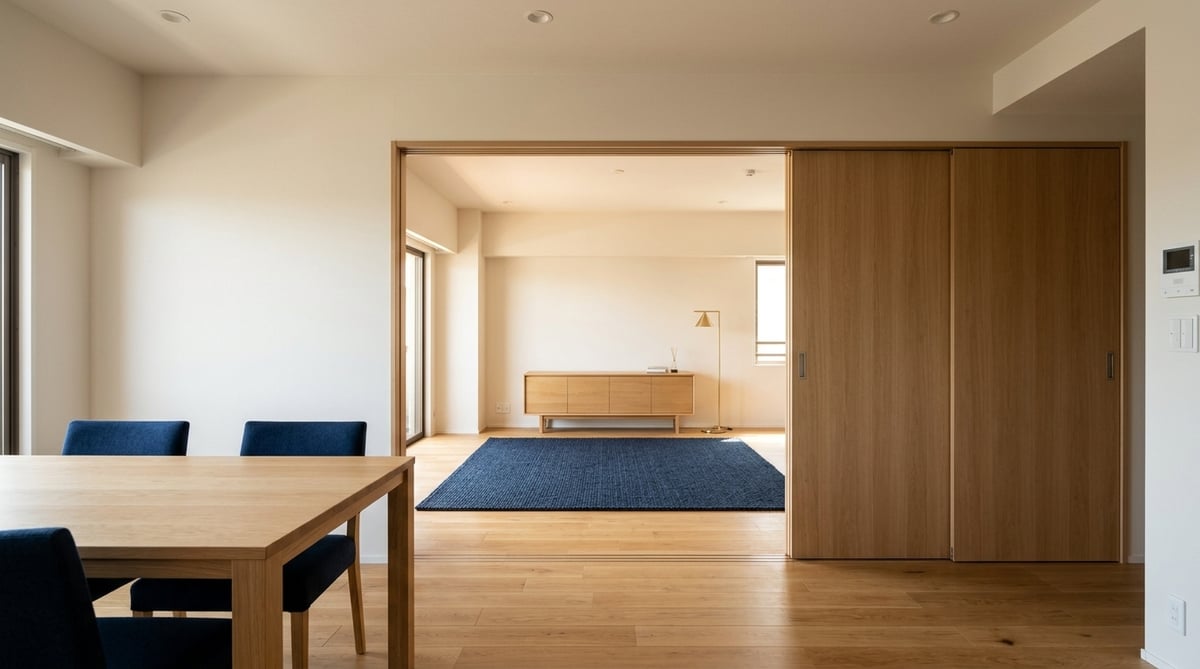
Stepping onto the platform at Ayase Station on the Chiyoda Line after 9:00 PM brings an immediate sense of relief. Picking up fresh produce and a bottle of wine at Ito-Yokado right outside the gates, or grabbing warm takeout dishes from the cozy eateries tucked beneath the railway overpass—for busy dual-income couples, having vibrant grocery options and late-night dining within arm's reach is an indispensable everyday luxury. In the morning, you can comfortably sit down on an originating train from Ayase all the way to Otemachi. Returning home, both partners have dedicated rooms to focus on remote work, before relaxing together in a spacious living room on weekends. Here lies an expansive, comfortable lifestyle for working couples, all within a sensible monthly rental budget.
Direct central Tokyo transit, daily convenience, and generous living space for two: while many believe compromise is inevitable when renting in Tokyo, the Ayase area in Adachi Ward offers a remarkably harmonious balance. Writing from the grounded perspective of a licensed real estate broker (Takken) with ten years of field experience in leasing contracts and property selection, this guide thoroughly explores the commuter reality of Ayase, a practical functional comparison between 2DK and 2LDK layouts, rent benchmarks against neighboring stations, and vital legal clauses to ensure a seamless tenancy.
- An in-depth guide by an active real estate broker on living comfort in 2DK and 2LDK rental apartments around Ayase Station.
- Guaranteed seated morning commutes toward Otemachi and Kasumigaseki from Track 2.
- Direct, transfer-free access into the heart of Tokyo on the Tokyo Metro Chiyoda Line.
Why Working Couples Choose Ayase: Seated Chiyoda Line Commutes and Late-Night Convenience
When dual-income couples working in central Tokyo search for a new home, the first hurdle they encounter is the compromise between commute fatigue and rental costs. Exhausting physical stamina on crowded trains before reaching the desk, only to return home too drained to prepare dinner, gradually diminishes the warmth of shared life. The primary reason Ayase Station enjoys such widespread acclaim among working couples is its distinct transit infrastructure advantage: originating turn-around train services on the Tokyo Metro Chiyoda Line.
Seated Commutes During Morning Rush on Originating Trains (Direct to Otemachi, Kasumigaseki, and Omotesando)
As the boundary station between the Tokyo Metro Chiyoda Line and the JR Joban Line Local service, Ayase Station features an elevated platform layout with Tracks 1 and 2 serving Yoyogi-uehara and Tracks 3 and 4 heading toward Matsudo and Abiko. Among these, the middle track, Track 2, operates numerous originating trains bound for Yoyogi-uehara during the peak morning commute hours between 7:00 AM and 8:00 AM.
Even during the peak window from 7:40 AM to 8:20 AM on weekday mornings, lining up at the designated platform boarding positions about 7 to 10 minutes prior to departure almost certainly guarantees a seat. Otemachi is reached in approximately 20 minutes, Kasumigaseki in 25 minutes, and Omotesando in 30 minutes. Once the doors slide shut and the train smoothly accelerates, you can quietly read a paperback or review your daily schedule and morning news on your smartphone. Spending 20 minutes calmly seated versus 20 minutes compressed in a packed car creates a transformative difference in mental composure when arriving at work.
Furthermore, because Ayase offers mutual through-service with the JR Joban Line Local service, outward connections toward Chiba hubs such as Matsudo and Kashiwa are effortless. If one partner works in central Tokyo while the other commutes to an office or research facility in Chiba or Ibaraki, Ayase serves as an optimal transit hub that minimizes travel stress for both.
Late-Night Grocery Stores and Under-Track Dining Supporting Late Arrivals
When overtime extends your workday, stepping off the train into an environment where procuring dinner is effortless becomes vital for dual-income households. Ayase Station boasts a dense concentration of supermarkets catering to diverse daily needs.
Facing the East Exit roundabout, the landmark Ito-Yokado Ayase Store provides an expansive basement food hall alongside daily necessities and apparel across upper levels. Stopping by on your walk home allows one-stop shopping for fresh vegetables, prime meats, freshly prepared delicatessen trays, artisanal cheeses, and wine. Additionally, the Tokyu Store Ayase Branch nestled beneath the elevated tracks remains open until 10:00 PM, while the nearby OK Store Ayase Station Branch stays open until 9:30 PM, and Big-A Ayase Store operates 24 hours a day. Even when arriving home past 11:00 PM or midnight, daily shopping remains completely seamless.
On evenings when you lack the energy to cook, the covered shopping arcades beneath the tracks and surrounding retail streets welcome you warmly. From classic yakitori stalls and delis serving handmade homestyle sides to beloved neighborhood Chinese diners, traditional set-meal spots, and relaxed Italian wine bars, unpretentious dining choices abound. Meeting up with your partner after a long day to share a hot meal and talk through the day's events brings grounded satisfaction to daily life.
Lifestyle Compatibility for Dual-Income Couples in Ayase
The life of dual-income couples centers on respecting each other's professional ambitions while cultivating comforting shared moments. Ayase offers a well-grounded atmosphere that adapts flexibly to both high-tempo weekdays and peaceful, restorative weekends.
On weekend mornings, a short stroll northeast of the station leads to Tokyo Metropolitan Higashi-Ayase Park, where a U-shaped green corridor sways with seasonal foliage. Quiet paved trails invite leisurely walks and outdoor reading on shady benches, while the adjacent Higashi-Ayase Park Heated Pool (Suisui Land Ayase) makes light exercise effortless. With rapid direct access to central business districts on one hand and serene residential neighborhoods on the other, this effortless balance is precisely why Ayase continues to be chosen by discerning residents.
A licensed real estate broker specializing in eastern Tokyo assists you via video call—from organizing requirements and checking unlisted vacancies to reviewing initial move-in costs.
Complete rental and living guide for all stations on the Tokyo Metro Chiyoda Line, from Kita-Ayase and Kita-Senju to downtown Otemachi.
2DK vs. 2LDK: Choosing the Right Floor Plan for Your Work Styles and Daily Routines
When searching for a rental home in Ayase, the most crucial decision is choosing between a 2DK and a 2LDK. While their designations appear similar, their floor areas, rental ranges, and daily functionalities differ substantially. There is no single universal answer; the ideal choice depends on your frequency of remote work and financial planning goals.
2DK Layout (40–48 sqm)
- ✔ Rent Range: 95,000–125,000 yen: Keeps monthly housing expenses minimal, leaving ample surplus for savings and travel.
- ✔ Two Completely Independent Private Rooms: Flanking the dining-kitchen (6–8 tatami), both rooms can serve as dedicated telework offices.
- ✔ Accommodates Divergent Sleep Schedules: Late-night returns or early-morning alarms will not disturb your partner's rest.
- △ Points to Note: Predominantly 1980s–90s reinforced concrete (RC) buildings; space for large sofas is limited, requiring a combined dining-lounge design.
2LDK Layout (50–65 sqm)
- ✔ Rent Range: 135,000–175,000 yen: Significantly cheaper than central Tokyo or Kitasenju while offering modern amenities and newer construction.
- ✔ Generous 12–16 Tatami LDK: Easily accommodates a 3-seater sofa, a 140 cm dining table, and modern home entertainment.
- ✔ Ready for Future Family Changes: Offers sufficient space to accommodate a child without immediately needing to move.
- △ Points to Note: Using one bedroom as a master suite leaves one private office, requiring the other partner to set up a desk nook in the LDK.
Functionality and Telework Compatibility of 2DK Units (40–48 sqm, Rent: 95,000–125,000 Yen)
Around Ayase Station, 2DK layouts are exceptionally well-regarded for practical functionality and cost performance. The neighborhood possesses an abundant housing stock of sturdy reinforced concrete (RC) buildings constructed during the 1980s and 1990s, many offering fully renovated, spotless interiors at accessible rents.
The structural advantage of a 2DK is having two distinct rooms that can be entirely closed off with doors. In addition to the dining-kitchen area (6 to 8 tatami mats), there are two Western-style rooms of roughly 5 to 6 tatami mats each, enabling versatile arrangements:
- Pattern 1: Dual Independent Workspaces
Room A serves as the partner's study and Room B as the other's, with a semi-double or double bed placed in either room for sleeping. Even when both partners are presenting in concurrent client meetings or team scrums, closing the doors creates an effective sound buffer. - Pattern 2: Separate Bedrooms & Workstations
Room A and Room B each feature a 120 cm wide desk and a single bed. For couples with differing work shifts or wake-up times, this setup eliminates the stress of waking your partner when preparing early or returning late.
In terms of furniture dimensions, a 6-tatami room easily accommodates a 120 cm wide by 60 cm deep work desk, an ergonomic office chair, and a 100 cm wide single bed while still preserving a comfortable 80 cm circulation aisle. A compact 80 cm by 80 cm two-person table fits neatly into the dining-kitchen for shared meals.
Spacious Living and Long-Term Flexibility of 2LDK Units (50–65 sqm, Rent: 135,000–175,000 Yen)
In contrast, 2LDK layouts are primarily found in newer RC residential buildings, offering generous floor plans from 50 to 65 sqm. Their defining hallmark is the open living-dining-kitchen (LDK) area spanning 12 to 16 tatami mats.
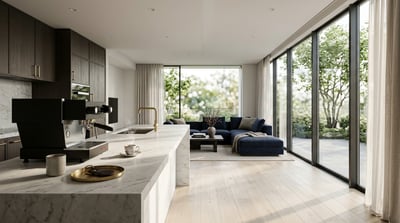
You can position a 140 cm four-person dining table beside an open counter kitchen, while easily styling the living area with a 3-seater sofa, coffee table, and large media console. For couples who love cooking together on weekends, hosting friends, or curling up for movie nights, this expansive gathering space offers incomparable comfort.
However, bedroom allocation requires thoughtful planning. Designating one bedroom (6 to 7 tatami mats) as the primary suite for a double bed and wardrobes leaves one private room (around 5 tatami mats) as a dedicated office. When both partners work from home simultaneously, one operates within the private study while the other utilizes a desk nook styled in the LDK.
Monthly Budget Simulations by Household Take-Home Pay (350,000 to 600,000 Yen)
In financial planning for dual-income couples, rent represents the single largest fixed cost. While the conventional rule of thumb suggests capping housing at one-third of take-home pay, allocating funds based on your career trajectory and savings targets is essential. Here is a breakdown of realistic monthly expenditure allocations in Ayase across income tiers.
| Combined Net Monthly Pay | Recommended Layout & Rent | Estimated Monthly Budget Breakdown | Financial Buffer & Lifestyle Features |
|---|---|---|---|
| 350,000 Yen (e.g., 200k / 150k split) |
2DK: 105,000 yen (incl. maintenance, 30.0% of net pay) |
• Food: 65,000 yen • Utilities: 22,000 yen • Internet & Mobile: 15,000 yen • Sundries: 18,000 yen • Leisure & Dining Out: 35,000 yen |
Monthly Savings: ~90,000 Yen A sustainable financial setup. Save over 1 million yen annually while maintaining individual home offices. |
| 450,000 Yen (e.g., 250k / 200k split) |
2DK/2LDK: 130,000 yen (incl. maintenance, 28.8% of net pay) |
• Food: 80,000 yen (incl. dining out) • Utilities: 25,000 yen • Internet & Mobile: 18,000 yen • Sundries & Apparel: 25,000 yen • Social & Hobbies: 50,000 yen |
Monthly Savings: ~122,000 Yen Choose between a fully renovated 2DK or an accessible 2LDK. Enjoy weekend travel while building substantial capital. |
| 550,000–600,000 Yen (300k / 250–300k split) |
2LDK: 155,000–165,000 yen (incl. maintenance, 26–28% of net pay) |
• Food: 100,000 yen • Utilities: 28,000 yen • Internet & Mobile: 20,000 yen • Sundries, Care & Culture: 40,000 yen • Leisure & Outings: 60,000 yen |
Monthly Savings: ~150,000–180,000 Yen High-spec 2LDK in a newer RC building. Expansive living spaces paired with robust financial foundations. |
Detailed Rent and Commercial Comparison: Ayase vs. Kitasenju and Kita-Ayase
When evaluating Ayase Station, its immediate neighbors on the Chiyoda Line—Kitasenju and Kita-Ayase—are inevitable points of comparison. Each station carries a distinct personality, and examining their rental ranges and urban functions brings Ayase's strategic positioning into sharp focus.
Comparing with Terminal Station Kitasenju: The Reality of a 50,000–70,000 Yen Monthly Rent Gap
Kitasenju Station is eastern Tokyo's premier railway junction, serving five train lines: Tokyo Metro Chiyoda and Hibiya Lines, JR Joban Line, Tobu Skytree Line, and Tsukuba Express. Featuring massive department stores like Lumine and Marui directly linked to the concourses, its retail vibrancy and dining density are extraordinary.
However, this bustling convenience is reflected directly in property rents. Searching for an equivalent RC 2LDK apartment around Kitasenju pushes monthly rents to 180,000–230,000 yen or higher. Compared to Ayase (135,000–175,000 yen), this represents an ongoing fixed premium of 50,000 to 70,000 yen per month—an annual difference of 600,000 to 800,000 yen. Calculated over a standard two-year lease term, including lease renewal fees and agent brokerage commissions, the total expenditure difference approaches 1.5 million yen.
What deserves attention here is the physical proximity between Ayase and Kitasenju. On the Chiyoda Line, it takes just one stop—approximately three minutes. Because the terrain is flat, you can also bicycle to Kitasenju Station in 10 to 15 minutes. By establishing a lifestyle where quiet weeknights are spent in peaceful Ayase while weekend shopping and special dinners take place in Kitasenju, you can access Kitasenju's rich urban amenities while saving hundreds of thousands of yen in annual housing overhead.
Comparing with Originating Station Kita-Ayase: Retail Infrastructure and Late-Night Availability
On the other side, Kita-Ayase, the terminal station of the Chiyoda Line branch, has gained popularity following the launch of 10-car direct through-trains to central Tokyo in 2019. Retaining an even quieter residential atmosphere than Ayase, 2LDK rents here range between 120,000 and 150,000 yen—roughly 10,000 to 20,000 yen lower than Ayase.
The primary advantage of Kita-Ayase is boarding originating trains to Yoyogi-uehara with guaranteed seating. However, a noticeable difference remains in the depth of station-front retail infrastructure. While Kita-Ayase provides daily amenities such as the Belx supermarket (closing at 9:00 PM) and local drugstores, options for late-night grocery shopping, independent diners, delicatessens, and bakeries are far more abundant around Ayase Station, which benefits from decades of established commercial development.
For working couples who frequently return home past 9:00 PM or 10:00 PM and need warm takeout dishes and flexible dining options, Ayase Station's commercial environment dramatically lowers everyday stress.
Why Ayase Represents the Most Balanced Choice
Synthesizing the core attributes of these three stations highlights Ayase's uniquely well-rounded appeal.
| Comparison Criteria | Ayase Station (Top Recommendation) | Kitasenju Station (Commercial Hub) | Kita-Ayase Station (Quiet Enclave) |
|---|---|---|---|
| Estimated 2DK Rent | 95,000–125,000 yen | 135,000–170,000 yen | 85,000–110,000 yen |
| Estimated 2LDK Rent | 135,000–175,000 yen | 185,000–235,000+ yen | 120,000–150,000 yen |
| Chiyoda Line Morning Seating | Excellent: Originating turn-around trains guarantee seating (Track 2, 7–10 min queue ensures a comfortable seat) |
Poor: Seating unavailable (Peak congestion section; boarding fully packed trains) |
Excellent: All trains originate here (Train frequency is lower than from Ayase) |
| Late-Night Retail & Dining | Excellent: Richly appointed (Yokado, Tokyu Store, OK Store, late-night eateries) |
Outstanding: Massive concentration (Lumine, Marui, extensive commercial district) |
Fair: Basic essentials covered (Residential focus; limited late-night options) |
| Residential Serenity | Good: Quiet residential streets just minutes away (Plentiful greenery at Higashi-Ayase Park) |
Fair: Vibrant nightlife requires noise vigilance (Residential areas begin 10+ minutes from the station) |
Excellent: Exceptionally calm (Gentle neighborhood dominated by low-rise homes) |
Guaranteed seating on originating commute trains, sustainable rents over 50,000 yen lower than Kitasenju, and comforting commercial vibrancy that welcomes late-night arrivals: Ayase represents the ideal balance of qualities sought by working couples.
Acoustic Comfort for Concurrent Remote Work: RC Structural Checkpoints
When dual-income partners work from home at the same time, floor plan separation alone does not solve one critical issue: sound insulation. To prevent audio bleeding into microphones or distraction from foot traffic and neighbor activity, evaluating the building structure and acoustic dampening performance is paramount.
Key Differences: Reinforced Concrete (RC/SRC) vs. Wood-Frame and Light Steel (S)
In the rental market, wood-frame and light-gauge steel (S) apartments often offer lower rents, but they are ill-suited for simultaneous remote work. Their partition walls typically consist of gypsum boards packed with mineral wool, which offers poor transmission loss for human speech and bass tones, allowing phone conversations to bleed directly into adjacent rooms.
For couples teleworking regularly, choosing reinforced concrete (RC) or steel-framed reinforced concrete (SRC) is essential. Concrete has high density and mass, providing superior physical dampening against acoustic vibration energy. When dividing party walls between adjacent residences feature cast concrete at least 150 mm to 200 mm thick, conversational audio and conference calls rarely leak to neighbors.
Furniture Layout Strategies for Concurrent Web Meetings
Even within an RC building, interior dividing walls between bedrooms are generally framed with light-gauge steel and drywall rather than solid concrete. Therefore, the spatial relationship of your rooms requires thoughtful consideration.
The gold standard is a "split layout" (furwake-type), where closets, storage spaces, or wet areas (bathroom/powder room) sit between the two bedrooms. Avoiding desk setups placed back-to-back along a single wall and using storage closets as an acoustic buffer dramatically reduces voice interference.
If the bedrooms share a direct partition wall, placing desks on opposing walls facing away from each other, installing acoustic dampening wall panels, or hanging heavy blackout drapes can effectively mitigate microphone pick-up.
Five Soundproofing Checkpoints to Test During Property Viewings
Even when a floor plan lists "RC construction," acoustic performance varies depending on construction quality and window specifications. During in-person viewings, always test these five checkpoints:
Everyday Life Supported by Ito-Yokado, Tokyu Store, OK Store, and Railway Gastronomy
The true value of a home extends beyond the four walls of an apartment. The walking route from your building's entrance to the station gates, the grocery markets stocking your kitchen, and tree-lined park paths on weekends define the holistic quality of your everyday life.
Key Station Supermarkets and Operating Hours
A notable strength of Ayase Station is the high concentration of distinct supermarkets within a five-minute walk of the ticket gates. From budget-conscious bulk staples to curated organic produce, you can tailor your shopping to each meal.
- Ito-Yokado Ayase (East Exit, 1-min walk / Hours: B1 & 1F 10:00–22:00, 2F+ until 21:00)
A comprehensive anchor department store facing the East Exit plaza. Its basement food hall boasts exceptionally fresh produce, seafood, and butcher cuts, alongside an extensive deli. Upper floors provide household goods, cosmetics, clothing, a bookstore, and a 100-yen shop, handling all daily shopping in one place. - Tokyu Store Ayase (Beneath East Exit Elevated Tracks, 2-min walk / Hours: 9:00–22:00)
Located directly beneath the tracks, this store offers a comfortable shopping experience during the 9:00 PM rush. Renowned for premium fresh foods, wine selections, artisanal cheeses, gourmet seasonings, and upscale prepared dishes, it is effortlessly accessible on your walk home. - OK Store Ayase Station Branch (East Exit, 4-min walk / Hours: 8:30–21:30)
A popular discount supermarket guided by the philosophy of "High Quality, Everyday Low Price." Offering unbeatable value on pantry goods, meats, and daily sundries, it enjoys loyal support from dual-income households managing food expenses. - Big-A Ayase (East Exit, 4-min walk / Open 24 Hours)
A 24-hour discount grocer offering invaluable flexibility for early-morning shifts or late-night arrivals. Drinks, frozen foods, and daily essentials are maintained at consistently low prices around the clock.
Welcoming Neighborhood Dining and Under-Track Spots for the Commute Home
Unlike entertainment districts filled exclusively with generic chain restaurants, Ayase features an inviting blend of longstanding independent bistros and welcoming taverns.
Around M'av Ayase Lieta beneath the railway overpass, you will find casual yakitori counters, oden stalls, and delis offering handmade takeaway dishes. Towards the West Exit, traditional hand-rolled soba shops, pour-over flannel-drip coffee houses, and bakeries serving crusty sourdough provide delightful weekend destinations.
Unpretentious, honest pricing paired with sincere, attentive hospitality gives the neighborhood a warm, grounded character that helps busy couples unwind from work pressures.
Natural Respite at Tokyo Metropolitan Higashi-Ayase Park
Any discussion of Ayase's residential appeal must highlight Tokyo Metropolitan Higashi-Ayase Park, which loops in an expansive U-shape from the northeast of the station toward the Ayase River. Originally built over former irrigation canals, this green greenway stretches approximately 2 kilometers.
Spring welcomes a cherry blossom canopy, summer brings dappled sunlight beneath lush greenery, and autumn turns the foliage brilliant amber. Free of vehicular traffic, the paved pathways are ideal for morning jogs or tranquil evening walks. The park also houses the Higashi-Ayase Park Heated Pool (Suisui Land Ayase), where residents can enjoy fitness swimming year-round. Having this level of nature and tranquility just 20 minutes from Tokyo's financial core is one of Ayase's greatest charms.
Legal Real Estate Insights: 2DK & 2LDK Leasing and Contract Essentials
Securing an ideal home and embarking on a peaceful lifestyle requires an accurate understanding of tenancy laws and leasing practices. To safeguard against unexpected expenses down the road, here are key contractual considerations explained from a licensed real estate broker's operational perspective.
Legal Scrutiny of Special Clauses in Contracts: Supreme Court Precedents
While standard leasing guidelines set clear baseline principles, actual lease contracts and Important Matters Explanation documents often include "special agreements" (tokuyaku). Examples include stipulations requiring the tenant to pay a fixed move-out cleaning fee (e.g., 55,000 yen) or cover mandatory air conditioning internal cleaning fees upon vacating.
For such special clauses to be deemed legally enforceable, they must satisfy the three validity criteria established by the Supreme Court of Japan Second Petty Bench Ruling of December 16, 2005:
- Objective Clarity of the Special Clause: The contract must explicitly state in plain, unmistakable language that the tenant assumes restoration costs for standard wear and tear or aging deterioration.
- Tenant's Clear Recognition and Consent: The tenant must be adequately informed during contract explanation that they are bearing costs beyond statutory obligations, and freely consent with full awareness.
- Absence of Unconscionability (Good Faith & Consumer Contract Act): The mandated amounts must not be exorbitant compared to prevailing market standards or rental rates, avoiding violation of Article 10 of the Consumer Contract Act (invalidation of clauses unilaterally harming consumer interests).
Additionally, regarding lease renewal fees, the Supreme Court Ruling of July 15, 2011 determined that renewal fees serve as supplemental rent prepayments and compensation for lease continuity; provided the amount is not egregiously disproportionate (such as multiple months of rent), it does not violate Consumer Contract Act Article 10 and remains legally valid. In the Ayase market, one month's rent every two years is the standard benchmark.
Regarding brokerage fees, Article 46 of the Real Estate Brokerage Act and Ministry of Land, Infrastructure, Transport and Tourism (MLIT) notifications stipulate that the statutory ceiling an intermediary broker may collect is capped at 0.55 months' rent (tax included) from the tenant and 0.55 months' rent from the landlord—totaling no more than 1.1 months—unless prior consent has been explicitly given by the requesting party. Always review your itemized cost estimate prior to contracting to ensure a full 1.1-month fee has not been billed without explanation.
Flood Risk and the Adachi Ward Hazard Map: Objective Perspectives on Floor Selection
The Ayase Station neighborhood sits on low-lying ground bounded by the Arakawa River to the west and the Ayase River to the east. Consulting the official Adachi Ward Flood Hazard Map (assuming maximum possible precipitation: a 1-in-1,000-year rainfall event) reveals that in the event of an Arakawa River breach, potential inundation depths reach between 3.0 and 5.0 meters (submerging levels up to the second or third floor eaves).
Consequently, when selecting a 2DK or 2LDK apartment in Ayase, floor level serves as a direct safety factor. While ground-floor units offer lower rental rates, selecting an apartment on the 3rd floor or higher is an objective broker recommendation for flood and dampness mitigation. In an RC building on or above the third floor, residents can execute safe "vertical evacuation" inside their home during severe weather emergencies, keeping valuable electronics and furnishings protected.
Leveraging Sorai Tokyo Smart Tools (SorAi) and Official LINE Support
When searching for a rental home, natural anxieties arise: is that portal listing still truly vacant, and has the provided cost estimate been inflated with unneeded mandatory add-on options?
At Sorai Tokyo, we adhere conscientiously to legal statutory fee limits by offering our brokerage services at half the conventional rate (0.55 months' rent, tax included). We avoid exaggerated instant automated claims; instead, when you share a property link through our official LINE, a dedicated licensed real estate broker directly consults official inter-broker databases (REINS) to verify genuine live availability, providing free audits of initial move-in estimates and second opinions on third-party quotes.
Whether using a smartphone via the fixed bottom navigation or viewing on desktop via the site footer, you can freely access Sorai Tokyo's suite of smart tools (SorAi), including our Upfront Cost Simulator. By eliminating extraneous incidental fees—such as redundant antibacterial deodorizing charges or inflated 24-hour support packages—you can move forward with total peace of mind.
Frequently Asked Questions (FAQ): 2DK & 2LDK Rentals in Ayase
Choosing a home is fundamentally about choosing how you spend your everyday hours. Starting your morning comfortably seated on an originating train, picking out dinner ingredients together at the supermarket after work, focusing productively in separate offices, and relaxing in an airy room on weekends: Ayase's 2DK and 2LDK apartments offer a resilient foundation to cultivate a comfortable life without overextending your finances.
If you have questions about property viewings or leasing agreements, feel free to consult Sorai Tokyo at your own pace. Our dedicated licensed real estate brokers are here to provide sincere, transparent guidance for the start of your shared life.
QHow many minutes prior to departure should I line up to ensure a seat on the originating morning Chiyoda Line train from Ayase?
ADuring the morning rush peak (around 7:40 AM to 8:20 AM on weekdays), lining up on Platform Track 2 about 7 to 10 minutes before train departure almost certainly guarantees a seat. Because queues can extend slightly on rainy days or Monday mornings, arriving 12 minutes early provides extra assurance. Being able to sit quietly all the way to Otemachi or Kasumigaseki provides a substantial productivity advantage for the workday ahead.
QAre there concerns regarding amenities or earthquake resistance in 1980s–1990s RC buildings that are over 30 years old?
ABuildings that received building confirmation on or after June 1, 1981, adhere to the "New Anti-Seismic Standards" (Shin-Taishin Kijun), engineered to prevent collapse even during major earthquakes of Upper 6 to 7 seismic intensity. In terms of amenities, many units have undergone full interior renovations, featuring separated bath and toilet rooms, standalone washbasins, bidet toilets, and updated modular kitchens. Rather than judging solely by exterior age, we recommend inspecting the actual state of interior updates and common area maintenance during an in-person viewing.
QIf both partners work full-time from home and conduct simultaneous video calls, is a 2DK or 2LDK better suited?
AIf both individuals conduct frequent speaking meetings with clients, a split-type 2DK layout is exceptionally functional and cost-effective. Designating the two private rooms as separate offices allows closing doors to prevent voice crossover. If choosing a 2LDK, one room typically acts as a dedicated office, while the second desk is positioned either at the far end of the LDK or within a quiet corner of the primary bedroom.
QHow is public safety around Ayase, especially when walking home late at night?
AReviewing recent neighborhood crime statistics from the Tokyo Metropolitan Police Department shows that violent crimes are exceptionally rare, with the vast majority of incidents consisting of non-intrusive theft, such as bicycle theft from station-front racks. The station area is well-lit with Ito-Yokado and restaurants open late, maintaining steady pedestrian foot traffic. Primary walking routes into residential areas feature streetlights and security cameras; for late-night walks, choosing an apartment along a well-lit main thoroughfare provides added peace of mind.

Author: Sorai Tokyo Editorial Team (Supervised by Licensed Real Estate Agents)
A real estate consulting team specializing in assisting foreign nationals find rooms and explaining initial costs in Tokyo. We break down language barriers and differences in customs, offering dedicated support in Japanese, English, and Vietnamese for a safe and secure start to your new life.