
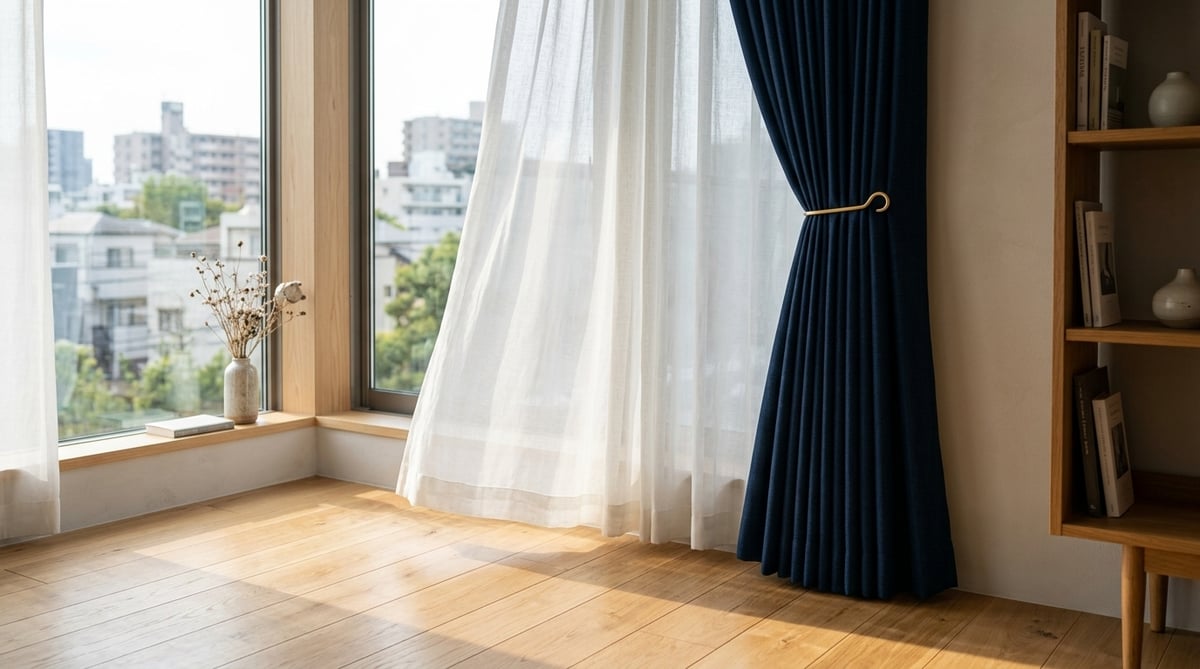
When starting the search for a new home together, almost every couple encounters a pivotal crossroads while studying floor plans: deciding between a "1LDK" and a "2DK."
Browsing property portals, newly built or recently renovated 1LDK units immediately catch the eye with modern counter kitchens, bright open-concept living rooms, and clean contemporary aesthetics. Yet, expanding your search criteria to include slightly older buildings reveals numerous 2DK apartments offering the same or even greater floor space, often for 20,000 to 30,000 JPY less per month. "We want to spend all our time together, so a 1LDK with a spacious living area sounds ideal." "Our working hours are different and we both work remotely, so having two separate rooms in a 2DK might offer more peace of mind." As visions and daily routines intersect, countless couples find themselves wondering which layout will truly suit their life together.
Regret in home selection often arises when choices are made purely on aesthetic floor plans or low rent, without visualizing the real-life flow, everyday sounds, and differing schedules in three dimensions. The aroma of freshly brewed coffee in the clear morning air, footsteps from a late return home from work, or the quiet personal breathing room to unwind on weekends. Drawing on a decade of practical experience as a licensed real estate broker, this guide carefully explores the key decision criteria and layout nuances to ensure your new life together is filled with comfort and ease.
- Comprehensive comparison of 1LDK and 2DK layouts tailored for couples moving in together
- Monthly rent gap between 1LDK and 2DK units of similar square footage in the same neighborhood
- Over ¥500,000 in total financial savings over 2 years from an initial ¥20,000 monthly rent difference
This pillar guide is designed for couples preparing to move in together who want to determine whether a 1LDK or 2DK layout best matches their lifestyle. We cover waking and sleeping schedules, remote work frequency, future lifestyle changes, and daily living traffic to guide you toward a regret-free decision.
Structural Differences Between 1LDK and 2DK for Cohabitating Couples
When considering moving in together, the first essential step is understanding the legal definitions and structural differences behind the designations "1LDK" and "2DK." Far from being a mere variation in letters, they reflect fundamentally different architectural philosophies regarding where daily life is centered.
Official Tatami Mat Size Standards for DK and LDK Set by the Real Estate Fair Trade Council
The designations "DK" (Dining-Kitchen) and "LDK" (Living-Dining-Kitchen) on floor plans cannot be applied arbitrarily by real estate agencies. To prevent misleading consumer representations, the Metropolitan Tokyo Real Estate Fair Trade Council enforces strict minimum tatami mat size criteria based on the number of separate bedrooms.
Specifically, when there is only one bedroom, a DK must measure at least 4.5 tatami mats (jo), while an LDK combining living and dining functions requires at least 8 mats. In contrast, for properties with two or more bedrooms, a DK must be at least 6 mats and an LDK at least 10 mats. In practice, a dining and kitchen space between 6 and under 10 mats is designated as a DK. Furthermore, under the Enforcement Regulations of the Fair Competition Code Concerning Real Estate Representations, one tatami mat (1 jo) is officially defined as at least 1.62 square meters of wall-center area.
Consequently, a 1LDK refers to a layout with one independent bedroom (typically 5 to 7 mats) paired with a spacious LDK of at least 8 mats (commonly 10 to 14 mats in practice). On the other hand, a 2DK features two independent bedrooms (typically around 6 mats each) and a dining space between 6 and under 10 mats (commonly 6 to 8 mats). Even when both units have an identical total floor area of around 40 to 45 square meters, there is a fundamental choice: sharing life in one expansive communal space, or dividing the area into distinct, functional zones.
Wall-Center vs. Interior Clearance Area: The Reality of Usable Space
When comparing floor plans, relying solely on total square meters can lead to unexpected surprises. Floor areas in Japanese property listings are calculated using the "wall-center method" (hekishin), measuring from the centerline of the exterior and dividing walls.
However, the actual usable floor space where furniture stands and you walk is calculated using the "interior clearance method" (uchinori), measuring from the inner surface of the walls. In reinforced concrete (RC) buildings, where walls are typically 15 to 20 cm thick, the actual interior living space is roughly 5% to 8% smaller than the advertised wall-center figure. A listing stating 42 square meters often translates to around 39 square meters of actual interior room.
Furthermore, in buildings where thick concrete columns or beams protrude inward, the footprint of those pillars is included in the room's tatami count. Common frustrations—such as placing a semi-double bed in a supposedly 6-mat bedroom only to find the closet door opens only halfway—stem from neglecting interior clearances and door swing radiuses. Beyond listed numbers, assessing usable wall lengths and traffic lines in detail ensures a smooth moving experience.
Even between rooms listed as 6 mats, an out-frame construction with flat walls and exterior pillars can feel nearly an entire mat larger than a room with bulky pillars projecting into the corners. When positioning linear furniture like beds or work desks, interior column alcoves frequently create dead space. During viewings, bring a tape measure and verify the usable dimensions between the baseboards to ensure your furniture fits seamlessly.
Contemporary Living Focused on Openness and Togetherness
- ✓ Expansive 10–14 mat LDK allows dining and lounging together in one unified area
- ✓ Many modern post-2000s builds featuring high-grade fixtures, auto-locks, and security
- ✓ Open layout naturally fosters conversation and shared everyday moments
Sensible Living Balancing Personal Privacy and Cost Efficiency
- ✓ Two separate bedrooms configurable as a shared bedroom plus home office, or individual private rooms
- ✓ Predominantly 1980s–1990s builds offering comparable square footage at ¥20,000–¥30,000 less per month
- ✓ Differing sleep and wake schedules do not disrupt your partner's rest
Experienced licensed brokers specializing in Tokyo's Joto district provide personalized video consultations, helping organize your criteria, verify off-market listings, and optimize initial move-in costs.
Simply enter the rent and deposit from portal listings to calculate a full, itemized breakdown including brokerage and guarantor fees without hidden add-ons.
1LDK Features, Benefits, and Key Considerations for Couples
Across Tokyo's 23 wards, 1LDK apartments currently enjoy the highest popularity among cohabitating couples. Picture brewing freshly ground coffee in a sunlit living room on a quiet weekend morning while chatting across an open counter kitchen—an inviting lifestyle scene naturally enabled by this layout.
The Sense of Openness and Togetherness Created by a Spacious LDK
The greatest appeal of a 1LDK is the welcoming sense of openness provided by an expansive 10 to 14-mat living-dining-kitchen space. With fewer dividing partitions, sightlines extend smoothly across the entire apartment, making the home feel considerably larger than its listed floor area.
You can comfortably arrange a cozy two-seater sofa, a low table, and a media console in the living zone, alongside a dining table in the kitchen area. While one person cooks dinner and the other unwinds on the couch with a book, you remain warmly attuned to each other's presence. Sharing small daily moments unfolds effortlessly, offering the distinct pleasure of true shared living.
Modern Amenities and High-Grade Fixtures Common in Post-2000s Buildings
The 1LDK layout grew rapidly in popularity after the year 2000, catering to the rise of working professionals and dual-income couples. As a result, the majority of units on the market are in buildings between 10 and 20 years old, or newly constructed properties.
Beyond common security features such as auto-lock entry, security cameras, and parcel delivery lockers, private unit amenities tend to be superior. Typical standard features include system kitchens with three-burner gas or induction cooktops, reheating bathtubs (oidaki), bathroom ventilation dryers ideal for rainy days, expansive three-mirror vanity units, and washlet bidet toilets. For residents seeking streamlined housework and a clean, hotel-like atmosphere, these modern conveniences provide significant comfort.
Preserving Private Space and Addressing Storage Shortages
Conversely, 1LDK living presents unique challenges. The most notable hurdle is the difficulty of securing dedicated personal privacy.
In a 1LDK, the bedroom is the only private room fully enclosed by a door. If a minor disagreement occurs, or if one partner returns home exhausted and simply needs quiet solitude, the bedroom is the sole physical retreat. If the other person is in the living area, everyday sounds and presence inevitably filter through.
Storage planning also requires careful attention. In many 1LDK layouts, storage is limited to a single closet in the bedroom. When combining two separate households—complete with work attire, seasonal coats, appliances, suitcases, and hobby equipment—a single closet often falls short. Storage bins or racks often end up stacked in living or bedroom corners, compromising the spacious feel of the open living room.
Furniture Layout and Clearance Dimensions for Traffic Flow
Living comfortably in a 1LDK requires clear simulations of furniture dimensions and walkway widths. When placing a standard two-seater sofa (width 1,400–1,600 mm × depth 800 mm) and dining table (width 1,200 mm × depth 750 mm) in the LDK, maintaining a walkway clearance of at least 600 mm (ideally 800 mm) between furniture and walls is necessary for comfortable movement.
Bed dimensions are equally critical. Cohabitating couples typically choose a double bed (width 1,400 mm × length 2,000 mm) or queen bed (width 1,600 mm × length 2,000 mm). In a bedroom measuring 5.0 to 5.5 mats, a double bed occupies nearly half the room's floor space. It is essential to verify on the floor plan that you have at least 500 mm of clearance around the bed to walk and roughly 600 mm of swing clearance to open closet doors unhindered.
2DK Features, Benefits, and Key Considerations for Couples
In contrast to the contemporary flair of a 1LDK, the 2DK remains enduringly popular as an embodiment of practical utility and functional balance. Constructed extensively across Japan in the 1980s and 1990s as the standard family rental layout, it continues to provide an exceptionally rational living environment for modern couples.
Total Separation of Daily Schedules and Privacy with Two Independent Rooms
The greatest strength of a 2DK is having two fully independent rooms that can be closed off with doors. In a "split layout" (furikake type), where the two bedrooms sit on opposite sides of a central 6 to 8-mat dining-kitchen, personal living zones can be completely separated.
How you utilize these two rooms can be tailored freely to your lifestyle. Room A can serve as a shared bedroom, while Room B functions as a dedicated home office and walk-in wardrobe. Alternatively, for couples who place premium value on personal independence, each person can have their own private bedroom with a bed and desk, gathering in the dining-kitchen primarily for meals. Whichever arrangement you choose, having physical walls and doors that guarantee personal time and space dramatically reduces the friction of cohabitation.
Cost Performance: Generous Square Footage and Lower Rent in 1980s–1990s Buildings
A compelling advantage of the 2DK is its outstanding financial value. In many Tokyo neighborhoods, comparing a 1LDK and 2DK with similar floor areas of 40 to 45 square meters reveals an average monthly rent difference of roughly ¥20,000 to ¥35,000.
The primary factor driving this price gap is building age. Most 2DK buildings were constructed in the 1980s and 1990s, putting their age around 30 to 40 years. In Japan's rental market, depreciation flattens after 20 years, resulting in highly economical rents relative to available floor space. Saving ¥25,000 per month generates ¥300,000 in annual savings, or ¥600,000 over a standard two-year lease term. Channeling this surplus toward wedding savings, travel, personal development, or investments offers substantial financial breathing room.
Plumbing, Insulation, and Electrical Capacity Checks in Older Properties
When considering an older 2DK property, however, specific practical inspection checkpoints must be verified in person.
First and foremost is the plumbing specification. While many renovated properties feature brand-new modular bathrooms and modern system kitchens, units retaining original fixtures may have a 2-point unit bath (sink combined inside the bathroom) or lack a water heater reheating function (oidaki). Furthermore, older kitchen counters were often built to an 80 cm height standard, which can strain your back during extended cooking sessions.
Equally critical yet often overlooked are the electrical amperage capacity and dedicated air conditioner circuits. Buildings from the 1980s were not designed for the simultaneous power draw of modern high-wattage appliances, and some units are capped at 30 amps. Running a microwave, hair dryer, and two air conditioners simultaneously will trip the breaker, so confirming whether the building allows an upgrade to 40A or 50A with the management company is essential. You must also check whether both bedrooms feature dedicated AC outlets and exterior wall sleeves for condenser piping.
Evaluating Units Renovated from Tatami to Western-Style Flooring
When searching for a 2DK, you will frequently encounter layouts with one Japanese tatami room and one Western room, or properties where original tatami mats were converted to modern flooring. It is common to see wood-grain laminate or cushion flooring (CF) laid over old subfloors, but this warrants close inspection.
If soundproofing underlayment was not properly installed during a tatami-to-flooring conversion, footsteps and rolling desk chair wheels can easily transmit noise downstairs. Additionally, storage often remains a traditional Japanese closet (oshiire) rather than a Western closet. While an oshiire has generous depth (approx. 900 mm) ideal for futons and storage trunks, it lacks a hanging garment rod. Verifying whether you can install tension hanging rods and checking that sliding doors open smoothly will ensure comfortable post-move living.
| Comparison Item | 1LDK (1 Bedroom + LDK) | 2DK (2 Bedrooms + DK) | Broker Insights & Decision Criteria |
|---|---|---|---|
| Spatial Openness | Very High (Unified 10–14 mat LDK space) | Partitioned into rooms; compact 6–8 mat DK | 1LDK is superior if you want a large sofa and dining set together |
| Privacy & Personal Retreat | Low (No retreat besides the bedroom) | Very High (Two completely separate rooms) | 2DK provides peace of mind if schedules differ or remote meetings overlap |
| Tokyo 23 Wards Rent Benchmark | Approx. ¥120,000 – ¥160,000 (Newer builds, high-spec fixtures) | Approx. ¥100,000 – ¥130,000 (Older, frequently renovated) | A ¥20,000–¥35,000 monthly fixed cost gap for similar square footage at the same station |
| Amenities & Building Age | Post-2000s builds (Auto-lock, bath reheater, bathroom dryer) | 1980s–1990s builds (Wide variation depending on renovation status) | Must verify electrical amperage and dedicated AC outlets for 2DK units |
| Remote Work Suitability | Requires coordination (Dividing living room and bedroom) | Highly comfortable (One entire room can be a dedicated office) | 2DK sound isolation is overwhelmingly superior if both have frequent online calls |
[In-Depth Guide & Recommended Reading] Securing Two Separate Rooms While Lowering Rent with a Renovated 2DK
For couples who specifically want two separate private rooms while maintaining the same rental budget as a 1LDK, a renovated vintage 2DK revitalized with contemporary interiors serves as a powerful option. Key viewing checkpoints and regional rent benchmarks for renovated vintage properties are explored in depth in our specialized guide below.
👉 [Renovated Vintage 2DK Guide] How to Secure Two Private Rooms at 1LDK Rent Levels
Selection Criteria Based on Daily Rhythms: Different Wake and Sleep Schedules
Among the frictions that can arise when living together, mismatched sleep environments are often the most damaging. Chronic sleep disruption drains emotional bandwidth and can erode everyday patience and mutual consideration.
Sleep Quality and Sound Insulation for Couples with Differing Wake and Sleep Times
When working hours diverge—for example, if one partner leaves for work at 7:00 AM while the other sleeps until 10:00 AM, or if one returns home past midnight while the other is asleep by 11:00 PM—the structural contrast between a 1LDK and a 2DK becomes stark.
In a 1LDK, the bedroom and living room sit directly adjacent, typically separated by only a single thin sliding door or standard interior door. When the early riser gets ready, the sound of opening closet doors, running sink water, boiling kettles, microwave chimes, and hallway light slipping through door gaps filter straight into the bedroom. Even without intending to wake the other, light sleep is repeatedly interrupted, leading to accumulated fatigue.
In a 2DK, the dining-kitchen buffers and isolates the sleeping quarters from morning preparation zones. The early riser can prepare breakfast, get dressed, and depart quietly from the kitchen or second room without disturbing the sleeping partner in the slightest. Eliminating the morning anxiety of tiptoeing around each other is a major advantage of having two distinct rooms in a 2DK.
Layout Traffic for Night Shift Workers and Late-Night Commuters
If either partner works irregular shifts or night rotations—such as healthcare professionals, infrastructure engineers, or hospitality staff—an entirely independent bedroom becomes an indispensable necessity.
For a partner who must sleep deeply during the day after a night shift, daytime sounds from an adjacent living room—such as television audio, phone calls, or vacuuming—create significant sleep disruption. Drawing blackout curtains, adjusting room temperature, and maintaining silence requires a bedroom isolated from daytime domestic activities. With a split-layout 2DK, one person can vacuum, do laundry, or cook without hesitation, while the other rests peacefully in an undisturbed private room.
The Emotional Value of Having a Private Room for Resetting and Decompressing
No matter how close a couple may be, sharing a home over years inevitably brings occasional disagreements or moments of work-related emotional tension.
When confined to a single shared space during such times, being constantly within each other's sightlines makes cooling off difficult. In a 2DK, closing the door to a private room allows you to listen to music, sip a hot cup of tea, or lie down to regain composure. Creating physical distance for even thirty minutes often allows both partners to naturally reconnect and apologize. Having a private room to retreat to acts as an invisible safety valve for sustaining a harmonious long-term relationship.
Remote Work Comfort: Comparing Work-from-Home Setups for Two
In contemporary apartment hunting, the frequency of remote work has become a decisive factor. With many couples working from home several days a week or full-time, the quality of workspace and network infrastructure directly impacts professional productivity and quality of life.
The Web Conference Overlap Dilemma When Both Work Remotely
The single most frequent challenge reported by cohabitating remote workers is audio interference during concurrent online video meetings.
When both join online calls within the same room or unpartitioned LDK, microphones pick up overlapping voices, causing audio feedback or broadcasting household background talk into critical client presentations. Furthermore, across many corporate roles subject to strict Non-Disclosure Agreements (NDAs), confidential client or corporate data must not be overheard, even by a domestic partner.
Limits and Workarounds for Remote Work Setups in a 1LDK
When two people work remotely in a 1LDK, the layout requires deliberate compromises. The typical solution is a split setup: one person sets up at the dining table (or a dedicated desk in the living room), while the other works at a desk placed in a corner of the bedroom.
Closing the bedroom door during calls provides moderate sound dampening. However, introducing a work desk (approx. 1,000 mm wide × 600 mm deep) and an ergonomic chair into the bedroom leaves minimal clearance beside the bed, creating a cramped feel. Psychologically, having monitors, laptops, and documents perpetually visible in your sleep sanctuary makes it difficult to mentally switch off after hours, potentially compromising sleep quality.
Creating a Dedicated Home Office and Study in a 2DK
By contrast, configuring a remote work environment in a 2DK is straightforward and stress-free: one entire bedroom can be dedicated as a private home office and study.
Two desks can be comfortably arranged side by side or back to back, with plenty of room for bookshelves, printers, and dual monitors. If only one person has a call, the other can step into the dining-kitchen to work uninterrupted. If simultaneous calls occur, one partner uses the office and the other uses the bedroom (or dining room) with the doors shut, functioning as two fully independent meeting booths. Best of all, at the end of the workday, closing the office door completely seals away all work reminders, allowing a smooth transition into evening relaxation.
When prioritizing remote work, an essential checkpoint alongside building age is the building's internal internet wiring system. Modern 1LDK apartments typically feature fiber-to-the-home (FTTH / Optical Wiring, up to 1–10 Gbps) direct to the unit. In contrast, older 2DK buildings may rely on VDSL (max 100 Mbps), which brings fiber to the utility room but distributes internet to individual units over existing copper telephone wiring. VDSL speeds often drop drastically during peak evening hours, causing lag during large file transfers or high-definition video calls. During your viewing, examine the wall outlet plate near the telephone jack to confirm the presence of a dedicated optical fiber port (marked "光").
Tokyo 23 Wards Rent Averages and 2-Year Total Cost Simulation
When selecting a home, a realistic expenditure plan is just as vital as ideal square footage or premium fixtures. Rent is the largest fixed monthly expense automatically deducted from your account, and even a modest monthly difference compounds into significant financial savings over several years.
1LDK vs. 2DK Rent Benchmarks Across Major Tokyo Areas
Here is an overview of representative market rents for 1LDK and 2DK apartments across Tokyo's 23 wards (based on 40–48 m² units within a 10-minute walk from a station):
In central Tokyo areas like Chiyoda, Minato, and Shibuya, 1LDK rents range from ¥200,000 to ¥280,000, while 2DK units average ¥160,000 to ¥220,000. In urban fringe areas such as Shinjuku, Bunkyo, Meguro, and Shinagawa, 1LDK units average ¥150,000 to ¥190,000, with 2DK units around ¥120,000 to ¥150,000. In western and southern residential hubs like Setagaya, Suginami, Nakano, and Ota, 1LDKs rent for ¥130,000 to ¥170,000, compared to ¥110,000 to ¥140,000 for 2DKs. Finally, in eastern and northern districts like Adachi, Katsushika, Edogawa, Kita, Itabashi, and Nerima, rents are approachable, with 1LDKs at ¥110,000 to ¥140,000 and 2DKs between ¥90,000 and ¥120,000.
Across all regions, comparing units of equal size in the same neighborhood reveals that 2DK apartments consistently run roughly ¥20,000 to ¥35,000 lower per month, reflecting the building age difference.
The Financial Impact of a ¥20,000 Rent Difference Over 2 Years
Suppose you are weighing a 1LDK at ¥140,000 per month against a 2DK at ¥120,000 per month, with comparable square footage and station distance. Let us examine the total financial difference generated over a standard two-year (24-month) lease period.
First, base rent savings equal ¥20,000 × 24 months = ¥480,000. In Japan, lease renewal fees (typically equivalent to one month's new rent) are charged every two years, adding an extra ¥20,000 gap. Furthermore, move-in closing costs—calculated on monthly rent multiples for deposit (1 month), key money (1 month), brokerage fee (0.55 months), and guarantor fee (0.5 months)—produce an upfront differential of approximately ¥61,000. Combined, this yields a total cost savings of roughly ¥560,000 over two years.
A surplus of over half a million yen could outfit your home with a washer-dryer combo, a large OLED television, and curated furniture upon moving in. Alternatively, it can fund overseas travel, a wedding fund, or a down payment for future homeownership. The rent difference is not just an abstract line item; it directly expands your lifestyle possibilities together.
Recommended Rent and Monthly Budget Breakdown by Combined Net Income
To ensure comfortable financial stability, a sound rent benchmark for couples is 20% to 25% of combined take-home pay (capped at 30% maximum). Here are realistic monthly budget breakdowns based on combined net earnings:
| Budget Category | Net ¥300,000 / mo | Net ¥400,000 / mo | Net ¥500,000 / mo |
|---|---|---|---|
| Target Rent (inc. maintenance) | ¥80,000 – ¥95,000 | ¥105,000 – ¥125,000 | ¥130,000 – ¥150,000 |
| Recommended Layout Style | Affordable 2DK in Joto / Johoku areas | Renovated 2DK or Suburban 1LDK | Near-Central 1LDK or Newer 2DK |
| Food (Groceries & Dining Out) | Approx. ¥55,000 | Approx. ¥70,000 | Approx. ¥85,000 |
| Utilities (Electricity, Gas, Water) | Approx. ¥20,000 | Approx. ¥22,000 | Approx. ¥25,000 |
| Telecommunications (Fiber & 2 Phones) | Approx. ¥12,000 | Approx. ¥14,000 | Approx. ¥16,000 |
| Daily Essentials & Sundries | Approx. ¥12,000 | Approx. ¥15,000 | Approx. ¥20,000 |
| Entertainment & Personal Spending (2 people) | Approx. ¥40,000 | Approx. ¥60,000 | Approx. ¥80,000 |
| Joint Savings & Reserve Funds | Approx. ¥70,000 | Approx. ¥100,000 | Approx. ¥135,000 |
Statutory Rules and Dispute Prevention in Cohabitation Leases
Once you have selected an ideal layout and found a property, understanding relevant legal rules and judicial precedents protects you as a tenant. Lease agreements contain dense clauses, but grasping core statutory principles prevents unfair fee claims and moving-out disputes.
MLIT Restoration Guidelines: Normal Wear and Tear vs. Natural Aging
The definitive benchmark for security deposit settlements when vacating is the "Guidelines on Restoration Troubles and Clarification" published by the Ministry of Land, Infrastructure, Transport and Tourism (MLIT). Legally, a tenant's restoration obligation does not mean returning the apartment to its pristine, move-in state.
Costs to repair "normal wear and tear" and "natural aging"—such as wallpaper discoloration from sunlight, floor indentations from furniture, or standard everyday dust—are legally considered covered by the monthly rent and must be borne by the landlord. Tenants are only liable for damage caused by willful neglect, negligence, or breach of the duty of good care (such as letting mold spread from unaddressed condensation or gouging a wall while moving).
The Tokyo Rule Ordinance and Precedent on Special Lease Clauses
When leasing in Tokyo, under the "Tokyo Metropolitan Ordinance Concerning the Prevention of Rental Housing Disputes" (commonly known as the Tokyo Rule), licensed brokers are legally required to deliver and explain an official document detailing the cost-bearing principles of restoration during the Explanation of Important Matters (Juyo Jiko Setsumei).
Moreover, while contracts frequently include special clauses such as "cleaning fees upon vacating shall be borne by the tenant," the Supreme Court of Japan (Ruling of Dec. 16, 2005) established strict validity conditions: for a special clause shifting normal wear-and-tear costs to the tenant to be legally enforceable, the specific scope and estimated expenses must be clearly defined and explicitly agreed upon in writing. Verifying that the contract contains no ambiguous obligations ensures full peace of mind.
Sorai Tokyo's Smart Support: Steps to a Confident Home Search
As you embark on your new life together, transparency and integrity from property search to contract signing determine your lasting peace of mind. Sorai Tokyo provides tenant-first brokerage services that eliminate opaque fee markups and high-pressure sales tactics traditional in real estate.
Inter-Broker Database (REINS) Verification and Free Second Opinions on Estimates
When browsing online portals like SUUMO or HOME'S, many people wonder: "Is this property genuinely still available?" or "Another agency quoted me tens of thousands of yen for 24-hour support, antibacterial sanitization, and mini fire extinguishers—are these mandatory?"
Sorai Tokyo avoids exaggerated claims. Simply send a property listing URL or another agency's quote (via photo or screenshot) to our official LINE, and our dedicated licensed brokers will verify accurate, up-to-the-minute availability using REINS (Real Estate Information Network System, designated by the Minister of MLIT) and professional trade databases. We also objectively review fee breakdowns, advise on optional add-ons that can be removed, and provide a complimentary second opinion on closing costs. With zero follow-up sales calls or pushy solicitations, you can consult at your own pace whenever convenient.
Direct On-Site Property Viewings
Traditional agencies typically require visiting their storefront first to fill out lengthy questionnaires before driving you to properties. This often monopolizes half a day and subjects renters to irrelevant listings.
Sorai Tokyo eliminates these inefficiencies. For property viewings, our standard practice is to meet directly at the building entrance and conclude on site. Without wasting your precious weekend or evening hours, you can tour only the properties you want to see, evaluating them alongside your dedicated licensed broker in a calm, focused setting.
Smart Real Estate Tools (SorAi) via Mobile Bottom Bar and Desktop Footer
To make apartment hunting intuitive and transparent, Sorai Tokyo provides a suite of smart tools (SorAi) completely free on our website.
Accessible from the fixed bottom navigation bar on smartphones or the page footer on desktop, you can freely use our Initial Cost Simulator and other smart tools at any time. Simply input your target rent and deposit/key money conditions to calculate estimated move-in costs reflecting half-price brokerage fees and personal capital requirements in seconds. We invite you to explore these tools during your early planning stages.
Organizing Daily Rhythms and Remote Work Needs
Choose between 1LDK and 2DK based on waking/sleeping schedule gaps and video meeting frequency
Checking Availability for Shortlisted Listings
Send portal listing URLs via official LINE for accurate vacancy verification through REINS
Direct On-Site Viewing
Measure usable dimensions and check soundproofing, plumbing, amperage, and neighborhood vibes in person
Smart Lease Signing with Half-Price Brokerage Fees
Eliminate unwanted optional fees, verify legal validity of special clauses, and transition into your new home with confidence
![[H2 2026] Lucky Daian Moving Calendar: Moving Costs by Rokuyo & 3 Steps to Save Big](https://soraitokyo.jp/hs-fs/hubfs/blog-eyecatches/batch3_realistic_genkan.jpg?width=400&height=225&name=batch3_realistic_genkan.jpg)
Frequently Asked Questions (FAQ) About Cohabitation Layouts
QWhen moving in together, is it easier to pass tenant screening for a 1LDK or a 2DK?
AThere is fundamentally no difference in screening difficulty caused by the layout itself. However, because tenant screening evaluates the ratio of annual income to rent, a 2DK—which typically features lower rent—can be easier to pass. The standard screening benchmark is a gross annual income of roughly 36 times the monthly rent (or net monthly income of roughly 3 times the rent). For cohabitation, key criteria include whether you are engaged, whether joint tenancy is permitted, and whether the guarantor company accepts combined income. Sorai Tokyo provides hands-on guidance, including selecting guarantor companies well-suited for unmarried couples.
QMany 2DK apartments are in older buildings. Are earthquake resistance and thermal insulation reliable?
AThe essential benchmark for earthquake safety is whether construction began on or after June 1, 1981, under the "New Anti-Seismic Standards" (Shin-Taishin). 2DK properties built in the late 1980s and 1990s all meet this standard, designed to resist collapse even during major tremors of seismic intensity upper 6 to 7. Regarding insulation, window sashes in older buildings may have lower airtightness than newly built properties; during viewings, we recommend checking for draftiness, condensation around window frames, and the smooth operation of sliding windows.
QIf both partners work remotely in a 1LDK, how can we prevent audio leakage during online meetings?
AThe baseline strategy is having one person work in the LDK and the other in the bedroom with the adjoining door firmly closed. Adding acoustic weatherstripping tape along door frames and using directional noise-canceling headsets will substantially filter out typing noise and background conversation. Establishing a shared calendar rule to flag critical client presentations in advance and prevent scheduling overlaps also proves highly effective in practice.
QWhen cohabitating couples sign a lease, is a joint contract or a single contract (with cohabitant registration) better?
AIn most cases, a single contract where one person serves as the primary tenant and the other registers as a cohabitant is the smoothest route. If the primary tenant's income satisfies the rent threshold (roughly 36 times the rent), paperwork and screening are streamlined. Conversely, for higher-rent 1LDK units where a single income falls short, or when both partners wish to claim corporate housing allowances from their respective employers, a joint lease (joint liability) or combined income evaluation becomes a viable solution. Management policies vary by property, so feel free to consult with us in advance.

Author: Sorai Tokyo Editorial Team (Supervised by Licensed Real Estate Agents)
A real estate consulting team specializing in assisting foreign nationals find rooms and explaining initial costs in Tokyo. We break down language barriers and differences in customs, offering dedicated support in Japanese, English, and Vietnamese for a safe and secure start to your new life.