
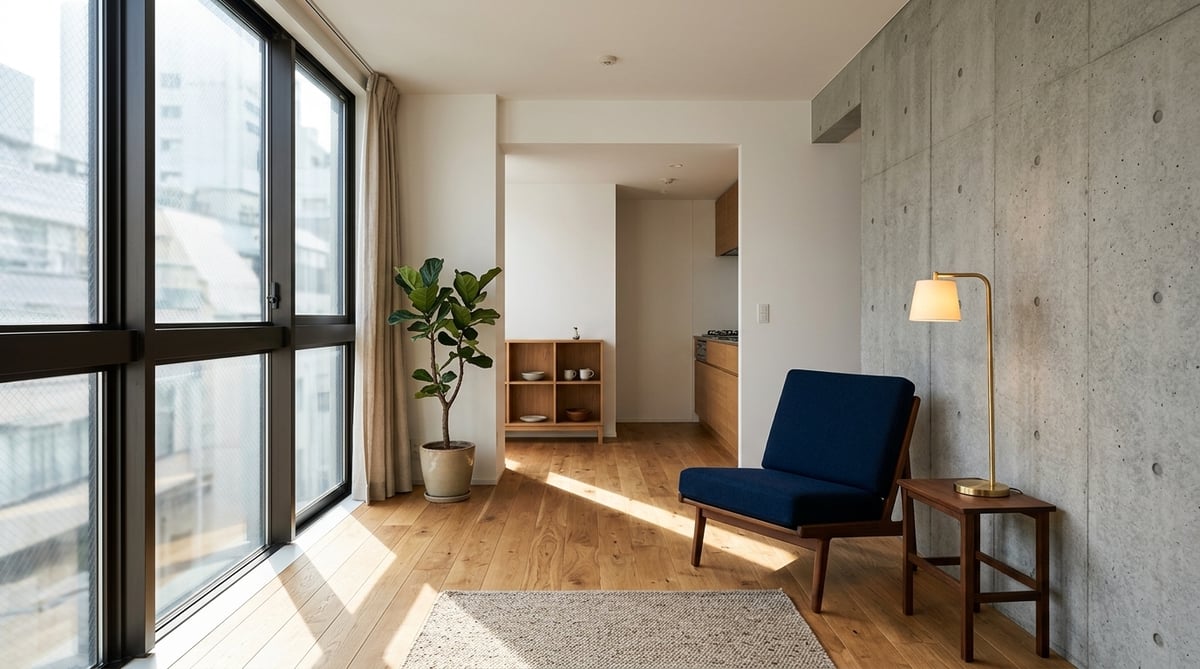
Emerging from Sumiyoshi Station in Koto Ward around dusk, where Shin-Ohashi-dori and Yotsume-dori intersect beneath an open sky, a gentle breeze carries through the quiet groves of Sarue Onshi Park. During a weekend apartment viewing, a client sat at a local cafe and spread out two property floor plans. One was a modern 1LDK apartment here in Sumiyoshi, where average rent sits comfortably around 166,000 yen per month. The other was across the Sumida River in Chiyoda Ward—around Jimbocho and Kudanshita—where 1LDK rents rise into the 233,000 to 246,000 yen bracket. For those looking to secure even more living space while controlling budget, heading just two stops further east on the Toei Shinjuku Line brings Ojima into view, where average 1LDK rent settles around 157,000 yen.
For house hunters evaluating neighborhoods east of central Tokyo across Koto, Sumida, and Edogawa Wards, the Tokyo Metro Hanzomon Line and the Toei Shinjuku Line form an exceptionally practical comparison pair, intersecting and running alongside each other across three key stations: Sumiyoshi, Jimbocho, and Kudanshita. While subway route maps might make both lines appear to serve similar east-west corridors across Tokyo, everyday residential satisfaction depends on much more than nominal transit times.
The core decision ultimately comes down to daily commute geometry: direct access to the southwestern business and creative hubs of Otemachi, Nagatacho, Omotesando, and Shibuya via the Hanzomon Line, versus direct access to Ichigaya, Shinjuku-sanchome, Shinjuku, and the Chuo or Keio Line corridors via the Toei Shinjuku Line. It is also an intentional lifestyle balance between spacious, cost-effective living in eastern Tokyo's flat neighborhoods with abundant supermarkets, and paying a higher premium for central Tokyo's elevated plateau topography and walking-distance convenience to work.
- Direct access to Otemachi, Omotesando, and Shibuya on the Hanzomon Line (with morning Shibuya-bound originating trains at Kiyosumi-shirakawa), versus direct access to Ichigaya, Shinjuku-sanchome, and Shinjuku on the fully 10-car Toei Shinjuku Line (with morning Shinjuku-bound originating trains at Ojima).
- Comparing eastern hubs like Sumiyoshi (1K: 99,000 yen, 1LDK: 166,000 yen) or Ojima (1K: 95,000 yen, 1LDK: 157,000 yen) against central hubs (Jimbocho, Kudanshita, Shinjuku, Shibuya) reveals a 2-year total housing cost difference of 1.0 to 1.5 million yen for 1K units, and around 2.0 million yen for 1LDK apartments.
- The sturdy loam plateau above Kudanzaka, Bancho, and Hanzomon offers zero-flood-zone peace of mind, whereas eastern lowland areas like Sumiyoshi and Ojima offer practical convenience with large supermarkets, shopping arcades, and a need to verify elevated electrical equipment.
Commuting Dynamics: Otemachi and Shibuya via Hanzomon Line vs. Ichigaya and Shinjuku via Toei Shinjuku Line
Even when boarding at the same station such as Sumiyoshi or Jimbocho, the Tokyo Metro Hanzomon Line and the Toei Shinjuku Line serve entirely distinct business quarters and offer noticeably different morning riding comfort. Here is a clear overview of operating parameters and through-service routes for both lines before evaluating their daily commute nuances.
| Comparison Metric | Tokyo Metro Hanzomon Line | Toei Shinjuku Line |
|---|---|---|
| Train Configuration | 10 cars (20m-class, 4 doors per car) | 10 cars (all trains standardized to 10 cars, 20m-class, 4 doors per car) |
| Through-Service & Express Operations | Direct through-service with Tokyu Den-en-toshi Line (Chuo-rinkan direction) and Tobu Skytree Line (Kuki / Minami-kurihashi direction). Local stops only within the subway line. | Direct through-service with Keio New Line and Keio Line (Sasazuka / Chofu / Hashimoto direction). Express services operated within the subway line. |
| Peak Congestion Rate (MLIT Official Data) | 111% (Shibuya → Omotesando, 8:00–9:00 AM) | 152% (Nishi-ojima → Sumiyoshi, 7:40–8:40 AM) |
| Major Direct Destinations | Oshiage, Kinshicho, Kiyosumi-shirakawa, Mitsukoshimae, Otemachi, Nagatacho, Aoyama-itchome, Omotesando, Shibuya | Moto-yawata, Ojima, Sumiyoshi, Morishita, Bakuro-yokoyama, Iwamotocho, Ogawamachi, Jimbocho, Ichigaya, Shinjuku-sanchome, Shinjuku |
| Key Morning Originating Stations | Oshiage, Kiyosumi-shirakawa (depot siding tracks), Shibuya | Moto-yawata, Mizue, Ojima (Ojima train maintenance depot) |
Direct Corridors: Otemachi-Omotesando-Shibuya Axis vs. Ichigaya-Shinjuku Subcenter Axis
The defining strength of the Hanzomon Line lies in its fluid alignment, connecting the residential neighborhoods of eastern Tokyo directly through the heart of Nihombashi and Marunouchi, and extending seamlessly toward the commercial and creative powerhouses of Akasaka, Aoyama, and Shibuya. Boarding at Sumiyoshi Station, for instance, reaches Otemachi in 10 direct minutes, Omotesando in approximately 25 minutes, and Shibuya in around 27 minutes. For professionals working in the financial and corporate trading hubs of Mitsukoshimae and Otemachi, those transferring at Nagatacho to the Yurakucho, Namboku, Ginza, or Marunouchi Lines, or weekend travelers heading out toward Omotesando and Shibuya, eliminating platform stair transfers provides an effortless door-to-door rhythm.
The Toei Shinjuku Line, by contrast, is a workhorse transit corridor that runs westward in a straight line along Yasukuni-dori and Shinjuku-dori from the northern edge of Kanda and Akihabara straight into the Shinjuku subcenter. From Sumiyoshi, local trains reach Ichigaya in approximately 15 direct minutes and Shinjuku in about 21 minutes, while express stops like Ojima and Morishita also offer daytime express services. Along with pragmatic commercial districts like Bakuro-yokoyama, Iwamotocho (walking distance to Akihabara), and Ogawamachi, it connects directly to the publishing and academic clusters of Ichigaya, the department stores of Shinjuku-sanchome, and the massive transit hub of Shinjuku. Direct through-service onto the Keio New Line and Keio Line also allows seamless travel toward Hatsudai, Sasazuka, and Meidaimae without passing through ticket gates.
For those commuting to Otemachi or Tokyo Station who choose to live at a standalone Toei Shinjuku Line station like Ojima or Nishi-ojima, an additional transfer is required—either transferring at Jimbocho to the Toei Mita Line bound for Otemachi, or walking through the underground passage at Ogawamachi to Awajicho on the Marunouchi Line or Shin-ochanomizu on the Chiyoda Line. Deciding whether to accept this one transfer in exchange for lower rent and express train speed, or prioritizing the direct convenience of the Hanzomon Line, is the primary baseline for choosing between these two routes.
Beyond Congestion Rates: Morning Train Comfort and Seated Commutes from Kiyosumi-shirakawa and Ojima
Looking at official congestion rate data published by the Ministry of Land, Infrastructure, Transport and Tourism (MLIT), the Hanzomon Line records 111% while the Toei Shinjuku Line records 152%. However, understanding the specific segments where these figures are measured provides a much clearer picture. The Hanzomon Line's highest congestion occurs on the section feeding into central Tokyo from the Tokyu Den-en-toshi Line between Shibuya and Omotesando. On the eastern stretch from Oshiage, Kinshicho, and Sumiyoshi toward Otemachi, while passenger volume from the Tobu Line is steady, severe physical crowding is relatively mild. Furthermore, the Hanzomon Line features Kiyosumi-shirakawa Station, equipped with an underground depot and siding tracks, where several trains originate bound for Shibuya during the morning rush. Waiting for one or two departures to secure a seat and read peacefully all the way to Otemachi or Omotesando remains a highly favored commute strategy.
In contrast, the Toei Shinjuku Line's peak congestion segment—Nishi-ojima to Sumiyoshi (7:40–8:40 AM, 152% congestion)—is precisely the eastern bottleneck where commuters from Ichikawa City and Edogawa Ward converge toward central Tokyo. While upgrading all train formations to 10 cars has noticeably reduced crowding compared to the previous 8-car era, boarding at mid-route stations during peak hours still leaves little room to comfortably read a tablet. This is where Ojima Station, adjacent to the Ojima Train Maintenance Depot, becomes a decisive asset with its morning rush originating trains toward Shinjuku. Even within Koto Ward, the difference between boarding a crowded mid-route train from Nishi-ojima or Sumiyoshi versus waiting on the platform at Ojima to sit comfortably all the way to Shinjuku provides a noticeably more relaxed start to the workday.
Underground Station Architecture and Real Transfer Realities across Kudanshita, Jimbocho, and Sumiyoshi
While the Hanzomon Line and the Toei Shinjuku Line cross at three stations, assuming that transferring is equally convenient at all three can lead to an unexpected amount of vertical stair climbing. Each of these three interchange stations has a distinct subterranean layout.
| Interchange Station | Platform Depth & Structure | Ticket Gate & Transfer Characteristics |
|---|---|---|
| Kudanshita Station | Both lines run parallel on B4F (3-platform, 4-track layout) | The central island platform connects Track 4 (Hanzomon Line for Otemachi / Oshiage) and Track 5 (Toei Shinjuku Line for Ichigaya / Shinjuku) for cross-platform transfers following barrier wall removal. Outer platforms (Track 3 for Shibuya, Track 6 for Moto-yawata) and the Tozai Line connect within a unified concourse. |
| Jimbocho Station | Shinjuku Line: B1F (2 side platforms, 2 tracks) Hanzomon Line: B4F (1 island platform, 2 tracks) |
Toei and Tokyo Metro gates are separate (positioned close together with dedicated transfer gates). Requires vertical movement across 3 basement levels between B1F and B4F. |
| Sumiyoshi Station | Shinjuku Line: B2F (2 side platforms, 2 tracks) Hanzomon Line: B3F (Shibuya direction) & B4F (Oshiage direction) |
Out-of-station transfer via the B1F concourse. The Toei Shinjuku Line features direction-specific gates where passengers cannot cross between opposite platforms inside the ticket gates. |
For rail transfers, Kudanshita Station offers by far the lowest physical burden. On the B4 level, both lines operate along a 3-platform, 4-track configuration. The historic dividing wall that once separated Tokyo Metro and Toei platforms was removed, allowing passengers transferring between Track 4 (Hanzomon Line toward Otemachi / Oshiage) and Track 5 (Toei Shinjuku Line toward Ichigaya / Shinjuku) to step directly across the central island platform without taking stairs or elevators. Outer tracks (Track 3 for Shibuya and Track 6 for Moto-yawata) and the Tozai Line are also linked within a shared fare-paid concourse. In contrast, Jimbocho Station spans three full subterranean levels between the shallow B1 level of the Toei Shinjuku Line along Yasukuni-dori and the deep B4 level of the Hanzomon Line, requiring meaningful walking and escalator time.
When selecting a neighborhood to call home, understanding the layout of Sumiyoshi Station is especially practical. Transferring between the two lines at Sumiyoshi requires passing through the B1 ticket gates to the outside concourse before re-entering, and the Hanzomon Line platform for Oshiage is situated deep on B4. Additionally, the Toei Shinjuku Line platforms on B2 use separate ticket barriers for each direction, meaning you cannot cross between opposite-direction platforms once inside the gates. When viewing apartments around Sumiyoshi, rather than simply looking at total walking minutes to the station entrance, it is worth verifying which surface exit is closest to the specific ticket gate and platform direction you will use every day.
Simply enter the rent and deposit from portal listings to calculate a full, itemized breakdown including brokerage and guarantor fees without hidden add-ons.
Apartment Rent Benchmarks and 2-Year Total Housing Cost Break-Even Points
Following commute dynamics, the next key consideration is the stepwise variation in rental prices between the Sumida River and the Arakawa River, alongside total housing expenditure over a standard two-year lease term. Below are current median monthly rents and unit pricing across representative stations on both lines.
| Station (Ward) | Primary Lines | 1K Median Rent | 1LDK Median Rent | 2LDK Median Rent | Rent per sqm |
|---|---|---|---|---|---|
| Omotesando (Minato Ward) | Hanzomon Line, etc. | 162,000 yen | 284,000 yen | 418,000 yen | 5,800 yen/sqm |
| Shibuya (Shibuya Ward) | Hanzomon Line, etc. | 157,000 yen | 274,000 yen | 404,000 yen | 5,600 yen/sqm |
| Shinjuku (Shinjuku Ward) | Toei Shinjuku Line, etc. | 145,000 yen | 251,000 yen | 367,000 yen | 5,300 yen/sqm |
| Kudanshita (Chiyoda Ward) | Hanzomon Line, Toei Shinjuku Line, etc. | 143,000 yen | 246,000 yen | 361,000 yen | 5,300 yen/sqm |
| Jimbocho (Chiyoda Ward) | Hanzomon Line, Toei Shinjuku Line, etc. | 136,000 yen | 233,000 yen | 338,000 yen | 5,100 yen/sqm |
| Kiyosumi-shirakawa (Koto Ward) | Hanzomon Line, Oedo Line | 117,000 yen | 196,000 yen | 280,000 yen | 4,500 yen/sqm |
| Sumiyoshi (Koto Ward) | Hanzomon Line, Toei Shinjuku Line | 99,000 yen | 166,000 yen | 235,000 yen | 4,000 yen/sqm |
| Ojima (Koto Ward) | Toei Shinjuku Line | 95,000 yen | 157,000 yen | 220,000 yen | 3,750 yen/sqm |
The 40,000–60,000 Yen Monthly Gap for Single 1K Units: Trading Commute Minutes for Living Space
Looking at single-occupancy 1K layouts, eastern hubs in Koto Ward like Sumiyoshi (99,000 yen) and Ojima (95,000 yen) stay comfortably under the 100,000 yen threshold. In contrast, central wards—Jimbocho, Kudanshita, Shinjuku, Shibuya, and Omotesando—step up sharply into the upper 130,000 to 160,000 yen range. This monthly difference of 40,000 to 60,000+ yen stems from structural land-use dynamics: in Chiyoda, Minato, Shibuya, and Shinjuku Wards, residential developments compete fiercely with commercial office and retail uses, directly inflating acquisition and construction costs, whereas Sumiyoshi and Ojima feature established residential zoning with consistent apartment supply.
A monthly gap of 44,000 yen (comparing a 1K in Sumiyoshi versus Kudanshita) accumulates to approximately 1,056,000 yen in pure base rent across 24 months. Factoring in rent-proportional fees like security deposits, key money, and lease renewal charges, the total financial difference reaches approximately 1.15 to 1.20 million yen over two years. When compared to Shibuya or Omotesando, that two-year housing cost difference exceeds 1.50 million yen. For professionals whose workdays regularly conclude after 10:00 PM and who prioritize trimming 10 minutes from transit time to maximize sleep and recovery, investing in central neighborhoods like Jimbocho, Kudanshita, or Toei Shinjuku Line stations such as Ichigaya (1K: 143,000 yen), Ogawamachi (1K: 137,000 yen), or Akebonobashi (1K: 131,000 yen) delivers tangible value. Conversely, for remote or hybrid workers seeking an independent bathroom vanity, 25+ square meters of floor area, and a 2-burner gas kitchen within a 100,000 yen budget, choosing Sumiyoshi, Ojima, or even Funabori in Edogawa Ward (1K: 88,000 yen) substantially enhances everyday interior comfort.
1LDK Break-Even Dynamics for Working Couples at Sumiyoshi vs. Neighboring Stations
For working couples and DINKs households whose workplaces are split between the Otemachi/Omotesando axis and the Ichigaya/Shinjuku axis, an interchange station served by both lines offers an exceptionally rational home base. However, renting a 1LDK at central interchange stations like Kudanshita or Jimbocho, or around Shinjuku, typically requires 230,000 to 250,000+ yen per month, bringing total two-year housing expenses near 6.0 million yen.
Turning attention to the third interchange station, Sumiyoshi, the median 1LDK rent drops to 166,000 yen. Compared to Kudanshita (246,000 yen) or Shinjuku (251,000 yen), this saves 80,000 to 85,000 yen monthly, generating a two-year total savings of roughly 2.0 million yen. Because Sumiyoshi reaches Otemachi in 10 direct minutes and Ichigaya in approximately 15 direct minutes, both partners enjoy a transfer-free commute while keeping housing costs manageable.
When searching around Sumiyoshi, comparing adjacent stations within a 10- to 12-minute walk is equally practical. Walking about 10 minutes north along Yotsume-dori brings you into the commercial orbit of Kinshicho Station (1LDK: 178,000 yen), served by the JR Sobu Line and the Hanzomon Line. A frequent question during viewings is whether adding roughly 10,000 yen in monthly budget to live closer to Kinshicho makes sense for direct access to large shopping malls, cinemas, and JR Rapid trains to Tokyo and Shinagawa. Looking west, the Toei Shinjuku Line's Kikukawa Station (1LDK: 182,000 yen), the Toei Oedo Line interchange at Morishita Station (1LDK: 196,000 yen), and originating-train hub Kiyosumi-shirakawa Station (1LDK: 196,000 yen) are all reachable by bicycle or on foot. If you place a 15,000 to 30,000 yen premium on Oedo Line access to Roppongi and Shiodome alongside specialty coffee shops, Morishita or Kiyosumi-shirakawa shine; if you prefer two direct subway lines, quiet parks, and large supermarkets anchored in the 160,000 yen range, Sumiyoshi provides solid value.
2LDK Family Housing: Eastern Space & Greenery vs. Chiyoda Ward Educational Heritage & Plateau Ground
For families with children or professionals requiring a dedicated home office in a 2LDK layout, the rent differential between eastern Tokyo and central districts widens to 100,000 to 180,000+ yen monthly. In Sumiyoshi (235,000 yen) and Ojima (220,000 yen), generous 55 to 65 square-meter floor plans with weekend lawn picnics at Sarue Onshi Park or Ojima Komatsugawa Park become realistic within balanced household budgets. Broad, flat sidewalks that accommodate strollers and make nursery drop-offs effortless are a hallmark of these eastern neighborhoods.
Conversely, families targeting Kudanshita, Jimbocho, or Hanzomon (2LDK: 394,000 yen) despite budgets in the upper 300,000 yen range often do so for compelling reasons. These include historic Chiyoda Ward public elementary school districts such as Fujimi Elementary, Kudan Elementary, Kojimachi Elementary, and Ochanomizu Elementary, along with the prestigious municipal six-year secondary school, Chiyoda Ward Kudan Secondary Education School. Paired with the structural security of elevated Musashino plateau topography outside flood hazard zones, the decision naturally aligns depending on whether you prioritize household financial margin and spacious square footage, or premier public educational environments and walking-distance proximity to work.
Ground Stability, Flood Mitigation, and Daily Grocery Convenience: Lowlands vs. Musashino Plateau
Once transit corridors and rent benchmarks are clear, examining topological contours, subterranean ground conditions, and daily supermarket networks brings everyday living realities into focus. Even along the same subway lines, ground history changes dramatically between the northwest of the Imperial Palace and the east bank of the Sumida River.
Resilient Loam Plateaus above Kudanzaka vs. Valley Lowlands in Jimbocho and Shibuya
While central Tokyo is often assumed to be entirely situated on solid elevated ground, walking the neighborhoods reveals distinct topographic transitions across single streets. Climbing west up Kudanzaka from Kudanshita Station toward Kudan-kita 2-chome (Category I Residential Zone), Kudan-minami 2-chome, and onward to Ichibancho (Category II Residential Zone) and Hirakawacho 1-chome around Hanzomon Station, you enter the volcanic loam plateau at the eastern edge of the Musashino Plateau, roughly 30 meters above sea level. These elevated districts sit entirely outside official flood hazard zones, preserving a tranquil residential atmosphere away from main avenues. The areas around Omotesando Station in Minami-aoyama 4-chome and Jingumae 3-chome share this same resilient plateau elevation.
At the bottom of Kudanzaka in Jimbocho, the landscape shifts. While Kanda-nishikicho 3-chome occupies slightly raised gravel ridges outside flood zones, areas along the Nihombashi River such as Hitotsubashi 2-chome form flat valley lowlands included in flood hazard maps (with potential flood depths of 0.5 to 3.0 meters). Similarly, the Hanzomon Line's starting hub around Shibuya Station (Shibuya 1-chome & 3-chome) sits in a commercial valley along the Shibuya River, whereas the Toei Shinjuku Line terminus at Shinjuku Station (Yoyogi 2-chome & Kabukicho 1-chome) occupies high loam ground with minimal flood risk, though commercial traffic and future building redevelopments on adjacent surface parking lots should be evaluated for natural lighting impacts.
Building Equipment Safeguards for Apartments in Low-Lying Eastern Districts
Bordered by the Sumida, Arakawa, and Kyu-Nakagawa Rivers, Sumiyoshi (Sumiyoshi 2-chome, Ishijima) and Ojima (Ojima 6-chome, Kitasuna 5-chome) are flat residential neighborhoods built largely on reclaimed land and alluvial plains since the Edo period. The absence of steep hills makes bicycle transit effortless, but these areas fall within the zero-meter zone of the Koto 5-Ward Large-Scale Flood Hazard Map, with projected flood depths of 2 to 5 meters during extreme Arakawa River overflow scenarios. Living safely in this corridor requires looking beyond just the floor number of your individual unit.
Everyday Groceries: Supermarket Chains & Arcades in Sumiyoshi and Ojima vs. Compact Urban Markets in Jimbocho and Kudanshita
Daily living convenience differs notably depending on whether you cook at home regularly or rely primarily on takeout and dining out after work.
Sumiyoshi and Ojima excel in accessible, unpretentious daily shopping within walking distance of the station. At Sumiyoshi Station, MyBasket Sumiyoshi Ekimae and MyBasket Sumiyoshi Eki-kita sit near the intersection of Shin-Ohashi-dori and Yotsume-dori, while across from Sarue Onshi Park lies Life Fukagawa Sarue, a large full-scale supermarket offering fresh produce, groceries, and daily essentials under one roof. Ojima offers even deeper neighborhood charm; beyond nearby MyBasket Ojima Ekimae and MyBasket Ojima Eki-minami, the vibrant Sun Road Nakanohashi Shopping Arcade features traditional greengrocers, delicatessens, and butcher shops. Picking up freshly fried side dishes and seasonal fruit on the stroll home provides an authentic neighborhood warmth rarely found in central corporate hubs.
Kudanshita and Jimbocho, as historic university, bookshop, and office districts, do not feature sprawling suburban-style supermarkets with parking lots. Daily groceries and essentials are handled via compact urban markets like MyBasket Kudan-kita 1-chome, MyBasket Jimbocho Ekimae, and Maruetsu Petit Kanda Jimbocho 2-chome, supplemented by gourmet specialties and prepared meals from Seijo Ishii Kanda Jimbocho. While bulk weekend shopping for large families requires planning, singles and working couples will appreciate the boundless selection of historic curry restaurants, casual set-meal diners, and specialty coffee shops tucked into every side street.
Regardless of which area you choose, inspecting real-time morning transit crowding, physical station transfer pathways, and local flood hazard maps in person is the most reliable way to avoid surprises after move-in.
When to Pass: Disqualification Criteria for the Hanzomon Line and Toei Shinjuku Line
While both subway routes offer excellent connectivity, neither is a universal solution for every lifestyle. Reviewing these disqualification factors will help clarify whether choosing the alternative line or a different station altogether will result in a more seamless daily routine.
When to Pass on the Hanzomon Line: Inter-Line Delay Propagation & Direct Access to Shinjuku
The first scenario where passing on the Hanzomon Line makes practical sense is when your priority is avoiding wide-area delay ripple effects. The Hanzomon Line connects directly with the Tokyu Den-en-toshi Line (Chuo-rinkan direction) in the west and the Tobu Skytree, Isesaki, and Nikko Lines (Kuki / Minami-kurihashi direction) in the east, spanning Kanagawa, Tokyo, and Saitama Prefectures. While convenient, weather disruptions, level-crossing checks, or passenger congestion along suburban surface tracks can trigger minor delays across the subway core. The Toei Shinjuku Line, by contrast, operates a more contained through-service with the Keio Line, offering relatively independent reliability for those with zero-tolerance schedules.
The second scenario is when your daily commute and social hubs center around Shinjuku, Ichigaya, Yotsuya (JR Chuo Line access), or the Tama region. Commuting toward Shinjuku from standalone Hanzomon Line stations like Kiyosumi-shirakawa, Suitengumae, or Oshiage requires transferring every day at Kudanshita, Nagatacho, or Shibuya. Basing yourself directly along the Toei Shinjuku Line (Ojima, Morishita, or express stop Funabori) provides direct access to Shinjuku-sanchome and Shinjuku, with options further east in Edogawa Ward offering an additional 10,000 to 20,000 yen in monthly rent savings.
When to Pass on the Toei Shinjuku Line: Omotesando/Shibuya Commutes & Non-Flood Plateau Living
Conversely, passing on the Toei Shinjuku Line is advisable when daily access to Otemachi, Aoyama-itchome, Omotesando, and Shibuya anchors your lifestyle. Commuting to Omotesando or Shibuya from standalone Toei Shinjuku Line stations like Ojima or Nishi-ojima entails transferring daily at Kudanshita or Jimbocho. If your work, dining, and weekend activities revolve around Aoyama, Shibuya, and Tokyu line destinations, residing directly along the Hanzomon Line in Sumiyoshi, Kiyosumi-shirakawa, or Kinshicho eliminates ongoing transfer friction.
The second scenario is when you want to completely avoid zero-meter flood hazard zones and reside exclusively on elevated plateau ground. The eastern stretch of the Toei Shinjuku Line (Morishita through Sumiyoshi, Ojima, and into Edogawa Ward) consists entirely of low-lying terrain within the Arakawa and Sumida basins. Achieving stable loam plateau ground on the Toei Shinjuku Line requires looking west toward Ichigaya (1LDK: 246,000 yen), Akebonobashi (1LDK: 222,000 yen), or Shinjuku. In that price bracket, evaluating the Hanzomon Line's plateau neighborhoods around Kudanzaka, Hanzomon (Ichibancho, Hirakawacho), and Omotesando (Minami-aoyama) provides a broader selection of quiet residential environments outside flood zones.
Ideal Fit for the Hanzomon Line
- ✓ Direct, transfer-free commutes to Otemachi, Mitsukoshimae, Nagatacho, Aoyama, Omotesando, and Shibuya.
- ✓ Morning seated commutes utilizing originating trains at Kiyosumi-shirakawa, alongside a relaxed cafe neighborhood feel.
- ✓ Option to select elevated plateau neighborhoods outside flood hazard zones (Kudanzaka, Bancho, Minami-aoyama) if budget permits.
- ✓ Seamless weekend excursions toward Futako-tamagawa (Tokyu Den-en-toshi Line) or Tokyo Skytree without transfers.
Ideal Fit for the Toei Shinjuku Line
- ✓ Swift travel to Ichigaya, Shinjuku-sanchome, Shinjuku, and Keio Line destinations utilizing express services.
- ✓ Controlled housing costs (1K in the 90,000 yen range, 1LDK in the 150,000 yen range) paired with morning seated commutes from Ojima.
- ✓ Reliable operational timetable with minimal exposure to multi-prefecture delay propagation.
- ✓ Down-to-earth daily shopping along Sun Road Nakanohashi Arcade (Ojima) or Life Fukagawa Sarue (Sumiyoshi).
Synthesizing Commute Geometry and Living Environments
Intersecting across Kudanshita, Jimbocho, and Sumiyoshi, the Tokyo Metro Hanzomon Line and Toei Shinjuku Line are not competitors where one objectively outperforms the other. Rather, they serve as mirrors reflecting where you need to be on weekday mornings and what kind of living environment you want to return to at night.
For direct access to Otemachi, Omotesando, and Shibuya, the Hanzomon Line is the natural choice. For rapid transit to Ichigaya, Shinjuku-sanchome, and Shinjuku alongside practical rental rates, the Toei Shinjuku Line is an effective ally. For dual-income couples splitting commutes across both lines, or those seeking central Tokyo proximity while trimming 1.0 to 2.0 million yen in housing costs over two years, the interchange hub of Sumiyoshi—complete with large supermarkets and extensive parkland—provides an ideal equilibrium. Those prioritizing morning seated departures and traditional shopping arcades will find Ojima or Kiyosumi-shirakawa compelling, while those seeking elevated plateau ground and walking proximity to work will gravitate toward Kudanshita (Kudan-kita / Kudan-minami) or Hanzomon.
If you encounter an apartment on rental portals and find yourself wondering about electrical equipment placement, street noise, or whether the initial cost breakdown is fair and transparent, please feel free to reach out to Sorai Tokyo. Simply send the property link via our official LINE account (@soraitokyo / https://line.me/R/ti/p/@soraitokyo). A licensed real estate broker will check real-time availability via professional real estate databases and provide an objective second-opinion review of initial fees—free of charge, with zero phone calls, no mandatory store visits, and no pushy sales tactics.
Even if you are still narrowing down preferred lines or stations, you are welcome to explore our smart advisory tools (SorAi) anonymously without submitting a phone number. Available via the fixed bottom menu on mobile or the footer on desktop, we invite you to consult with us comfortably at your own pace. We look forward to supporting your move to Tokyo with calm, reliable guidance.
Frequently Asked Questions: Hanzomon Line vs. Toei Shinjuku Line
QAmong Kudanshita, Jimbocho, and Sumiyoshi, which interchange station offers the smoothest daily transfers?
AKudanshita Station offers the lowest walking burden. On level B4, both lines run alongside each other in a 3-platform, 4-track configuration. The historic dividing wall between the central island platform was removed, enabling seamless cross-platform transfers between Track 4 (Hanzomon Line for Otemachi / Oshiage) and Track 5 (Toei Shinjuku Line for Ichigaya / Shinjuku), while outer tracks connect inside a unified concourse. In contrast, Jimbocho Station spans three basement levels between B1 and B4, and Sumiyoshi Station requires an out-of-station transfer via the B1 concourse, making Kudanshita by far the most seamless interchange hub.
QWhich stations are realistic options if I want to sit down during the morning commute into central Tokyo?
AOn the Hanzomon Line, Kiyosumi-shirakawa Station (equipped with depot siding tracks and morning originating trains toward Shibuya) or Oshiage Station are primary candidates. On the Toei Shinjuku Line, Ojima Station (equipped with the Ojima Train Maintenance Depot and morning rush originating trains toward Shinjuku), Mizue Station, or Moto-yawata Station are top choices. Waiting on the platform for an originating departure substantially increases your chances of securing a seated commute to Otemachi, Omotesando, or Shinjuku.
QFor a working couple commuting to Otemachi and Shinjuku respectively, which station best balances rent and commute time?
ASumiyoshi Station in Koto Ward provides an exceptionally balanced solution. From Sumiyoshi, Otemachi is 10 minutes direct on the Hanzomon Line, while Shinjuku is approximately 21 minutes direct on the Toei Shinjuku Line. Furthermore, median 1LDK rent in Sumiyoshi is approximately 166,000 yen, saving roughly 2.0 million yen in total two-year housing expenses compared to central hubs like Kudanshita (246,000 yen) or Shinjuku (251,000 yen).
QWhen viewing apartments in low-lying eastern districts like Sumiyoshi or Ojima, what should I inspect regarding flood preparedness?
AIn areas designated within river flood hazard zones, beyond choosing an apartment on upper floors (such as the 3rd floor or higher), it is essential to check whether the building's electrical substation (power distribution room) and main water pumps are elevated to the 2nd floor or placed on raised plinths. Additionally, check for flood barrier boards installed at ground entrances and underground parking ramps. Buildings with elevated shared infrastructure mitigate the risk of prolonged power and water outages during extreme weather events.




Author: Sorai Tokyo Editorial Team (Supervised by Licensed Real Estate Agents)
A real estate consulting team specializing in assisting foreign nationals find rooms and explaining initial costs in Tokyo. We break down language barriers and differences in customs, offering dedicated support in Japanese, English, and Vietnamese for a safe and secure start to your new life.