
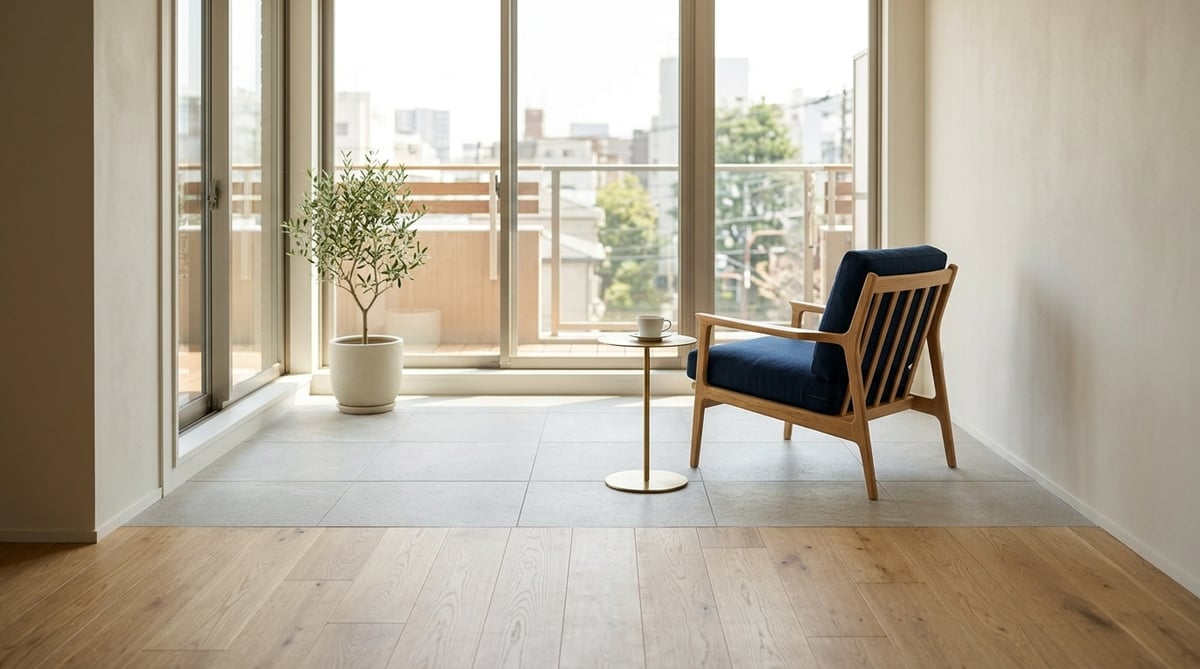
Stepping onto the platform in the crisp morning air and arriving at your office building’s entrance in just ten-odd minutes. Opening the book you were reading last night without having to endure the prolonged jostling of an overcrowded train—such calm, orderly mornings provide an invaluable buffer of serenity for professionals working in central Tokyo.
For those commuting each morning to Marunouchi, the core of Japan's business economy; Yurakucho, where sophisticated culture and commerce intersect; or Hibiya, overlooking the lush greenery of Hibiya Park and the Imperial Palace Outer Gardens, living close to work is a lifestyle goal almost everyone envisions. However, searching for a home in the central wards of Minato, Chiyoda, or Chuo often reveals rental market rates exceeding ¥130,000 to ¥160,000 for standard studio or 1K layouts, placing a heavy strain on disposable income.
To enjoy the daily ease of living close to the workplace without sacrificing financial peace of mind, three stations along the northeastern segment of the Tokyo Metro Chiyoda Line hold the key: Yushima, Nezu, and Nishi-Nippori. Despite being a direct 7- to 13-minute ride from Hibiya Station, their monthly rents settle into the accessible ¥80,000 to ¥110,000 range, combining downtown warmth, verdant nature, and exceptional mobility. Drawing upon more than a decade of experience in central Tokyo rental brokerage and contract verification, a licensed real estate broker breaks down the genuine living comfort and smart selection criteria for these three stations.
- Essential guide for Hibiya, Otemachi, and Yurakucho workers: Licensed brokers explore Yushima, Nezu, and Nishi-Nippori—direct to Hibiya in under 15 minutes with rents from ¥80,000 to ¥110,000.
- Direct transit times: Yushima in 7 min, Nezu in 9 min, and Nishi-Nippori in 13 min without transfers.
- Saves approx. ¥40,000–¥50,000 monthly (¥500,000–¥600,000 annually) compared to central city wards.
The Reality of Living Near Work for Professionals in Marunouchi, Yurakucho, and Hibiya
The areas of Marunouchi and Otemachi extending west of Tokyo Station, alongside Yurakucho and Hibiya adjacent to Ginza across Harumi-dori, serve as major hubs hosting financial institutions, trading houses, international consultancies, law firms, and major developers. For professionals working in these districts, each day begins with early market checks and strategic briefings, moving through intensive project milestones and networking dinners.
In the midst of demanding schedules, reducing transit time to secure rest and personal hours is essential not only for professional output but also for personal wellbeing. Enduring long commutes on crowded trains from distant suburbs gradually depletes daily vitality. A commute under 30 minutes door-to-door—or under 15 minutes on the train—creates unhurried morning routines and eliminates the anxiety of late-night commutes after dinner engagements.
Surging Central Rents and the Case for the Northeastern Chiyoda Line
The primary barrier to living near work in central Tokyo is rental pricing across Chiyoda and Minato wards. On the southwestern segment of the Chiyoda Line (such as Akasaka, Nogizaka, Omotesando, and Yoyogi-koen), standard 1K apartments (around 25 sqm, built within the past 15 years with separate bath and toilet) command monthly rents between ¥125,000 and ¥160,000. Monthly rates around Akasaka average ¥135,000, Nogizaka reaches ¥140,000, and Omotesando frequently exceeds ¥150,000. For an individual taking home ¥300,000 to ¥400,000 per month, housing alone can swallow 35% to 45% of net income, constraining savings, investments, and personal development.
In contrast, the northeastern segment of the Chiyoda Line on the opposite side of the Imperial Palace presents an appealing alternative. The line travels from Yoyogi-uehara through Omotesando, Kasumigaseki, Hibiya, Nijubashimae, and Otemachi, continuing onward to Yushima, Nezu, Sendagi, Nishi-Nippori, Machiya, and Kita-Senju. Just a few stops past the central office towers, the urban landscape softens into serene residential neighborhoods and historic traditional streets, bringing a noticeable decrease in rent levels.
Daily Time Savings and Healthy Boundaries Within a 15-Minute Direct Ride
From Hibiya Station, travel times on the Chiyoda Line are approximately 7 minutes to Yushima, 9 minutes to Nezu, and 13 minutes to Nishi-Nippori, all without changing trains. A ride under 15 minutes allows you to review your daily schedule or read a few pages of a book before arriving at your stop. The minimal physical fatigue ensures that you arrive at your desk with mental clarity.
Equally valuable is establishing a healthy psychological buffer between work and private life. Residing immediately next to your workplace often blurs personal boundaries, creating the possibility of running into colleagues or clients during weekend errands. A manageable train journey of 7 to 13 minutes provides an ideal emotional decompression zone, transitioning you smoothly from corporate focus to the comfort of home.
Licensed real estate brokers with in-depth knowledge of Eastern Tokyo support you via video call, from clarifying criteria and reviewing off-market listings to optimizing initial moving costs.
Complete rental and living guide for all stations on the Tokyo Metro Chiyoda Line, from Kita-Ayase and Kita-Senju to downtown Otemachi.
Comparing the 3 Value Stations: Direct Hibiya Access Under 15 Minutes with Rents of ¥80k–¥110k
While Yushima, Nezu, and Nishi-Nippori all sit within 15 minutes of Hibiya, each possesses its own distinct residential atmosphere and local history. Below is an objective comparison of their transit access, rental price ranges, and surrounding environments.
| Item / Station Name | Yushima | Nezu | Nishi-Nippori |
|---|---|---|---|
| Ride Time to Hibiya Station | Approx. 7 min (Direct) | Approx. 9 min (Direct) | Approx. 13 min (Direct) |
| Ride Time to Otemachi Station | Approx. 4 min (Direct) | Approx. 6 min (Direct) | Approx. 10 min (Direct) |
| Available Rail Lines | Tokyo Metro Chiyoda Line JR Yamanote / Keihin-Tohoku Line (Okachimachi Sta. 5 min walk), Ginza Line (Ueno-hirokoji Sta. 3 min walk), Oedo Line (Ueno-okachimachi Sta. 4 min walk) |
Tokyo Metro Chiyoda Line Namboku Line (Todaimae Sta. 10 min walk) |
Tokyo Metro Chiyoda Line JR Yamanote Line / JR Keihin-Tohoku Line Nippori-Toneri Liner |
| Rent Benchmark (1K, ~25 sqm) | ¥95,000 – ¥112,000 | ¥85,000 – ¥100,000 | ¥80,000 – ¥95,000 |
| Rent Benchmark (1LDK, 35–45 sqm) | ¥165,000 – ¥200,000 | ¥150,000 – ¥185,000 | ¥140,000 – ¥175,000 |
| Administrative Ward | Bunkyo Ward (partly bordering Taito Ward) | Bunkyo Ward | Arakawa Ward (bordering Bunkyo & Taito Wards) |
| Core Value of Living Environment | Lush nature near Ueno Onshi Park and Shinobazu Pond, paired with city access to Okachimachi and Akihabara | Exceptional safety in Bunkyo Ward, combined with the academic calm of the University of Tokyo campus and historic Yanesen alleys | Direct JR Yamanote Line access and outstanding daily cost-performance from local shopping streets and supermarkets |
Single 1K Dimensions, Wall-Center Calculations, and Pillar Dead Space
When reviewing property floor plans, renters often take listed figures like "25 sqm floor area, 8-tatami room" at face value. However, actual living comfort depends on the usable interior dimensions that accommodate furniture. Here is essential structural knowledge every renter should consider before signing a lease.
Under Japanese Building Standard Law and fair competition housing regulations, condominium floor plans calculate exclusive floor area from the wall center lines (known as hekishin). In contrast, the actual floor area measured during an in-person viewing is the clear interior dimension (uchinori), which excludes the wall thickness. In standard reinforced concrete (RC) buildings, the clear interior area is roughly 5% to 8% smaller than the wall-center calculation. Thus, a listed floor area of 25.0 sqm yields an actual interior room space of approximately 23.0 to 23.7 sqm.
Additionally, structural pillars and ceiling beams (especially in buildings without out-frame construction) can generate significant dead space. If a 40 cm x 40 cm pillar protrudes into a corner, placing a bed or desk flush against the wall becomes impossible, leaving an awkward 20 cm to 30 cm gap. Even if a room is listed as 6.5 tatami mats, deducting pillar intrusions and the door swing radius may leave an effective living space equivalent to only 5.2 to 5.5 tatami mats.
Standard dimensions for single beds are 97 cm wide by 195 cm long, and 120 cm wide by 195 cm long for semi-doubles. When viewing an apartment, bring a tape measure to verify that you have at least 200 cm of unobstructed wall length between structural pillars. With hinged or folding closet doors, an improperly placed bed can easily obstruct opening. Confirming clear door pathways and furniture layouts during your visit is essential to avoiding post-move regrets.
The comparison table below provides a practical reference between listed floor areas and usable living dimensions for standard single rentals.
| Exclusive Area (Wall Center) | Listed Tatami Size | Effective Size (Pillars Considered) | Accommodated Core Furniture | Ideal Lifestyle Match |
|---|---|---|---|---|
| 20.0–22.0 sqm | Approx. 5.5–6.0 tatami | Approx. 4.5–5.0 tatami | Single bed, small low table, compact TV stand | Primarily used for sleeping on weekdays. Best for minimalist lifestyles with few belongings |
| 24.0–26.0 sqm | Approx. 7.0–8.0 tatami | Approx. 6.0–6.8 tatami | Semi-double bed, work desk & chair, storage shelf | Hybrid workers (2–3 remote days weekly). Standard layout balancing sleep and dedicated work areas |
| 28.0–32.0 sqm | Approx. 8.5–10.0 tatami | Approx. 7.5–8.8 tatami | Semi-double bed, dedicated desk, 2-seater sofa, bookshelf | Fully remote professionals and residents seeking generous space for reading and hobbies on weekends |
For residents prioritizing Yamanote Line access and multi-station mobility
- ✓ Prime transit: 7 min direct to Hibiya, 4 min direct to Otemachi
- ✓ 3 to 5 minutes on foot to JR Okachimachi and Ginza Line Ueno-hirokoji Stations
- ✓ Lush nature at Ueno Onshi Park and Shinobazu Pond for morning strolls
- ✓ Rents range from ¥95,000 to ¥110,000+, slightly higher among the three
For residents seeking Bunkyo Ward safety, Yanesen charm, and tranquil surroundings
- ✓ Effortless commute: 9 min direct to Hibiya, 6 min direct to Otemachi
- ✓ Bunkyo Ward security backed by exceptionally low violent crime statistics
- ✓ Serenity surrounded by Yanaka and Nezu alleyways, vintage cafes, and University of Tokyo greenery
- ✓ No mega-complexes; neighborhood relies on quiet, independent local retailers
For residents seeking Yamanote Line interchange convenience with solid rent affordability
- ✓ 4 lines: Chiyoda Line, Yamanote Line, Keihin-Tohoku Line, and Nippori-Toneri Liner
- ✓ Outstanding economy with single 1K rents in the ¥80,000 to ¥95,000 range
- ✓ Swift direct Yamanote Line access to Ikebukuro, Shinjuku, and Shibuya
- ✓ Station plaza is lively with dining and rail viaducts; the western elevated ridge is prime
Yushima Station: A Prime City-Adjacent Gem Merging Yamanote Walking Distance with Ueno Park Nature
Positioned just two stops from Otemachi and three from Hibiya on the Chiyoda Line, Yushima Station genuinely embodies the character of an adjacent neighborhood to Tokyo's commercial core. Even during late-night returns following overtime work, a taxi from Otemachi or Marunouchi takes roughly 10 minutes, costing around ¥1,500 to ¥1,800 under late-night fares. For business professionals who value career dedication, this physical proximity offers reassuring peace of mind.
Multi-Line Access Spanning Okachimachi, Ueno, and Akihabara with Varied Terrain
A notable strength of Yushima is its walking access to multiple train lines beyond the Chiyoda Line itself. Walking eastward along Kasuga-dori brings you to Okachimachi Station on the JR Yamanote and Keihin-Tohoku Lines. Furthermore, Tokyo Metro Ginza Line's Ueno-hirokoji Station is a 3-minute walk, Toei Oedo Line's Ueno-okachimachi Station is 4 minutes, and Hibiya Line's Naka-okachimachi Station is reachable in about 6 minutes. Venturing south, the commercial and office hubs of Akihabara are a 10- to 12-minute walk.
Direct underground access on the Chiyoda Line to Otemachi, Kasumigaseki, and Omotesando; JR lines to Tokyo, Shinagawa, Shinjuku, and Shibuya; and Ginza Line service connecting directly to Nihombashi and Ginza. Having this comprehensive rail network within daily walking range is an uncommon advantage across Tokyo's 23 wards.
However, when evaluating housing options here, topographical elevation changes require careful inspection. Yushima sits at the eastern edge of the Musashino Plateau (the Hongo Plateau), creating an elevation difference of roughly 15 to 20 meters down toward the lowlands of Okachimachi and Ueno. The area surrounding Yushima Tenmangu (Yushima Tenjin Shrine) features steep historic slopes such as Kiridoshizaka, Sanemorizaka, and Mikumizaka. While avenues along Kasuga-dori (around the Tenjin-shita intersection) and Shinobazu Pond remain level, approaches ascending toward Hongo 3-chome or Yushima 2-chome and 3-chome involve noticeable gradients or stairways. While an electric assist bicycle or share-cycle readily softens incline fatigue, walking the exact route between the station and prospective apartment during an in-person viewing remains essential.
Morning Serenity at Shinobazu Pond and Refined Living Below Tenjin
Emerging from Yushima Station's exits, Shinobazu Pond at the southern edge of Ueno Onshi Park enters view. With lotus blossoms carpeting the water in summer and migratory waterfowl arriving through autumn and winter, this landscape offers an organic sanctuary moments from the city center.
Taking an early morning walk along the perimeter or pausing on a bench to enjoy the morning air provides a refreshing ritual to balance a demanding schedule. Ueno Onshi Park also hosts major cultural venues, including the National Museum of Western Art, the Tokyo National Museum, and the Tokyo Metropolitan Art Museum, offering an effortless cultural retreat on weekends.
The precincts of Yushima Tenmangu Shrine, revered as the patron deity of scholarship, exude a dignified calm throughout all seasons. The neighborhood maintains a comfortable distance from the nightlife districts of Ueno and Nakamachi-dori; turning north into the residential streets toward Hongo reveals peaceful enclaves of well-kept condominiums and low-rise residences.
Practical Grocery Routes and Late-Night Supermarkets in Yushima
For individuals cooking at home, neighborhood grocery infrastructure significantly influences everyday satisfaction. Yushima provides highly practical commercial options for busy schedules.
The primary grocery resource is Summit Store Yushima Tenjin-minami on Kasuga-dori (open 9:00 to 23:00). Offering an extensive selection of fresh meats, fish, and produce until 11:00 PM, it caters seamlessly to post-work grocery stops. Toward Ueno-hirokoji, Gyomu Super Ueno-hirokoji (9:00 to 22:00) provides bulk groceries, frozen foods, seasonings, and beverages at reasonable prices.
In front of Okachimachi Station stands the renowned food department store Yoshiike (9:30 to 20:30), known for its exceptional seafood and meats. The basement seafood counters display seasonal catches, broadening the scope of home cooking. Accompanied by gourmet takeout from Matsuzakaya Ueno Department Store's basement and daily household supplies from Takeya, Yushima allows residents to choose shopping venues tailored precisely to budget and purpose.
Nezu Station: Serene Living Framed by Bunkyo Ward Safety and Historic Yanesen Charm
Located just one stop and roughly two minutes from Yushima on the Chiyoda Line, Nezu Station welcomes residents into a noticeably more tranquil atmosphere. Despite providing direct commutes of 9 minutes to Hibiya and 6 minutes to Otemachi, stepping out of the ticket gates leads into a relaxed townscape set apart from metropolitan noise. Anchoring the historic Yanesen district (comprising Yanaka, Nezu, and Sendagi), Nezu retains traditional wooden architecture, quiet cafes, and neighborhood bakeries that reflect deep cultural warmth.
Proven Bunkyo Ward Public Safety and Solo Apartment Living
Bunkyo Ward, where Nezu Station is located, consistently ranks at the top of Tokyo's 23 wards for having among the lowest reported crime rates. According to police data from the Tokyo Metropolitan Police Department broken down by district, reported offenses across Nezu 1-chome and 2-chome, as well as neighboring Yayoi 1-chome and 2-chome, remain exceptionally rare, with violent offenses being almost non-existent.
The majority of reported infractions consist of unsecured bicycle thefts, which can be effectively prevented by utilizing auto-locked bicycle parking facilities and using double locks. Strict ward zoning regulations limit amusement parlors, pachinko halls, and entertainment venues, ensuring quiet residential nights free from disturbances. Shinobazu-dori and Kototoi-dori feature ample street lighting, offering well-lit walking conditions after dark. For residents setting up their first solo home in Tokyo or those prioritizing quiet surroundings, Nezu stands out as a dependable choice.
Historic Yanesen Laneways and the University of Tokyo's Green Spaces
Just west of Nezu Station lie the Hongo and Yayoi (Faculty of Agriculture) campuses of the University of Tokyo. Ascending the slope toward the Hongo Plateau leads directly into historic campus grounds framed by iconic ginkgo avenues. The University of Tokyo's grounds are open for respectful community walking; strolling around Sanshiro Pond lets residents enjoy natural woodland calmness in the heart of the metropolis.
To the east and north, the intimate alleys of Yanesen are dotted with renovated traditional machiya houses, artisanal coffee roasters, Japanese confectionery shops, and independent art galleries. Savoring freshly baked morning bread along quiet laneways or unwinding at a neighborhood coffee house provides everyday sensory comfort that elevates quality of life.
Neighborhood Conveniences Along Shinobazu-dori and Akafudado Supermarket
While celebrated for its historical character, Nezu provides solid everyday living convenience. Just outside Exit 1 along Shinobazu-dori sits Akafudado Nezu (open 10:00 to 21:00), the central supermarket serving local residents with a dependable selection of daily groceries and household items.
North of the station, MyBasket Nezu-ekikita operates from 7:00 to 24:00, accommodating early-morning breakfasts and late-night convenience purchases. Toward Ikenohata, Maruetsu Petit Ikenohata 2-chome (8:00 to 23:00) provides an additional grocery option. Pharmacies, medical clinics, post offices, and automated banking facilities align neatly along Shinobazu-dori, establishing a compact urban setting where daily errands can be completed within a short radius.
Nishi-Nippori Station: Yamanote Line Interchange Agility and High-Value Rent Efficiency
Travelling two stops beyond Nezu past Sendagi brings you to Nishi-Nippori Station. Travel times are approximately 13 minutes direct to Hibiya and 10 minutes to Otemachi. The hallmark of this station is its direct interchange with Tokyo's premier loop rail, the JR Yamanote Line, alongside average monthly rents for single 1K apartments settling in the ¥80,000 to ¥95,000 range—delivering remarkable value for a location within 15 minutes of the central business district.
Exceptional Mobility Across Four Major Rail Lines
Nishi-Nippori serves as a central junction connecting four separate rail lines: the underground Tokyo Metro Chiyoda Line, elevated JR Yamanote and Keihin-Tohoku Lines, and the Nippori-Toneri Liner. The direct underground transfer gate between the Chiyoda Line and JR tracks allows commuters to switch lines seamlessly without stepping out into rainy weather.
Via the Chiyoda Line, destinations such as Otemachi, Nijubashimae, Hibiya, Kasumigaseki, Akasaka, and Omotesando are reachable on a single direct train. Via the JR Yamanote Line, Ikebukuro is roughly 11 minutes away, Shinjuku is 20 minutes, Shibuya is 27 minutes, Ueno is 5 minutes, and Tokyo Station is 11 minutes. Rapid Keihin-Tohoku Line trains also stop during daytime hours, ensuring swift transit toward Akihabara and Shinagawa.
Commuting to Hibiya and Marunouchi on weekdays via the subway, and setting off across major Tokyo terminals via the Yamanote Line on weekends—this versatile connectivity gives active professionals a substantial daily advantage.
The Dual Charm of Dokanyama Ridge and Welcoming Downtown Streets
Topographically, Nishi-Nippori presents two distinct environments on either side of the station. The eastern side (toward Ogubashi-dori and Mikawashima) features flat downtown streetscapes filled with local retail, dining spots, and residential clusters. The western side (bordering Bunkyo and Taito wards) ascends onto the elevated Dokanyama ridge of the Musashino Plateau, home to the academic grounds of Kaisei Junior and Senior High School.
For renters looking for a quiet living environment, the elevated residential pocket to the west (Nishi-Nippori 3-chome and 4-chome toward Yanaka) is particularly recommended. Walking up Suwazaka or Jizozaka away from the railway tracks leads to low-rise condominiums and quiet homes. From the grounds of Suwa Shrine atop the bluff, visitors can enjoy broad views of trains passing below, making it a peaceful neighborhood landmark.
Managing Monthly Expenses with Convenient Supermarkets and Dining
A key reason for Nishi-Nippori's popularity is its accessibility to budget-conscious grocery and food choices.
The station area features MyBasket Nishi-Nippori 2-chome and MyBasket Nishi-Nippori 5-chome, alongside Maruetsu Petit Nishi-Nippori Ekimae beneath the elevated tracks, which operates late into the night. Walking west along Dokanyama-dori brings you to Summit Store Dokanyama Ekimae, while Hanamasa Doshinzaka toward Shinobazu-dori provides bulk grocery purchasing.
For dining out, the station vicinity features a welcoming variety of casual eateries, noodle shops, traditional diners, and bakeries. Reducing both housing overhead and daily food costs creates a meaningful buffer in personal finances compared to living in prime central districts.
Weather-Proof Commuting: Navigating Hibiya Station's Underground Network to Your Desk
A major advantage of using the Chiyoda Line to reach Hibiya Station is the extensive underground passageway network directly linked to the concourses. Hibiya Station's ticket gates connect directly to Tokyo Midtown Hibiya, the Imperial Theatre, Yurakucho Denki Building, Dai-ichi Life Hibiya First, JR Yurakucho Station, and the underground concourses of Marunouchi Naka-dori. Utilizing these corridors allows you to walk straight from the train to your office desk on rainy days or during midsummer heatwaves without opening an umbrella.
Optimal Car and Door Positions from Platform to Exit A and Midtown Hibiya
The Chiyoda Line Hibiya Station platform is situated on the second basement level (B2F) with an island platform layout (Track 1 for Yoyogi-uehara; Track 2 for Ayase and Kita-Ayase). Trains boarded from Yushima, Nezu, or Nishi-Nippori bound for central Tokyo arrive at Track 1.
When disembarking toward Marunouchi or Yurakucho offices, choosing the right car and door positions saves valuable time. Hibiya Station features two principal ticket gate concourses: the north gates (facing Otemachi and Yurakucho) and the south gates (facing Kasumigaseki and Hibiya Park).
Stairways and escalators leading to the primary Exit A group (A0 through A14), which connects directly to Marunouchi, Yurakucho, and Tokyo Midtown Hibiya, are positioned at the forward end of the train (Cars 1 and 2). Specifically, boarding near Car 1 Door 4, or Car 2 Door 3 positions you right next to the escalators ascending to the concourse.
Boarding rear cars (Cars 8 through 10) requires a long walk along the platform, so selecting forward cars (Cars 1–2) ensures an efficient morning arrival.
Board Cars 1–2
Board toward the front of the train (Cars 1 or 2) at Yushima, Nezu, or Nishi-Nippori.
Ascend Direct Escalators
Upon arrival at Hibiya, take the direct escalators up to the ticket gate concourse.
Exit Gate A to Corridors
Turn left for Midtown (Exit A11), or continue forward to Yurakucho and Marunouchi concourses.
Reach Your Desk Weather-Free
Ride building elevators directly to your floor for a commute unaffected by weather.
Navigating the Underground Walkways Connecting Yurakucho, Marunouchi, and Otemachi
The pedestrian network extending from Hibiya Station’s concourses provides comprehensive underground connectivity across the district. Key exits and connections include:
- Exit A11: Directly connected to Tokyo Midtown Hibiya, leading via arcade passages to building amenities and office lobbies.
- Exits A3 & B3: Directly connecting to Yurakucho Denki Building (A3) and the Imperial Theatre (B3), providing the closest access to Yurakucho station plaza and the theater district.
- Exits B1 & B2: Directly serving Dai-ichi Life Hibiya First (formerly DN Tower 21), reaching moat-facing offices without surface exposure.
- Exits A6–A8: Connecting passages toward JR Yurakucho Station (Central and Hibiya exits) and Tokyo Metro Yurakucho Line ticket gates.
- Nijubashimae Link Exits (D1–D4): Connecting corridors toward Tokyo International Forum and Marunouchi 3-chome.
Heading north through the continuous underground corridor from Hibiya connects directly to Nijubashimae (Marunouchi) Station, Marunouchi Nijubashi Building, Meiji Yasuda Village (Marunouchi MY PLAZA), Marunouchi Building (Marubiru), Shin-Marunouchi Building (Shin-Marubiru), Tokyo Station Underground Arcades, and the concourses of Otemachi Station—all without setting foot outside.
During rainy seasons or humid Tokyo summers, an air-conditioned, covered commute provides meaningful comfort for professionals residing along the Chiyoda Line.
Broker Standards: Contract Verification and Moving Cost Defenses
Once you identify an attractive home and neighborhood, scrutinizing the contract terms and move-in estimates is essential. In rental brokerage practice, unnecessary optional services are sometimes placed onto initial estimates by default or billed above customary market rates. Here, we outline the legal protections and key review points that safeguard tenant rights and optimize initial moving expenditures.
Supreme Court Precedents on Deposit Deductions and Fixed Cleaning Clauses
Rental lease agreements frequently feature special clauses stating terms such as "Fixed move-out cleaning fee of ¥55,000 (tax incl.) borne by tenant" or "One month deposit non-refundable amortization (shikibiki)." While standard deterioration from ordinary wear and tear is legally the landlord’s responsibility, specific legal criteria govern whether such special clauses are enforceable.
The benchmark ruling on this matter was delivered by the Supreme Court of Japan on December 16, 2005 (Second Petty Bench). The Court articulated the necessary criteria for special repair clauses covering ordinary wear and tear (such as fixed deposit deduction clauses) to be deemed legally valid:
- Objective Clarity of the Special Clause: The agreement must clearly and objectively specify that the tenant is assuming repair costs for ordinary wear and tear and natural aging.
- Tenant's Recognition and Mutual Agreement: The tenant must have understood and expressly consented at the time of contracting to assume repair costs for deterioration they would not ordinarily be liable for under statutory principles.
- Absence of Unconscionability (Compliance with Good Faith): The agreed financial burden must not be excessive or unilaterally disadvantageous to the consumer (tenant) in violation of good faith principles (Article 10 of the Consumer Contract Act).
Even if an agreement explicitly assigns move-out cleaning fees to the tenant, clauses setting charges substantially above prevailing market rates per square meter may be held invalid under Article 10 of the Consumer Contract Act. Carefully reviewing special clauses during the Explanation of Important Matters (Juyo Jiko Setsumei) and ensuring cost terms are fair helps protect your financial interests.
| Rent Tier Model | Nishi-Nippori (Rent: ¥85,000) | Nezu (Rent: ¥95,000) | Yushima (Rent: ¥105,000) |
|---|---|---|---|
| Advance Rent + Management Fee (1 Mo) | ¥93,000 (Mgt Fee: ¥8,000) | ¥105,000 (Mgt Fee: ¥10,000) | ¥115,000 (Mgt Fee: ¥10,000) |
| Security Deposit & Key Money (1 Mo Each) | ¥170,000 | ¥190,000 | ¥210,000 |
| Guarantor Company Initial Fee (50%) | ¥46,500 | ¥52,500 | ¥57,500 |
| Fire Insurance + Lock Replacement | Approx. ¥38,000 | Approx. ¥38,000 | Approx. ¥38,000 |
| Standard Brokerage Fee (Other Agencies: 1.1 Mo) | ¥93,500 | ¥104,500 | ¥115,500 |
| Sorai Tokyo Brokerage Fee (0.55 Mo) | ¥46,750 | ¥52,250 | ¥57,750 |
| Estimated Move-in Total (After Sorai Rate) | Approx. ¥394,000 – ¥410,000 | Approx. ¥437,000 – ¥450,000 | Approx. ¥478,000 – ¥500,000 |
| Brokerage Savings Effect | Saves ¥46,750 | Saves ¥52,250 | Saves ¥57,750 |
Conclusion: Refined Living Close to Work via the 15-Minute Chiyoda Line Corridor
Living close to central offices does not require overextending your finances in prime high-rent zones. Rather than dedicating excessive portions of your income to high central rents, selecting Yushima, Nezu, or Nishi-Nippori—just 7 to 13 minutes direct to Hibiya—allows you to secure comfortable housing for ¥80,000 to ¥110,000 per month, redirecting saved financial resources and time toward health, learning, and personal pursuits.
Choose Yushima for active multi-line mobility; Nezu for tranquil residential surroundings steeped in Bunkyo heritage; or Nishi-Nippori for superior transit connectivity paired with everyday affordability. Regardless of your choice, direct Chiyoda Line connections and Hibiya Station's underground corridors will reliably support your daily commute.
At Sorai Tokyo, licensed real estate brokers with specialized expertise in central and eastern Tokyo provide attentive apartment search support tailored to your unique lifestyle. Use our free SorAi tools—including the Move-in Cost Simulator—accessible via the bottom navigation bar on mobile or the footer on desktop. When you find an apartment of interest, feel free to reach out anytime through our official LINE account.
Frequently Asked Questions (FAQ): Commuting and Apartment Hunting on the Chiyoda Line
QCan I really walk from Hibiya Station to Marunouchi and Yurakucho offices without getting wet in the rain?
AYes, you can commute entirely sheltered from rain via connected underground passageways. Leaving the north ticket gates of Chiyoda Line Hibiya Station (accessed via stairs or escalators near Cars 1 and 2), passages extend across the district. Direct covered connections lead to Tokyo Midtown Hibiya (Exit A11), Yurakucho Denki Building (Exit A3), Imperial Theatre (Exit B3), and Dai-ichi Life Hibiya First (Exits B1 and B2). Continuing northward through the concourses connects seamlessly through Nijubashimae Station, Marunouchi Nijubashi Building, Marubiru, Shin-Marubiru, Tokyo Station, and Otemachi concourses, providing weather-protected walking throughout.
QAmong Yushima, Nezu, and Nishi-Nippori, which station is most recommended for women living alone?
AIf peace of mind and quiet surroundings are your top criteria, Nezu Station in Bunkyo Ward is a standout choice. Municipal crime statistics show exceptionally low incidences of violent offenses, and local ordinances strictly restrict late-night entertainment businesses, making evening walks calm and secure. Around Yushima, residential streets north of Kasuga-dori (behind Yushima Tenjin toward Hongo) are safe and quiet, while around Nishi-Nippori, the elevated western ridge near Kaisei High School (Nishi-Nippori 3-chome) provides well-lit, serene residential environments.
QGiven the sloped terrain in these areas, what should I check regarding walking routes from the station?
ABecause Yushima, Nezu, and Nishi-Nippori border the eastern bluff of the Musashino Plateau, notable slopes and stairways separate the uplands from lower areas—such as Kiridoshizaka in Yushima, Ijinzaka in Nezu, or Suwazaka in Nishi-Nippori. A listed "5-minute walk" that involves an uphill climb can feel longer in daily practice. Uplands often feature firm ground stability and lower flood risk, while lowlands provide flat walking access. We advise walking the route in person during your viewing to ensure the gradient aligns comfortably with your daily routine.
QCan Sorai Tokyo verify quotations or apply its half-month brokerage fee to properties found through other agencies?
AYes, absolutely. If you send the URL of a listing from portals like SUUMO or HOME'S, or an initial cost estimate provided by another brokerage, to Sorai Tokyo's official LINE account, a licensed real estate broker will check real-time availability via inter-broker property databases. We provide a second-opinion audit to remove unnecessary optional fees (such as indoor sanitization, emergency extinguishers, or document fees). When finalizing your contract through Sorai Tokyo, our brokerage fee is consistently capped at 0.55 months' rent (tax included).

Author: Sorai Tokyo Editorial Team (Supervised by Licensed Real Estate Agents)
A real estate consulting team specializing in assisting foreign nationals find rooms and explaining initial costs in Tokyo. We break down language barriers and differences in customs, offering dedicated support in Japanese, English, and Vietnamese for a safe and secure start to your new life.