
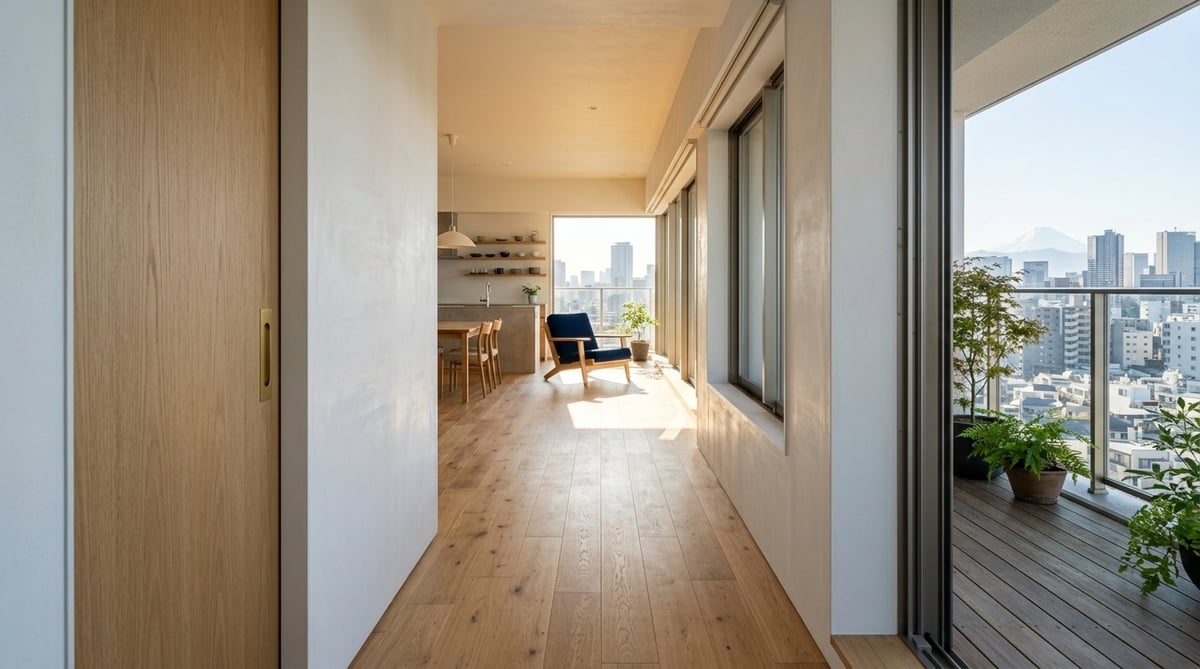
On an evening walk back from viewing an apartment in Shintomicho, stepping through the orderly grid of Irifune and Akashicho toward the Tsukuda-ohashi Bridge ramp opens up the skyline all at once. A cool breeze drifts across the Sumida River, and on the opposite bank, Okawabata River City 21 and the high-rise residential towers around Tsukishima Station glow softly against the dusk. Although these two stations sit just one stop and two minutes apart on the Tokyo Metro Yurakucho Line, the river acts as a clear boundary where both the urban scale and the rhythm of daily life shift noticeably.
For residents looking for a home in Chuo Ward, this boundary often becomes a key decision point because rent levels and lifestyle priorities sit in direct contrast. For a 1LDK apartment, average rent is ¥242,000 in Shintomicho compared with ¥224,000 in Tsukishima—a monthly difference of ¥18,000. For a 2LDK, the gap widens to ¥29,000 per month (¥354,000 versus ¥325,000). Choosing between accepting that higher fixed cost for the convenience of walking home from Ginza or Tokyo Station without crossing a bridge, or gaining more space, direct Toei Oedo Line access, and large-format supermarkets on the Tsukishima side, will shape how you spend your time every day.
In addition, anyone considering Shintomicho will naturally weigh nearby Tsukiji, Hatchobori, and Ginza-itchome, all within a few minutes on foot. Below, we organize the practical criteria—from two-year total housing costs and station transfer depth to grocery shopping routes, storm-surge hazard maps, and condominium rules—so you can choose the neighborhood that genuinely fits your routine.
- Tsukishima saves roughly ¥486,000 on a 1LDK and ¥783,000 on a 2LDK over two years compared with Shintomicho, making it easier to upgrade floor area or building amenities within the same budget.
- Shintomicho offers walkable access to Ginza and street-level connections to Tsukiji and Hatchobori, while Tsukishima provides direct Oedo Line access to Daimon, Roppongi, and Shinjuku without transfers.
- Shintomicho and Minato rely on compact local grocers, whereas Tsukishima concentrates four full-scale supermarkets and the Nishinaka-dori shopping street within easy walking distance.
Rent Benchmarks and Two-Year Total Housing Costs: Shintomicho, Tsukishima, and Nearby Stations
Comparing housing costs across the Sumida River, Tsukishima remains consistently more moderate than Shintomicho across every layout, from single-occupant 1K units to family-sized 2LDK and 3LDK apartments. At the same time, placing Shintomicho alongside its inland neighbors—Ginza-itchome, Tsukiji, and Hatchobori—shows how stepping just slightly east of Ginza's commercial core significantly reduces monthly fixed expenses.
| Station (Main Lines) | 1K | 1LDK (Est. 2-Year Total) | 2LDK (Est. 2-Year Total) | 3LDK | Est. Rent / sqm |
|---|---|---|---|---|---|
| Shintomicho (Yurakucho Line) | ¥140,000 | ¥242,000 (¥6,534,000) | ¥354,000 (¥9,558,000) | ¥438,000 | ¥5,200 |
| Tsukishima (Yurakucho & Oedo Lines) | ¥131,000 | ¥224,000 (¥6,048,000) | ¥325,000 (¥8,775,000) | ¥402,000 | ¥4,900 |
| Ginza-itchome (Yurakucho Line) | ¥162,000 | ¥284,000 (¥7,668,000) | ¥418,000 (¥11,286,000) | ¥517,000 | ¥5,800 |
| Tsukiji (Hibiya Line) | ¥140,000 | ¥242,000 (¥6,534,000) | ¥354,000 (¥9,558,000) | ¥438,000 | ¥5,200 |
| Hatchobori (Hibiya Line & JR Keiyo Line) | ¥136,000 | ¥233,000 (¥6,291,000) | ¥338,000 (¥9,126,000) | ¥418,000 | ¥5,100 |
The estimated two-year total above uses a 27-month equivalent (24 months of rent plus roughly 3 months' worth of non-refundable initial fees and renewal fees, excluding refundable security deposits) to reflect practical housing costs. All stations are located in Chuo Ward, Tokyo; 3LDK figures are reference estimates based on market listings.
How a ¥18,000–¥29,000 Monthly Difference Changes Floor Area and Building Type
For dual-income couples or single professionals seeking extra room in a 1LDK, the two-year total cost difference between Shintomicho and Tsukishima reaches ¥486,000. For a 2LDK, it grows to ¥783,000, and for a 3LDK, ¥972,000 (¥11,826,000 versus ¥10,854,000). When you tour apartments with a fixed monthly budget of around ¥240,000 or ¥350,000, the types of buildings available on either side of the river are noticeably different.
In Shintomicho, Irifune, and Minato, the housing stock consists mainly of compact mid-rise residences—typically 10 to 14 stories tall with only two or three units per floor. These buildings offer a high ratio of corner units and a brisk, low-friction exit onto the street within about a minute of leaving your door, though shared amenities are usually limited to auto-lock entry and parcel lockers. By contrast, in Tsukishima and Tsukuda, the same budget often secures 3 to 5 square meters of additional living space, or opens access to large-scale condominium towers and riverside sublease units featuring 24-hour staffed management, front-desk concierge services, trash rooms on every floor, and climate-controlled interior corridors. For a closer look at specific blocks, see our Shintomicho living guide and Tsukishima living guide.
Choosing Between Shintomicho, Ginza-itchome, Tsukiji, and Hatchobori
Clients considering Shintomicho often ask whether it makes more sense to live directly near Ginza, Tsukiji, or Hatchobori if all of them are within walking distance. Walking the area in person reveals how each station serves a distinct role.
Compared with Ginza-itchome immediately to the west, simply crossing Showa-dori and the Shuto Expressway Inner Circular Route reduces two-year housing costs by ¥1,134,000 for a 1LDK and ¥1,728,000 for a 2LDK. You stay roughly a 10-minute walk from Ginza Chuo-dori while sleeping in a quieter residential pocket removed from weekend tourist traffic.
Meanwhile, Tsukiji to the south shares nearly identical rent levels with Shintomicho, making it a strong fit if you rely primarily on the Hibiya Line (direct to Kasumigaseki, Roppongi, Ebisu, and Ueno) or prefer the tree-lined streets around St. Luke's International Hospital in Akashicho. To the northeast, Hatchobori is roughly ¥243,000 lower over two years for a 1LDK and suits commuters who want the JR Keiyo Line's two-minute ride to Tokyo Station or a walkable commute to Marunouchi and Nihonbashi. Shintomicho and Irifune sit neatly at the center of these three areas. On the island side, Tsukishima also stands out against neighboring Kachidoki on the Oedo Line (where 1LDK rents average ¥235,000), offering two-line access at a slightly calmer price point.
Simply enter the rent and deposit from portal listings to calculate a full, itemized breakdown including brokerage and guarantor fees without hidden add-ons.
Station Layouts and Commute Routes: Inland Connections vs. Oedo Line Access
Both stations share the Tokyo Metro Yurakucho Line, which runs across 24 stations between Wakoshi and Shin-Kiba (including 16 central stations from Ikebukuro to Shin-Kiba). All regular trains stop at every station, and every platform is equipped with platform screen doors. Commuters do not have to worry about express trains bypassing their stop, and direct rides to Yurakucho (about 3 minutes from Shintomicho, 5 minutes from Tsukishima), Nagatacho, and Iidabashi remain steady throughout the day. Because the Yurakucho Line does not run directly to Shibuya or Yokohama, transfers at Nagatacho (for the Hanzomon or Ginza lines) or Yurakucho (for the JR Yamanote and Keihin-Tohoku lines) form the standard routine. For a broader overview, see our Yurakucho Line area guide.
Shintomicho Station: Shallow Platforms and Street-Level Links to Tsukiji and Hatchobori
Shintomicho Station's platforms sit on the second basement level (B2F) in a two-track, two-platform configuration—relatively shallow for a Tokyo subway station, allowing a quick transition from street level to the train. Ticket gates are divided into the Chuo City Office gate on the west side (with a street-level elevator) and the Akashicho gate on the east side, so your daily exit naturally aligns with whether you live toward Shintomi and Ginza or Irifune, Minato, and Akashicho.
A practical advantage here is the street-level transfer from Exit 4 to Tsukiji Station on the Tokyo Metro Hibiya Line (a 2- to 3-minute walk). Although it requires exiting the ticket gates, IC card users (PASMO or Suica) benefit from Tokyo Metro's 60-minute transfer rule, effectively giving Shintomicho residents two-line convenience. You will need an umbrella for those two minutes on rainy days, but direct access to Kasumigaseki, Kamiyacho, Roppongi, Ebisu, Kayabacho, and Akihabara is a major plus. From Irifune or Minato, Hatchobori Station (JR Keiyo and Hibiya lines) is also an easy 5- to 7-minute walk along flat sidewalks.
Tsukishima Station: Underground Oedo Line Transfers and Crossing Tsukuda-ohashi Bridge
Tsukishima Station is a fully underground transfer hub where the Yurakucho Line (B3F island platform) intersects with the Toei Oedo Line (B2F island platform). You can switch between the two lines without stepping outside, even during heavy rain or wind. The Oedo Line provides direct, no-transfer access to Shiodome, Daimon (Hamamatsucho), Azabu-juban, Roppongi, Aoyama-itchome, and Shinjuku-nishiguchi, while the opposite direction reaches Monzen-nakacho and Kiyosumi-shirakawa in just a few minutes. You can compare stations along that route in our Oedo Line area guide.
When touring Tsukishima, it is worth checking station depth and elevator locations. Because the Yurakucho Line sits on B3F, reaching the platform from street level takes a few extra minutes. Street-to-concourse elevators are limited to Exit 6 (which has restricted operating hours) and Exit 10 (by the Tsukishima Civic Center). If you use a stroller or travel frequently with large suitcases, walking the route from your prospective building to the nearest elevator exit is a helpful precaution.
As for walking or cycling from Tsukishima or Tsukuda toward Ginza and Shintomicho, much depends on how you feel crossing Tsukuda-ohashi Bridge (or Chuo-ohashi Bridge toward Minato and Shinkawa). On calm, sunny mornings, crossing the Sumida River on foot or by electric-assist bicycle is pleasant, but near the river mouth, seasonal winds—such as early spring gusts, typhoon edges, and winter north winds—can feel strong along the bridge's gentle incline. If you plan to cross by bike or on foot daily, try walking the bridge on a breezy evening before signing a lease.
Daily Shopping and Neighborhood Atmosphere: Quiet Mid-Rise Blocks vs. Waterfront Island Convenience
Looking at groceries and weekend routines, the two sides of the river offer contrasting lifestyles: integrating your daily errands with adjacent central districts in Shintomicho, or having everything self-contained on the island in Tsukishima.
Shintomicho, Irifune, and Minato: Local Grocers with Ginza and Tsukiji Next Door
Although much of Shintomi, Irifune, and Minato is zoned as commercial districts (typically 500%–600% floor-area ratio), the atmosphere is far from a loud nightlife zone. Long-standing printing and design offices sit quietly alongside mid-rise apartments, counter-seating washoku restaurants, and neighborhood bistros. After 7:00 p.m. on weekdays, office foot traffic thins out, leaving calm, well-lit streets for the walk home.
One practical detail to note is that there is no large-scale general supermarket right outside Shintomicho Station. Daily shopping usually means rotating between compact grocers such as My Basket Shintomicho Ekimae and Delido Minato near the river. In exchange, you can walk to Tsukiji Outer Market for fresh seafood and specialty ingredients, or stroll to the basement food halls of Matsuya Ginza, Ginza Mitsukoshi, and regional antenna shops around Yurakucho on weekends. This setup works especially well for residents who pair online grocery delivery on weekdays with selective weekend shopping in Ginza and Tsukiji.
Tsukishima and Tsukuda: Four Large Supermarkets and Riverside Open Space
Tsukishima and Tsukuda, by contrast, are built for self-contained daily convenience. Along Kiyosumi-dori and near the station, you have Bunkado Tsukishima, Aeon Food Style Tsukishima, and Fuji Mart Tsukishima, plus Lincos River City to the north in River City 21. Having four substantial supermarkets within walking distance makes it easy to compare fresh produce, prices, and prepared meals on your way home.
Tsukishima Nishinaka-dori—famous for its monjayaki restaurants—also functions as a practical neighborhood hub with greengrocers, butchers, bakeries, pharmacies, and medical clinics. Because Nishinaka-dori draws visitors on evenings and weekends, residents who prioritize quiet streets often prefer the blocks east of Kiyosumi-dori (Tsukishima 1-chome and 3-chome) or the Tsukuda area, which includes Category 1 Residential zones. Along Tsukuda 1-chome and 2-chome, Ishikawajima Park, Paris Square, and the Sumida River Terrace offer wide lawns and open sky—a rare sense of breathing room in central Tokyo for morning runs, dog walks, and families with children.
| Comparison Point | Shintomicho Area (Shintomi, Irifune, Minato, Akashicho) | Tsukishima Area (Tsukishima & Tsukuda) |
|---|---|---|
| Zoning & Building Scale | Primarily commercial zones (some residential); mainly 10–14 story mid-rise residences | Commercial corridors along Kiyosumi-dori and Category 1 Residential zones in Tsukuda; high-rise towers alongside low-rise blocks |
| Daily Supermarkets | Compact stores (My Basket Shintomicho, Delido Minato) supplemented by Ginza & Tsukiji | Four large supermarkets: Bunkado, Aeon Food Style, Fuji Mart, and Lincos River City |
| Parks & Waterfront | Quiet neighborhood parks such as Minato Park, Tsukijigawa Park, and Akashicho Riverside Park | Expansive waterfront lawns and promenades at Ishikawajima Park, Tsukuda Park, and Sumida River Terrace |
| Evening & Weekend Vibe | Calm, quiet, and adult-oriented with light foot traffic at night and on weekends | Lively around Nishinaka-dori on weekends; peaceful and family-friendly in Tsukuda and riverside blocks |
| Public School Districts (Examples) | Kyobashi Tsukiji Elem. (Shintomi 1-chome, etc.) / Akashi Elem. (Irifune 3-chome, etc.) / Ginza Junior High (varies by lot number) | Tsukishima Daiichi Elem., Tsukudajima Elem., etc. / Tsukuda Junior High (varies by lot number) |
Because Chuo Ward adjusts public school assignments in response to residential development and operates a special-recognition school system, families should always confirm the designated school using the exact property address with the Chuo Ward Board of Education.
Storm-Surge Hazards, Lease Terms, and When to Choose the Opposite Bank
Both Shintomicho and Tsukishima sit on flat terrain near the mouth of the Sumida River, making cycling and pushing strollers effortless. At the same time, living in a low-lying waterfront area—and often in condominium subleases—calls for practical checks on flood preparedness and lease terms before you apply.
Land History, Vertical Evacuation, and Window Soundproofing
Historically, the Shintomicho, Irifune, and Minato side consists of reclaimed lowland developed from the Edo through Meiji periods, while most of Tsukishima and Tsukuda (outside the historic Tsukudajima core) was reclaimed from the Meiji era onward. While river embankments and tidewalls protect against ordinary flooding, both areas fall within maximum-scale storm-surge and tsunami inundation zones (as well as inland rainwater drainage zones) on Tokyo Metropolitan Government and Chuo Ward hazard maps.
In central river-mouth districts, the standard approach during severe typhoons is not horizontal evacuation across bridges, but "vertical evacuation" (sheltering in place) on upper floors—typically the 3rd or 4th floor and above—of reinforced-concrete buildings. During viewings, it is worth checking two building-level details:
- Electrical Rooms and Flood Barriers: If the building's main electrical transformer room is in the basement or on the ground floor, check whether water-stop boards are installed at entrances and garage ramps, or whether the equipment has been elevated to the second floor or higher.
- Emergency Supplies and Window Soundproofing (T-Ratings): Many Tsukishima tower residences maintain emergency supply rooms and backup generators on multiple floors. Along busier roads such as Shin-Ohashi-dori and Heisei-dori in Shintomicho or Kiyosumi-dori in Tsukishima, open and close the windows during your tour to verify soundproofing performance (T-2 to T-4 ratings or double-pane sashes).
Tower Bylaws, Fixed-Term Leases (Article 38), and Tokyo Rule Protections
When leasing a condominium unit in Tsukishima or a newer mid-rise in Shintomicho, three practical contract points deserve attention:
First, building management bylaws. If you own a car, confirm mechanical parking pallet dimensions—especially for modern SUVs exceeding 1,850 mm in width, 1,550 mm in height, or 2,000 kg in weight—as well as current waitlist times. Even in pet-friendly units, condominium rules often specify strict height and weight limits and require carrying pets or using enclosed carriers in shared hallways and designated elevators.
Second, early termination rules on fixed-term leases (Article 38 of the Act on Land and Building Leases). Many owner-leased condominiums in Chuo Ward use 2- to 3-year fixed-term contracts. Under Article 38, Paragraph 7, statutory early termination with one month's notice for unavoidable reasons (such as job relocation, medical care, or family caregiving) on residential units under 200 sqm applies only to individual leases, not corporate leases. If your employer is signing the lease as corporate housing, verify whether an explicit early-termination clause is included and whether short-term cancellation penalties apply.
Third, move-out restoration and transparent initial fees. Under the Tokyo Metropolitan Ordinance on Prevention of Disputes in Rental Housing (the "Tokyo Rule") and Ministry of Land, Infrastructure, Transport and Tourism guidelines, normal wear and tear—such as sun-faded wallpaper over a six-year statutory lifespan—is the landlord's responsibility, and tenant-caused damage is generally prorated per wall surface. At the explanation of important matters, confirm that any fixed cleaning or air-conditioner washing fees meet Supreme Court standards (clear wording, tenant awareness, and reasonable pricing). Also note that under Article 46 of the Real Estate Brokerage Act, brokerage fees for residential leases are capped at 0.55 months' rent unless the tenant gives prior consent (and 1.1 months' rent maximum even with consent). If you want an objective check on whether optional add-on charges are inflated, our SorAi initial cost simulator and quote review can break down the numbers clearly.
When to Choose Shintomicho—and When to Choose Tsukishima
Both neighborhoods have clear strengths, and knowing which trade-offs you want to avoid makes the decision straightforward.
Best Fit for Shintomicho (Skip Tsukishima If...)
- ✓ You want to walk to Ginza, Tokyo Station, or Marunouchi without crossing a bridge
- ✓ You prefer stepping out onto the street in 1–2 minutes from a mid-rise building over waiting for tower elevators
- ✓ You want the Hibiya Line (Tsukiji/Hatchobori) and JR Keiyo Line alongside the Yurakucho Line
- ✓ Small local grocers, online delivery, and weekend trips to Ginza and Tsukiji cover your shopping
Best Fit for Tsukishima (Skip Shintomicho If...)
- ✓ You want to put ¥486,000–¥783,000 in two-year savings toward a larger floor plan or newer building
- ✓ You need direct Oedo Line access to Roppongi, Daimon, and Shinjuku without transfers
- ✓ You want four full-scale supermarkets and a local shopping street on your route home
- ✓ You value daily walks along the Sumida River Terrace and Ishikawajima Park
Three Practical Steps Before Signing Your Lease
Once you have narrowed your shortlist to a few apartments, taking these three steps before submitting an application will give you a much clearer picture of daily life after move-in.
Shintomicho brings Ginza, Tsukiji, and Hatchobori within easy walking reach while keeping your home in a calm, central pocket. Tsukishima offers open waterfront skies, two-line connectivity, and four major supermarkets that make everyday errands effortless. Neither is universally better—the right choice depends on how you want to spend the first and last 15 minutes of your weekday, and what kind of scenery you want outside your door on weekends.
If you are weighing properties in Shintomicho, Tsukishima, Tsukiji, or Hatchobori—or navigating foreign-resident screening, no-guarantor options, or corporate lease terms—feel free to message Sorai Tokyo anytime. Simply send any listing URL to our 24/7 AI concierge on LINE (@soraitokyo), and our licensed agents will check live availability in the inter-broker database and provide a transparent quote second opinion. No phone number is required, there are zero pushy sales calls, and no store visits are needed—you can also access our SorAi tools from the bottom menu on mobile or the footer on desktop at your own pace.
Frequently Asked Questions About Renting in Shintomicho and Tsukishima
QCan you comfortably walk from Shintomicho to Ginza or Tokyo Station every day?
AYes. From most apartments in Shintomicho, Ginza Chuo-dori (Ginza 1-chome to 4-chome) is an 8- to 12-minute walk along flat sidewalks, making it very practical for daily commutes and weekend errands. Tokyo Station (Yaesu and Kyobashi side) is roughly 15 to 20 minutes on foot from Shintomi or Irifune, so you can easily walk home late at night without relying on a taxi.
QWhat should I watch out for when transferring between the Yurakucho and Oedo lines at Tsukishima Station?
AThe Oedo Line (B2F) and Yurakucho Line (B3F) connect underground via the B1F concourse, so you never have to step outside. However, because the Yurakucho Line platform is three levels below ground, residents on upper floors of tower apartments should allow an extra 5 to 8 minutes in the morning for elevator and concourse walking time. If you use a stroller, check the route to Exit 10 (Tsukishima Civic Center) or Exit 6 (restricted hours) for street-level elevators.
QHow should I choose an apartment in Shintomicho or Tsukishima to prepare for potential flooding?
ABecause both the reclaimed lowlands around Shintomicho and the landfill areas of Tsukishima fall within Chuo Ward's storm-surge hazard zones, many residents choose reinforced-concrete apartments on the 3rd or 4th floor and above so they can shelter safely in place. During viewings, also check whether the building's electrical room is elevated to the second floor or higher, or whether flood barriers are installed at ground-level entrances and basement ramps.
QDo lease terms differ between Tsukishima tower subleases and Shintomicho mid-rise apartments?
AYes. Individually owned condominium units leased out as subleases—common in Tsukishima's towers—often use fixed-term leases without automatic renewal. For corporate leases, the statutory early-termination right under Article 38 of the Act on Land and Building Leases does not apply, so it is essential to confirm whether a custom early-termination clause is included. Condominium bylaws for parking sizes, pets, and designated moving companies are also stricter, so having a licensed agent obtain the rules before you apply is recommended.




Sorai Tokyo Co., Ltd. Editorial (Licensed Real Estate Agency #113297)
Licensed online real estate agency handling residential leasing across 15 major Tokyo lines (Member of All Japan Real Estate Association). Powered by our proprietary 24/7 AI "SorAi" on iOS/LINE and dedicated licensed realtors, we support renters end-to-end from vacancy checks on major portals to viewings and digital contracts.