
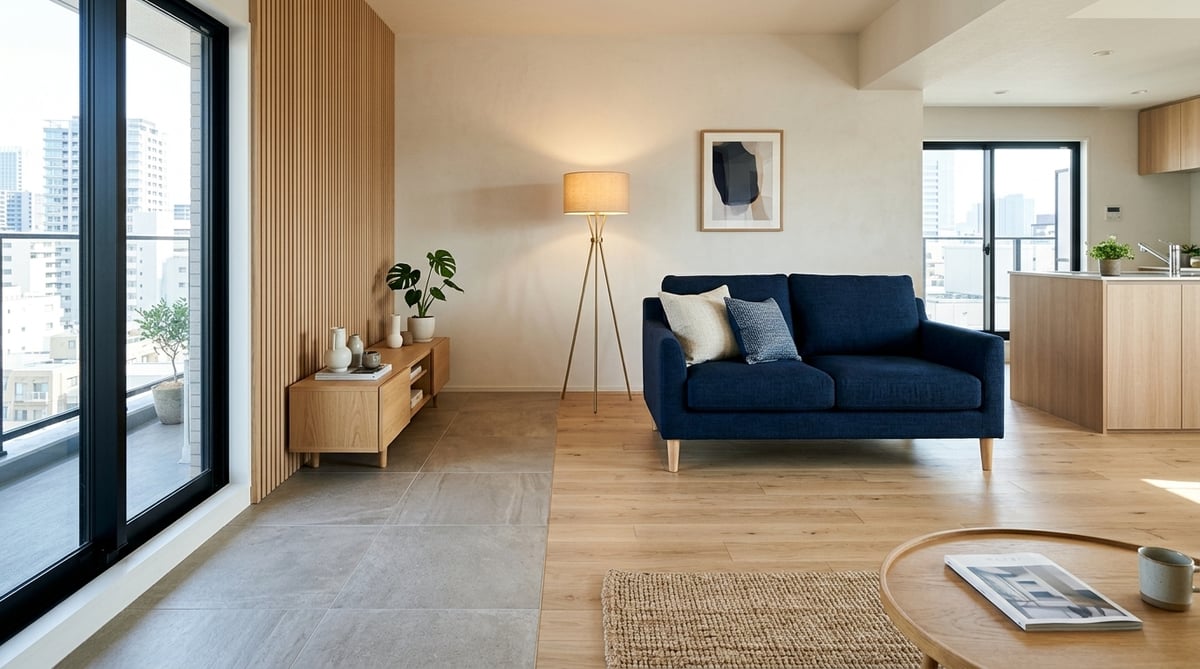
Walking along the pedestrian walkways at the Suwacho intersection where Meiji-dori and Suwa-dori avenues cross, the manicured landscaping of Waseda University Nishi-Waseda Campus and the lush canopy of Metropolitan Toyama Park immediately catch your eye. Stepping just one block off the wide thoroughfare into the residential lanes, the bustling energy of the student district instantly fades into a quiet, sunlit neighborhood where tree-filtered light gently illuminates the balconies of mid-rise condominium residences.
Yet, when showing homes around this neighborhood during property viewings, many prospective renters stop and ponder at the very same crossroads. Located in Shinjuku Ward, Nishi-Waseda Station commands solid central Tokyo rental rates: median rent sits at 122,000 yen for a 1K studio, 205,000 yen for a 1LDK one-bedroom apartment, and 293,000 yen for a 2LDK two-bedroom residence (approximately 4,700 yen per square meter). Furthermore, Tokyo Metro Fukutoshin Line serves Nishi-Waseda Station solely with Local trains—Express and Commuter Express trains bypass the station entirely. Adding to the deliberation, Takadanobaba Station—a major transit hub served by the JR Yamanote Line, Tokyo Metro Tozai Line, and Seibu Shinjuku Line—lies merely 10 to 12 minutes away on foot to the northwest.
"If Takadanobaba Station is within walking distance and average rents are practically identical, wouldn't it be far more practical to live right next to Takadanobaba with its multiple train lines?" or "Does choosing Nishi-Waseda Station simply to escape transit hustle truly justify this rent level in daily life?" Choosing a home around Nishi-Waseda begins with evaluating this core lifestyle balance: do you prioritize multi-line transit hubs and lively commercial streets, or do you value nighttime serenity, academic calm, and parkside greenery?
- Median rents stand at 122,000 yen for 1K, 205,000 yen for 1LDK, and 293,000 yen for 2LDK apartments. The Fukutoshin Line offers rapid direct access to three major hubs—Ikebukuro (4 min), Shinjuku-sanchome (5 min), and Shibuya (11 min)—while saving roughly 26,000 to 35,000 yen per month on single layouts and 53,000 to 69,000 yen per month on 1LDKs compared to living directly near Shinjuku-sanchome or Shibuya.
- Rent levels are virtually identical to neighboring Takadanobaba Station (JR Yamanote & Tozai Lines) and Waseda Station. Opt for Takadanobaba or Waseda if direct commutes to Otemachi and Tokyo Station or bustling dining options are your top priorities; choose Nishi-Waseda if you prefer direct links to Shibuya and Daikanyama combined with peaceful residential nights.
- The station accommodates Local trains only, platforms sit deep underground on the 3rd basement level (B3F), and there are no large shopping malls directly connected to the station. Verifying precise hazard map flood zones is essential, as elevation differs sharply between the elevated Yodobashi upland plateau and the Kanda River lowland basin.
Fukutoshin Line Local Trains & Deep Underground Platforms: Commute Realities and Station Exits
Nishi-Waseda Station (Station Number: F11) is an underground subway station featuring an island platform serving two tracks running north-south beneath Meiji-dori Avenue. While Fukutoshin Line Express and Commuter Express trains skip this station, its prime central Tokyo location—just 2 stops and 4 minutes to Ikebukuro, 2 stops and 5 minutes to Shinjuku-sanchome, and 5 stops and 11 minutes to Shibuya—means riding local trains incurs virtually zero noticeable travel time penalty for daily downtown travel. Rather than waiting for rapid services, daily commuters simply hop onto the first arriving local train and arrive at core terminal hubs in mere minutes.
On the other hand, understanding station depths and exit orientations directly impacts morning commutes and grocery stops on your way home. Ticket gates are split across the 1st basement level (B1F) into the North Gate and the Waseda University Science and Engineering Gate, while train platforms reside three levels down on the 3rd basement level (B3F). The station features four official surface access points, and selecting the right gate and exit determines how smooth your morning rush will be.
| Ticket Gate (Level) | Connected Official Exit | Elevators / Escalators | Surrounding Area & Key Landmarks |
|---|---|---|---|
| North Gate (B1F) |
Exit 1 | Stairs, Upward Escalator | Toward Takadanobaba Station (10–12 min walk northwest), Suwacho intersection (West side of Meiji-dori), MyBasket Nishi-Waseda Ekimae (1 min walk) |
| North Gate (B1F) |
Exit 2 | Stairs, Surface Elevator | East side of Meiji-dori, toward Anahachiman-gu Shrine & Gakushuin Women's College, Olympic Waseda Supermarket (2 min walk) |
| Science & Engineering Gate (B1F) |
Exit 3 | Direct stairs into Waseda Campus (Restricted campus opening hours apply) |
Waseda University Nishi-Waseda Campus, Shinjuku Cosmic Center (3 min walk), Metropolitan Toyama Park direction |
| Science & Engineering Gate (B1F) |
Elevator-Only Exit | Direct Surface Elevator | South side of Meiji-dori, Shinjuku Cosmic Center, Okubo 3-chome & Toyama district |
Vertical Flow from B3F Platform to Ground Level & Exit 3 Access Restrictions
Even if an apartment listing advertises "3 minutes walk from Nishi-Waseda Station," remember that Japanese real estate standards calculate walking time based solely on surface road distance (80 meters per minute) measured from the nearest surface exit to the building's entrance. Because Nishi-Waseda's train platforms are located on the 3rd basement level (B3F), navigating from surface entry through ticket gates down to train boarding typically requires an additional 3 to 4 minutes. Factoring in this buffer ensures stress-free morning commutes. Both ticket gate areas feature barrier-free elevator access, so Exit 2 or the Elevator-Only Exit are your best options when traveling with strollers or heavy luggage.
A crucial detail often overlooked during apartment viewings is the operating schedule of Exit 3. Exit 3 consists of staircases leading directly inside the grounds of Waseda University's Nishi-Waseda Campus (Faculty of Science and Engineering), meaning its access is strictly tied to university open hours. While viewing properties on weekday afternoons makes Exit 3 seem like an effortless shortcut toward Okubo 3-chome and Toyama Park, gates are locked late at night, on Sundays, public holidays, and during university breaks. When evaluating homes on the south side of the station, never rely solely on Exit 3; always walk the alternative routes via the Meiji-dori Elevator-Only Exit or Exit 2 to verify lighting and walking times.
Direct Links to Shibuya, Shinjuku-sanchome, and Ikebukuro vs. Commuting toward Otemachi & Tokyo Station
Nishi-Waseda Station excels tremendously if your workplace or weekend leisure centers around Shinjuku-sanchome, Shibuya, Harajuku (Meiji-jingumae), or Ikebukuro, as well as destinations along the Tokyu Toyoko and Minatomirai Lines such as Nakameguro, Daikanyama, and Yokohama. Commuting to these commercial hotspots from outer suburban lines often involves exhausting transfers across massive terminal stations. From Nishi-Waseda, you simply step onto the subway platform and ride directly to your destination. Rainy day commutes are equally comfortable, as entrance portals along Meiji-dori provide swift underground shelter.
Conversely, commuting to major eastern business hubs like Otemachi, Tokyo Station, and Nihombashi requires upfront consideration. The Fukutoshin Line runs north-south across western Tokyo and does not connect directly to Tokyo Station. Commuters heading toward Marunouchi must either transfer to the Marunouchi Line at Shinjuku-sanchome or Ikebukuro, or walk to Takadanobaba or Waseda Station to catch the Tozai Line. If a transfer-free commute to Otemachi is your non-negotiable priority, living exclusively near Nishi-Waseda Station involves slight detours, making dual-access locations (such as eastern Nishi-Waseda 1-chome or 2-chome near Takadanobaba) an ideal compromise.
Simply enter the rent and deposit from portal listings to calculate a full, itemized breakdown including brokerage and guarantor fees without hidden add-ons.
Nishi-Waseda Rent Market: Layouts, Pricing & Shinjuku Ward Housing Quality
The rental market surrounding Nishi-Waseda Station averages approximately 4,700 yen per square meter, placing it in the moderate-to-premium range for residential neighborhoods in Shinjuku Ward. While significantly more affordable for comparable square footage than Shinjuku-sanchome two stops south (5,400 yen/sqm) or Shibuya five stops south (5,600 yen/sqm), Nishi-Waseda's rent slightly edges out Zoshigaya in neighboring Toshima Ward (4,400 yen/sqm) and even Ikebukuro terminal (4,500 yen/sqm). This reflects sustained demand for Shinjuku Ward's prestigious educational districts situated within or hugging the Yamanote Line loop.
| Apartment Layout | Median Rent | Core Price Range (P20–P80) | Market Characteristics & Housing Stock |
|---|---|---|---|
| 1R (Studio) | ¥90,000 | ¥77,000 – ¥107,000 | Dominated by compact units for students and young professionals. Starting around ¥100,000, newer or renovated units with auto-locks and separate vanity sinks become available. |
| 1K (Single Room + Kitchen) | ¥122,000 | ¥107,000 – ¥137,000 | Core category for working singles. Abundant condominium-grade rental units along Meiji-dori and Waseda-dori offering delivery boxes and robust auto-lock security. |
| 1DK (1 Bed + Dining/Kitchen) | ¥150,000 | ¥134,000 – ¥171,000 | Popular among spacious solo dwellers and remote workers needing roughly 30 sqm. Functional partition doors separate sleep zones from dining and work desks. |
| 1LDK (1 Bed + Living/Dining/Kitchen) | ¥205,000 | ¥181,000 – ¥236,000 | Tailored for working couples and upscale singles. Low-to-mid-rise quiet residences set back one street from main avenues in Category I Mid/High-Rise Residential Zones. |
| 2LDK (2 Bed + Living/Dining/Kitchen) | ¥293,000 | ¥251,000 – ¥348,000 | Aimed at families with children and dual-income couples needing separate home offices. High-caliber stock nestled near Toyama Park and Gakushuin Women's College. |
Budget Guidelines for Singles (1R & 1K): Main Avenue Condos vs. Quiet Backstreet Living
For solo residents seeking modern amenities and security, the 1K layout serves as the market benchmark with a median rent of 122,000 yen (core range: 107,000 to 137,000 yen). Due to the nearby university campus, 1R units in older wooden apartments or retro flats range between 77,000 and 90,000 yen. However, working professionals seeking a modern 25-sqm unit with separated bath/toilet, standalone vanity sink, and delivery boxes should budget between 115,000 and 130,000 yen including management fees.
A defining architectural characteristic of Nishi-Waseda is that solid reinforced concrete (RC) and steel-reinforced concrete (SRC) condominium buildings line major arteries like Meiji-dori and Suwa-dori, while just one block inward, the landscape shifts abruptly into quiet low-rise residential pockets. For late-night commuters who prioritize walking home along well-lit, open boulevards, roadside condominium towers offer reassuring security. Conversely, for remote workers and readers who want to open their windows on sunny weekends without hearing traffic noise, the quiet interior lanes of Nishi-Waseda 2-chome provide an exceptionally serene environment.
Couples & Families (1DK, 1LDK, 2LDK): Balancing Floor Space, Age, and School Zones
For couples and professionals seeking dedicated home workspace, 1LDK apartments show a median rent of 205,000 yen (core range: 181,000 to 236,000 yen), while family-sized 2LDK homes median at 293,000 yen (core range: 251,000 to 348,000 yen). By comparison, 1LDK medians reach 258,000 yen in Shinjuku-sanchome and 274,000 yen in Shibuya. Living in Nishi-Waseda allows you to save 50,000 to 70,000 yen per month in recurring living expenses while maintaining seamless single-train access to Tokyo's commercial center.
If you are planning to move in as a couple on a budget of 160,000 to 180,000 yen, consider expanding your search beyond brand-new 1LDKs to spacious 1DK layouts (median 150,000 yen) or well-maintained vintage condominiums built 15 to 25 years ago in Nishi-Waseda 2-chome and the Toyama district. Because this area matured early as a premier residential enclave, you can frequently find beautifully renovated units featuring elegant tiled exteriors and immaculate management. For families moving with children, many residential blocks in Nishi-Waseda 2-chome fall within the school attendance zones for Totsuka No. 2 Elementary School and Nishi-Waseda Junior High School. Because school catchment boundaries split finely across blocks, our licensed advisors recommend verifying official municipal school zoning using your exact target address before signing lease agreements.
Comparing Nishi-Waseda with 4 Walking-Distance Neighboring Stations
Within an 800-meter to 1-kilometer radius of Nishi-Waseda Station lie several distinct transit hubs with totally different neighborhood vibes. Renters frequently weigh Nishi-Waseda against walkable Takadanobaba and Waseda Stations, as well as its immediate Fukutoshin Line neighbors, Higashi-Shinjuku and Zoshigaya. Comparing key metrics across these five stations reveals clear functional differences.
| Station (Ward) | Rent per sqm | 1K Median (P20–P80) |
1LDK Median (P20–P80) |
2LDK Median (P20–P80) |
Transit Lines & Neighborhood Character |
|---|---|---|---|---|---|
| Nishi-Waseda (Shinjuku Ward) |
¥4,700 | ¥122,000 (¥107k–¥137k) |
¥205,000 (¥181k–¥236k) |
¥293,000 (¥251k–¥348k) |
Fukutoshin Line (Local). Peaceful academic and green residential district adjacent to university campus & Toyama Park. |
| Takadanobaba (Shinjuku Ward) |
¥4,700 | ¥122,000 (¥107k–¥137k) |
¥207,000 (¥183k–¥239k) |
¥298,000 (¥255k–¥355k) |
JR Yamanote Line, Tozai Line, Seibu Shinjuku Line. High-density commercial hub packed with dining, late-night shops, and constant foot traffic. |
| Waseda (Shinjuku Ward) |
¥4,700 | ¥122,000 (¥107k–¥137k) |
¥205,000 (¥181k–¥236k) |
¥293,000 (¥251k–¥348k) |
Tokyo Metro Tozai Line. Direct link to Otemachi and Nihombashi; lively shopping streets along Waseda-dori and quiet hilltop residential lanes. |
| Higashi-Shinjuku (Shinjuku Ward) |
¥4,900 | ¥129,000 (¥114k–¥146k) |
¥220,000 (¥194k–¥254k) |
¥316,000 (¥271k–¥377k) |
Fukutoshin Line, Toei Oedo Line. Highly commercialized downtown zone at the intersection of Shokuan-dori and Meiji-dori near central Shinjuku. |
| Zoshigaya (Toshima Ward) |
¥4,400 | ¥112,000 (¥99k–¥126k) |
¥190,000 (¥168k–¥219k) |
¥269,000 (¥230k–¥320k) |
Fukutoshin Line (Local), Toden Arakawa Line (Kishibojinmae). Peaceful green residential district; station-front retail options are quite limited. |
Nishi-Waseda vs. Takadanobaba & Waseda: Choosing Between Multi-Line Buzz and Nighttime Calm
Notice the remarkable statistical fact: Nishi-Waseda, Takadanobaba, and Waseda share the exact same rental unit rate (4,700 yen/sqm) and the exact same 1K median rent (122,000 yen). Even for 1LDK and 2LDK homes, discrepancies remain within a few thousand yen. In short, your choice should not be driven by saving money, but purely by your daily commute direction and preferred neighborhood ambiance.
Walking 10 to 12 minutes northwest from Exit 1 brings you to Takadanobaba Station, a vibrant junction for the JR Yamanote, Tozai, and Seibu Shinjuku Lines. The station area is densely packed with izakayas, international restaurants, and convenience stores open around the clock. For food lovers and commuters demanding all-around transit versatility, Takadanobaba is immensely appealing, though late-night student chatter and nightlife energy linger near the gates. Nishi-Waseda, by contrast, sits entirely outside the entertainment perimeter; after 9:00 PM, streets return to tranquil quietude. A very popular lifestyle strategy among savvy expats is living in calm Nishi-Waseda 2-chome while walking 10 minutes to Takadanobaba when you want to take the Yamanote Line or enjoy diverse dinner options.
Meanwhile, comparing Nishi-Waseda to Waseda Station on the Tozai Line comes down to your primary work location. If you travel daily to Otemachi, Nihombashi, or Kayabacho, Waseda Station offers unbeatable direct trains—though morning rush hour crowding on the Tozai Line is notorious across Tokyo. If your office is in Shibuya, Shinjuku, or Roppongi, Nishi-Waseda on the Fukutoshin Line offers far faster, more pleasant commutes without crowded line changes. In eastern Nishi-Waseda 1-chome or 2-chome, you can easily find homes within an 8-to-10-minute walk of both stations.
Nishi-Waseda vs. Higashi-Shinjuku & Zoshigaya: Commercial Density and Rent Gradients
Evaluating Nishi-Waseda against its immediate neighboring stops on the Fukutoshin Line highlights its sweet-spot positioning. While all three stations provide direct, transfer-free rides to Ikebukuro, Shinjuku-sanchome, and Shibuya, streetscape atmosphere and rent prices follow a clear gradient.
One stop south, Higashi-Shinjuku Station intersects with the Toei Oedo Line and places you within walking distance of central Shinjuku, Kabukicho, and Shin-Okubo. Rents reflect this commercial premium: 1K medians rise to 129,000 yen (+7,000 yen vs. Nishi-Waseda) and 1LDK medians reach 220,000 yen (+15,000 yen). While having direct Oedo Line access to Roppongi and Shiodome alongside late-night dining is great, the intense commercial traffic along Okubo-dori and Shokuan-dori forms your daily backdrop. Many residents who love being close to Shinjuku's pulse but want to sleep in quiet surroundings choose Nishi-Waseda, just one subway stop away.
Heading north across the Kanda River into Toshima Ward, Zoshigaya Station sees rents ease down: 1K medians drop to 112,000 yen (-10,000 yen vs. Nishi-Waseda) and 1LDK medians drop to 190,000 yen (-15,000 yen). The historic zelkova tree-lined avenues of Kishibojin Shrine and Gakushuin University create charming streetscapes, but everyday grocery options right around Zoshigaya Station are sparse, requiring careful shopping planning. (Renters seeking even lower pricing can look further north to Kanamecho at 104,000 yen or Kotake-mukaihara at 99,000 yen). For those who want established everyday supermarkets like Olympic Waseda (2 min walk) combined with park greenery and calm nights, Nishi-Waseda hits the ideal balance between Higashi-Shinjuku's vibrancy and Zoshigaya's quietude.
Everyday Shopping & Topography: Upland Plateau vs. Kanda River Lowlands
While Nishi-Waseda Station lacks large station department stores, practical grocery stores and daily necessities are conveniently scattered from the station exits into residential pockets. Furthermore, securing a safe, comfortable home in this neighborhood requires understanding Tokyo's dramatic topography: the transition between the elevated Musashino Upland and the alluvial Kanda River valley.
Everyday Grocery Supermarkets and Parkside Living near Toyama Park
The anchor for daily household shopping is Olympic Waseda Supermarket, situated about a 2-minute walk along Meiji-dori from Exit 2. In addition to fresh produce, meats, fish, and prepared bento meals, Olympic stocks extensive cookware, storage items, stationery, and pet supplies—invaluable for setting up your new apartment or making bulk grocery runs after work. For quick late-night items like milk, bread, or fresh salad, MyBasket Nishi-Waseda Ekimae is just 1 minute from Exit 1, and MyBasket Nishi-Waseda 3-chome sits 5 minutes north.
For high-quality fresh seafood, meats, and specialty deli foods, a pleasant 8-to-10-minute stroll toward Waseda-dori brings you to Santoku Nishi-Waseda Supermarket in Nishi-Waseda 1-chome. On days when you desire department store basement food halls, electronics superstores, or fast-fashion shopping, cycling or walking to Takadanobaba or taking a 4-to-5-minute subway ride to Ikebukuro or Shinjuku-sanchome is effortless.
What truly elevates daily life here is Metropolitan Toyama Park, stretching south and east of the station, and Shinjuku Cosmic Center, just 3 minutes from Exit 3. Toyama Park is divided into the Hakone-yama hill sector—the highest natural elevation point inside the Yamanote Line loop—and the Okubo open lawn sector, providing scenic trails for morning jogging and weekend reading under the trees. The adjacent Shinjuku Cosmic Center features an indoor heated 25m swimming pool, sports gymnasiums, and a public planetarium, allowing you to easily maintain active fitness routines in central Tokyo without costly private gym memberships.
Elevation Contrast: 25–30m Upland Plateau (2-chome/Toyama) vs. 10m Lowlands (3-chome)
When selecting a home in Nishi-Waseda, our licensed realtors always emphasize the distinct elevation difference and flood hazard map boundaries between north and south. Directly above and south/east of Nishi-Waseda Station (Nishi-Waseda 2-chome, Toyama, and Okubo 3-chome), the ground sits on the solid loam plateau of the Musashino Upland (Yodobashi Plateau) at an elevation of 25 to 30 meters above sea level. This plateau area lies completely outside municipal river flood hazard zones (though localized internal pluvial drainage should always be verified on a parcel basis).
However, descending north along Meiji-dori or side streets toward the Kanda River (around Omokagebashi, Gakushuin-shita, and northern Takadanobaba), the terrain slopes downward into an alluvial river valley at an elevation of roughly 10 meters above sea level. In portions of Nishi-Waseda 3-chome and low-lying plots along the Kanda River, official hazard maps designate areas subject to 0.5m to under 3.0m of flood inundation under maximum expected rainfall scenarios. Even within the same "Nishi-Waseda" postal address, foundation stability and flood precautions differ significantly depending on whether a property sits atop the plateau or in the river valley.
3 Essential On-Site Inspection Steps from the Station Platform to the Property
Once you identify attractive properties online, avoid meeting agents directly by taxi at the building entrance. Instead, start your viewing by stepping onto the subway platform at Nishi-Waseda Station and walking the real route yourself. Here is our recommended three-step checklist for on-site apartment inspections:
- Step 1 (Measure B3F Platform to Surface Time & Check Night Routes): Step off the train and time the exact walk through the North Gate (Exits 1 & 2) or Science Gate to ground level. If Exit 3 is your closest exit, walk the detour routes via the Elevator-Only Exit or Exit 2 that you will use when campus gates are locked, checking streetlamp brightness and safety.
- Step 2 (Evaluate Avenue Noise, Window Sashes & Air Vents): Upon entering the apartment, gauge ambient street noise from Meiji-dori, Suwa-dori, or Waseda-dori. Test window acoustic sealing by opening and closing sashes (checking for T-ratings or secondary interior glazing), and inspect adjacent southern lots in residential zones to ensure there are no open parking lots or dilapidated houses that could be redeveloped into tall buildings.
- Step 3 (Inspect Elevation Slopes & Building Flood Barriers): In elevated plateau areas, check retaining walls and exterior drainage slopes. If evaluating lower-lying northern blocks near the Kanda River (such as parts of Nishi-Waseda 3-chome), select units on the 2nd floor or higher, and verify that the building's electrical transformer room is elevated and flood barriers are installed at the main lobby entrance.
Who Thrives in Nishi-Waseda vs. When to Reconsider: Making an Informed Decision
As we have explored, Nishi-Waseda Station is not designed as an all-in-one entertainment district. Rather, it is a serene haven in Shinjuku Ward inside the Yamanote Line loop, protected from excessive commercial noise by leafy university campuses and expansive public parks. To help you evaluate whether this neighborhood aligns with your lifestyle, we have contrasted who thrives here against scenarios where another area may prove more practical.
Who Thrives Living Near Nishi-Waseda Station
- ✓ Commuters wanting direct subway rides to Ikebukuro (4m), Shinjuku-sanchome (5m), Shibuya (11m), and Tokyu Toyoko Line destinations.
- ✓ Renters who enjoy walking to Takadanobaba or Waseda for dining and transit, but prefer sleeping in a tranquil, low-traffic residential street.
- ✓ Fitness enthusiasts wishing to make Metropolitan Toyama Park and Shinjuku Cosmic Center part of their daily jogging or swimming routine.
- ✓ Safety-conscious residents seeking flood-safe, elevated ground (25m+ elevation) on the Musashino Plateau in Nishi-Waseda 2-chome or Toyama.
When Other Stations Offer Greater Value
- ― Commuters requiring Express train stops or direct, transfer-free access to Otemachi, Tokyo Station, or Nihombashi.
- ― Renters who demand large station department stores, shopping malls, or late-night entertainment right at their doorstep.
- ― Anyone who dislikes deep subway platforms and prefers shallow stations or ground-level train lines for quick egress.
- ― Buyers or renters seeking zero flood risk whose target apartments are limited to lower riverbed zones in Nishi-Waseda 3-chome.
When choosing a home in Tokyo, there is no single "correct" answer between living next to a colossal commercial transit hub and settling near a calm, parkside local subway station. Greeting the morning breeze as you stroll past Toyama Park's lush trees, picking up dinner ingredients at Olympic or MyBasket on your way home, and falling asleep in a quiet residential haven—if you value this understated, unpretentious calm, Nishi-Waseda will serve as a deeply cherished home base.
If you are comparing rental listings and wondering, "Does this specific address sit on the elevated plateau or inside the Kanda River lowland?" or "Is this unit along Meiji-dori sufficiently soundproofed and reasonably priced?" feel free to reach out to Sorai Tokyo anytime. Simply send the property link or listing screenshot to our official LINE account (@soraitokyo / https://line.me/R/ti/p/@soraitokyo). Our licensed realtors will cross-check the real-time B2B agent database, provide an objective initial cost breakdown, and deliver a transparent second opinion on the lease terms.
You can check listing availability and initial quotes 100% anonymously—no phone number required, zero sales calls, and no store visits needed. We also support foreign residents with English guidance, no-guarantor rental options, and smooth visa screening. Access our digital concierge anytime via the bottom menu on mobile or the footer on desktop. We are here to ensure your new chapter living in Tokyo is completely calm, confident, and fulfilling.
Frequently Asked Questions: Living Around Nishi-Waseda Station
QNishi-Waseda Station is served only by Local trains. Does this feel inconvenient for daily commuting?
ANot for inner-city commutes. Major central hubs are extraordinarily close: Ikebukuro is 4 minutes away, Shinjuku-sanchome is 5 minutes, and Shibuya is 11 minutes. Within central Tokyo, the difference between local and express trains is negligible. However, if commuting longer distances toward Wakoshi or Yokohama/Musashi-Kosugi on the Tokyu Toyoko Line, transferring to an Express or F-Liner train at Ikebukuro, Shinjuku-sanchome, or Shibuya often saves time. Also, keep in mind that navigating from the surface down to the B3F platform takes roughly 3 to 4 minutes, so build a small buffer into your morning departures.
QWhich specific area is best if I want to walk to Takadanobaba Station as well?
AFocus your search on the northern part of Nishi-Waseda 2-chome (near Exits 1 and 2) or along Meiji-dori in Nishi-Waseda 3-chome. These pockets place you within a 2-to-5-minute walk of Nishi-Waseda Station, while allowing you to reach Takadanobaba Station (JR Yamanote, Tozai, and Seibu Shinjuku Lines) in roughly 10 to 12 minutes on foot. This lets you enjoy the peaceful ambiance of Nishi-Waseda daily while easily tapping into Takadanobaba's multi-line transit and dining options. Because heading further north approaches the Kanda River lowland, be sure to verify building elevation against municipal flood maps.
QWithout a large shopping mall near the station, is everyday grocery shopping difficult for home cooks?
ANot at all. While there is no station building mall, Olympic Waseda Supermarket (2 minutes from Exit 2) provides a full selection of fresh groceries, household goods, and kitchenware. In addition, MyBasket Nishi-Waseda Ekimae (1 minute from Exit 1), MyBasket Nishi-Waseda 3-chome, and Santoku Nishi-Waseda (8–10 minutes away) offer plenty of practical grocery shopping within easy walking distance. When you need department store delicacies or electronics, Ikebukuro and Shinjuku-sanchome are just 4 to 5 minutes away by direct subway.
QCan I verify whether a listing is still available and whether the initial quote is reasonable before committing?
AYes, absolutely. If you send the URL or screenshot of any rental property found on portal sites to our official LINE account (@soraitokyo / https://line.me/R/ti/p/@soraitokyo), our licensed realtors will cross-check the official B2B agent database to verify actual availability. We also provide a free, transparent second opinion on all incidental fees and move-in quotes. You can use our digital tools 24/7 via the bottom menu on mobile or footer on desktop—completely anonymously with no phone number required and zero sales pressure.




Author: Sorai Tokyo Editorial Team (Supervised by Licensed Real Estate Agents)
A real estate consulting team specializing in assisting foreign nationals find rooms and explaining initial costs in Tokyo. We break down language barriers and differences in customs, offering dedicated support in Japanese, English, and Vietnamese for a safe and secure start to your new life.