
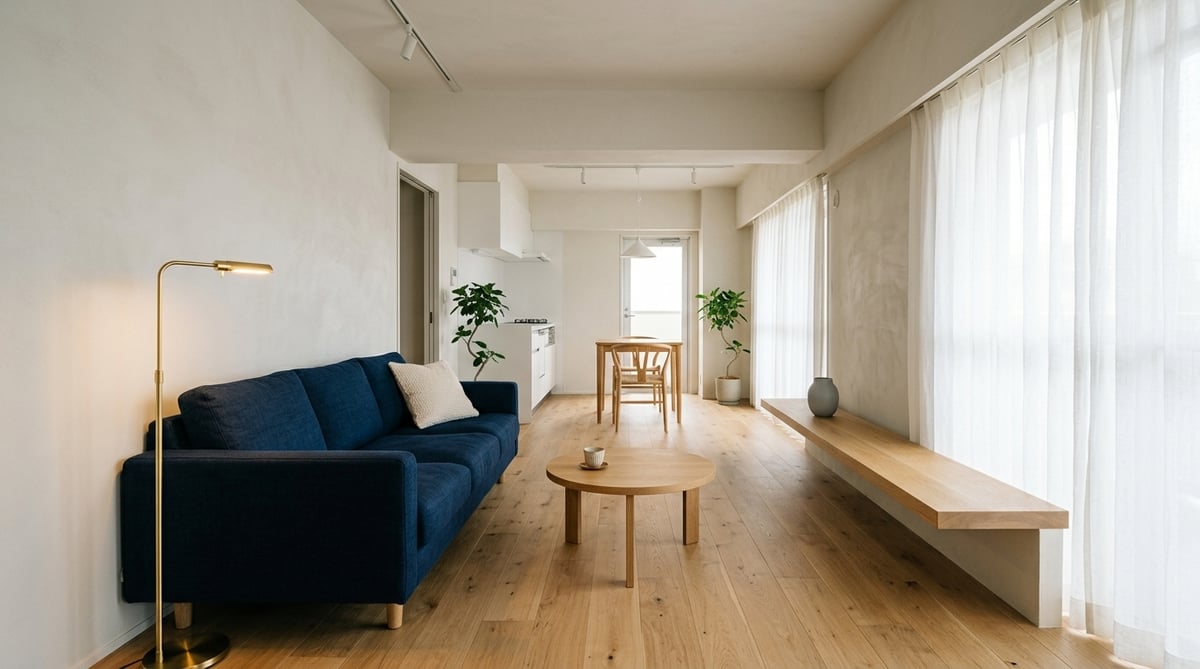
Stepping up from the underground exit of Ochiai Station, where Waseda-dori and Yamate-dori intersect, and crossing the main road into a side street just one block back, the sound of passing traffic fades almost immediately. In its place is a calm residential neighborhood lined with detached homes and low- to mid-rise apartment buildings. Recently, on the walk back toward Higashi-Nakano after showing a 1LDK apartment in Kami-Ochiai, a client and I talked about a classic Tokyo trade-off: whether to prioritize having large supermarkets right outside your station, or to choose quiet residential streets around your home with a direct train to Otemachi.
In Ochiai (Shinjuku Ward) on the Tokyo Metro Tozai Line, median rents stand at ¥122,000 for a 1K and ¥205,000 for a 1LDK (approximately ¥4,700 per square meter). Many prospective renters pause when they see these numbers because they are nearly identical to neighboring Takadanobaba Station (1K ¥122,000), which offers Yamanote Line access, and Higashi-Nakano Station (1K ¥120,000), which is within walking distance and has large supermarkets right at the exit. It is completely natural to wonder whether it makes sense to pay the same rent in Ochiai without a major commercial complex at the station, or how to weigh morning Tozai Line crowding and flood-risk zones near the Kanda and Myoshoji rivers.
Ochiai's real value lies not in being a self-contained commercial hub, but in how it connects your daily routine: on weekdays, the Tozai Line takes you straight from beneath the main avenue to central Tokyo's business districts, while on evenings and weekends, Higashi-Nakano Station and Nakai Station—just a 6- to 9-minute walk away—seamlessly expand your shopping and transit options. Below is a practical, ground-level breakdown to help you decide if Ochiai fits your rhythm of life in Tokyo.
- Every Tozai Line train stops at Ochiai, offering a direct ride to Iidabashi in about 10 minutes and Otemachi in about 15 minutes with no transfers.
- Higashi-Nakano Station (JR Sobu Line & Oedo Line) and Nakai Station (Seibu Shinjuku Line & Oedo Line) are within a 6- to 9-minute walk for everyday use.
- Median rents are ¥122,000 for a 1K and ¥205,000 for a 1LDK—well regarded by residents seeking quiet, low-key streets away from nightlife districts.
Direct Tozai Line Access to Otemachi & Walking Connections to Higashi-Nakano and Nakai
All-Train Stopping Service & Direct Commutes to Central Business Districts
The Tokyo Metro Tozai Line serving Ochiai Station cuts straight across several of Tokyo's core business districts. Between Toyocho and Nakano stations, every train—including Rapid and Commuter Rapid services—stops at every station. On the Ochiai platform, you never have to check whether an approaching train will skip your stop; you can simply board the first train that arrives. Neighboring Takadanobaba Station is about 3 minutes away, Iidabashi is about 10 minutes, Kudanshita is about 12 minutes, and Otemachi—connected underground to Marunouchi and Tokyo Station—is roughly 15 minutes away. Nihombashi and Kayabacho are also within a 20-minute ride.
Keeping your door-to-door commute around 30 minutes frees up an extra 15 minutes in the morning to get ready unhurriedly or enjoy a freshly brewed cup of coffee. In addition, some westbound trains from neighboring Nakano Station (the line's western terminus) continue directly onto the JR Chuo-Sobu Line (Local) toward Mitaka, making weekend trips to Ogikubo or Kichijoji effortless without changing trains. For a broader look at how rents and neighborhood character shift along the route, see our Tozai Line Area Guide.
Expanding North-South Mobility via Higashi-Nakano and Nakai
When considering a station served by a single subway line, two common concerns are needing transfers for north-south travel and lacking backup routes during weather disruptions or service delays. Ochiai offsets both concerns thanks to two nearby stations located along the Yamate-dori corridor.
Walking 6 to 8 minutes south brings you to Higashi-Nakano Station, served by the JR Chuo-Sobu Line (Local) and the Toei Oedo Line. Walking 7 to 9 minutes north leads to Nakai Station, served by the Toei Oedo Line and the Seibu Shinjuku Line. On weekdays, you can commute directly to Otemachi or Nihombashi on the Tozai Line; on weekends, you can walk to Higashi-Nakano or Nakai to reach Shinjuku, Yoyogi, Aoyama-itchome, Roppongi, or Azabu-Juban without a transfer. If the Tozai Line ever experiences a morning delay, being able to walk straight to a JR or Toei subway line—without waiting in long bus or taxi queues—provides reliable peace of mind.
Morning Rush-Hour Crowding & Practical Boarding Habits
One reality to factor in before signing a lease is morning crowding on eastbound trains (toward Takadanobaba and Otemachi) between roughly 7:30 AM and 8:45 AM. Because JR Chuo Line transfer passengers and originating commuters board in large numbers at neighboring Nakano Station, trains arriving at Ochiai are already packed shoulder-to-shoulder. If you assume there will be breathing room simply because Ochiai is one stop after Nakano, the first few mornings may come as a surprise.
Residents often note that Takadanobaba is only one stop—about three minutes—away, so they treat that first leg as a short milestone. At Takadanobaba, many passengers alight for the JR Yamanote Line, though a substantial number also board from the Seibu Shinjuku Line. Choosing a car slightly away from the main staircases or adjusting your commute to before 7:30 AM or after 9:00 AM under a flexible schedule can make a noticeable difference in daily comfort.
Simply enter the rent and deposit from portal listings to calculate a full, itemized breakdown including brokerage and guarantor fees without hidden add-ons.
Ochiai Rent Comparison: Takadanobaba, Nakano, Higashi-Nakano & Nakai
| Station (Ward) | Rent / sqm | 1R | 1K | 1DK | 1LDK | 2LDK | Lines & Neighborhood Character |
|---|---|---|---|---|---|---|---|
| Ochiai (Shinjuku) | ¥4,700 | ¥90,000 | ¥122,000 | ¥150,000 | ¥205,000 | ¥293,000 | Tozai Line / Direct city access with quiet residential streets one block off the main road |
| Takadanobaba (Shinjuku) | ¥4,700 | ¥90,000 | ¥122,000 | ¥150,000 | ¥207,000 | ¥298,000 | Tozai, JR Yamanote & Seibu Shinjuku Lines / Lively student & dining hub |
| Nakano (Nakano) | ¥4,600 | ¥88,000 | ¥118,000 | ¥144,000 | ¥197,000 | ¥278,000 | Tozai Line (originating trains), JR Chuo & Sobu Lines / Large shopping arcade & cultural hub |
| Higashi-Nakano (Nakano) | ¥4,650 | ¥89,000 | ¥120,000 | ¥148,000 | ¥203,000 | ¥290,000 | JR Sobu & Toei Oedo Lines / 6–8 min south of Ochiai; major supermarkets at station |
| Nakai (Shinjuku) | ¥4,450 | ¥84,000 | ¥114,000 | ¥140,000 | ¥190,000 | ¥269,000 | Toei Oedo & Seibu Shinjuku Lines / 7–9 min north of Ochiai; traditional local shopping street |
Why Renters Choose Ochiai at Rents Similar to Takadanobaba and Nakano
As the comparison table shows, Ochiai's rent levels sit almost level with major hub Takadanobaba and slightly above Nakano. Even though all three stations share direct Tozai Line access to Otemachi and Nihombashi—and Ochiai lacks large commercial complexes—its rents hold steady because of the residential quality available within a 5-minute walk of the exits.
Around Takadanobaba and Nakano, commercial buildings and late-night dining districts occupy a wide radius around the stations. Finding a quiet apartment where you can sleep undisturbed often requires walking 10 minutes or more away from the hub. In Ochiai, residential blocks begin just steps past the main intersection. For the same monthly budget, it is much easier to secure a modern, auto-lock-equipped building within a 3- to 5-minute walk of the station while still enjoying calm nights free from late-night street noise. Compared with renting near Otemachi (1K ¥162,000, 1LDK ¥284,000) or Nihombashi (1K ¥148,000, 1LDK ¥256,000), living 15 minutes out in Ochiai can trim ¥30,000 to ¥80,000 per month from fixed housing costs—freeing up budget for a larger floor plan or daily quality of life.
Deciding Between Ochiai and Living Directly by Higashi-Nakano or Nakai
Another natural question is whether it makes more sense to live right next to Higashi-Nakano or Nakai if you are already planning to walk there anyway. The answer usually comes down to where you commute on weekdays: along the Tozai Line, or toward Shinjuku and Roppongi.
If your workplace is in Shinjuku (1K ¥145,000, 1LDK ¥251,000) or Roppongi and you want to stop by a large supermarket right outside the ticket gate every evening, Higashi-Nakano is the more practical base. However, if you commute to Otemachi, Nihombashi, Kayabacho, or Iidabashi, starting from Higashi-Nakano means transferring at Nakano every morning and evening. Eliminating that daily rush-hour transfer and boarding the Tozai Line directly from your home station adds up to a meaningful difference over the course of a year. Meanwhile, if you prefer to keep monthly rent lower and enjoy a neighborhood with independent local shops, expanding your search toward Nakai (the northern part of Kami-Ochiai 2-chome or Naka-Ochiai) is also worth considering.
Station Layout: 2 Ticket Gates, 5 Exits & Everyday Shopping
| Ticket Gate (Location) | Exit | Accessibility & Hours | Directions & Nearby Facilities |
|---|---|---|---|
| Yamate-dori Gate (B1F, Nakano side) Elevator from platform to gate |
Exit 1 | Stairs only | Higashi-Nakano 3-chome & Kami-Ochiai 3-chome (south side of Waseda-dori / west of intersection). Shortest route to Higashi-Nakano Station; Tsuruha Drug Shinjuku Kami-Ochiai on the northwest corner. |
| Exit 2a | Elevator to street level | West side of Yamate-dori, Kami-Ochiai 3-chome & Nakai Station direction. My Basket Ochiai Ekimae right outside; Super Mirabel Nakai further north on Yamate-dori. | |
| Exit 2b | Elevator to street level | East side of Yamate-dori, Kami-Ochiai 2-chome & Higashi-Nakano Station direction. | |
| Otakibashi Gate (B1F, Nishi-Funabashi side) Stairs & ramp |
Exit 3 | Stairs only (6:00 AM–last train) | Waseda-dori & Otakibashi-dori direction. Ochiai Post Office & My Basket Kami-Ochiai. |
| Exit 4 | Stairs only (6:00 AM–last train) | North side of Waseda-dori & Otakibashi direction. Ochiai Daini Elementary School, Ochiai Water Reclamation Center, Kami-Ochiai 1-chome residential area. |
Equipment & Operating-Hour Differences Between the Two Gates
Ochiai Station features an island platform on B2F and two distinct ticket gates at opposite ends of B1F. When viewing apartments, look beyond the simple "4 minutes from Ochiai Station" label and check which of the five official exits (Exit 1, 2a, 2b, 3, or 4) is actually closest to the building.
For families with strollers or frequent travelers carrying suitcases, the Yamate-dori Gate (on the Nakano side) is the most convenient, offering an elevator from the platform to the concourse as well as street-level elevators at both Exit 2a and Exit 2b. By contrast, the Otakibashi Gate (on the Nishi-Funabashi/Takadanobaba side) and its Exits 3 and 4 have no elevators and are only open from 6:00 AM until the last train. Even if you live in Kami-Ochiai 1-chome near Otakibashi, an early 5:00 AM departure with heavy luggage will require walking to the Yamate-dori Gate, so it is helpful to gauge that street-level distance beforehand.
A Two-Tier Shopping Routine: Local Mini-Markets & Higashi-Nakano Supermarkets
While Ochiai's main intersection has no department store or station building, compact supermarkets and drugstores are well positioned along everyday walking routes for weeknight cooking. Stepping out of Exit 2a puts you directly in front of My Basket Ochiai Ekimae for quick stops for milk, vegetables, or breakfast bread. Near Exit 1 sits Tsuruha Drug Shinjuku Kami-Ochiai for daily necessities and pharmacy items, while the route from Exits 3 and 4 along Waseda-dori passes My Basket Kami-Ochiai. Heading north from Exit 2a along Yamate-dori toward Nakai brings you to Super Mirabel Nakai, a practical spot for affordable fresh produce.
For weekend grocery runs where you want a broader selection of fresh fish, meat, and prepared foods, walking 7 to 8 minutes south to Higashi-Nakano is part of the local routine. Life Higashi-Nakano stands right outside the JR West Exit, and Summit Store Higashi-Nakano is located inside Unison Mall on the east side. With atre vie Higashi-Nakano and the independent eateries around Nakai also within walking distance, you can keep your immediate home street quiet while still having multiple full-scale supermarkets nearby.
Evaluating Ground Elevation: Valley Lowlands vs. Loam Plateaus
Flood-Risk Differences Between the River Lowlands and Elevated Plateaus
When advising clients in Ochiai, one of the most important checks we cover is micro-topography and municipal hazard maps. True to the name "Ochiai"—historically referring to the confluence of two rivers—the area northeast and east of the station (toward Otakibashi, Shimo-Ochiai, and parts of Kami-Ochiai 1-chome) sits in a valley lowland along the Kanda and Myoshoji rivers. From there, the land rises gently southward toward Higashi-Nakano (the Nakano Plateau) and northward toward Naka-Ochiai and northern Nakai (the Mejiro Plateau).
This terrain is clearly reflected in local flood hazard maps. Around the Waseda-dori and Yamate-dori intersection and in the river lowlands (including parts of Kami-Ochiai 1-chome), streets are flat and easy to walk, but some blocks carry projected inland or river flooding depths of 0.5 to under 3.0 meters during extreme rainfall. Moving south up the gentle slope into Higashi-Nakano 2-chome through 4-chome puts you on a more stable loam plateau, where many blocks fall outside designated flood zones (though parts of Higashi-Nakano 1-chome near the river are still within flood-projected areas, making block-by-block checks essential). Even within the same "6-minute walk from Ochiai Station," choosing between flat river-side streets and slightly elevated plateau blocks can significantly change your long-term peace of mind.
Inspecting Soundproofing on Main Avenues vs. Quiet Residential Backstreets
Rental apartments around Ochiai generally fall into two distinct environments. The first consists of mid- to high-rise condominiums along Yamate-dori and Waseda-dori. These offer well-lit sidewalks all the way home and a strong supply of newer 1K and 1LDK units with modern amenities, though traffic noise and occasional emergency sirens can carry. During viewings, check how quiet the room feels with the windows shut, whether double-pane or sound-insulated sashes are installed, and whether the balcony faces away from the main road toward the inner residential blocks.
The second environment consists of low- to mid-rise apartments tucked one block off the main roads in Category 1 Residential Zones (such as Kami-Ochiai) or height-restricted Category 1 Low-Rise Exclusive Residential Zones (parts of Higashi-Nakano 2-chome and Naka-Ochiai 2-chome). With minimal through-traffic, these streets offer a calm setting for quiet evenings at home. Because streetlight spacing and road widths vary by block, walking the route from your nearest exit to the building entrance with evening visibility in mind—and checking whether adjacent old houses or coin-operated parking lots might be redeveloped—helps prevent surprises after moving in.
Who Thrives in Ochiai vs. When Another Station Fits Better
Renters Who Match Ochiai's Lifestyle
- ✓ Commuters heading to Otemachi, Nihombashi, or Iidabashi without transfers
- ✓ Residents who prefer quiet, low-key streets away from nightlife hubs
- ✓ People comfortable walking to Higashi-Nakano or Nakai for other lines and large supermarkets
- ✓ Renters seeking modern, well-equipped apartments within a 5-minute walk of the station
When Another Station or Block Fits Better
- ✓ Wanting a station-connected mall or large supermarket right at the ticket gate
- ✓ Wanting to avoid peak morning Tozai Line crowding
- ✓ Requiring zero flood-zone designation as a strict condition
- ✓ Seeking a dense selection of late-night restaurants and cafes right outside the station
When to Prioritize Higashi-Nakano, Nakano, or Takadanobaba Instead
Even in a well-connected neighborhood, personal priorities can point elsewhere. The first reason to look beyond Ochiai is wanting everything—a large supermarket, delicatessens, bookstores, and cafes—clustered right outside your ticket gate. If a 7- to 8-minute walk to Higashi-Nakano on rainy evenings sounds tiring, basing yourself directly in Higashi-Nakano, Nakano, or Takadanobaba will feel smoother day to day.
The second factor is tolerance for morning train crowding. The stretch between Ochiai and Takadanobaba is one of the busiest on the Tozai Line. If you strongly prefer a seated commute or more personal space, Nakano (where originating Tozai Line trains start) or stations along the Toei Oedo or Seibu Shinjuku lines may suit you better. Third, if your budget only allows for ground-floor units in low-lying river blocks and flood risk concerns you, it is wiser not to compromise—look instead toward the elevated loam plateau in Higashi-Nakano or the higher-ground blocks around Nakai, where median rents (1K ¥114,000, 1LDK ¥190,000) also leave a little more room in your budget.
The Smart Middle-Ground: Living Between Two Stations
Conversely, many long-term residents in the area share a simple strategy: rather than filtering strictly for "within 3 minutes of Ochiai Station," they look at the 6- to 8-minute overlap zone between Ochiai and Higashi-Nakano (or Nakai)—such as Kami-Ochiai 2–3 chome or Higashi-Nakano 3–4 chome.
Living in this middle zone lets you take the Tozai Line from Ochiai straight to Otemachi in the morning, and step off at Higashi-Nakano on the way home whenever you want to pick up groceries at Life or Summit Store. For anyone who enjoys a quiet residential walk as a natural buffer between work and home, Ochiai's median rents of ¥122,000 (1K) and ¥205,000 (1LDK) deliver everyday livability well beyond what the station's modest exterior suggests.
Summary: Key Criteria for Choosing an Apartment in Ochiai
Ochiai does not announce itself with flashy landmarks. Instead, it offers reliable 15-minute direct Tozai Line access to Otemachi, calm residential streets just one block off the main avenues, and effortless walking access to Higashi-Nakano and Nakai for extra train lines and full-scale supermarkets.
When comparing floor plans and visiting properties, keep three criteria in mind: which exit and nearby station best match your daily shopping route, whether you prefer main-avenue convenience with soundproofing or quiet backstreet living, and how each block sits relative to river lowlands and elevated plateaus. There is no single right answer—the best choice is the one that fits your daily routine naturally.
If you are comparing listings or unsure about a specific building in Ochiai, simply send the property URL to Sorai Tokyo's official LINE (@soraitokyo). Our 24/7 AI concierge and licensed real estate agents can check live availability in the industry database, provide a transparent second opinion on initial move-in costs, and review hazard-map and screening details—including no-guarantor options and smooth visa-friendly support—with no phone number required, zero pushy sales calls, and no store visits needed.
Frequently Asked Questions About Living in Ochiai
QDo Tozai Line Rapid trains stop at Ochiai Station, and how crowded is the morning rush?
AYes. Between Toyocho and Nakano stations, all Tozai Line trains—including Rapid and Commuter Rapid services—stop at every station, including Ochiai. During weekday morning rush hour toward Takadanobaba and Otemachi, trains arrive full from neighboring Nakano Station. While Takadanobaba is only one stop (about 3 minutes) away, many passengers also board there from the Seibu Shinjuku Line, so choosing a car away from the stairs or shifting your commute time slightly can make the ride much more comfortable.
QIs it inconvenient to cook at home without a large supermarket right outside Ochiai Station?
AFor weekday essentials, My Basket Ochiai Ekimae (right outside Exit 2a), Tsuruha Drug Shinjuku Kami-Ochiai (near Exit 1), My Basket Kami-Ochiai (toward Exits 3 and 4), and Super Mirabel Nakai (north along Yamate-dori) cover daily needs easily. For larger weekend grocery shopping, walking 7 to 8 minutes south to Life Higashi-Nakano or Summit Store Higashi-Nakano gives you full-scale supermarket selection.
QWhich areas around Ochiai have more stable ground and lower flood risk?
ALow-lying blocks near the Waseda-dori and Yamate-dori intersection and along the Kanda and Myoshoji rivers (such as parts of Kami-Ochiai 1-chome) have projected flood zones on municipal hazard maps. If minimizing flood risk is a priority, focus on the elevated loam plateau in Higashi-Nakano 2-chome through 4-chome to the south or the higher-ground blocks toward Naka-Ochiai to the north, checking the hazard map at the exact block level.
QCan I ask Sorai Tokyo about an Ochiai listing I found on another portal site?
AYes, of course. Send the listing URL or floor plan to Sorai Tokyo's official LINE (@soraitokyo), and our licensed real estate agents will verify live availability in the industry database, review your initial-cost quote for unnecessary fees, and provide an objective second opinion on the building's location and hazard profile—all without phone calls or store visits.




Sorai Tokyo Co., Ltd. Editorial (Licensed Real Estate Agency #113297)
Licensed online real estate agency handling residential leasing across 15 major Tokyo lines (Member of All Japan Real Estate Association). Powered by our proprietary 24/7 AI "SorAi" on iOS/LINE and dedicated licensed realtors, we support renters end-to-end from vacancy checks on major portals to viewings and digital contracts.