
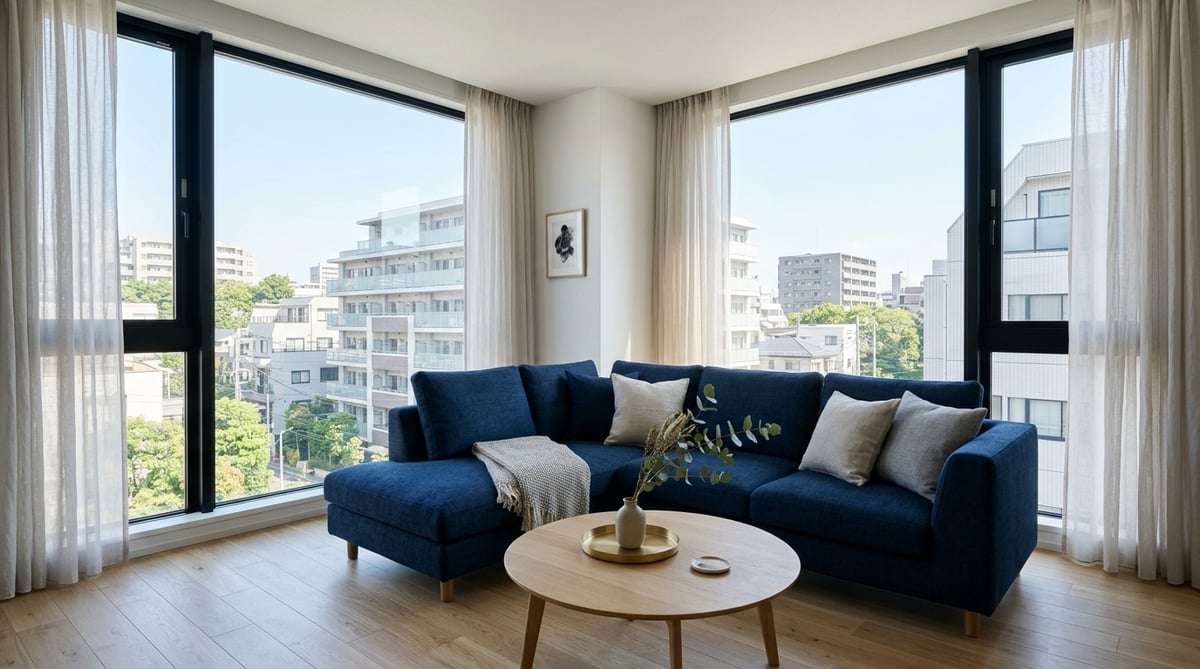
Just past 8:00 AM, along the gentle, tree-lined slopes of Moto-Azabu where soft sunlight filters through the leaves, parents and children walk at a unhurried pace toward international schools, conversing in a mix of English and Japanese. Just one valley over, around Ark Hills in Roppongi-Itchome, a quiet morning begins with the aroma of freshly ground coffee drifting from bakeries as professionals head into office towers housing foreign-affiliated firms and financial institutions.
When guiding families, executives, or expatriate households through 2LDK and 3LDK apartments around the three Tokyo Metro Namboku Line stations—Azabu-Juban, Roppongi-Itchome, and Tameike-Sanno—many clients voice the same question on the walk back from a viewing: "Should we settle into a quiet, low-rise residence on the elevated plateau surrounded by greenery, or choose a station-connected, base-isolated tower where we can commute underground even on rainy days?" Another important consideration—one that cannot be measured by floor plan dimensions or building age alone—is whether daily life feels more natural in a calm hilltop residential neighborhood or along a flat street lined with long-established shops and supermarkets.
There is no single right answer for everyone. By carefully weighing your morning school bus or office commute, the dimensions of your vehicle, and practical contract terms such as individual versus corporate housing leases, the residence where your family can live most comfortably will naturally come into focus.
- Azabu-Juban, Roppongi-Itchome, and Tameike-Sanno sit within a narrow rent band—418,000 to 425,000 yen for 2LDK and 517,000 to 526,000 yen for 3LDK—allowing you to choose based on neighborhood character and daily routes rather than price alone.
- Your primary decision is whether to prioritize the quiet privacy of a low-rise residence on the elevated loam plateau or the all-weather mobility of a station-connected, vibration-damped or base-isolated tower.
- If you value deeper greenery and overall cost balance, Shirokanedai and Hiroo are also comfortable options, offering estimated savings of roughly 1,026,000 to 1,269,000 yen over a 27-month period.
Namboku Line Central 3 Stations: Train Operations, Gate Layouts & Commute/School Routes
The Tokyo Metro Namboku Line, which forms the daily backbone of the Azabu and Akasaka areas, operates exclusively as a local service—meaning every train stops at every station, so you never need to worry about express trains bypassing your stop or checking train types. Every station is equipped with full-height platform screen doors extending from floor to ceiling, providing a reassuring level of safety on the platform during busy morning and evening hours when traveling hand-in-hand with young children. For a broader overview of the line and its neighborhoods, see our Namboku Line Area Guide.
Complementary Routes to Tokyo & Otemachi Stations and Transfer Tips
One practical point to keep in mind when choosing a home along the Namboku Line is that the line itself does not run directly to Tokyo Station or Otemachi Station. Professionals commuting to Marunouchi or Otemachi, as well as executives who frequently travel by Shinkansen, typically rely on two main complementary routes.
The first is heading north to Tameike-Sanno Station to transfer to the Ginza Line (toward Ginza and Nihombashi), or walking through the underground passage inside the ticket gates to Kokkai-gijidomae Station to connect to the Marunouchi Line (for Tokyo and Otemachi) or the Chiyoda Line (for Nijubashimae and Otemachi). The second option is expanding your search toward Shirokanedai or Shirokane-takanawa, or taking advantage of the shared track between Meguro and Shirokane-takanawa with the Toei Mita Line to reach Hibiya and Otemachi. (Note: when transferring in the same direction—such as between Meguro-bound trains or northbound trains at Shirokane-takanawa—you can transfer on the same platform; however, if you travel south from Azabu-Juban and turn back northbound onto the Toei Mita Line at Shirokane-takanawa, you will move between platforms via the concourse. Additionally, because Shirokane-takanawa and Meguro stations have originating trains, comparing those areas is worthwhile if you prioritize sitting during your commute.) For more detail on these branching structures and morning routes, please refer to our Namboku Line vs. Toei Mita Line Commute & Branching Comparison Guide.
Ticket Gate & Elevator Layouts and Direct-Access Complexes Across the 3 Stations
Even though these three stations sit consecutively on the Namboku Line, their underground-to-surface layouts and street-level approaches differ significantly. Below is a practical breakdown of the routes that affect daily life with a stroller or a suitcase on a rainy day.
| Station | Lines Served | Ticket Gate & Elevator (EV) Structure | Connected / Adjacent Major Complexes & Features |
|---|---|---|---|
| Azabu-Juban | Namboku Line, Toei Oedo Line | Single Namboku Line gate. Connected to the Oedo Line via a ~280–300m outside-gate underground passage (5–6 min walk). Street-level EVs near Exits 1 and 5. | Flat connection to Azabu-Juban Shopping Street. Access to Moto-Azabu and Minami-Azabu hills via slopes or Exits 1, 4, and 7. |
| Roppongi-Itchome | Namboku Line | Central, North, and West gates. Large EVs and escalators inside directly connected buildings can be used to navigate elevation changes. | Direct underground passages and pedestrian decks to Izumi Garden, Ark Hills, and Azabudai Hills (via the West gate). |
| Tameike-Sanno | Namboku Line, Ginza Line (inside-gate underground link to Marunouchi & Chiyoda Lines at Kokkai-gijidomae) | Street-level EVs near Exits 7 and 11. Exit 12 area connects to basement floors of mixed-use towers. | Business and commercial hub including Tokyo World Gate Akasaka (direct via Exit 12), Akasaka Intercity AIR, and Sanno Park Tower. |
At Azabu-Juban Station, one detail worth verifying in person is the distance between the Namboku Line and the Toei Oedo Line. Although listings state "two lines available," in practice you exit the single Namboku Line gate and walk roughly 280 to 300 meters (about 5 to 6 minutes) through an underground corridor to reach the Oedo Line gate. If your family frequently uses the Oedo Line toward Shinjuku, Roppongi, or Shiodome, choosing a building closer to Ichinohashi Intersection (Exits 5 and 7) will make daily travel smoother; if you prefer flat access toward Mita or Minami-Azabu, the Exit 1 side is more convenient. For a closer look at individual streets around the station, see our Azabu-Juban Station Area Guide.
By contrast, although Roppongi-Itchome Station sits deep in a valley, its Central, North, and West gates connect seamlessly to underground concourses and pedestrian decks leading to Izumi Garden, Ark Hills, and Azabudai Hills. Because you can use the complexes' elevators and escalators as part of your approach home, you can stop by your office, a supermarket, or a clinic without opening an umbrella. Meanwhile, Tameike-Sanno Station offers flat access to areas such as Tokyo World Gate Akasaka (directly linked to Exit 12), where international law firms, consulting firms, and government offices cluster—making it a frequent choice for dual-income households and corporate executive housing. You can also explore the detailed exits and surroundings in our Roppongi-Itchome Station Livability & Rent Guide and Tameike-Sanno Station Area Guide.
How Living Near Chiyoda Line's Akasaka Station Differs Within Overlapping Walking Radius
When searching on the northwest side of Roppongi-Itchome (around Akasaka 6-chome and 4-chome) or the west side of Tameike-Sanno (around Akasaka 2-chome), you will often encounter properties listed as "6 minutes' walk to Akasaka Station, 8 minutes to Tameike-Sanno, 9 minutes to Roppongi-Itchome." A natural question arises: if Akasaka Station is within walking distance, how does living near Chiyoda Line's Akasaka Station compare?
Centering your life around Akasaka Station on the Chiyoda Line offers direct, one-seat rides to Otemachi, Kasumigaseki, Omotesando, and Yoyogi-Uehara, along with the convenience of stopping by Akasaka Biz Tower or flat commercial facilities along Akasaka-dori on your way home. However, the commercial zone immediately around Akasaka Station remains lively with restaurants late into the night. For families seeking quiet evenings or households with large vehicles, basing yourself on the elevated residential blocks near Roppongi-Itchome or Tameike-Sanno (such as Akasaka 1-chome, Akasaka 6-chome, or around Ark Hills) and walking to Akasaka Station when you need the Chiyoda Line often provides a better balance between indoor tranquility and rail connectivity.
Simply enter the rent and deposit from portal listings to calculate a full, itemized breakdown including brokerage and guarantor fees without hidden add-ons.
2LDK & 3LDK Rent Benchmarks and Budget Positioning Across the 3 Stations
When searching for family- or executive-grade 2LDK and 3LDK apartments, these three central stations behave differently from typical commuter lines. On most lines, rents step up gradually as you approach the city center. Between Azabu-Juban and Tameike-Sanno, however, Azabu-Juban's historic shopping street and residential prestige stand alongside the international mixed-use districts of Roppongi-Itchome and Tameike-Sanno, placing all three stations in a remarkably similar rent band.
Narrow Rent Spreads Across the 3 Central Stations & Akasaka
Below is a comparison of median rents and per-square-meter unit prices across the three Namboku Line stations, nearby Akasaka Station on the Chiyoda Line, and Shirokanedai Station two stops south.
| Station (Ward / Main Lines) | 1LDK Median | 2LDK Median | 3LDK Median | Est. Price per sqm |
|---|---|---|---|---|
| Azabu-Juban (Minato / Namboku, Oedo) | 289,000 JPY | 425,000 JPY | 526,000 JPY | 5,900 JPY/sqm |
| Roppongi-Itchome (Minato / Namboku) | 289,000 JPY | 425,000 JPY | 526,000 JPY | 5,900 JPY/sqm |
| Tameike-Sanno (Chiyoda-Minato border / Namboku, Ginza) | 284,000 JPY | 418,000 JPY | 517,000 JPY | 5,800 JPY/sqm |
| Akasaka (Minato / Chiyoda, nearby comparison) | 284,000 JPY | 421,000 JPY | 520,000 JPY | 5,700 JPY/sqm |
| Shirokanedai (Minato / Namboku, Mita, nearby comparison) | 263,000 JPY | 387,000 JPY | 479,000 JPY | 5,500 JPY/sqm |
As the table shows, Azabu-Juban and Roppongi-Itchome match each other across every layout median and unit price, while Tameike-Sanno and Akasaka sit only a few thousand yen per month lower. For renters, this means you do not need to compromise on neighborhood character just to save a small amount on rent—you can choose purely based on whether you prefer the warmth of a traditional shopping street and proximity to international schools, or the security of a station-connected complex and walk-to-work convenience. For a detailed look at how these two neighboring stations differ in daily rhythm, see Azabu-Juban vs. Roppongi-Itchome: Comparing Same-Rent Minato Ward Neighbors.
Of course, upper-floor residences in newer tower condominiums or expansive expat-spec vintage residences exceeding 120 sqm frequently list at 800,000 to 1,500,000+ JPY per month. However, for well-maintained 65–80 sqm condominium-grade 2LDK units or 75–90 sqm 3LDK units in quiet residential zones, the median benchmarks above represent realistic starting points.
27-Month Total Cost Comparison with Shirokanedai & Hiroo
If your corporate housing allowance has a strict ceiling, or if you prefer deeper greenery and an educational environment slightly removed from the office core, expanding your search two stops south to Shirokanedai—or to Hiroo on the Hibiya Line (2LDK median: 411,000 JPY; 5,700 JPY/sqm)—is a comfortable alternative.
Comparing Azabu-Juban/Roppongi-Itchome with Shirokanedai on a 27-month basis (24 months of rent plus an estimated 3 months' worth of initial fees such as key money and brokerage fees), Shirokanedai saves roughly 1,026,000 JPY for a 2LDK and 1,269,000 JPY for a 3LDK. Redirecting that difference toward an on-site flat parking space (typically 45,000–70,000 JPY/month in central Tokyo) or children's activities is a practical approach. If living near the Institute for Nature Study or Arisugawa-no-miya Memorial Park appeals to you, our Meguro, Shirokanedai & Hiroo Expat Family 2LDK & 3LDK Rental Comparison outlines how those southern Minato and Meguro plateaus compare.
Monthly Cash Flow: Management Fees, Parking & Renewal Terms
In the 400,000–500,000+ JPY/month bracket, pay close attention to how your company's housing policy treats management/common-area fees and parking. Some companies set a combined cap (e.g., "rent + management fee up to 500,000 JPY"), while others cap base rent only and treat management fees separately or deduct them from salary. Because condominium-grade rentals vary—some list rent inclusive of management fees, while others add 20,000–40,000 JPY separately—checking the total monthly outlay against your corporate policy early prevents delays during internal approval.
Azabu & Akasaka Micro-Topography: Choosing Between Low-Rise Residences & Base-Isolated Towers
Walking around Azabu-Juban, Roppongi-Itchome, and Tameike-Sanno reveals how dramatically the terrain and streetscape shift within just a few hundred meters. Because the eastern edge of the Musashino Plateau (loam upland) meets valleys and lowlands shaped by the Furukawa River and historic moats, understanding block-by-block topography and building structure is essential.
On-Site Checks: Loam Plateaus (Moto-Azabu, Roppongi 5, Akasaka Heights) vs. Commercial Lowlands
The table below summarizes ground conditions, zoning tendencies, and practical inspection points for representative blocks.
| Area / Representative Blocks | Topography & Zoning | Sample Public School Districts | Practical Viewing Checkpoints |
|---|---|---|---|
| Moto-Azabu & Roppongi 5-chome (Azabu-Juban Hilltop Side) |
Stable loam plateau; primarily medium-to-high-rise residential zones. | Minato Nanzan Elementary / Roppongi Junior High (splits to Azabu or Hommura Elementary by block) | Slope gradients and sidewalk widths on Sendai-zaka, Kurayami-zaka, and Torii-zaka; nighttime street lighting; condition of retaining walls and drainage. |
| Azabu-Juban 2 & 3-chome (Shopping Street / Furukawa Side) |
Flat lowland (backswamp); primarily commercial zones. | Minato Higashimachi Elementary / Roppongi Junior High | Window soundproofing grade (T-rating / double-pane) against weekend/evening foot traffic; elevated electrical rooms and flood barriers. |
| Akasaka 6-chome & Azabudai 3-chome (Roppongi-Itchome / Akasaka Hilltop) |
Elevated loam plateau; residential zones bordering commercial avenues. | Akasaka 6: Akasaka Elem. / Jr. High; Azabudai 3: Azabu Elem. / Roppongi Jr. High | On commercial-zone edges, check whether adjacent small lots or parking lots could be redeveloped in front of main windows; verify station deck routes. |
| Akasaka 1-chome (Hilltop) vs. 2-chome (Lowland) (Tameike-Sanno / Akasaka Area) |
1-chome (Reinanzaka, etc.): loam plateau residential/office; 2-chome: flat valley commercial zone. | Minato Akasaka Elementary / Akasaka Junior High | In 2-chome lowlands, check elevated electrical rooms, flood boards, and distance from nightlife streets; in 1-chome, check slope grades and porte-cochere access. |
The loam-plateau residential neighborhoods of Moto-Azabu, Minami-Azabu, Roppongi 5-chome, and Akasaka 1-, 4-, and 6-chome largely lie outside official flood-inundation zones on municipal hazard maps, and stepping one street off major avenues brings noticeable quiet. Conversely, flat commercial pockets such as Azabu-Juban 2-chome and Akasaka 2-chome offer slope-free convenience for strollers and grocery runs, but require attention to heavy-rain drainage and urban noise. During viewings, confirming whether the building has flood barriers at the entrance, whether electrical rooms are elevated to the second floor or higher to prevent power outages, and whether windows use double glazing or T-2+ soundproof sashes will give you lasting peace of mind.
Hilltop Low-Rise Vintage Residences vs. Station-Connected Base-Isolated Towers
When narrowing down 2LDK and 3LDK options in this area, most households weigh two distinct styles of living: a low-rise hilltop residence (including classic vintage condominiums) versus a vibration-damped or base-isolated tower in a station-connected complex.
Low-Rise & Vintage Residences
- ✓ Fewer total units mean minimal elevator waits and fewer encounters in common areas
- ✓ Views of courtyard landscaping and street trees create a grounded, unhurried atmosphere
- ✓ Generous living room widths and separate, well-proportioned kitchens and wet areas
- ✓ Well-designed porte-cocheres and direct elevator access from underground flat parking
Mixed-Use Base-Isolated / Damped Towers
- ✓ Underground passages and decks link directly to stations and retail, keeping commutes dry in storms
- ✓ Base-isolated or damped structures with emergency generators and disaster supply storage
- ✓ 24-hour staffed management, bilingual concierge desks, and trash rooms on every floor
- ✓ Modern conveniences such as disposers and floor heating as standard
When considering a hilltop vintage residence over 20 years old, look beyond its exterior presence and ask your licensed agent to verify the management association's plumbing replacement history, whether windows have been upgraded to double glazing (for winter warmth and condensation control), and how fiber-optic internet lines are wired into individual units so remote work remains smooth.
Mita-Koyamacho West Redevelopment & Block-by-Block Public School Zoning
International Schools, Embassies & Daily Shopping and Medical Care
For expatriate executives and returnee families, the enduring appeal of Azabu and Akasaka lies in how naturally international schools and embassies blend into everyday neighborhood walks.
Routes to Nishimachi, BST Azabudai & ASIJ Bus Stops and Embassy-District Calm
In the quiet residential streets of Moto-Azabu 2-chome sits the historic Nishimachi International School. Because Nishimachi does not operate school buses, many families choose homes within walking distance or easy transit reach in Azabu-Juban, Moto-Azabu, Minami-Azabu, or Hiroo. Meanwhile, inside Azabudai Hills—directly connected to Roppongi-Itchome Station via underground passage—the British School in Tokyo (BST Azabudai Hills Campus) operates its Primary Campus, further strengthening school access from Roppongi-Itchome, Toranomon, and Akasaka. Additionally, the American School in Japan (ASIJ), whose main campus is in Chofu, runs school bus routes covering Moto-Azabu, Minami-Azabu, Roppongi, and Akasaka, and also operates its Early Learning Center in Roppongi Hills. (Because exact bus stop locations and routes are kept confidential for security and reviewed annually, please confirm details through the school's admissions office or your relocation specialist prior to signing.)
Walking through the neighborhood, you pass embassies set amid mature trees—including the U.S. Embassy and Swedish Embassy (in Ark Mori Building) in Akasaka 1-chome, the Spanish Embassy in Roppongi 1-chome, the Austrian and Chinese Embassies in Moto-Azabu, and the French and German Embassies in Minami-Azabu. Regular police presence keeps the streets calm for morning and evening walks or jogs. Minato City also provides free basic childcare and school lunches for all ages at accredited nurseries and certified centers, as well as subsidies for Tokyo-certified nurseries—welcome support for dual-income families with young children.
Supermarkets for Imported & Additive-Free Groceries and Major Hospitals
Despite being in the heart of Tokyo, families who cook at home or prioritize ingredient quality have abundant daily options across all three station areas.
Around Azabu-Juban's flat shopping streets, you will find Seijo Ishii Azabu-Juban, the French organic supermarket Bio c' Bon Azabu-Juban, and Daiei Azabu-Juban for everyday groceries and household goods. A short walk east past Ichinohashi toward Higashi-Azabu brings you to Nissin World Delicatessen, well known for imported cheeses, wines, whole cuts of meat, halal items, and gluten-free products.
Around Roppongi-Itchome and Azabudai, residents rely on the 24-hour Seijo Ishii Akasaka Ark Hills, Meidi-ya Azabudai Store inside Azabudai Hills Market, and Fukushimaya Roppongi (in Ark Hills South Tower) for domestic, additive-free ingredients and handmade prepared foods. Near Tameike-Sanno, Akasaka, and Toranomon, Fukushimaya Toranomon and Maruetsu Petit Akasaka Biz Tower cover daily essentials.
For medical care, Toranomon Hospital sits near Tameike-Sanno and Toranomon, while International University of Health and Welfare Mita Hospital is nearby on the Akabanebashi/Mita side of Azabu-Juban. Several international clinics, pediatricians, and dentists offering English consultations and cashless international insurance billing are also located throughout the area.
Legal Practicalities for Foreign & Corporate Leases and Large SUV Parking
Renting a 2LDK or 3LDK above 400,000–500,000 JPY/month involves different legal rules and screening standards than standard single-occupant apartments. Understanding these boundaries upfront helps corporate housing teams and expatriate families avoid unexpected costs upon transfer or move-out.
Fixed-Term Leases (Article 38, Paragraph 7), Corporate Exclusion, Break Clauses & E-Contracts
Many condominium-grade rentals and low-rise residences in Akasaka and Azabu use a "Fixed-Term Lease" (Teiki Shakuya Keiyaku under Article 38 of the Act on Land and Building Leases), which ends definitively at the expiration of the term without automatic renewal (re-contracting is possible if both landlord and tenant agree, though you should confirm whether a re-contracting fee applies). The most critical legal point here concerns early termination due to sudden job transfers or repatriation.
Note also that under the May 2022 amendments to the Act on Land and Building Leases and the Real Estate Brokerage Act, online explanations of important matters (IT-Jusetsu) and electronic delivery of fixed-term lease pre-explanations and contracts are fully permitted. If the landlord and management company support e-contracts, arriving executives or foreign-affiliated companies with digital approval workflows can complete signing without waiting for international couriers.
Restoration Rules, Supreme Court Precedent, Consumer Contract Act Art. 10 & Brokerage Fees
Legal protections for move-out restoration costs also differ between individual and corporate leases. For residential leases in Tokyo, the Tokyo Ordinance on Prevention of Residential Lease Disputes (Tokyo Rule) and the Ministry of Land, Infrastructure, Transport and Tourism's Restoration Guidelines establish that normal wear and tear and aging are the landlord's responsibility (for example, wallpaper has a statutory useful life of 6 years, reaching 1 yen residual value at year 6, and tenant-caused damage is generally prorated per wall surface), and repairs for aging equipment such as water heaters or air conditioners also fall on the landlord. Licensed agents are required to explain and deliver these principles in writing before contract signing.
For a special clause shifting normal wear-and-tear costs (such as professional housecleaning) onto the tenant to be valid, the Supreme Court Second Petty Bench ruling of December 16, 2005 requires that the scope of the tenant's burden be clearly and unambiguously stated in the contract and that the tenant knowingly agrees to bear costs they would not otherwise owe. While individual tenants (consumers) can invoke Article 10 of the Consumer Contract Act to challenge excessively one-sided deduction clauses, corporate lessees are not "consumers," so Article 10 does not apply. In corporate leases, therefore, it is prudent to align upfront on per-square-meter cleaning rates, air conditioner internal cleaning fees, and rules for picture rails or wall-mounting hardware.
Regarding brokerage fees—a major component of initial move-in costs—Article 46 of the Real Estate Brokerage Act caps total commission from both parties at 1 month's rent (plus consumption tax), and caps the tenant's share at 0.5 months' rent (plus tax) unless the tenant gives prior consent to pay up to 1 month's rent (plus tax). At rent levels of 420,000–520,000 JPY, that 0.5-month difference exceeds 200,000 JPY, making transparent fee quotes and consent terms well worth checking.
Large SUV Parking Dimensions, Pet Rules & English-Friendly Guarantor Screening
One of the most common practical hurdles in central Tokyo is parking for large SUVs and imported sedans. Models such as the Range Rover, Mercedes-Benz GLE/GLS, BMW X5/X7, Porsche Cayenne, and Lexus RX/LX often measure 1,950–2,050 mm wide, 1,800–2,000 mm tall, and 2,300–2,600 kg (2.5-ton class) in weight. Because standard mechanical pallets in Tokyo buildings often cap width at 1,850 mm and weight at 2,000 kg, always verify whether a large high-roof mechanical space or underground flat space (supporting 1,950–2,050 mm width, 2,000 mm height, and 2.5 tons) is currently vacant—and check tire width and ramp angles against your vehicle registration at the same time as your apartment viewing.
Similarly, for pet-friendly listings, confirm the building's management bylaws regarding the number of pets, size/weight limits (especially for large dogs), carrier rules in elevators and corridors, paw-washing stations, and move-out deodorizing/special cleaning terms.
For foreign nationals arriving on a new assignment without Japanese credit history or tax certificates, choosing properties that accept English-capable guarantor companies such as Global Trust Networks (GTN) allows screening to proceed smoothly using your passport, Residence Card (or Certificate of Eligibility [COE] prior to arrival), and employment contract or offer letter. Below is the four-step process from inquiry to move-in.
Choosing a Comfortable 2LDK or 3LDK in Azabu & Akasaka
Azabu-Juban, Roppongi-Itchome, and Tameike-Sanno sit within a remarkably close rent band—418,000 to 425,000 JPY for 2LDK and 517,000 to 526,000 JPY for 3LDK—yet each offers a distinct morning rhythm and neighborhood character.
If you are drawn to walking to international schools, lively local shopping streets, and quiet low-rise residences in Moto-Azabu or Minami-Azabu, Azabu-Juban is a natural fit. If you value all-weather underground passages and decks leading to Ark Hills and Azabudai Hills in a base-isolated tower, Roppongi-Itchome stands out. For effortless access to Marunouchi, Kasumigaseki, and Toranomon across four rail lines, look to Tameike-Sanno and Akasaka Heights—or consider Shirokanedai and Hiroo if deeper greenery and long-term cost balance are your priorities. Whichever you choose, aligning your family's daily routine with the right lease terms and parking specifications will give you a calm, dependable home base in Tokyo.
If you have found a candidate property on a portal site and want to check whether its fixed-term lease or break clause fits your corporate policy, whether your SUV will fit the parking pallet, or whether an initial cost quote is fair, feel free to use Sorai Tokyo's Property Diagnosis & Concierge Desk. Simply send the listing URL to our official LINE account (@soraitokyo)—a licensed agent will check real-time availability in the inter-brokerage database and provide an objective second opinion on initial fees. You can consult anonymously with no phone number required, zero pushy sales calls, and no store visits, or access our smart tools anytime from the bottom menu on mobile or the footer on desktop. We wish you and your family a smooth, comfortable start in your new Tokyo neighborhood.
Frequently Asked Questions (FAQ)
QWhat should we watch out for when signing a Fixed-Term Lease under a corporate housing contract?
AThe statutory right to terminate early due to unavoidable circumstances such as job transfers (Article 38, Paragraph 7 of the Act on Land and Building Leases) applies only to individual residential leases under 200 sqm—it does not apply to corporate leases. To avoid paying rent for the remaining lease term upon a sudden transfer or repatriation, confirm with the landlord at the application stage that an explicit break clause (such as 2 months' prior notice) can be written into the contract.
QWhich area is easiest for strollers and large SUV parking among Azabu-Juban, Roppongi-Itchome, and Tameike-Sanno?
AFor barrier-free stroller access from ticket gates to shops and residences, Roppongi-Itchome (directly linked to Ark Hills, Izumi Garden, and Azabudai Hills via elevators and underground passages) and the flat shopping streets of Azabu-Juban 2–3-chome are very smooth. For large SUVs exceeding 1,950 mm in width and 2.5 tons in weight, underground flat or self-propelled parking in hilltop low-rise residences (Moto-Azabu, Minami-Azabu, Akasaka 1-chome) or large high-roof bays in newer base-isolated towers are best—though large bays often fill up first, so check vacancy alongside your viewing.
QCan we apply for and sign a 2LDK or 3LDK lease before arriving in Japan without domestic screening documents?
AYes. In addition to corporate leases by foreign-affiliated companies, individual foreign applicants can complete screening before arrival using a passport, Certificate of Eligibility (COE), and employment contract or offer letter at properties that accept multilingual guarantor companies such as GTN. If the landlord and management company support IT-Jusetsu (online explanation of important matters) and e-contracts, you can complete the entire signing process remotely from abroad.

Sorai Tokyo Co., Ltd. Editorial (Licensed Real Estate Agency #113297)
Licensed online real estate agency handling residential leasing across 15 major Tokyo lines (Member of All Japan Real Estate Association). Powered by our proprietary 24/7 AI "SorAi" on iOS/LINE and dedicated licensed realtors, we support renters end-to-end from vacancy checks on major portals to viewings and digital contracts.