
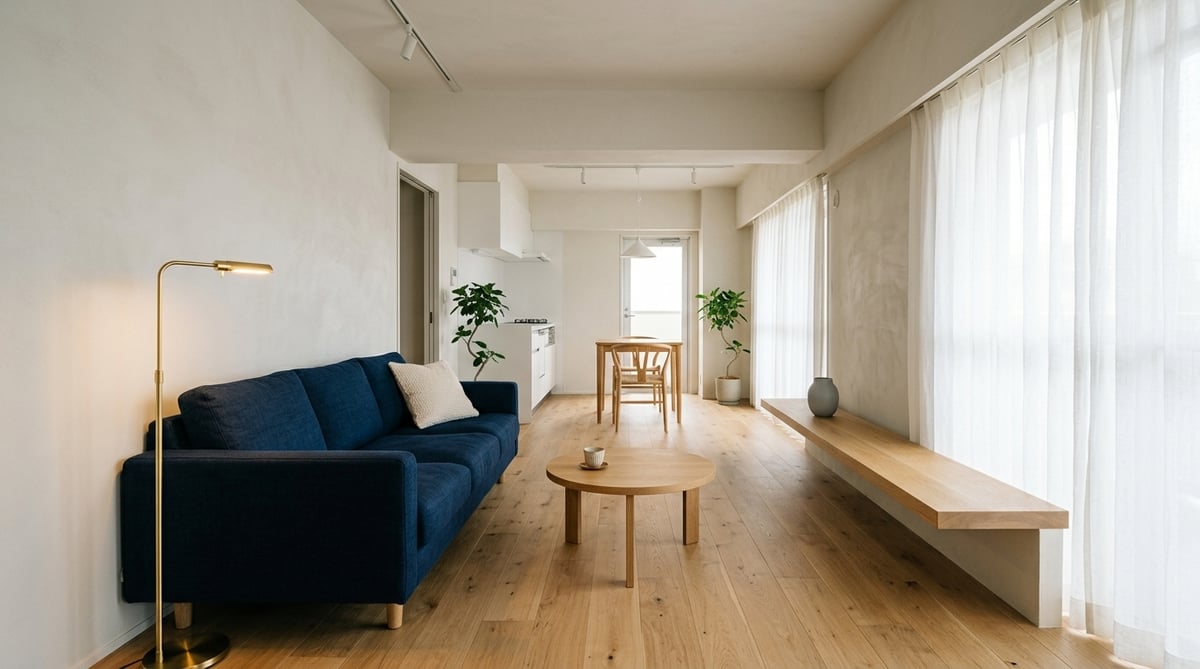
Walking through Koishikawa in the morning, as soft light filters through the trees lining Kasuga-dori Avenue, the crisp air of the upland plateau touches your cheeks. Passing a neighborhood bakery near the station where the aroma of freshly roasted coffee lingers, commuters descend the shallow stairs of Myogadani Station with a calm, unhurried pace. If you walk down the gentle slope to the northwest, pass through the quiet, tree-shaded grounds of Gokokuji Temple, and step onto Otowa-dori Avenue, the distant rumble of Yurakucho Line trains rising from deep underground blends with the brisk footsteps of commuters heading into central Tokyo.
Starting from Ikebukuro and running nearly parallel through the residential neighborhoods of Bunkyo Ward before gliding into the heart of the city, the Tokyo Metro Marunouchi Line and Yurakucho Line are frequently compared by our clients. On the way back from property viewings, many pause to weigh their options: should they choose the Marunouchi Line for its reliable schedule and direct access to Tokyo, Otemachi, Ginza, and Shinjuku, or the Yurakucho Line for its spacious 10-car trains and straight connection through Iidabashi, Nagatacho, and Yurakucho to the waterfront neighborhoods of Tsukishima and Toyosu?
There is no single right answer. Whether you value the ease of stepping from your front door onto a shallow platform in minutes and the quiet of an elevated plateau, or prefer wider train cars and flat waterfront streets, each line offers its own distinct comfort. To help you choose a station that fits both your commute and your weekends, this guide walks through daily train operations, two-year total housing costs, terrain and hazard considerations, and local shopping environments.
- The Marunouchi Line operates independently with high punctuality, connecting shallow platforms directly to Otemachi, Tokyo, Ginza, and Shinjuku.
- The Yurakucho Line runs spacious 20-meter, 10-car trains through Iidabashi, Nagatacho, Yurakucho, Tsukishima, and Toyosu, offering access to flat waterfront districts.
- In Bunkyo Ward, Myogadani and Gokokuji (194,000 yen for a 1LDK) as well as Korakuen and Edogawabashi (200,000 yen) share identical median rent levels.
Commute Routes, Operations, and Transfer Realities Compared
Looking at a map heading toward central Tokyo from Ikebukuro Station, the Marunouchi Line and Yurakucho Line run roughly one kilometer apart through Bunkyo Ward before branching toward their respective business districts north and east of the Imperial Palace. While you can explore individual station profiles in our Marunouchi Line Area Guide and Yurakucho Line Area Guide, the table below summarizes the rolling stock, operational structure, and transfer conditions that shape your daily commute.
| Comparison Item | Tokyo Metro Marunouchi Line | Tokyo Metro Yurakucho Line |
|---|---|---|
| Train Cars & Length | 18m cars, 6-car trains (including Honancho Branch through-service) | 20m large cars, 10-car trains (Local service; weekday reserved-seat S-TRAIN available) |
| Operation & Platform Depth | Third-rail, fully independent operation (no external through-service) / Shallow cut-and-cover stations & elevated sections | Overhead catenary, wide-area through-service with Tobu Tojo & Seibu lines / Mostly deep underground platforms |
| Morning Peak Congestion (FY2025) | 154% (Shin-Otsuka to Myogadani, 8:00–9:00; FY2024: 146%, 5-weekday average) | 153% (Higashi-Ikebukuro to Gokokuji, 7:45–8:45; FY2024: 145%, 5-weekday average) |
| Key Origin / Mid-Line Starting Stations | Ikebukuro, Myogadani (select trains), Nakano-fujimicho, Honancho, Ogikubo | Wakoshi, Kotake-mukaihara (select trains), Ikebukuro (select trains), Toyosu (select trains), Shin-Kiba |
| Approx. Travel Time from Ikebukuro | Korakuen ~7 min / Otemachi ~14 min / Tokyo ~16 min / Ginza ~19 min / Kasumigaseki ~23 min / Shinjuku ~34–35 min | Gokokuji ~4 min / Edogawabashi ~6–7 min / Iidabashi ~9–10 min / Nagatacho ~15–17 min / Yurakucho ~19–21 min / Tsukishima ~24–26 min / Toyosu ~26–28 min |
| Main Interchange Stations | Ikebukuro (out-of-gate transfer within 60 min) / Akasaka-mitsuke <-> Nagatacho (in-gate transfer, ~5–10 min walk) / Ginza <-> Ginza-itchome (out-of-gate transfer within 60 min, ~5–8 min street walk) | |
Independent Operation and Shallow Platforms vs. 10-Car Capacity and Through-Service
The most noticeable difference during a morning commute is whether you prioritize schedule stability and shallow platforms, or greater interior space per train. Because the Marunouchi Line operates completely independently without through-service onto other railways, weather disruptions or delays on suburban private lines rarely spill over into its schedule, offering dependable arrival times at the office. Moreover, as one of Tokyo's earliest subway lines, many stations—such as Myogadani and Shin-Otsuka—were built using shallow cut-and-cover construction, allowing you to reach the platform via a short flight of stairs right after tapping through the ticket gate. Emerging onto the elevated section between Myogadani and Korakuen, where morning sunlight fills the train windows, is a pleasant daily highlight that eases the enclosed feeling of underground travel.
The Yurakucho Line, by contrast, operates 10-car trains made up of 20-meter-long carriages. According to the Ministry of Land, Infrastructure, Transport and Tourism's FY2025 urban railway congestion survey, both lines show nearly identical peak figures—154% on the Marunouchi Line (Shin-Otsuka to Myogadani) and 153% on the Yurakucho Line (Higashi-Ikebukuro to Gokokuji). In practice, however, stepping toward the center of a 20-meter, 10-car Yurakucho Line train often feels noticeably roomier around the shoulders than an 18-meter, 6-car Marunouchi Line train. Keep in mind that because the Yurakucho Line shares tracks with the Fukutoshin Line between Kotake-mukaihara and Wakoshi and runs through-services with the Tobu Tojo, Seibu Yurakucho, and Seibu Ikebukuro lines, delays further out in the suburbs can affect central Tokyo schedules (for a closer look at how it compares with the Fukutoshin Line, see our Yurakucho vs. Fukutoshin Line Comparison and Marunouchi vs. Fukutoshin Line Comparison). Additionally, as a newer subway line, stations like Gokokuji and Nagatacho sit deep underground, so allowing an extra 3 to 5 minutes from street entrance to platform keeps your morning routine unhurried. Looking ahead, construction began in November 2024 on the Yurakucho Line extension from Toyosu through Toyocho to Sumiyoshi (targeted to open in the mid-2030s), which will further improve connectivity toward eastern Tokyo and the Hanzomon Line (see also our Yurakucho vs. Tozai Line Waterfront Comparison).
Seated Commute Options and Using the S-TRAIN
For those who prefer to turn their morning ride into quiet time for reading or organizing the day's schedule, originating and mid-line starting trains are a valuable asset. On the Marunouchi Line, waiting for the next train at Ikebukuro—where all trains turn around—virtually guarantees a seat toward Otemachi, Tokyo, and Ginza, and Myogadani Station also offers select morning trains originating there. If you broaden your search to the western half of the line toward Shinjuku and Akasaka-mitsuke, Nakano-fujimicho (adjacent to the train depot), Honancho (with frequent through-trains to the main line), and the terminus at Ogikubo also provide reliable seated commutes.
On the Yurakucho Line, select originating trains depart from Wakoshi, Kotake-mukaihara (where the Seibu line merges), and Ikebukuro. Heading inbound from the waterfront toward Yurakucho, Nagatacho, and Iidabashi, commuters can also take advantage of originating trains from Shin-Kiba and select departures from Toyosu. On weekday mornings and evenings, the reserved-seat "S-TRAIN" runs between the Seibu network and Iidabashi, Yurakucho, and Toyosu, offering a comfortable seated option from Nerima into central Tokyo and the bay area.
Transfer Realities at Ikebukuro, Akasaka-mitsuke/Nagatacho, and Ginza/Ginza-itchome
Although the two lines intersect at three points on the transit map, each transfer works differently in practice. At Ikebukuro Station, there is no in-gate connection; you walk through the underground concourse and exit the gates for an out-of-gate transfer within 60 minutes (through-fares apply; paper ticket users should pass through the orange transfer gates). At Akasaka-mitsuke (Marunouchi Line) and Nagatacho (Yurakucho Line), the stations are connected inside the ticket gates via underground passages and moving walkways. However, moving from the shallow Marunouchi Line platform—which shares cross-platform transfers with the Ginza Line (see our Marunouchi vs. Ginza Line Comparison)—down to the deep Yurakucho Line platform involves notable distance and elevation changes, taking roughly 5 to 10 minutes. Finally, Ginza (Marunouchi Line) and Ginza-itchome (Yurakucho Line) also use a 60-minute out-of-gate transfer, but because there is no direct underground passage, you walk 200 to 300 meters at street level (about 5 to 8 minutes), and commuter pass holders should check fare-zone rules if traveling outside their pass area (for neighborhood details, see our Ginza-itchome Station Area Guide).
In Bunkyo Ward, living between the two parallel lines—such as between Myogadani and Gokokuji (12–15 minutes on foot), Gokokuji and Shin-Otsuka (12–15 minutes), or Myogadani and Edogawabashi (around 15 minutes)—is a popular way to enjoy access to both lines. While this flexibility is appealing, routes linking the Kohinatadai and Mejirodai plateaus with the Otowa valley floor include steep slopes and staircases such as Munatsuki-zaka, Nezumi-zaka, and Fuzoku-yoko-zaka (near Otsuka 1- and 2-chome). During property viewings, it is wise to walk the actual incline yourself to ensure it feels manageable in dress shoes or on rainy evenings. If you prefer to connect between the two corridors by rail, the Namboku Line or Oedo Line links Korakuen (Kasuga) and Iidabashi in just one stop (2 to 3 minutes).
Simply enter the rent and deposit from portal listings to calculate a full, itemized breakdown including brokerage and guarantor fees without hidden add-ons.
Station Rent Averages and 2-Year Total Housing Cost Break-Even
One of the most striking findings when comparing the parallel stations in Bunkyo Ward is that median rents across layouts match almost down to the yen. However, once you look toward central business hubs like Tokyo and Yurakucho, or eastward along the Yurakucho Line to Tsukishima and Toyosu, the two-year total housing cost (calculated as 25 months, including 24 months of rent plus a 1-month renewal fee equivalent) diverges by 1 million to over 2 million yen depending on the layout—and for 2LDK family apartments, the price order between Bunkyo Ward and the waterfront actually reverses.
| Line | Station (Ward) | 1R | 1K | 1DK | 1LDK | 2LDK | Rent / sqm |
|---|---|---|---|---|---|---|---|
| Marunouchi / Yurakucho | Ikebukuro (Toshima) | ¥86,000 | ¥117,000 | ¥143,000 | ¥194,000 | ¥272,000 | ¥4,500 |
| Marunouchi Line | Shin-Otsuka (Bunkyo) | ¥79,000 | ¥107,000 | ¥131,000 | ¥178,000 | ¥252,000 | ¥4,200 |
| Marunouchi Line | Myogadani (Bunkyo) | ¥85,000 | ¥114,000 | ¥141,000 | ¥194,000 | ¥275,000 | ¥4,500 |
| Marunouchi Line | Korakuen (Bunkyo) | ¥88,000 | ¥119,000 | ¥147,000 | ¥200,000 | ¥286,000 | ¥4,600 |
| Marunouchi Line | Tokyo (Chiyoda) | ¥120,000 | ¥162,000 | ¥200,000 | ¥284,000 | ¥418,000 | ¥5,800 |
| Yurakucho Line | Kotake-mukaihara (Nerima) | ¥73,000 | ¥99,000 | ¥122,000 | ¥162,000 | ¥229,000 | ¥3,900 |
| Yurakucho Line | Gokokuji (Bunkyo) | ¥85,000 | ¥114,000 | ¥141,000 | ¥194,000 | ¥275,000 | ¥4,500 |
| Yurakucho Line | Edogawabashi (Bunkyo) | ¥88,000 | ¥119,000 | ¥147,000 | ¥200,000 | ¥286,000 | ¥4,600 |
| Yurakucho Line | Yurakucho (Chiyoda) | ¥114,000 | ¥154,000 | ¥189,000 | ¥270,000 | ¥394,000 | ¥5,600 |
| Yurakucho Line | Tsukishima (Chuo) | ¥97,000 | ¥131,000 | ¥161,000 | ¥224,000 | ¥325,000 | ¥4,900 |
| Yurakucho Line | Toyosu (Koto) | ¥95,000 | ¥128,000 | ¥158,000 | ¥219,000 | ¥321,000 | ¥4,800 |
Equal Rents in Bunkyo Ward: Choosing a Single-Person Apartment (1R/1K)
A key takeaway from the table above is that there is no difference in median rent between Myogadani and Gokokuji, or between Korakuen and Edogawabashi. When looking for a single-person apartment in Bunkyo Ward (typically around 114,000 to 119,000 yen for a 1K), you do not need to compromise on budget; you can choose purely based on whether a hilltop neighborhood with direct access to Otemachi and Tokyo Station or a valley-side neighborhood along Otowa and the Kanda River with direct access to Yurakucho, Nagatacho, and Iidabashi fits your daily routine. If you prefer a well-organized commercial district closer to Ikebukuro near Sunshine City, Higashi-Ikebukuro Station shares the same 119,000 yen 1K median as Korakuen and Edogawabashi (see our Higashi-Ikebukuro Station Area Guide).
If you want to keep fixed monthly rent closer to 100,000 yen and allocate more of your budget toward floor space or personal pursuits, looking one to three stops outward from Ikebukuro opens up practical options. On the Marunouchi Line, Shin-Otsuka keeps a Bunkyo Ward address at 107,000 yen for a 1K (while Nakano-fujimicho at 104,000 yen and Honancho at 102,000 yen offer originating trains on the western side). On the Yurakucho Line, Kanamecho (104,000 yen) is one stop from Ikebukuro, and Kotake-mukaihara (99,000 yen) provides mid-line starting trains plus Fukutoshin Line express service. Comparing Shin-Otsuka (107,000 yen) with Tsukishima (131,000 yen) reveals a 24,000 yen monthly difference—or 600,000 yen over 25 months. While Tsukishima's five-minute ride to Yurakucho is convenient, accepting a 15-minute commute often puts a quiet low-rise residence with a separate washbasin well within reach.
Couples & Dual-Income Households (1LDK): Saving ¥1M to ¥2.25M Over 2 Years
For couples or remote workers seeking a 1LDK with dedicated workspace, the cost gap between central business hubs and residential stations becomes substantial enough to shape your overall lifestyle budget. Living near Tokyo Station (284,000 yen), Ginza (299,000 yen), or Yurakucho (270,000 yen) lets you walk or take a short cab to the office, yet riding just 5 to 17 minutes outward changes the numbers dramatically.
Over a 25-month cycle (24 months plus a 1-month renewal fee), moving from Tokyo Station (284,000 yen) to Myogadani (194,000 yen)—an 11- to 12-minute ride—saves 90,000 yen per month, or 2,250,000 yen over two years. Using Yurakucho Station (270,000 yen) as a baseline, choosing Tsukishima (224,000 yen, 5 minutes away) saves 46,000 yen monthly (1,150,000 yen over 25 months), while Gokokuji (194,000 yen, 15–17 minutes away) reduces housing costs by 76,000 yen monthly (1,900,000 yen over 25 months). (For a closer look at Shintomicho at 242,000 yen versus Tsukishima, see our Shintomicho vs. Tsukishima Comparison.) Even between Tsukishima (224,000 yen) or Toyosu (219,000 yen) and Bunkyo's Myogadani or Gokokuji (194,000 yen), there is a 625,000 to 750,000 yen difference over 25 months. You can decide whether to invest in door-to-door proximity and waterfront openness, or use the savings to furnish your home and travel.
Families (2LDK): The Price Reversal Between Bunkyo Uplands and the Waterfront
For families or couples wanting two separate bedrooms, the price relationship between Bunkyo Ward and the waterfront shifts noticeably compared to 1K apartments. Whereas a 1K in Korakuen or Edogawabashi (119,000 yen) is only 12,000 yen less than in Tsukishima (131,000 yen), at the 2LDK level Toyosu (321,000 yen) and Tsukishima (325,000 yen) sit well above Myogadani and Gokokuji (275,000 yen) or Korakuen and Edogawabashi (286,000 yen).
Choosing Myogadani or Gokokuji (275,000 yen) over Tsukishima (325,000 yen) saves 50,000 yen per month—600,000 yen per year, or 1,250,000 yen over 25 months. Including Shin-Otsuka (252,000 yen) brings calm family apartments into the mid-200,000 yen range. This gap exists because 2LDK listings in Tsukishima and Toyosu are dominated by large-scale tower condominiums featuring 24-hour staffed management, lounges, guest rooms, and trash rooms on every floor, whereas Bunkyo Ward offers many solid mid- to low-rise condominiums without costly shared amenities. If you want modern tower facilities and flat waterfront streets, the Yurakucho Line bay area fits naturally; if you prefer a green, quiet educational environment with lower fixed costs, Bunkyo Ward is a practical choice.
Terrain, Hazard Profiles, and Everyday Shopping
Floor plans and walking minutes to the station do not tell you about the incline of the walk home, the underlying ground, or the character of local grocery stores. Even within Bunkyo Ward, crossing a single street can transition from an elevated plateau to a valley floor, offering a very different environment from the reclaimed land of the bay area.
Navigating the Koishikawa/Mejirodai Plateaus and Otowa/Kanda River Valleys
While Bunkyo Ward is often pictured as entirely hilly, it is actually a patchwork of volcanic ash plateaus (loam uplands) at the eastern edge of the Musashino Terrace and low-lying valleys carved by the Kanda River and Otowa Valley.
Neighborhoods around the Marunouchi Line's Myogadani Station (such as Koishikawa 5-chome) and the northwestern uplands of Korakuen Station (Koishikawa 2-chome and Kasuga 2-chome) sit on relatively stable loam plateaus outside designated flood inundation zones on Bunkyo Ward's hazard maps. Stepping one street off Kasuga-dori Avenue reveals quiet residential blocks of mid- to high-rise condominiums with well-lit streets for late-evening walks.
By contrast, the Yurakucho Line's Gokokuji Station (Gokokuji Area Guide) and Edogawabashi Station (Edogawabashi Area Guide) encompass both hilltop uplands and flat valley floors within walking distance. Climbing the slope from Gokokuji toward Mejirodai 3-chome brings you to a mid-rise residential zone on the loam plateau, while heading up from Edogawabashi toward Sekiguchi 2-chome near Hotel Chinzanso leads to a quiet Category 1 low-rise residential zone (outside flood zones) limited to three-story homes. Conversely, Otowa 2-chome along Otowa-dori Avenue and Sekiguchi 1-chome along the Kanda River lie in flat valley-bottom commercial zones, with riverside areas such as Sekiguchi 1-chome falling within flood inundation zones (projected maximum depth of 3.0 to under 5.0 meters). When prioritizing flat, station-close convenience in these valley areas, choosing a unit on the second floor or higher and checking drainage slopes and electrical equipment placement adds peace of mind.
Flat Waterfront Paths and Storm-Surge / Liquefaction Checks in Tsukishima and Toyosu
East of Ginza-itchome and Shintomicho across the Sumida River, Tsukishima, Tsukuda, and Toyosu offer completely flat, reclaimed-land streetscapes. Whether carrying heavy groceries, pushing a stroller, or riding an electric-assist bicycle, you never have to climb a hill, and wide sidewalks along the Sumida River Terrace and canals provide an open, breezy daily route.
For long-term peace of mind in waterfront neighborhoods, it is worth checking building-level preparedness for storm surges, tsunamis, and liquefaction during viewings. While modern large-scale condominiums and towers incorporate strong countermeasures, reviewing management rules and important-matter disclosures to confirm whether electrical rooms are elevated above projected flood depths (such as on the second floor or higher), whether floodgates are installed at entrances and underground parking ramps, and whether emergency supply rooms are stocked on each floor helps you evaluate resilience against severe weather.
2026 Grocery & Shopping Guide: From Neighborhood Supermarkets to Shopping Streets
Daily grocery options also vary clearly by station. As of 2026, Myogadani Station on the Marunouchi Line features Santoku Myogadani Ekimae and Maruetsu Petit Myogadani right by the station, plus Santoku Myogadani a short walk away, all well regarded for fresh produce and prepared foods (note that while a Summit Store is planned for the ground floor of the large Livio City Bunkyo Koishikawa residence in Koishikawa 4-chome, completion and handover are scheduled for late February 2027 or later, so current residents rely on Santoku and Maruetsu Petit). Nearby Korakuen Station offers Seijo Ishii Tokyo Dome LaQua, Queen's Isetan Koishikawa, and Maruetsu Kasuga Ekimae, while Shin-Otsuka Station has a spacious Life Shin-Otsuka.
On the Yurakucho Line, everyday shopping right outside Gokokuji Station centers on Maruetsu Petit Gokokuji Ekimae, so residents who cook frequently often bicycle or walk to neighboring Edogawabashi or Higashi-Ikebukuro for larger hauls. Edogawabashi Station is particularly convenient for home cooks, pairing Maruetsu Edogawabashi (accessible from the station building basement) and Comodi-iida Edogawabashi with the lively Edogawabashi Jizo-dori Shopping Street, lined with delis and fishmongers. Around Higashi-Ikebukuro Station, Santoku Toshima Ward Office-mae opened on the ground floor of Grand City Tower Ikebukuro in July 2026, complementing the existing Maruetsu Petit Higashi-Ikebukuro 5-chome and 3-chome stores. In the bay area, Tsukishima Station is served by Food Style Tsukishima (renovated and rebranded from the former Daiei at the end of July 2026), Bunkado Tsukishima, Fuji Mart Tsukishima, and My Basket Tsukishima 2-chome (opened January 2026), while Toyosu Station added Super Sanwa LaLaport Toyosu in September 2026 alongside Daiei Toyosu and Bunkado Toyosu.
Matching Your Lifestyle and Practical Contract & Viewing Tips
Bringing together train operations, two-year housing costs, and neighborhood terrain makes it easier to see which line naturally fits your daily rhythm.
When the Marunouchi Line Fits Best
- ✓ You commute directly to Otemachi, Tokyo, Ginza, Kasumigaseki, or Shinjuku without transfers.
- ✓ You value high punctuality insulated from suburban rail delays and shallow, quick-access platforms.
- ✓ You want a calm mid- to high-rise residential neighborhood on stable loam uplands such as Koishikawa.
- ✓ You want to keep 2LDK rent moderate while enjoying Bunkyo Ward's schools and supermarkets.
When the Yurakucho Line Fits Best
- ✓ Your daily commute centers on Iidabashi, Ichigaya, Kojimachi, Nagatacho, Yurakucho, or Toyosu.
- ✓ You prefer spacious 20m, 10-car trains, originating services at Kotake-mukaihara or Toyosu, or the S-TRAIN.
- ✓ You want either Edogawabashi's warm shopping street or Tsukishima and Toyosu's flat waterfront blocks.
- ✓ You appreciate newer large-scale condominiums with full shared amenities and direct weekend rail links.
When Switching to the Other Line Improves Daily Satisfaction
Many clients start their search set on Myogadani or Korakuen on the Marunouchi Line, only to find greater satisfaction after shifting to the Yurakucho Line. For example, if flat terrain for an electric-assist bicycle or stroller is a top priority, or if you want wide sidewalks and large shopping complexes for one-stop weekend errands, flat areas in Tsukishima, Toyosu, or Edogawabashi can feel much lighter on daily routines than Bunkyo's hills. Likewise, if your office is in Hibiya, Yurakucho, Kojimachi, or Nagatacho, riding the Yurakucho Line directly to your nearest exit is far more comfortable on rainy days than walking from Tokyo or Akasaka-mitsuke stations.
Conversely, clients who begin by looking at Tsukishima, Gokokuji, or Edogawabashi often switch to the Marunouchi Line and feel glad they did. If you have frequent morning meetings and want to avoid even minor delays from suburban through-services, prefer stepping onto a train immediately without riding long escalators deep underground, or want a 2LDK under 300,000 yen on elevated ground outside flood zones, walking around Myogadani, Shin-Otsuka, or the upland side of Korakuen is well worth your time.
Checking Soundproofing Along Arterial Roads and Neighboring Sunlight
Within a five-minute walk of stations on both lines, many apartments sit in commercial zones along major arterial roads such as Kasuga-dori, Mejiro-dori, Otowa-dori, and Kiyosumi-dori. While main streets offer bright lighting and reassurance when returning late at night, indoor traffic noise depends heavily on window sash performance. During viewings, open the window briefly to gauge outside traffic, then close it to check the sash sound-insulation rating (such as T-2 or higher, or double-pane windows) and listen for sound coming through 24-hour ventilation vents. Also, in commercial zones with looser height restrictions, look across from the main south-facing windows: if there is a coin-operated parking lot or an aging low-rise building, consider whether future redevelopment could affect sunlight or views.
Fixed-Term Leases and Restoration Clauses: Key Legal Standards
Condominium rentals in Bunkyo Ward and tower apartments in Tsukishima and Toyosu frequently use fixed-term lease contracts (such as when an owner is temporarily relocated) or include custom restoration clauses. Understanding the official legal framework helps you sign with confidence and avoid surprises at move-out.
Regarding move-out restoration, the Ministry of Land, Infrastructure, Transport and Tourism's guidelines set the useful life of wallpaper at 6 years (reaching a residual value of 1 yen after six years), and even when a tenant causes damage through negligence, cost-sharing is generally prorated per affected wall face rather than the entire room. In Tokyo, the Tokyo Ordinance for the Prevention of Rental Housing Disputes (Tokyo Rules) requires a licensed real estate transaction specialist to explain these cost-sharing principles and any special clauses in writing prior to signing.
For a special clause shifting normal wear-and-tear or aging costs—such as professional house cleaning—to the tenant to be legally valid, the Supreme Court Second Petty Bench ruling of December 16, 2005 requires two conditions: the scope of the tenant's burden must be clearly and unambiguously stated in the contract, and the tenant must explicitly understand and agree to bear costs they would not ordinarily owe. Meanwhile, in individual consumer leases, if a non-refundable deposit deduction or fixed-rate repair clause is excessively high relative to the rent and local norms so as to violate good faith and unilaterally harm the consumer's interests, its validity is evaluated under Article 10 of the Consumer Contract Act (and Supreme Court rulings of March 24 and July 12, 2011). Reviewing exact amounts and scope before signing protects your peace of mind.
Summary: Choosing Between the Marunouchi and Yurakucho Lines
Whether you picture yourself stepping down onto a shallow Marunouchi Line platform from the sunlit uplands of Kasuga-dori Avenue, or strolling past Otowa-dori and the Jizo-dori Shopping Street to board a spacious 10-car Yurakucho Line train toward Yurakucho and the waterfront, both corridors connect Ikebukuro and central Tokyo with distinct character and comfort.
Because median rents in Bunkyo Ward—Myogadani and Gokokuji, Korakuen and Edogawabashi—are identical, you can base your choice directly on your commute destination, preference for punctuality versus train space, and whether you prefer quiet uplands or flat shopping streets. And when comparing 1LDK or 2LDK options against central Tokyo or the bay area, weighing the 600,000 to 2.25 million yen two-year housing cost difference against your broader lifestyle goals will point you toward a comfortable decision.
If you would like to compare slope gradients, hazard profiles, or fixed-term lease conditions for specific properties—or if you want an objective second opinion on an initial-cost quote—please feel free to reach out to Sorai Tokyo. Simply send the property URL to our official LINE (@soraitokyo / https://line.me/R/ti/p/@soraitokyo), available 24/7 with no phone number required, no pushy sales calls, and no store visits needed. Our licensed real estate specialists will check real-time availability in the inter-agent database and provide a transparent quote review, including guidance on no-guarantor options and smooth visa and rental screening. You can also access our smart tools anytime from the bottom menu on mobile or the footer on desktop. We look forward to helping your new life in Tokyo begin calmly and smoothly.
Frequently Asked Questions (FAQ)
QBetween Myogadani/Korakuen (Marunouchi Line) and Gokokuji/Edogawabashi (Yurakucho Line) in Bunkyo Ward, which offers an easier morning commute?
AIn the FY2025 MLIT congestion survey, the Marunouchi Line (Shin-Otsuka to Myogadani, 154%) and Yurakucho Line (Higashi-Ikebukuro to Gokokuji, 153%) are virtually tied. The Marunouchi Line suits those who prioritize punctuality insulated from other railways' delays and shallow platforms close to street level. The Yurakucho Line suits those who prefer the extra interior space of 20-meter, 10-car trains and direct access to Yurakucho, Nagatacho, and Iidabashi. For a seated commute, originating trains at Ikebukuro, Myogadani (select), or Kotake-mukaihara (select) are helpful options.
QCan I live between Myogadani and Gokokuji, or Korakuen and Edogawabashi, and use both lines?
AYes. Myogadani and Gokokuji are about a 12- to 15-minute walk apart, and Myogadani to Edogawabashi is around 15 minutes, making dual-line living practical. However, routes connecting the Kohinatadai and Mejirodai plateaus with the Otowa and Kanda River valleys include steep slopes and stairs such as Munatsuki-zaka and Nezumi-zaka. We recommend walking the route in person—checking lighting and incline—before deciding. By train, Korakuen (Kasuga) and Iidabashi are also just one stop (2–3 minutes) apart on the Namboku or Oedo lines.
QWhat should I watch out for in costs and contracts when comparing Tsukishima/Toyosu with Bunkyo Ward?
AOn cost, note that for 2LDK apartments, Myogadani and Gokokuji (275,000 yen) are 50,000 yen per month (600,000 yen per year) less than Tsukishima (325,000 yen). On contracts and buildings, remember that the statutory early-termination right in fixed-term leases (Act on Land and Building Leases Art. 38, Para. 7) does not apply to corporate-name leases, so verify that a voluntary termination clause is included. For waterfront or low-lying properties, also confirm elevated electrical room placement and floodgate installation.



Sorai Tokyo Co., Ltd. Editorial (Licensed Real Estate Agency #113297)
Licensed online real estate agency handling residential leasing across 15 major Tokyo lines (Member of All Japan Real Estate Association). Powered by our proprietary 24/7 AI "SorAi" on iOS/LINE and dedicated licensed realtors, we support renters end-to-end from vacancy checks on major portals to viewings and digital contracts.