
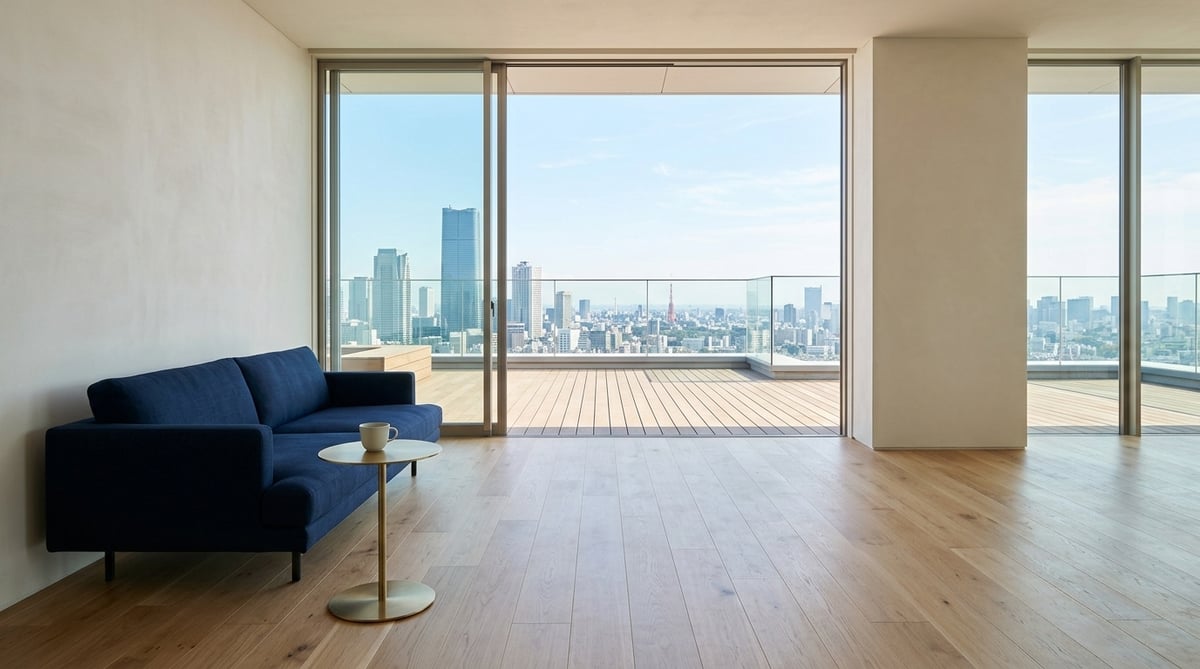
Before 8:00 a.m. on a weekday morning, on the elevated platform at Nakameguro Station, commuters stepping off the Tokyu Toyoko Line walk just a few paces across the same platform and quietly board a waiting Tokyo Metro Hibiya Line train—every single one of which originates right here. Meanwhile, a few kilometers to the east on the underground platform at Shirokane-Takanawa Station, commuters line up neatly in a climate-controlled concourse as the headlights of an approaching Namboku Line train reflect softly off the floor-to-ceiling, full-screen platform doors.
When advising clients whose offices are in central Tokyo hubs such as Roppongi, Toranomon, Kasumigaseki, or Tameike-sanno, we often see them weighing whether to base their daily life along the Hibiya Line or the Namboku Line. Although these two lines run parallel and cross paths right through the heart of the city, they do not share a single direct transfer station under the same name. As a result, your daily comfort depends heavily on which exit is closest to your office building, how you prefer to secure a seat in the morning, and the atmosphere of the neighborhood you step out into after work.
Both axes offer distinct, irreplaceable appeal: the Hibiya Line corridor through Nakameguro, Ebisu, and Kita-Senju with effortless access to Shibuya and Ginza, and the Namboku Line corridor through Shirokane-Takanawa, Komagome, and Akabane-iwabuchi threading through quiet upland residential districts. While we cover individual stations in detail in our Hibiya Line Area Guide and Namboku Line Area Guide, this article compares both lines side by side across commute routes, 25-month total housing costs, terrain and flood-hazard profiles, and lease-contract practicalities to help you choose a neighborhood that fits your rhythm.
- The two lines have no direct transfer station; instead, Roppongi and Roppongi-itchome, and Kasumigaseki and Tameike-sanno, sit close by to divide central Tokyo's business districts.
- The Hibiya Line operates standardized 7-car trains with starting-station seating at Nakameguro and Kita-Senju, while the Namboku Line features full-screen platform doors at every station and starting trains from Shirokane-Takanawa, Oji-kamiya, and Akabane-iwabuchi.
- In the Jonan (south-central) belt, Nakameguro saves JPY 150,000–500,000 over 25 months compared with Shirokane-Takanawa, and Meguro lowers total 25-month costs by an additional JPY 250,000–875,000.
Commute Routes and Seating Strategies Around Roppongi, Kasumigaseki, and Tameike-sanno
The first point to understand when comparing the Hibiya Line and the Namboku Line is their geographic layout: they bracket the office districts of Minato and Chiyoda Wards at close range. Let us begin with an overview of train formations, through-service networks, and morning rush-hour crowding.
| Comparison Item | Tokyo Metro Hibiya Line | Tokyo Metro Namboku Line |
|---|---|---|
| Train Formation & Platform Doors | Standardized 20m-class, 7-car trains (13000 Series, Tobu 70000 Series, etc.) Movable platform gates installed at all 22 stations |
20m-class, 6-car and 8-car trains (8-car fleet expanding) Full-screen platform doors at all 19 stations since opening |
| Through-Service & Shared Track | Through-service from Kita-Senju onto the Tobu Skytree Line Nakameguro through-service ended; all trains originate/turn back at Nakameguro |
Shares tracks with the Toei Mita Line between Meguro and Shirokane-Takanawa Through-service to Tokyu Meguro, Tokyu Shin-Yokohama, Sotetsu, and Saitama Railway lines |
| Peak Congestion Rate (Published) | 163% (Minowa → Iriya; same level in FY2024 and FY2025) | 156% (Komagome → Hon-komagome; FY2025 published figure, up from 152%) |
| Starting Stations & Seating Options | Nakameguro (all trains originate here), Kita-Senju (originating trains available) Reserved-seat "TH Liner" (operational stop only at Kita-Senju with no boarding/alighting; free-seating zone between Kasumigaseki and Ebisu) |
Akabane-iwabuchi, Oji-kamiya (morning rush-hour originating trains) Shirokane-Takanawa (turn-back originating trains; same-platform transfer with Toei Mita Line) |
| Travel Time to Roppongi Area | Nakameguro → Roppongi: ~8 min / Kita-Senju → Roppongi: ~35–37 min | Shirokane-Takanawa → Roppongi-itchome: ~3–4 min / Komagome → Roppongi-itchome: ~19 min |
| Kasumigaseki / Tameike-sanno | Nakameguro → Kasumigaseki: ~14–15 min / Kita-Senju → Kasumigaseki: ~30 min (~21–23 min via Chiyoda Line) | Shirokane-Takanawa → Tameike-sanno: ~5–6 min / Komagome → Tameike-sanno: ~17 min / Akabane-iwabuchi → Tameike-sanno: ~27–29 min |
Crossing Central Tokyo Without a Direct Transfer: Station Placement and Office Access
At first glance on a route map, the two lines appear to overlap around Roppongi and Kasumigaseki, yet there is no station where you can pass through a single transfer gate between them. For example, Hibiya Line's Roppongi Station and Namboku Line's Roppongi-itchome Station are roughly 600 to 700 meters apart in a straight line—about a 10-minute walk along the sloped Roppongi-dori Avenue. On the other hand, improved pedestrian decks and underground passages around Azabudai Hills now allow a calm 10-minute walk between Hibiya Line's Kamiyacho Station and Namboku Line's Roppongi-itchome Station.
A similar relationship exists in the government and business district. Namboku Line's Tameike-sanno Station connects inside the ticket gates via a transfer passageway to Kokkai-gijidomae Station on the Marunouchi and Chiyoda Lines, from which Kasumigaseki Station on the Hibiya Line is one stop away—but the long corridor with stairs and escalators makes it cumbersome for a daily commute. Choosing the Hibiya Line if your office is near Roppongi Hills, Toranomon Hills, or Hibiya Park, or the Namboku Line if you work near Izumi Garden, Ark Hills, or Akasaka Intercity AIR, keeps rainy-morning walks to a minimum. If you are also considering other lines around Roppongi Crossing, Kasumigaseki, or Ginza, our comparisons of the Hibiya Line vs. Toei Oedo Line and the Marunouchi Line vs. Hibiya Line will help clarify which ticket gate aligns best with each office building.
Hibiya Line Mornings: Nakameguro & Kita-Senju Starting Trains and the TH Liner
A defining feature of the Hibiya Line is its fleet modernization from older 18-meter, 8-car trains to standardized 20-meter, 4-door, 7-car trains, alongside the completion of movable platform gates at all 22 stations in March 2024 with the activation at Minami-Senju Station. Since ending through-service with the Tokyu Toyoko Line in 2013, Nakameguro Station at the southern terminus has served as a dedicated starting station for every single Hibiya Line train. Even during morning rush hour, letting one or two trains pass virtually guarantees a seat, leaving you time to read or check the news on your way to Roppongi, Kasumigaseki, or Ginza.
From the northern side, peak congestion between Minowa and Iriya reaches 163%—crowded enough that shoulders touch—but Kita-Senju Station offers originating Hibiya Line trains in addition to through-trains from the Tobu Skytree Line. The reserved-seat "TH Liner" also runs from the Tobu network onto the Hibiya Line; while it makes only an operational crew-change stop at Kita-Senju with no passenger boarding or alighting, the segment between Kasumigaseki and Ebisu is open as a free-seating zone without a seat reservation, offering a pleasant chance to ride in transverse seating if your timing aligns.
Namboku Line Strengths: Full-Screen Platform Doors and Three Starting Stations
The Namboku Line was Japan's first subway line equipped from opening day with full-screen platform doors reaching all the way to the ceiling at all 19 stations. Because the trackway is completely separated from the platform, wind pressure and train noise are significantly reduced, and air conditioning in summer or heating in winter stays comfortably inside the concourse. In addition to the traditional 6-car trains, 8-car formations are steadily expanding, giving commuters more breathing room near the added end cars.
Operationally, the Namboku Line shares tracks with the Toei Mita Line between Meguro and Shirokane-Takanawa. At Shirokane-Takanawa, you can transfer between the two lines in just a few steps across the island platform, and turn-back originating trains also depart from here. Southbound trains continue from Meguro onto the Tokyu Meguro Line, Tokyu Shin-Yokohama Line, and Sotetsu Line, making it convenient for frequent Tokaido Shinkansen travelers using Shin-Yokohama Station. On the northern side, peak congestion (Komagome to Hon-komagome) is 156%—slightly calmer than the Hibiya Line—and morning rush-hour originating trains depart not only from Akabane-iwabuchi (connecting to the Saitama Railway) but also from Oji-kamiya, which sits next to the Oji Depot. For a closer look at the shared southern segment, see our Namboku Line vs. Toei Mita Line Comparison Guide.
Simply enter the rent and deposit from portal listings to calculate a full, itemized breakdown including brokerage and guarantor fees without hidden add-ons.
Rent Prices and 25-Month Total Housing Costs by Budget Tier
Even among stations with similar commute times, your choice of line and station creates a steady, measurable difference in monthly fixed expenses. Because many Tokyo leases charge a renewal fee equal to one month's new rent every two years, comparing "24 months of rent + 1 month renewal fee = 25 months" (excluding common-area fees and initial move-in costs) reveals the true financial impact.
| Line & Station (Ward) | Approx. Rent / sqm | 1R / 1K | 1DK / 1LDK | 2LDK | 25-Month Total (1K / 1LDK) |
|---|---|---|---|---|---|
| [Hibiya] Roppongi (Minato) | JPY 6,000/sqm | JPY 127k / 171k | JPY 210k / 299k | JPY 443k | JPY 4.275M / 7.475M |
| [Namboku] Roppongi-itchome (Minato) | JPY 5,900/sqm | JPY 122k / 165k | JPY 203k / 289k | JPY 425k | JPY 4.125M / 7.225M |
| [Hibiya] Kasumigaseki (Chiyoda) | JPY 5,800/sqm | JPY 120k / 162k | JPY 200k / 284k | JPY 418k | JPY 4.050M / 7.100M |
| [Namboku] Tameike-sanno (Chiyoda) | JPY 5,800/sqm | JPY 120k / 162k | JPY 200k / 284k | JPY 418k | JPY 4.050M / 7.100M |
| [Hibiya] Hiroo (Minato) | JPY 5,700/sqm | JPY 118k / 159k | JPY 196k / 279k | JPY 411k | JPY 3.975M / 6.975M |
| [Namboku] Shirokane-Takanawa (Minato) | JPY 5,500/sqm | JPY 112k / 151k | JPY 186k / 263k | JPY 387k | JPY 3.775M / 6.575M |
| [Hibiya] Ebisu (Shibuya) | JPY 5,400/sqm | JPY 110k / 148k | JPY 182k / 258k | JPY 374k | JPY 3.700M / 6.450M |
| [Hibiya] Nakameguro (Meguro) | JPY 5,300/sqm | JPY 108k / 145k | JPY 179k / 253k | JPY 367k | JPY 3.625M / 6.325M |
| [Namboku] Meguro (Meguro) | JPY 5,000/sqm | JPY 100k / 135k | JPY 166k / 228k | JPY 332k | JPY 3.375M / 5.700M |
| [Hibiya] Ueno (Taito) | JPY 4,500/sqm | JPY 86k / 117k | JPY 143k / 196k | JPY 280k | JPY 2.925M / 4.900M |
| [Namboku] Komagome (Toshima) | JPY 4,100/sqm | JPY 77k / 104k | JPY 128k / 173k | JPY 243k | JPY 2.600M / 4.325M |
| [Hibiya] Kita-Senju (Adachi) | JPY 3,900/sqm | JPY 73k / 98k | JPY 121k / 162k | JPY 229k | JPY 2.450M / 4.050M |
| [Namboku] Oji (Kita) | JPY 3,900/sqm | JPY 72k / 97k | JPY 119k / 162k | JPY 229k | JPY 2.425M / 4.050M |
| [Namboku] Akabane-iwabuchi (Kita) | JPY 3,800/sqm | JPY 70k / 94k | JPY 116k / 158k | JPY 223k | JPY 2.350M / 3.950M |
Jonan & Central-Adjacent Belt: Nakameguro, Ebisu, Hiroo vs. Shirokane-Takanawa, Azabu-Juban, Meguro
In the Jonan area, where proximity to central Tokyo and refined streetscapes are priorities, Minato Ward's Shirokane-Takanawa (and similarly priced Shirokanedai) is frequently compared with Meguro Ward's Nakameguro. On a 25-month basis, Nakameguro is lighter by JPY 150,000 for a 1K, JPY 250,000 for a 1LDK, and JPY 500,000 for a 2LDK. Even a monthly gap of JPY 6,000 to JPY 20,000 compounds over two years into enough budget to furnish a new living room.
Broadening your search one stop to Meguro Station on the Namboku Line lowers 25-month housing costs even further compared with Nakameguro—by JPY 250,000 for a 1K and JPY 625,000 for a 1LDK. While Nakameguro offers guaranteed starting-station seating and the lively Meguro River corridor, Meguro gives you access to four lines including the JR Yamanote Line, making it easier to secure a slightly larger floor plan or newer building on the same budget. Conversely, those prioritizing ultra-short commutes or corporate housing for families often gravitate toward Hiroo near Arisugawa-no-miya Memorial Park, or the upland stretch from Azabu-Juban (1K JPY 165k, 1LDK JPY 289k, 2LDK JPY 425k) to Roppongi-itchome. For deeper detail on this tier, see our Hiroo Station Area Guide and Azabu-Juban, Roppongi-itchome & Tameike-sanno 2LDK/3LDK Expat & Corporate Lease Guide.
Northern Yamanote & Academic Uplands: Ueno & Naka-okachimachi vs. Komagome & Hon-komagome
For renters aiming to keep door-to-door commutes under 30 minutes while holding 1K rents around JPY 100,000 and 1LDK rents in the JPY 170,000–190,000 range, the northern side of the Yamanote Line is a major decision point. The Hibiya Line's Ueno and Naka-okachimachi area offers rapid access to Ginza and Akihabara plus walking-distance Shinkansen terminals, which keeps rents firm in a distinctly commercial setting.
By contrast, Komagome Station on the Namboku Line also connects to the JR Yamanote Line and reaches Tameike-sanno in ~17 minutes and Roppongi-itchome in ~19 minutes, yet 25-month costs are JPY 325,000 lower for a 1K, JPY 575,000 lower for a 1LDK, and JPY 925,000 lower for a 2LDK compared with Ueno. Together with neighboring Hon-komagome in Bunkyo Ward (1K JPY 109k, 1LDK JPY 182k), this quiet residential pocket has few nightlife districts, appealing to couples and solo professionals who value peaceful nights and balanced housing costs. You can explore the full rent gradient along the Namboku Line inside the Yamanote loop in our Namboku Line Inner-Yamanote 14 Stations Comparison, and compare the Ueno–Ginza corridor in our Ginza Line vs. Hibiya Line Guide.
Practical Value Belt (1K ~JPY 90k / 1LDK ~JPY 160k): Kita-Senju & Minami-Senju vs. Oji & Akabane-iwabuchi
When keeping monthly fixed costs low is the priority, the Hibiya Line's Kita-Senju and Minami-Senju (1K JPY 94k, 1LDK JPY 158k) and the Namboku Line's Oji, Oji-kamiya, and Akabane-iwabuchi stand out. Kita-Senju and Oji sit at identical 1LDK and 2LDK benchmarks, with Akabane-iwabuchi within JPY 100,000–150,000 over 25 months. Looking one stop further to Oji-kamiya (1K JPY 90k, 1LDK JPY 150k), where originating trains are available, brings a 1LDK down to JPY 3.75 million over 25 months.
In this price tier, the deciding factor is less about rent differences and more about station-front atmosphere and backup rail lines. Kita-Senju is a five-line hub (Hibiya, Chiyoda, JR Joban, Tobu, and Tsukuba Express), letting you take the Chiyoda Line (~21–23 minutes) when hurrying to Kasumigaseki or board an originating Hibiya Line train when you want a seat to Roppongi or Ginza. Oji and Akabane-iwabuchi offer direct Namboku Line access to Tameike-sanno and Roppongi-itchome alongside the JR Keihin-Tohoku Line and—at nearby JR Akabane Station—the Shonan-Shinjuku and Ueno-Tokyo Lines for flexible access to Shinjuku, Shibuya, and Tokyo Station.
Neighborhood Atmosphere, Weekend Living, and Station-by-Station Character
Even when travel times and rents are similar, the 10-minute walk from the ticket gate to your front door feels remarkably different along these two lines. Here is how their daily rhythms compare.
Light, Ground-Level Access and Vibrant Neighborhood Strolls
- ✓ Renters who prefer elevated or shallow underground stations for quick gate-to-platform transfers
- ✓ Those who enjoy weekend walks or direct rides to Daikanyama, Ebisu, Ginza, and Ueno
- ✓ People who like stopping by station-front malls and independent street-level shops on the way home
Quiet Upland Residential Streets and Calm Evenings
- ✓ Renters seeking quiet residential hills in Takanawa, Shirokanedai, Komagome, or Hon-komagome
- ✓ Those who appreciate quiet, enclosed full-screen platforms and starting-station seating
- ✓ People who want walking access to neighboring hubs like Azabu-Juban, Meguro, or JR Akabane
Nakameguro and Ebisu: Riverside Walks and Elevated-Track Convenience
Because the Hibiya Line was built relatively early in Tokyo Metro's history, many of its stations—including elevated Nakameguro, ground-level Minami-Senju and Kita-Senju, and shallow underground stops—require minimal vertical travel. Skipping long, multi-stage escalators every morning makes a subtle but real difference over a five-day workweek.
Stepping out of Nakameguro's main exit and crossing Yamate-dori brings you to the tree-lined Meguro River within minutes. Picking up groceries at Préce Nakameguro under the tracks, Tokyu Store Nakameguro Honten, or Life Nakameguro on Komazawa-dori suits anyone who likes balancing dining out with home cooking. While flat Aobadai along the river is lively with shops, climbing the gentle slope into Kamimeguro 3-chome reveals a quiet, low-rise residential zone with strict height limits. One stop away in Ebisu, Seijo Ishii Atre Ebisu and The Garden Jiyugaoka Ebisu sit right at the station, connecting easily on weekends to Daikanyama and Hiroo (where Meidi-ya Hiroo Store reopened after a refresh in October 2026).
Shirokane-Takanawa and Komagome: Upland Calm Above Deep Underground Platforms
As a newer line, the Namboku Line runs deeper underground, so reaching street level takes a little longer—but you are rewarded with quiet residential and academic neighborhoods. At Shirokane-Takanawa, Exit 4 connects directly to Shirokane Aer City and Queen's Isetan Shirokane-Takanawa for rain-free grocery shopping, while Food Style Mita (converted in March 2026) serves the flat Mita side. Walking up Gyoranzaka or into Takanawa 1-chome leads into orderly mid-rise residential streets far removed from main-road noise, with JR Tamachi/Toei Mita ~10 minutes east and Azabu-Juban's specialty supermarkets (Seijo Ishii, Naniwaya, Nissin World Delicatessen) to the northeast.
Further north, Komagome and Hon-komagome embody the same composed atmosphere. Just off Hongo-dori near Rikugien Gardens, well-kept hedges and low- to mid-rise residences line quiet streets. Daily shopping is covered by Maruetsu Petit Komagome near the East Exit, Super Sakagami Komagome (known for fresh fish and prepared foods) toward Exit 5 and Komagome 6-chome, and Aeon Food Style Bunkyo Green Court along Hongo-dori.
Kita-Senju vs. Akabane-iwabuchi: All-in-One Station Hub vs. Quiet Neighboring Access
At the northern, budget-friendly ends of both lines, the urban layouts contrast sharply. Kita-Senju packs Lumine (Seijo Ishii), Marui (Kitano Ace), York Foods Senju, Tobu Store, and historic shopping streets within a few minutes' walk of the station. One stop closer to the city, Minami-Senju offers a spacious neighborhood anchored by Libre Keisei LaLa Terrace Minami-Senju.
By contrast, Akabane-iwabuchi at the northern terminus of the Namboku Line sits in a calm apartment district where Hokuto-dori meets Kanpachi-dori, while major commercial facilities cluster an 8- to 10-minute walk south around JR Akabane Station. Clients often ask why not simply live near JR Akabane; the answer is that JR Akabane's dining and nightlife stay lively late into the night, whereas living near Akabane-iwabuchi lets you use Ito-Yokado Akabane and Maruetsu Akabanedai on weekends while boarding quiet, originating Namboku Line trains directly to Tameike-sanno and Roppongi-itchome on weekday mornings. If you prefer supermarkets right outside your station, Oji (with Summit Store Oji and Summit Store Oji Sakuradori) is another comfortable option.
Terrain, Flood Hazards, and Practical Lease & Inspection Standards
Choosing a home for long-term peace of mind requires looking beyond neighborhood ambiance to check ground elevation, flood-hazard maps, and lease-contract clauses. Below is a summary of terrain characteristics and on-site inspection points across both corridors.
| Area & Key Stations | Terrain & Flood-Hazard Profile | Operating Everyday Supermarkets | Key On-Site Viewing Checks |
|---|---|---|---|
| Nakameguro, Ebisu, Hiroo (Hibiya Line Southwest) |
Valley lowland along Meguro River; stable loam plateau in Kamimeguro 3-chome, Hiroo, and Moto-Azabu (mostly outside flood-hazard zones) | Tokyu Store Nakameguro, Préce Nakameguro, Life Nakameguro, Seijo Ishii Atre Ebisu, Meidi-ya Hiroo | Check nighttime traffic noise and window soundproofing (T-rating) along rivers/Yamate-dori; check slope grade and street lighting on hills |
| Shirokane-Takanawa, Azabu-Juban, Tameike-sanno (Namboku Line Central-South) |
Loam plateau in Takanawa 1-chome & Akasaka 1-chome; back-marsh/valley lowlands adjacent in Mita 4-chome, Azabu-Juban & Akasaka 2-chome | Queen's Isetan Shirokane-Takanawa, Food Style Mita, Seijo Ishii Azabu-Juban, Super Naniwaya | Check double-glazed windows and future redevelopment risk on adjacent lots along Sakurada-dori/Azabu-dori; check drainage in lowlands |
| Komagome, Hon-komagome (Namboku Line North Yamanote) |
Predominantly Musashino loam plateau (largely outside official flood-hazard zones with relatively stable ground) | Super Sakagami Komagome, Maruetsu Petit Komagome, Aeon Food Style Bunkyo Green Court | Verify window sound insulation on Hongo-dori and check nighttime lighting and sidewalk width in quiet side streets |
| Kita-Senju, Minami-Senju (Hibiya Line Northeast) |
Alluvial sandbar/lowland of Arakawa & Sumida Rivers (projected Arakawa flood depth 3.0–5.0m, parts 5.0m+ with prolonged inundation) | York Foods Senju, Tobu Store Kita-Senju, Seijo Ishii Lumine Kita-Senju, Libre Keisei LaLa Terrace Minami-Senju | Prioritize 2nd floor or higher; verify elevated electrical rooms, flood barriers (stop-logs), and evacuation routes |
| Akabane-iwabuchi, Oji (Namboku Line North Terminus) |
Back-marsh/lowland along Arakawa River (Akabane-iwabuchi & Shimo include 3.0–5.0m to 5.0m+ zones on Kita Ward hazard maps) | Maruetsu Akabanedai, Ito-Yokado Akabane, Summit Store Oji, Summit Store Oji Sakuradori | Check soundproofing along Hokuto-dori and confirm electrical room elevation and flood barriers in common areas |
Plateau vs. River Lowland Shifts and Equipment Checks in Arakawa Flood Zones
Looking at the topographic cross-section of both lines, each descends gradually from southwestern/central plateaus toward the northern Arakawa lowlands, though their mid-route paths differ. The Hibiya Line crosses stable loam plateaus in Kamimeguro and Moto-Azabu before entering reclaimed land at Kasumigaseki/Hibiya and eastern lowlands. The Namboku Line, by contrast, runs for a longer stretch through Musashino Plateau upland neighborhoods—from Takanawa 1-chome and Roppongi-itchome up to Hon-komagome and Komagome—largely outside flood-hazard zones. Even within a single station area, crossing one street can change both terrain and zoning—such as Aobadai 1-chome (valley lowland, commercial) versus Kamimeguro 3-chome (loam plateau, Category 1 Low-Rise Residential) in Nakameguro.
When considering affordable northern areas such as Kita-Senju, Minami-Senju, or Akabane-iwabuchi/Shimo, always check the municipal flood-hazard maps for Adachi, Arakawa, and Kita Wards. These flat districts are easy to navigate by bicycle, but include areas with projected Arakawa River flood depths of 3.0 to 5.0 meters (and some 5.0 meters or more, with inundation lasting one to two weeks). Aim for units on the 3rd floor (or at least the 2nd floor) and above, and during viewings check whether the building's electrical/transformer room is elevated to the 2nd floor or higher and whether flood barriers are installed at entrances and parking ramps.
Fixed-Term Leases (Article 38(7) of the Act on Land and Building Leases) and Restoration Rules
In central and Jonan condominium rentals—such as Roppongi, Hiroo, Shirokane-Takanawa, and Nakameguro—many units are offered under a Fixed-Term Lease (Article 38 of the Act on Land and Building Leases) rather than an ordinary renewable lease. A fixed-term lease ends definitively upon expiration without automatic renewal; while re-contracting is often possible by mutual agreement, confirming upfront whether re-contracting is allowed and whether a re-contracting fee (typically 0.5–1 month's new rent) applies helps you plan two years ahead.
Regarding move-out restoration costs, knowing the official standards removes unnecessary worry. Under the Ministry of Land, Infrastructure, Transport and Tourism's Restoration Guidelines and the Tokyo Metropolitan Ordinance on Prevention of Rental Housing Disputes (the "Tokyo Rule"), normal wear and tear and sun-fading of wallpaper are the landlord's responsibility. Wallpaper has a statutory useful life of six years (reaching a residual value of JPY 1 after six years), and even if a tenant accidentally damages a wall, cost-sharing is generally calculated on a single-wall basis rather than the entire room.
If a contract includes a special clause shifting house-cleaning or normal wear-and-tear costs to the tenant, the Supreme Court Second Petty Bench ruling of December 16, 2005 requires that the scope of the tenant's burden be clearly and specifically stated in the contract and that the tenant explicitly understands and agrees to pay for normal wear and tear they would not otherwise owe. Furthermore, in individual consumer leases, if a non-refundable deposit deduction or fixed-repair fee is disproportionately high relative to rent and local norms, it may be invalid under Article 10 of the Consumer Contract Act (and Supreme Court rulings of March 24 and July 12, 2011). Reviewing these clauses calmly during the pre-contract Explanation of Important Matters lays the groundwork for a smooth stay.
Choosing the Line and Neighborhood That Fits Your Daily Rhythm
Both the Hibiya Line and the Namboku Line connect Roppongi, Kasumigaseki, and Tameike-sanno reliably, yet they differ in scenery, station depth, and street-level character. If you value starting-station seating on elevated tracks and weekend walks around Ebisu, Ginza, or Kita-Senju's lively shopping streets, the Hibiya Line fits naturally. If you prefer quiet full-screen platforms, upland residential streets in Shirokane-Takanawa or Komagome, or the calm balance of Akabane-iwabuchi near JR Akabane, the Namboku Line is a steady partner.
There is no single right answer—only the balance of morning commute comfort, 25-month housing cost, and living space that feels right to you. If you are weighing specific stations or listings, feel free to reach out to Sorai Tokyo on our official LINE (@soraitokyo)—anonymously, with no phone number required and zero pushy sales calls. Send us any property URL for a free, objective second opinion on initial costs, fixed-term lease clauses, and live availability from our licensed real estate agents, or explore our smart SorAi tools from the menu below at your own pace.
Frequently Asked Questions (FAQ)
QCan I transfer directly between the Hibiya Line and the Namboku Line when commuting to Roppongi, Kasumigaseki, or Tameike-sanno?
ANo, the Hibiya Line and Namboku Line do not share a direct transfer station under the same name. In central Tokyo, Roppongi and Kamiyacho Stations (Hibiya Line) sit within a ~10-minute walk of Roppongi-itchome Station (Namboku Line), and Tameike-sanno Station (Namboku Line) connects via an inside-gate passage to Kokkai-gijidomae Station, one stop from Kasumigaseki (Hibiya Line) on the Marunouchi or Chiyoda Line. For daily comfort, it is best to choose the line closest to your office building rather than planning a transfer.
QHow should I compare rent and livability between Nakameguro, Shirokane-Takanawa, and Meguro?
AOn a 25-month basis (24 months' rent plus 1 month renewal fee), Nakameguro (1K JPY 3.625M / 1LDK JPY 6.325M) saves JPY 150,000–250,000 compared with Shirokane-Takanawa (1K JPY 3.775M / 1LDK JPY 6.575M). Choose Nakameguro for guaranteed starting-station seating, riverside shops, and cross-platform Toyoko Line transfers; choose Shirokane-Takanawa for quiet Minato Ward uplands, direct Queen's Isetan access, and high train frequency shared with the Toei Mita Line. If you want more space or JR Yamanote Line access on the same budget, Meguro—JPY 625,000 lower than Nakameguro over 25 months for a 1LDK—is also a strong option.
QWhat should I check when apartment hunting in Kita-Senju or Akabane-iwabuchi around JPY 90,000 for a 1K?
AKita-Senju (1K JPY 98k) and Akabane-iwabuchi (1K JPY 94k) are within JPY 100,000 of each other over 25 months: Kita-Senju excels for five-line access and station-front malls, while Akabane-iwabuchi offers quiet Namboku Line starting-station seating plus walking access to JR Akabane. Because both sit in Arakawa River lowlands with projected flood depths of 3.0–5.0m (or 5.0m+ in parts), choose a unit on the 2nd floor or higher and confirm during viewing that the building's electrical room is elevated and flood barriers are in place.

Sorai Tokyo Co., Ltd. Editorial (Licensed Real Estate Agency #113297)
Licensed online real estate agency handling residential leasing across 15 major Tokyo lines (Member of All Japan Real Estate Association). Powered by our proprietary 24/7 AI "SorAi" on iOS/LINE and dedicated licensed realtors, we support renters end-to-end from vacancy checks on major portals to viewings and digital contracts.